What Is Distributed Infrastructure?
- What is distributed infrastructure?
- What are the key components of distributed infrastructure?
- What is the difference between a distributed system and a centralized system?
- What are the benefits of a distributed computing infrastructure?
- What are the types of distributed infrastructure?
- What are the main challenges of a distributed infrastructure?
- How can AWS support your distributed infrastructure requirements?
What is distributed infrastructure?
Distributed infrastructure is a collection of networked computing resources over a dispersed area, coordinating to function as a unified system. Using a distributed IT infrastructure allows organizations to combine elements from different systems, providers, and sites, which can lead to multiple benefits, including reduced latency and geographic compliance. Distributed infrastructures can include multi-region components, edge computing, on-site networks, and more.
What are the key components of distributed infrastructure?
Consider all the resources you need to run a specific business system. Often, these resources can reside on one machine or a series of servers. In a distributed infrastructure model, these resources can be in various locations across the world, connected by advanced networking technologies and techniques. These resources are placed around a city or around the world, depending on your requirements, creating a decentralized system.
Compute resources
Compute resources perform the data processing within your business, running entire applications, performing AI inference, and other tasks.
Storage systems
Storage systems come in all different types, ranging from deep archival storage to cache that must be alongside compute, and database systems storage. Depending on your architecture, plan where data resides for optimal operations, resource sharing, and compliance.
Network connectivity
The network communication between resources in a distributed system must be carefully architected to make sure that the system works as expected, as a whole, in a responsive manner.
Load balancing and traffic management
Load balancing and traffic management are networking strategies that help to improve latencies across the distributed architecture.
Data synchronization and data management
Data synchronization is the mechanisms that help in accurate data propagation throughout the system while avoiding conflicts. This includes conflict resolution strategies, eventual consistency models, and consensus protocols. Distributed databases use advanced strategies for data synchronization and data management.
What is the difference between a distributed system and a centralized system?
A centralized system concentrates all computing resources in one physical location. An example of centralized infrastructure is an on-site server room. Centralized infrastructures are useful for low latencies in the office, high security environments, or for legacy systems that are difficult to migrate. However, centralized infrastructures need maintenance, support, and physical infrastructure and security measures. A centralized architecture means you have a single point of failure.
The main difference between centralized systems and distributed systems is that distributed systems have resources scattered across multiple locations. Organizations can choose regional locations closer to their users, take advantage of secure data centers, and outsource hardware maintenance. Both centralized infrastructure and distributed infrastructure have specific use cases, making the choice highly personalized to your organization.
What are the benefits of a distributed computing infrastructure?
Arranging your resources in a distributed computing system comes with a range of benefits.
Improved fault tolerance
With a distributed system, because resources are not in one place, the infrastructure is less susceptible to faults in hardware. For example, suppose you have multiple servers with the same data running in three different locations or Availability Zones. In that case, you can re-route traffic if one node fails unexpectedly.
Geographic compliance
Different countries and industries have different laws and regulations surrounding how and where to store data for compliance purposes. For example, government agencies typically must store, process, and transmit data within the country’s borders. Distributed systems reduce the overhead of compliance with different data policies across multiple locations.
Independent scaling
Your scalability with a centralized infrastructure depends on the availability of current resources. Once your resources are at their maximum capacity, your only option is to purchase, install, and configure more hardware, or to consider using distributed systems. Depending on your distributed system’s architecture, you can use elastic scaling, horizontal scaling, or redistribution strategies across an area. This scalability means you can easily add more computing power, serve new remote users, or increase the complexity of your computational resources.
Reduced latency
Depending on your requirements, using a distributed infrastructure can help reduce latency. For example, where remote sites are very far away from the central business location, distributing resources closer to the remote sites reduces latency in user access from these locations.
What are the types of distributed infrastructure?
Computing resources can be distributed in various configurations, depending on the goal of the infrastructure design.
Edge computing
Edge computing is where resources are distributed close to users, for faster access and availability. This includes compute resources at the edge, for example, industrial internet of things (IoT) for critical infrastructure, edge AI inferencing, or real-time gaming applications.
Multi-region deployments
A multi-region deployment is a distributed configuration of resources that runs in several different geographic regions.
Hybrid and multi-cloud computing
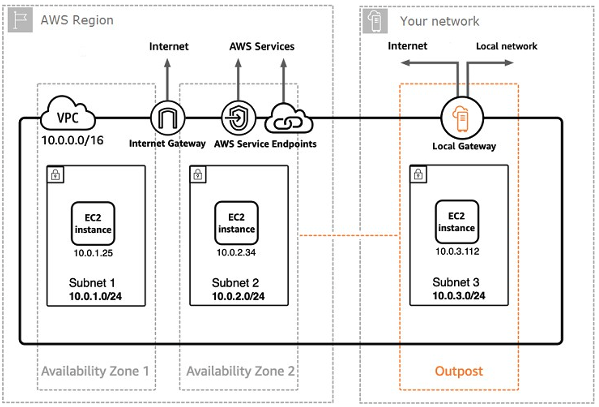
A hybrid cloud is a combination of on-premises infrastructure and cloud-based infrastructure. Multi-cloud is a combination of different cloud providers’ resources.
Content delivery networks
Content delivery networks (CDNs) automatically distribute resources to various global locations. For example, if you are hosting a website, it can be distributed with a CDN such as Amazon CloudFront.
What are the main challenges of a distributed infrastructure?
Although there are many benefits to gain from a distributed infrastructure, there are some challenges to overcome for optimized operations.
Network complexity
Designing a distributed system means that you need to carefully architect your network links, strategies, and controls for system reliability. Using a virtual network infrastructure composer, such as Amazon Virtual Private Cloud, can help you create an optimized network across various regions.
Data consistency
Despite distance, the resources within your infrastructure must operate in a unified manner. Data consistency means replicating and synchronizing changes across the infrastructure without conflicts. You can achieve data consistency by integrating infrastructure components consistently, with attention to your data controls.
Security management
Security of a distributed infrastructure must be considered both as an entire system and of its parts. For example, you should use a unified security solution such as AWS Security Hub to manage your AWS distributed cloud infrastructure, but also consider the physical security policy of your on-site systems, your outsourced data centers, and your cloud computing providers.
Operational overhead
If you are managing multiple distributed sites and infrastructure, this can be a considerable effort in maintenance. Instead of managing physical infrastructure, most organizations running distributed operations choose to use virtualization, through cloud providers or in managed data centers. Under this model, you rent virtual infrastructure from the provider, and thus only have to perform software maintenance and orchestration, whereas the provider takes care of the operational overheads of the physical infrastructure. Outsourcing the physical operations of your IT infrastructure can result in cost savings.
How can AWS support your distributed infrastructure requirements?
AWS runs a global, distributed infrastructure to support the needs of organizations of all sizes in all places. Each AWS service is designed with distributed environments and tailored solutions in mind. Some of our most popular distributed infrastructure management services include:
-
Amazon CloudFront to deliver fast, secure websites to viewers around the globe in milliseconds with built-in data compression, edge compute capabilities, and field-level encryption.
-
AWS Local Zones to run applications on AWS infrastructure closer to your end users and workloads, meeting data residency requirements for regulatory and compliance-sensitive workloads.
-
AWS Outposts allows you to run some AWS services locally and connect to a broad range of services available in the local AWS Region. Run applications and workloads on premises or in edge locations using familiar AWS services, tools, and APIs.
-
AWS Wavelength allows you to run applications using AWS Infrastructure and services in AWS telco partners’ data centers to meet your low-latency, data residency, and resiliency needs.
Get started with distributed infrastructure on AWS by creating a free account today.
Browse all cloud computing concepts
Browse all cloud computing concepts content here:
Did you find what you were looking for today?
Let us know so we can improve the quality of the content on our pages