Artificial Intelligence
Accelerating aircraft IFEC diagnostics with agentic AI on AWS
Panasonic Avionics Corporation provides in-flight entertainment and connectivity (IFEC) systems across a large global fleet serving hundreds of airlines and billions of passengers annually. When a system issue affects passenger experience at this scale, engineers must diagnose the root cause quickly across thousands of unique deployment configurations. Doing this manually, correlating logs, metrics, and ticketing data across diverse fleet variants, can take hours and requires deep institutional knowledge.
In this post, you will learn how Panasonic Avionics Corporation worked with AWS and the AWS Generative AI Innovation Center for architectural guidance to build an agentic AI system. The solution uses Amazon Bedrock, Amazon SageMaker, and AWS Glue to significantly reduce diagnosis time while maintaining high accuracy.
Challenge: Evolving maintenance at scale
Panasonic Avionics Corporation’s operational data serves as a critical asset for monitoring fleet IFEC health. The company relies on a data lake and data system built on AWS to store and organize operational data gathered from across its fleet, processing large volumes of data daily.
Despite this robust data infrastructure, translating raw operational data into actionable diagnostics presented operational challenges at scale. Panasonic Avionics Corporation deploys services with configurations tailored to individual operational requirements. Each deployment generates unique log patterns, which complicates fleet-wide performance assessment. Teams performed manual reviews to correlate metrics across multiple operational data sources.
This process presented several opportunities for optimization across operational efficiency and engineering productivity:
- Manual analysis effort – Correlation across diverse configurations required detailed manual investigation. This facilitated diagnostic accuracy but extended the overall analysis cycle.
- Mean Time to Detect (MTTD) – Detection relied primarily on ticket generation and manual review, which influenced how quickly emerging patterns were identified.
- Mean Time to Resolve (MTTR) – Resolution timelines included significant investigative effort before corrective action could begin, contributing to longer end-to-end resolution cycles.
- Automation opportunities – Repetitive investigative tasks and log reviews created significant opportunities for intelligent automation, particularly during peak activity periods.
- Knowledge scaling – Manual correlation processes required deep system familiarity, creating opportunities to use AI to scale institutional knowledge more broadly across engineering teams.
- Resource optimization – Engineers spent recurring time on diagnostic activities, reducing bandwidth for innovation, feature development, and long-term reliability improvements.
Panasonic Avionics Corporation identified a clear opportunity to evolve toward proactive health monitoring and fleet-wide pattern recognition, while preserving diagnostic rigor. The objective was to maintain analytical depth while significantly improving MTTD and MTTR, so engineers can focus more on solution design, optimization, and strategic reliability enhancements rather than investigative overhead.
Solution overview
Panasonic Avionics Corporation partnered with AWS and the AWS Generative AI Innovation Center to explore how generative AI could enhance internal diagnostic workflows across its fleet IFEC operations. The collaboration combined Panasonic Avionics Corporation’s deep domain expertise in IFEC operations with generative AI capabilities available through AWS services and the Innovation Center’s architectural guidance on system design.
Architecture
The following diagram illustrates the diagnostic architecture on AWS. The solution uses a multi-agent workflow system that processes data through three distinct layers working in harmony. A Trend Analyzer identifies anomalies by analyzing key performance indicators and service degradation metrics. Parallel Diagnostic Agents execute specific diagnostic functions including correlation analysis, system checks, and log pattern matching. A Summarizer powered by a large language model (LLM) integrates outputs into coherent diagnostic reports with root cause analysis and recommended actions.
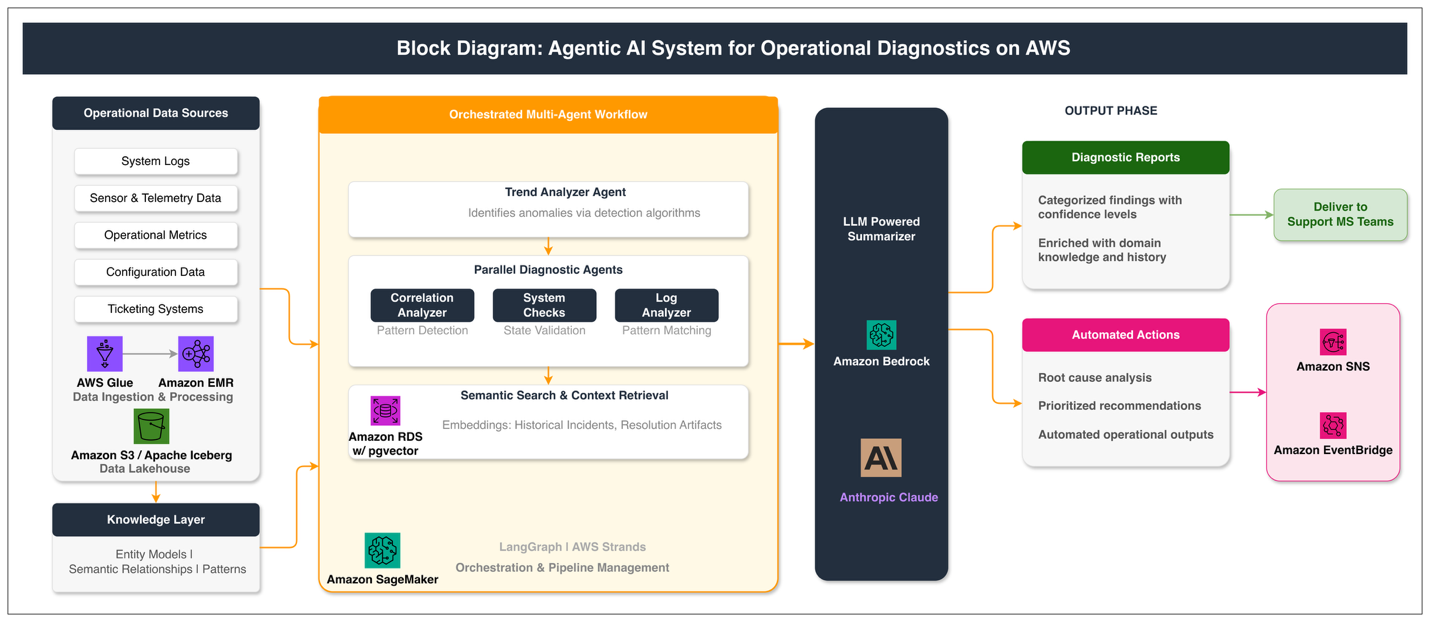
Figure 1: Multi-agent IFEC diagnostic architecture on AWS
Solution walkthrough
The system processes operational data through the following five phases:
1. Ingest and normalize
The system ingests raw operational data from across the fleet, transforms it into standardized service metrics, and stores it in an Amazon Simple Storage Service (Amazon S3) data lakehouse using Apache Iceberg. AWS Glue and Amazon EMR handle this extract, transform, and load (ETL) pipeline. A domain ontology, a shared vocabulary that defines fleet entities and their relationships, normalizes terminology across fleet variants. This consistency lets data from diverse configurations be compared at fleet scale. The ontology also links performance metrics with configuration metadata and ticketing information, creating a unified view for cross-fleet diagnostics.
2. Detect
The Trend Analyzer agent continuously evaluates key performance indicators, service-level adherence, and degradation metrics. Fleet-wide relationship modeling detects patterns invisible when examining individual deployments in isolation, such as gradual degradation affecting only deployments sharing a specific configuration variant.
This moves Panasonic Avionics Corporation from reactive detection through ticket generation to proactive identification of emerging problems before they escalate.
3. Diagnose
When the Trend Analyzer flags a concern, parallel diagnostic agents investigate simultaneously from multiple angles:
- Correlation Analyzer: Detects recurring patterns across deployments that share configurations, identifying whether an issue is isolated or systemic.
- System Checks: Validates metadata and service status against ticketing workflows, determining whether known maintenance activities explain observed behavior.
- Log Analyzer: Matches current log patterns against a library of previously identified failure modes using rule-based and pattern-based detection.
Amazon SageMaker orchestrates these agents using LangGraph, an open source framework for managing stateful AI workflows. The Strands Agents SDK, an open source Python framework for building AI agents, provides the agent implementation and execution capabilities. Together, they run these agents in parallel, which reduces investigation from hours of manual review to minutes of automated analysis in Panasonic Avionics Corporation’s internal testing.
4. Contextualize
The system queries past incidents and resolution artifacts stored as vector representations in Amazon Relational Database Service (Amazon RDS) with pgvector (a PostgreSQL extension for vector similarity search). Semantic search retrieves similar patterns and their resolutions, even when exact symptoms differ, giving the system institutional memory that scales across the engineering organization.
5. Recommend and act
Anthropic Claude on Amazon Bedrock synthesizes findings from the Correlation Analyzer, System Checks, and Log Analyzer into structured diagnostic reports. Each report includes root cause hypotheses, impact analysis across affected fleet segments, and prioritized remediation recommendations.
The system categorizes reports by severity. For critical findings, the system automatically creates alerts, prioritizes incidents, and routes them to the appropriate engineering teams with recommended resolution actions, alleviating manual triage while preserving engineering oversight for remediation decisions.
AI-generated recommendations are grounded using retrieved operational data and historical incidents, validated against deterministic business rules, and presented with supporting evidence. Human engineers review diagnostic findings and approve remediation actions for operationally significant incidents. The system also maintains traceability of agent decisions and recommendations to support auditability and continuous improvement.
Across these five phases, building a fleet-scale diagnostic system required infrastructure that grows with demand. Serverless data processing through AWS Glue and Amazon EMR, the model flexibility of Amazon Bedrock, and the governed agent runtime of Amazon SageMaker let Panasonic Avionics Corporation focus on diagnostic logic rather than infrastructure.
From concept to production
Panasonic Avionics Corporation validated the solution with guidance from the AWS Generative AI Innovation Center advisory team on event-driven design patterns, parallel processing strategies, and performance optimization techniques for production scalability.
Establish rigorous validation early: Panasonic Avionics Corporation implemented cross-reference validation against ground truth data, achieving accuracy that consistently exceeded requirements throughout testing.
Design for modularity and transparency: Design principles emphasized atomic agent operations, transparency in prompts and logic, and human-in-the-loop review capabilities. This modular approach allowed for independent agent updates without requiring system-wide changes as the solution scales.
Optimize AI components strategically: Guidance emphasized using tuned parameter configurations for deterministic outputs and focused responses. The team limited LLM use to summarization and error reasoning tasks where generative capabilities add clear value.
Iterate with continuous feedback: The solution moved to production only when automated actions aligned with manual expert assessment, so the system maintained diagnostic accuracy while reducing time to resolution. The system now generates diagnostic reports daily covering the active fleet.
Conclusion
Panasonic Avionics Corporation’s AI-driven diagnostic system on AWS delivers measurable improvements across key operational metrics. Manual analysis effort decreased significantly, while Mean Time to Detect (MTTD) and Mean Time to Resolve (MTTR) both improved. In targeted use cases, the system has demonstrated 20–40 percent improvements in operational efficiency. Support teams confirmed significant reduction in repetitive investigative burden, as the system now handles work that previously required hours of manual effort. Engineering capacity for independent diagnostics increased meaningfully, so the team can diagnose and resolve issues that previously required escalation. These improvements fundamentally shift the operational model as systems grow, so the team can handle increased scale through AI agents and reduce both costs and operational risk.
To explore how the AWS Generative AI Innovation Center can help your organization build similar solutions, visit the AWS Generative AI Innovation Center. For more on the services used in this post, refer to Amazon Bedrock, Amazon SageMaker, and AWS Glue. For aviation-specific use cases, visit AWS for Aerospace and Satellite.
For more information about multi-agent orchestration on AWS, refer to the following posts:
- Build Strands Agents with SageMaker AI models and MLflow.
- Build a serverless conversational AI agent using Claude with LangGraph and managed MLflow on Amazon SageMaker AI.
Disclaimer: This post describes an internal initiative by Panasonic Avionics Corporation in collaboration with AWS. The architecture and approach described reflect a specific implementation. Actual results might vary based on data characteristics, operational context, and system configuration.