Artificial Intelligence
Category: Artificial Intelligence
Build a generative AI-powered business reporting solution with Amazon Bedrock
This post introduces generative AI guided business reporting—with a focus on writing achievements & challenges about your business—providing a smart, practical solution that helps simplify and accelerate internal communication and reporting.

Safeguard generative AI applications with Amazon Bedrock Guardrails
In this post, we demonstrate how you can address these challenges by adding centralized safeguards to a custom multi-provider generative AI gateway using Amazon Bedrock Guardrails.

Scale creative asset discovery with Amazon Nova Multimodal Embeddings unified vector search
In this post, we describe how you can use Amazon Nova Multimodal Embeddings to retrieve specific video segments. We also review a real-world use case in which Nova Multimodal Embeddings achieved a recall success rate of 96.7% and a high-precision recall of 73.3% (returning the target content in the top two results) when tested against a library of 170 gaming creative assets. The model also demonstrates strong cross-language capabilities with minimal performance degradation across multiple languages.
How AutoScout24 built a Bot Factory to standardize AI agent development with Amazon Bedrock
In this post, we explore the architecture that AutoScout24 used to build their standardized AI development framework, enabling rapid deployment of secure and scalable AI agents.
Transform AI development with new Amazon SageMaker AI model customization and large-scale training capabilities
This post explores how new serverless model customization capabilities, elastic training, checkpointless training, and serverless MLflow work together to accelerate your AI development from months to days.

Securing Amazon Bedrock cross-Region inference: Geographic and global
In this post, we explore the security considerations and best practices for implementing Amazon Bedrock cross-Region inference profiles. Whether you’re building a generative AI application or need to meet specific regional compliance requirements, this guide will help you understand the secure architecture of Amazon Bedrock CRIS and how to properly configure your implementation.
How Omada Health scaled patient care by fine-tuning Llama models on Amazon SageMaker AI
This post is co-written with Sunaina Kavi, AI/ML Product Manager at Omada Health. Omada Health, a longtime innovator in virtual healthcare delivery, launched a new nutrition experience in 2025, featuring OmadaSpark, an AI agent trained with robust clinical input that delivers real-time motivational interviewing and nutrition education. It was built on AWS. OmadaSpark was designed […]
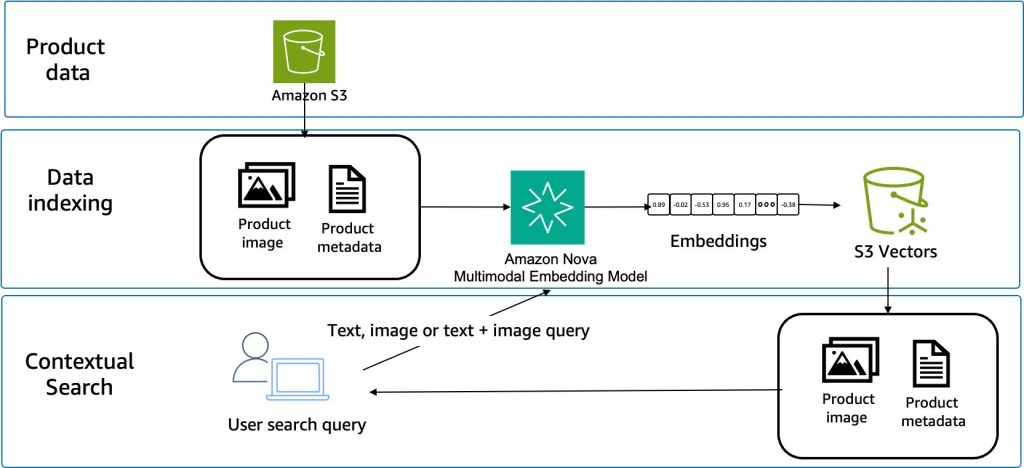
Crossmodal search with Amazon Nova Multimodal Embeddings
In this post, we explore how Amazon Nova Multimodal Embeddings addresses the challenges of crossmodal search through a practical ecommerce use case. We examine the technical limitations of traditional approaches and demonstrate how Amazon Nova Multimodal Embeddings enables retrieval across text, images, and other modalities. You learn how to implement a crossmodal search system by generating embeddings, handling queries, and measuring performance. We provide working code examples and share how to add these capabilities to your applications.

Accelerating LLM inference with post-training weight and activation using AWQ and GPTQ on Amazon SageMaker AI
Quantized models can be seamlessly deployed on Amazon SageMaker AI using a few lines of code. In this post, we explore why quantization matters—how it enables lower-cost inference, supports deployment on resource-constrained hardware, and reduces both the financial and environmental impact of modern LLMs, while preserving most of their original performance. We also take a deep dive into the principles behind PTQ and demonstrate how to quantize the model of your choice and deploy it on Amazon SageMaker.
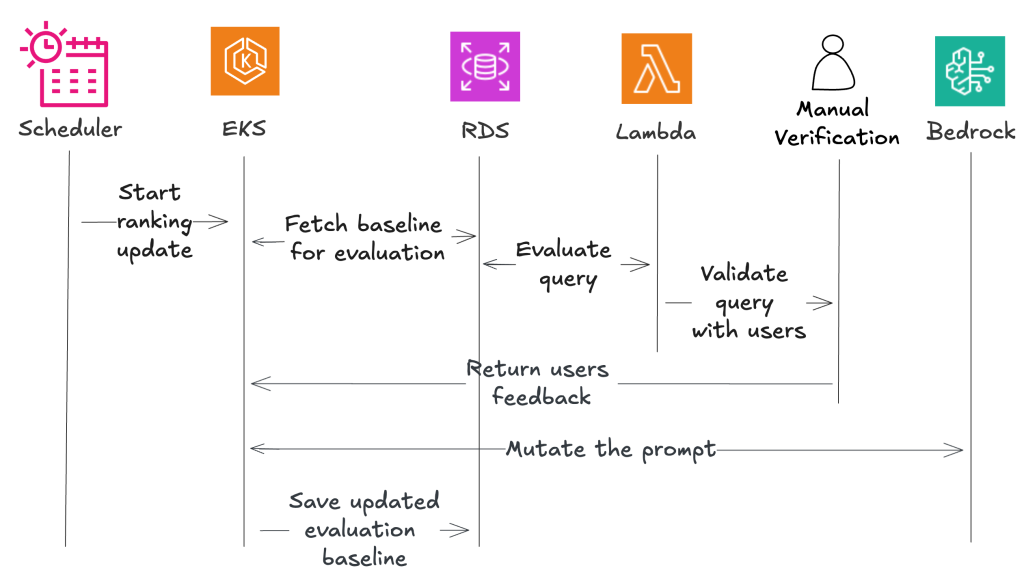
How Beekeeper by LumApps optimized user personalization with Amazon Bedrock
Beekeeper’s automated leaderboard approach and human feedback loop system for dynamic LLM and prompt pair selection addresses the key challenges organizations face in navigating the rapidly evolving landscape of language models.