Artificial Intelligence
Introducing Visa Intelligent Commerce on AWS: Enabling agentic commerce with Amazon Bedrock AgentCore
This post is cowritten with Sangeetha Bharath and Seemal Zaman from Visa.
Across every industry, agentic AI is redefining how work gets done by shifting digital experiences from manual, user-driven interactions to autonomous, outcome-driven workflows. Unlike traditional AI systems that merely answer questions or provide suggestions, agentic AI introduces intelligent agents capable of reasoning, acting, collaborating with other agents, and completing multistep tasks on the user’s behalf. This shift is already transforming sectors such as travel, healthcare, banking, logistics, and customer service, where agents can research, plan, optimize, and execute end-to-end processes with minimal human intervention.
The payments industry is also entering a major transformation as agentic commerce shifts how consumers and businesses initiate, authorize, and complete transactions. Instead of manual steps across multiple apps and websites, autonomous agents can coordinate discovery, decision-making, and secure payments in the background. This change mirrors the shift to ecommerce in the early 2000s, when digital checkout reshaped customer expectations. Today, agentic commerce is setting up a similar foundation by making payments more seamless, contextual, and intelligent. Developers building agents require enablement and support for this to really work securely and at scale. Until recently, even advanced AI agents could only assist with planning, comparing options, and preparing carts, but to complete the purchase, consumers still had to pull out their credit or debit cards and finalize the checkout process themselves. Without trusted, standardized, and compliant integrations to existing payment networks, agents couldn’t reliably or safely initiate transactions from end to end.
To support this shift, Amazon Web Services (AWS) and Visa have teamed up to help enterprises serving both consumers and business-to-business (B2B) enterprises build for the new agentic commerce world. In April 2025, Visa launched Visa Intelligent Commerce for developers (and even non developers) to connect their agentic payment applications directly to Visa’s payment network and trigger transactions with straightforward, natural language commands. This initiative and offering also provides support for building network-agnostic agentic commerce flows and enables secure communication between agents and merchants using Visa’s Trusted Agent Protocol.
As part of this partnership with AWS, Visa is planning to use Amazon Bedrock AgentCore to host Model Context Protocol (MCP) tools so partners can build end-to-end, network agnostic agentic workflows on the platform.
The goal is straightforward: provide a secure, scalable foundation for building the next generation of intelligent commerce solutions.
Introducing Visa Intelligent Commerce on AWS
Visa Intelligent Commerce empowers businesses and developers to build the next generation of agentic payment experiences. In AWS Marketplace, developers can learn about Visa’s suite of essential agentic commerce tools, including authentication, agentic tokenization, and user intent capture, that are designed to enable autonomous, secure, and contextual payment flows. The blueprints Visa and AWS are making available through the Amazon Bedrock AgentCore samples repo are designed for integration with Visa’s MCP server and agentic APIs, supporting secure, tokenized transactions, with additional support for multi-network agentic commerce flows coming soon. Through this initiative, Visa and AWS are making it easier and more accessible to incorporate payments into agentic workflows.
How Amazon Bedrock AgentCore powers these solutions
Before diving into the specific use cases, it’s important to understand the role Amazon Bedrock AgentCore plays as the foundational infrastructure enabling these agentic commerce experiences. Bedrock AgentCore isn’t merely another component—it’s the secure, scalable backbone that makes production-grade multi-agent systems possible.
The value Amazon Bedrock AgentCore adds:
- The core of this solution is Amazon Bedrock AgentCore Runtime, a secure, serverless hosting environment purpose-built for AI agents and MCP servers. Each agent runs in isolated micro virtual machine (VM) sandboxes so sensitive data such as travel itineraries, payment credentials, and personally identifiable information (PII) remains protected throughout workflows. Bedrock AgentCore Runtime scales automatically to handle thousands of concurrent users without manual capacity planning, serving peak holiday traffic as easily as off-season queries. Unlike typical request-response APIs, it supports long session durations and large context payloads, enabling agents to maintain context across multiday trip planning or complex comparison shopping sessions.
- Supporting Bedrock AgentCore Runtime is Amazon Bedrock AgentCore Identity, providing inbound authentication (using AWS Amplify in this solution) for user sign-in and outbound authentication to securely access endpoints such as online travel agency (OTA) or retail MCP servers, and Visa Intelligent Commerce MCP enabling the user’s identity, consent state, and authorized payment credentials to be securely carried through the workflow without exposing sensitive information.
- Through Amazon Bedrock AgentCore Gateway, agents gain governed, auditable access to tools and MCP servers for flight and hotel search, product search, and Visa Intelligent Commerce MCP for payment, consent, and card lifecycle operations. Amazon Bedrock AgentCore Gateway processes agent tool requests and enables tool calls to meet the trusted access controls required in regulated payment flows.
- Amazon Bedrock AgentCore Memory maintains long-duration context over extended, multistep journeys like travel planning, product research, and checkout. This enables agents to reason more effectively and remember complex data—such as multicity itineraries, hotel bundles, weather insights, or merchant offers—without performance impact. The current implementation uses Bedrock AgentCore short-term memory to maintain conversational context and session state while also enabling secure, controlled context sharing across agents. A future update will incorporate long-term memory capabilities for extracting user preferences and generating session summaries.
- To meet regulatory and compliance requirements, Amazon Bedrock AgentCore Observability, built on OpenTelemetry (OTEL), provides full transparency into agent operations across the entire workflow by capturing a complete, audit-ready record of every agent action, including reasoning traces, individual spans, tool invocations, MCP server calls, authentication flows, and latency metrics. Users can view these operations in the Amazon CloudWatch generative AI observability dashboard.
A reusable supervisor architecture
One of the key architectural advantages demonstrated in these samples is the reusable supervisor pattern. This pattern uses the agents as tools paradigm, where subagents are exposed to the supervisor as tools it can invoke. Both the travel booking and shopping assistant solutions share the same supervisor agent design, which acts as the central orchestrator coordinating user interactions. How the shared supervisor works:
- Routes requests to the appropriate specialized agents based on user intent
- Maintains conversation context using Amazon Bedrock AgentCore Memory through the Strands AgentCore Memory Session Manager, preserving state across sessions
- Formats and presents responses from subagents back to users
- Handles multiturn conversations with full context awareness
This means you can effectively deploy the same supervisor infrastructure for both travel and shopping use cases—or any other agentic commerce scenario—merely by swapping out the specialized subagents (and making desired system prompt updates). The supervisor’s orchestration logic, memory management, and conversation handling remain consistent. This is important because this modular approach reduces development overhead. Rather than building separate orchestration systems for each use case, developers can:
- Reuse the supervisor agent across multiple domains
- Add new specialized agents (such as insurance, car rental, or grocery) without modifying the core orchestration
- Maintain consistent user experience patterns across different commerce scenarios
- Use the same Amazon Bedrock AgentCore infrastructure (such as Runtime, Memory, Identity, Gateway, or Observability) for their deployments
This post contains two multi-agent samples using Visa Intelligent Commerce:
- Travel booking agent
- Shopping assistant agent
Part 1: Reimagining the travel booking experience with Amazon Bedrock AgentCore and Visa
Travelers face a disjointed travel planning experience, jumping across airline sites, OTAs, hotel platforms, loyalty portals, review channels, and payment screens to plan a single trip. Prices fluctuate by the minute, loyalty program terms are complex, personalization is inconsistent, and even after hours of research, there’s no guarantee they found the best option or maximized value from their card benefits.
To address these challenges, we’ve developed a travel booking multi-agent system using Amazon Bedrock AgentCore, Strands Agents, and Visa Intelligent Commerce that plans, optimizes, and books end-to-end travel experiences on a user’s behalf with governance and security in place. It brings together discovery, personalization, and secure payments into a single, seamless workflow driven by natural language.
Amazon Bedrock AgentCore provides a secure, serverless runtime purpose-built for orchestrating multi-agent systems with long-running sessions, large context payloads, and governed tool access. Its built-in isolation, identity, observability, and MCP integration make it well suited for handling sensitive travel and payment interactions at production scale.
With Visa Intelligent Commerce, the user can approve or confirm their intent, allowing the same multi-agent system that builds the itinerary to authorize bookings and execute payment, creating a seamless and highly personal travel commerce experience that goes far beyond traditional travel research agents.
The travel agent blueprint consists of three specialized agents working together to provide comprehensive travel planning:
- Supervisor – Main agentic orchestrator that coordinates interactions
- Travel assistant – Handles travel planning, bookings, and destination information
- Cart manager – Manages shopping cart, payments, and purchase flow
The supervisor acts as the central orchestrator of the entire experience. It orchestrates conversations, delegates tasks to specialized agents, and manages the user’s itinerary. Running on Amazon Bedrock AgentCore Runtime, the supervisor agent maintains conversation context across sessions using AgentCore Memory, enabling it to remember user preferences, in-progress itineraries, and prior decisions even across extended planning sessions. Core capabilities include:
- Routes user requests to appropriate specialized agents
- Maintains conversation context and memory across sessions using AgentCore Memory
- Formats and presents responses from subagents to users
- Handles multiturn conversations with context awareness
- Supports multiple item types such as flight, hotel, activity, restaurant, and transport
The travel assistant specializes in travel-related queries including destination research, weather information, flight and hotel searches, and local recommendations using OTA MCP tools through the Amazon Bedrock AgentCore Gateway. It compares offers, assembles itineraries, manages modifications, and aligns trip components—air, hotel, activities—with user preferences and constraints. Although these OTA tools aren’t inherent to MCP servers, we can use Amazon Bedrock AgentCore Runtime to host them and expose them to the agents as MCP compatible tools using AgentCore Gateway.
Tools:
- Weather information –
get_weather(query) - Internet search –
search_tool(query) - Local places search –
google_places_tool(query) - Flight search –
get_flight_offers_tool(origin, destination, departure_date, adults, max_price, currency) - Hotel search –
get_hotel_data_tool(city_code, ratings, amenities, max_price) - Date updates –
update_itinerary_date(user_id, identifier, item_type, new_date)
The cart manager handles shopping cart operations, payment processing, and purchase flow. This is where Amazon Bedrock AgentCore security capabilities become critical. Bedrock AgentCore Identity manages the secure handoff to Visa Intelligent Commerce, enabling user identity, consent state, and tokenized credentials to flow through the payment authorization without exposing sensitive data. Bedrock AgentCore Runtime isolated execution runs payment operations in protected sandboxes, and Bedrock AgentCore Observability captures the complete transaction flow for regulatory compliance and audit requirements.
The following diagram illustrates this architecture.
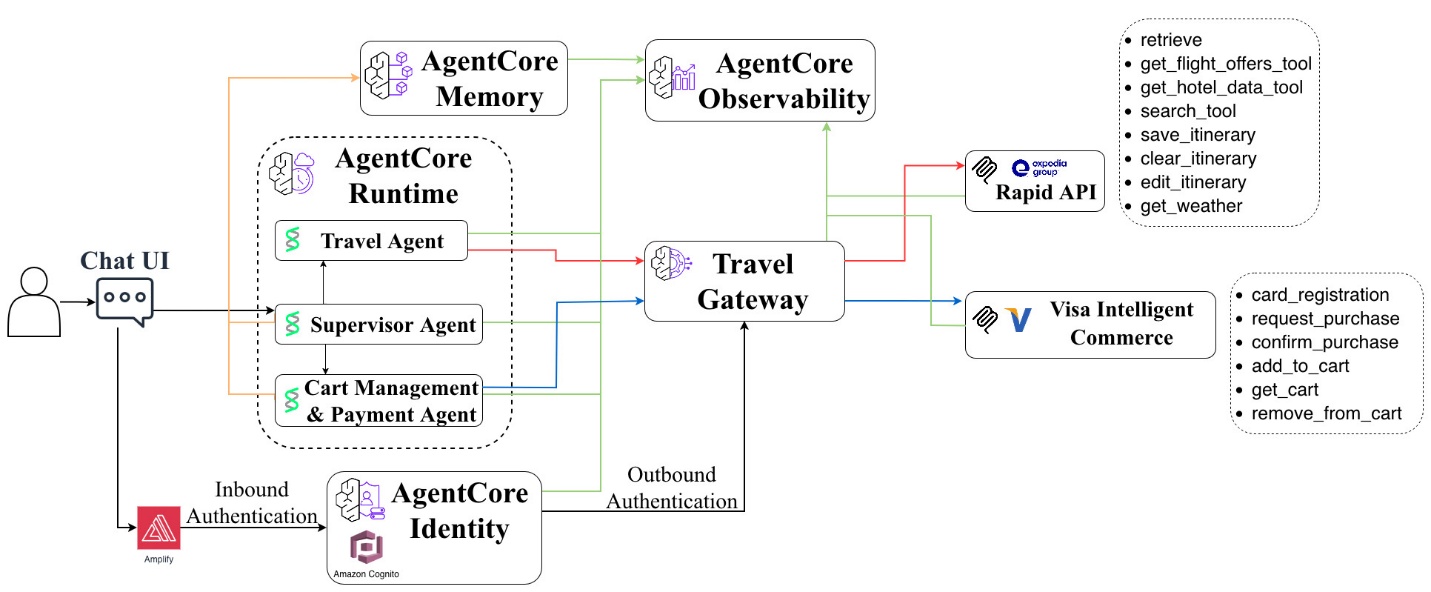
Before proceeding with payment, the agent requests human confirmation where the user sets clear parameters and permits the agent to spend on their behalf. The request_purchase_confirmation tool first captures the user’s explicit authorization, and then the confirm_purchase tool completes the transaction when the authorization has been secured. The agent then uses Visa Intelligent Commerce APIs to request payment credentials, trigger authentication, and complete the purchase securely. This human-in-the-loop step means that users retain control while benefiting from agentic automation.
Tools:
- Cart viewing –
get_cart(user_id) - Adding items to cart –
add_to_cart(user_id, items) - Removing items –
remove_from_cart(user_id, identifiers, item_type) - Payment card management –
onboard_card(user_id, card_number, expiration_date, cvv, card_type, is_primary), request_purchase_confirmation, confirm_purchase
Going further with Expedia Group’s Rapid APIs
To extend this sample architecture, consider integrating Expedia Group’s Rapid APIs to enable flight, lodging, car rental, and activity bookings. These APIs deliver real-time access to global travel inventory, supporting richer itineraries and seamless end-to-end booking experiences. Rapid APIs can be integrated directly or by using MCP servers, providing flexibility and alignment with your architectural and scalability needs.
To learn more, visit Expedia Group Rapid API Developer Hub.
Part 2: Future of shopping with agentic commerce, powered by Amazon Bedrock AgentCore and Visa
With so many online portals, shopping apps, loyalty programs, and checkout flows competing for attention, shoppers must navigate a complex maze to buy a single item. When you receive a promotional offer, the product link takes you to a different site, loyalty points hide in yet another portal, and checkout requires reentering the same card details across multiple merchants. Prices shift constantly, availability changes by the hour, and even after comparing everything manually, shoppers still feel unsure whether they got the best deal, the fastest delivery, or the maximum value from their rewards.
With a multi-agent shopping assistant powered by Amazon Bedrock AgentCore and integrated with Visa Intelligent Commerce, shopping becomes frictionless as the work shifts from the shopper to the agents. Instead of juggling tabs and comparing prices, users can say something like: “Find the best offer for Sony PlayStation 5 Pro, compare it across merchants for Black Friday promotions, check delivery dates, apply my rewards. My Budget is under $500.” Behind the scenes, a coordinated team of agents will search the product across various merchant sites and portals, check and compare pricing including promotions, review delivery timelines and apply loyalty benefits.
With Visa Intelligent Commerce integrated, the shopping assistant can validate the user’s identity, retrieve tokenized credentials tied to their specific request, and execute the purchase without the user navigating a single checkout page. The entire shopping flow, from research to comparison to optimization to payment, happens autonomously, with the user guiding the process through natural language instead of manual clicks. The shopping assistant agent blueprint consists of three specialized agents working together to provide comprehensive shopping planning:
- Supervisor – Main orchestrator that coordinates interactions
- Shopping – Handles product search and recommendations
- Cart manager – Manages shopping cart, payments, and purchase flow
As highlighted in the beginning, we’re using a reusable supervisor agent architecture for both travel assistant and shopping assistant solutions. For the multi-agent shopping assistant use case, the supervisor agent acts as the central orchestrator of the entire experience. It orchestrates conversations, delegates tasks to specialized agents, and manages the user’s itinerary. Running on Amazon Bedrock AgentCore Runtime, the supervisor agent maintains conversation context across sessions using Bedrock AgentCore Memory, enabling it to remember user preferences, in-progress inineraries, and prior decisions even across extended planning sessions.
Core capabilities include:
- Routes user requests to appropriate specialized agents
- Maintains conversation context and memory across sessions using Bedrock AgentCore Memory
- Formats and presents responses from sub-agents to users
- Handles multiturn conversations with context awareness
The shopping assistant specializes in product discovery, recommendations, and packing list generation. Using Amazon Bedrock AgentCore Gateway, it connects to retail MCP servers for product search while maintaining audit trails of each query. Bedrock AgentCore Memory preserves shopping context—remembering budget constraints, preferred brands, and items already considered—across the entire shopping journey.
Tools:
- Product search –
single_productsearch(user_id, question) - Packing list generation –
generate_packinglist(user_id, question)
The cart manager handles shopping cart operations, payment processing, and purchase flow. This is where Amazon Bedrock AgentCore security capabilities become critical. Bedrock AgentCore Identity manages the secure handoff to Visa Intelligent Commerce, enabling user identity, consent state, and tokenized credentials to flow through the payment authorization without exposing sensitive data. Bedrock AgentCore Runtime isolated execution runs payment operations in protected sandboxes, and Bedrock AgentCore Observability captures the transaction flow and interactions with Amazon Bedrock AgentCore Runtime, Bedrock AgentCore Memory, and Bedrock AgentCore Gateway for regulatory compliance and audit requirements.
The following diagram shows this architecture.
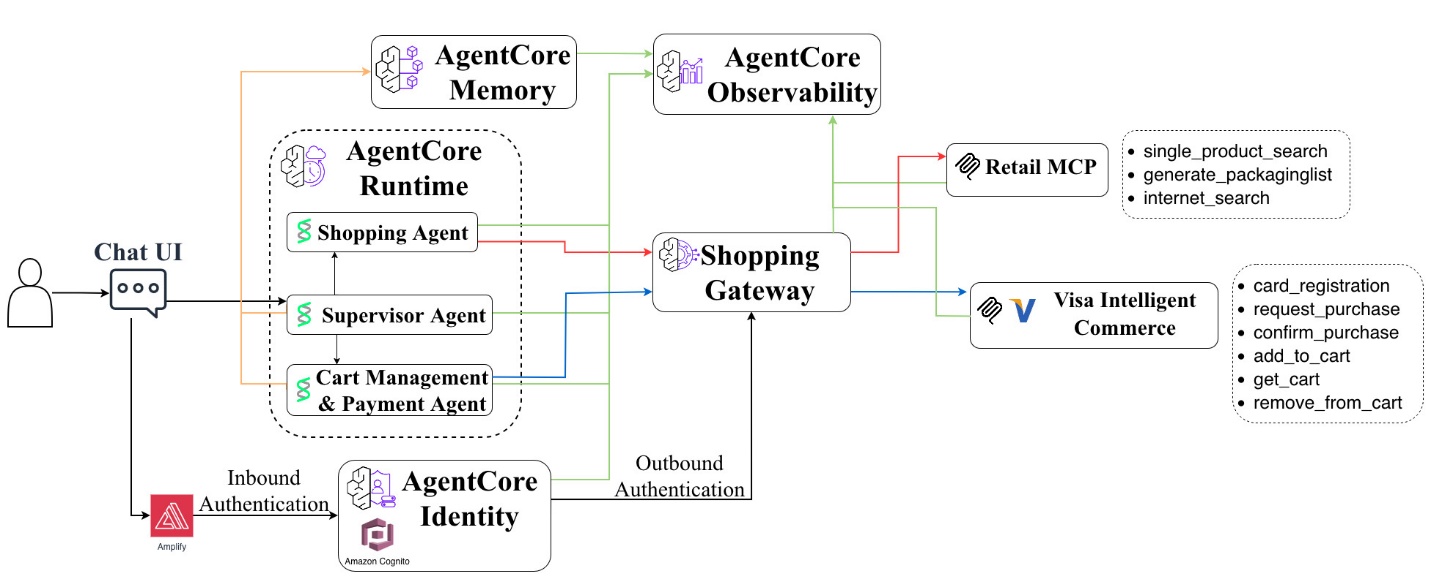
Before proceeding with payment, the agent requests human confirmation where the user sets clear parameters and permits the agent to spend on their behalf. The agent then uses Visa Intelligent Commerce APIs to request payment credentials, trigger authentication, and complete the purchase securely. This human-in-the-loop step gives users control while benefiting from agentic automation.
Tools:
- Cart viewing –
get_cart(user_id) - Adding items to cart –
add_to_cart(user_id, items) - Removing items –
remove_from_cart(user_id, identifiers, item_type) - Payment card management –
onboard_card(user_id, card_number, expiration_date, cvv, card_type, is_primary), request_purchase_confirmation, confirm_purchase
Conclusion
This collaboration between AWS and Visa demonstrates how agentic commerce can fundamentally reshape the commerce experience, transforming what has traditionally been a fragmented, multistep process into a seamless, intelligent, and secure journey from discovery to purchase. These capabilities represent the future of digital travel and shopping: intelligent, secure, and effortlessly connected, where trusted agents work on behalf of customers to turn travel intent into booked experiences in a single, unified flow. The components in these workflows are modular and reusable across use cases in the agentic commerce ecosystem. Come join the conversation and start building these secure, seamless payment experiences for your customers, using Amazon Bedrock AgentCore, Strands Agents, and Visa Intelligent Commerce. Here’s the sample GitHub repo to get started:
About the authors
 Sangeetha Bharath is a leader in AI strategy at Visa, where she shapes the technical vision across developer, enterprise, and cloud segments. She specializes in neural network architectures, large language models (LLMs), and reinforcement learning from human feedback (RLHF)—expertise she applies to advance AI-driven innovation in payments. Sangeetha led the development of Visa’s first MCP server and champions developer experiences that make Visa the best way to pay and be paid. She also drives strategic growth initiatives and partnerships at the intersection of AI and fintech.
 Seemal Zaman is a product leader with experience building and scaling FinTech products. She has led zero-to-one initiatives, complex integrations, and innovations in payments, with a current focus on applying agentic AI to transform B2B and consumer experiences. Seemal currently works on a team focused on Visa Intelligent Commerce and Trusted Agent Protocol, where she is driving innovation in agentic commerce. She thrives at the intersection of technology and commerce, bringing bold ideas to life and turning them into products that make an impact.

Isaac Privitera is a Principal Data Scientist with the AWS Generative AI Innovation Center, where he develops bespoke agentic AI-based solutions to address customers’ business problems. His primary focus lies in building responsible AI systems, using techniques such as RAG, multi-agent systems, and model fine-tuning. When not immersed in the world of AI, Isaac can be found on the golf course, enjoying a football game, or hiking trails with his loyal canine companion, Barry.
 Hardik Thakkar is a Sr. Security Prototyping SA at Amazon Web Services (AWS) with the Prototyping and Cloud Engineering Team in Global Financial Services (GFS). He specializes in secure architecture design and foundations on AWS, leveraging his security expertise to serve financial services customers. His focus areas include security-first design patterns, financial services compliance frameworks, and helping institutions build robust cloud infrastructures and AI-based solutions on AWS.
 Daniela Vargas is a Prototyping Solutions Architect with the Prototyping and Cloud Engineering Team in AWS Global Financial Services (GFS), where she works backwards from customer needs to create innovative prototypes. Her expertise spans from data analytics pipelines that unlock business insights to cutting-edge generative AI implementations that transform customer experiences.
 Ritambhara Chaterjee is a Senior Solutions Architect in AWS Global Financial Services with expertise in machine learning and payment technologies. She helps financial institutions innovate on the AWS Cloud by providing solutions for fraud detection, transaction processing, and AI-powered financial applications using AWS products and services.
 Ankit Pathak leads ML, generative AI, and agentic AI GTM practice for AWS Global Financial Services, bringing 15+ years of technical depth across data, analytics, and AI engineering. His focus areas include developing frontier agentic AI patterns including multi-agent systems leveraging autonomous planning, tool-use optimization, safe guardrails, and long-context reasoning, blending applied research with real-world patterns to drive compliant enterprise generative AI adoption.