AWS Public Sector Blog
SaaS design levers for sovereignty on AWS
According to an IDC market forecast, global spending on sovereignty is increasing at 27% and is set to reach $409 billion by 2029. For software as a service (SaaS) providers, sovereignty is becoming a prerequisite for selling into public sector and regulated industries such as healthcare and finance.
The challenge for SaaS providers is how to maintain the pooled-resource economics, multi-tenant architecture, operational simplicity, and rapid innovation velocity of a true SaaS model while giving each tenant the sovereignty assurances regulators demand.
The answer lies in design levers, which are architectural settings SaaS builders can adjust independently to deliver individual customer sovereignty requirements without regressing to a fully siloed, single-tenant world. In this post, we explore practical design patterns for SaaS offerings on Amazon Web Services (AWS) and show how sovereignty can be a tunable design dimension rather than an all-or-nothing rebuild.
How sovereignty applies to SaaS
Digital sovereignty lacks a single global definition, but through deep engagement with customers, partners, and regulators, AWS has distilled it into a set of consistent, actionable themes.
Here’s how these themes apply to SaaS:
- Data sovereignty – Covers data residency, meaning tenant data must be stored and processed within defined geographic or legal boundaries. This might include metadata. It also covers operator access restriction, which is where SaaS providers must demonstrate verifiable access controls, giving tenants confidence that even the operator can’t access their data.
- Operational sovereignty – Covers resiliency and survivability, meaning SaaS control and application planes must be resilient and independently operable per geographic region despite geopolitical disruption, natural disasters, or technical failure. It also covers independence and transparency, where providers might need in-jurisdiction personnel and transparency about the software supply chain.
- AI sovereignty – Control over models, inputs, outputs, training data, and inference pipelines. AI-powered SaaS features must respect data boundaries through the full AI lifecycle.
Not all workloads require all these measures. For example, data residency requirements most commonly apply to only customer data, but in some cases might also apply to metadata. Hence design levers that can be adjusted independently.
The six design levers
Based on the SaaS implications of sovereignty, the six key design levers are as follows:
- Deployment topology – Where you deploy the control and application planes
- Tenant isolation – How you separate the tenants
- Encryption key management – Where you store the keys and who manages them
- Operator access – Who can access the system and where they are located
- Resilience – The ability to recover from infrastructure or service disruptions
- AI sovereignty – Control and choice across the AI stack
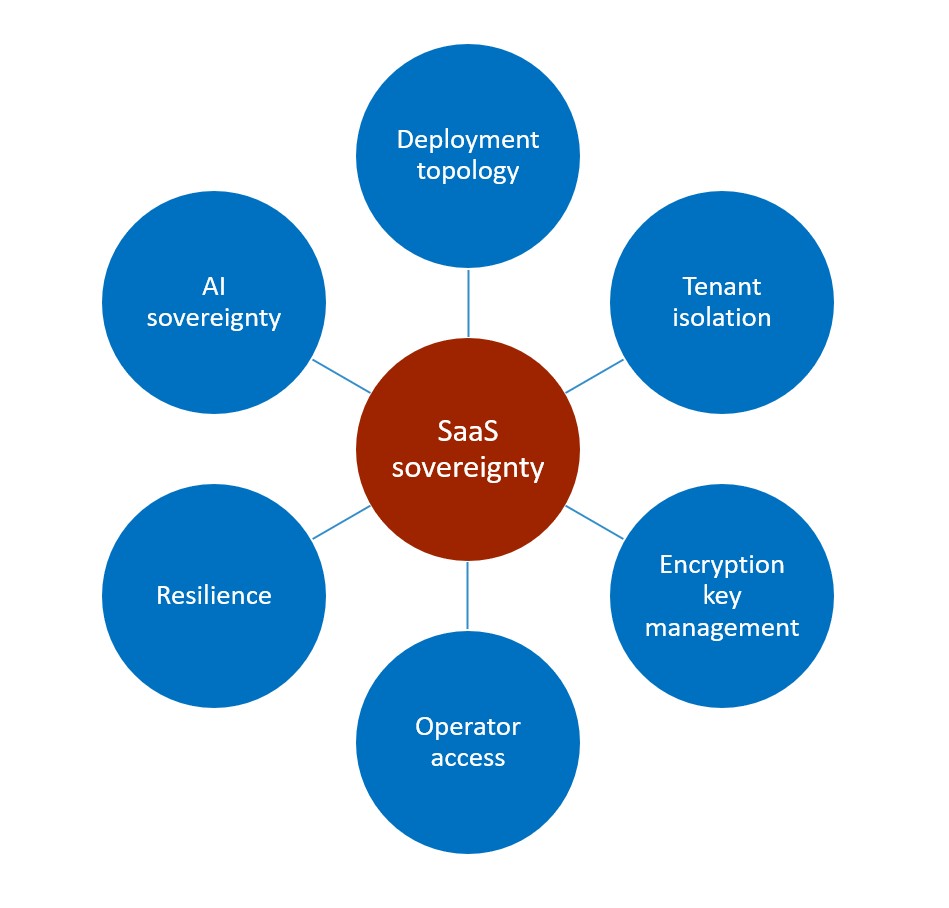
Figure 1: The six design levers
Deployment topology
The deployment topology is the most visible lever. SaaS providers must separate the control plane—tenant management, billing, onboarding—from the application plane where tenant workloads and data actually reside. The control plane is typically global for centralization and ease of management, but it can be regional or in-country depending on metadata residency requirements. This separation allows the application plane to follow the tenant’s data residency requirements and confirms data processing takes place where data resides.
The application plane ranges across a spectrum:
- Single-Region multi-tenant – Deploy in a single sovereign-by-design AWS Region. Most streamlined operations, but limits data residency options to a single jurisdiction.
- Multi-Region multi-tenant – Deploy the application plane in each required jurisdiction across multiple Regions. Can be extended to AWS Local Zones to bring compute closer to a specific metro area within a jurisdiction.
- Trusted Secure Enclaves – An AWS solution for deploying isolated, security-hardened environments within commercial Regions for sensitive workloads.
- Infrastructure exclusive to a customer – For workloads that must stay in a customer-specific facility. AWS Dedicated Local Zones are AWS infrastructure in a customer-chosen location. AWS Outposts brings AWS services on premises. AWS AI Factories provides AWS AI infrastructure in the customer’s data center.
- Sovereign cloud – AWS European Sovereign Cloud is an independent cloud designed to help customers meet Europe’s most demanding sovereignty needs, operated separately from global Regions.
Beyond choosing where to deploy, SaaS architects need preventive controls to make sure data doesn’t leak across boundaries. For example, AWS Control Tower data residency controls can enforce Region restrictions and prevent inadvertent cross-boundary data movement.
Tenant isolation
The second lever is how you separate the tenants. Although a shared infrastructure with logical separation typically meets the requirements of most customers, in some customer segments (for example, government or healthcare), full-stack isolation makes it straightforward to establish a hard security boundary and demonstrate compliance. In between these two options, the SaaS providers can also architect isolation at some layers such as shared web tier with siloed storage, known as the bridge model.
Encryption key management
This lever gives customers confidence that their data is inaccessible without their consent. Encryption is a powerful sovereignty lever that’s often overlooked.
There are three main options for data encryption on AWS, each providing incremental control:
- AWS managed keys – AWS handles everything. This is the most streamlined option with zero operational overhead. Includes server-side encryption with Amazon Simple Storage Service (Amazon S3) managed keys (SSE-S3) (fully transparent, no config) and server-side encryption with AWS Key Management Service (AWS KMS) keys (SSE-KMS) that are managed by AWS (adds audit logging). Neither the provider nor tenant controls the key.
- SaaS provider-managed keys – The SaaS provider creates and controls KMS keys in their own AWS account. Can be shared across tenants or can be one key per tenant. The per-tenant approach enables crypto-shredding (deleting the key makes data unrecoverable). The tenant can’t revoke independently.
- Tenant-managed keys – The tenant controls the key and can revoke the provider’s access at any time. Options range from least to most control: tenant KMS key with AWS generated key material and cross-account access, bring your own key (BYOK) where the tenant imports their own key material into AWS KMS, AWS CloudHSM with dedicated single-tenant HSMs, AWS External Key Store (XKS) where the key material doesn’t enter AWS and stays in the tenant’s own key manager, and client-side encryption where the tenant encrypts before data reaches the provider.
Beyond key ownership, there are patterns that address processing-time security. AWS Nitro Enclaves with AWS KMS attestation restrict decryption to a verified enclave so the provider can process tenant data without exposing plaintext in memory. Multi-party or split-key approaches require both provider and tenant to participate in decryption so neither party can access data unilaterally. This is typically seen in regulated financial services or dual-control scenarios.
Operator access
Sovereignty requirements can extend beyond where data is stored to those who can access it. It can also extend to how the software supply chain works. For SaaS providers, operator access can be one of the most scrutinized levers by regulators and customers.
To help customers meet their requirements, SaaS providers should offer operator access models with increasing levels of access restriction:
- Shared operations team – A global team manages all tenants regardless of geography, with operators located anywhere. The default for most SaaS, sufficient when tenants have no jurisdictional access constraints.
- Geo-restricted operators – Only personnel physically located in-country or in-region can access sovereign environments. Common for European Union (EU) data residency, government workloads, or where data export restrictions apply to viewing data.
- Security-cleared personnel – Operators hold government-issued security clearances or equivalent vetting, with access requiring both clearance and location. Used for defense, intelligence, and critical national infrastructure workloads.
- Customer-managed operators – The customer provides and manages their own operations staff, and the SaaS provider relinquishes day-to-day operational access entirely. Maximum sovereignty where the customer accepts operational responsibility in exchange for full access control.
For the latter three options, SaaS providers might have to develop a handover process for software updates from global teams to respective operators.
SaaS providers should implement defense-in-depth for operator access, where each layer—AWS service control policies (SCPs), AWS resource control policies (RCPs), and Region-scoped IAM permissions—is evaluated independently, and an operator must satisfy all layers to gain access. A misconfiguration at one layer can’t bypass controls at another. By parameterizing the access model per tenant and storing the access tier as tenant metadata, a single SaaS architecture can serve tenants across the full sovereignty spectrum without requiring separate control plane deployments.
Resilience
SaaS tenants require continuity assurance: that failover and disaster recovery don’t inadvertently violate jurisdictional boundaries. A SaaS provider that replicates to an out-of-jurisdiction Region during a disruption has broken its sovereignty contract. This includes geopolitical scenarios where an entire Region might become unavailable, requiring failover to an alternative Region or service provider within the same jurisdiction.
Building on the deployment topology lever, SaaS providers must confirm both the control plane and application plane can sustain operations within sovereign boundaries:
- Multi-Availability Zone within a Region – Both the control plane and application plane should be deployed across multiple Availability Zones (AZs) for high availability. Data doesn’t leave the Region boundary. This is the standard pattern and satisfies most sovereignty requirements with no additional architecture.
- Multi-Region within a jurisdiction – Disaster recovery across Regions within the same sovereign boundary, for example eu-central-1 and eu-west-1 for EU sovereignty, in active-passive or active-active configurations. If the control plane is global, it must be designed so a Regional failure doesn’t prevent sovereign tenants from operating. Requires explicit routing logic to prevent failover to non-approved Regions. To learn more, refer to Architecting Multi-Region SaaS Solutions on AWS.
- AWS European Sovereign Cloud – An additional in-jurisdiction Region option purpose-built for sovereignty requirements, usable as a primary deployment target or failover destination within Europe.
AI sovereignty
As SaaS products embed AI for features such as chat assistants, workflow automation, and autonomous agents, sovereignty requirements extend to the AI layer. The AWS approach to AI sovereignty identifies key controls that we recommend SaaS providers offer across the sovereignty spectrum:
- Model choice and deployment location – Options range from using models through Amazon Bedrock (including open weight models) in the Region where the tenant is deployed, cross-Region inference where jurisdictional boundaries allow, self-hosting open source models on GPU instances within a specific Region, or self-trained models where the tenant controls the training data and artifacts.
- Inference and data protection – Where customer data is involved, such as in prompts, fine-tuning, or training, it must be treated with the same sovereignty controls as the rest of the tenant’s data. Nitro backed instances confirm model inputs and outputs remain confidential. Amazon SageMaker AI allows fine-tuning within a single Region.
- AI agent governance – As AI agents take autonomous actions on behalf of tenants, they must operate within tenant-scoped permissions. Amazon Bedrock AgentCore Identity and Amazon Bedrock AgentCore Policy provide identity propagation and policy enforcement so agents can only access resources the tenant has authorized.
Putting it together: A tiered sovereignty architecture
Not every tenant needs maximum sovereignty. Smart SaaS design offers tiered sovereignty, meaning customers can self-select the level of control they need. We recommend creating multiple tiers such as standard, enhanced, and premium that are available out-of-the-box, addressing the common sovereignty requirements of customers.
- Standard – Aimed at startups and small and medium-sized businesses (SMBs). Single-Region deployment, multi-tenant architecture, AWS managed encryption, and global AI inference. Optimized for cost and ease of adoption.
- Enhanced – Aimed at regulated industries. In-Region application plane, multi-tenant with per-tenant KMS keys, siloed storage, shared operations team, and cross-Region AI inference.
- Premium – Aimed at government, defense, and critical infrastructure. AWS account per tenant, XKS or CloudHSM encryption, deployed in a Trusted Secure Enclave, AWS Dedicated Local Zones or AWS European Sovereign Cloud, with in-Region AI inference.
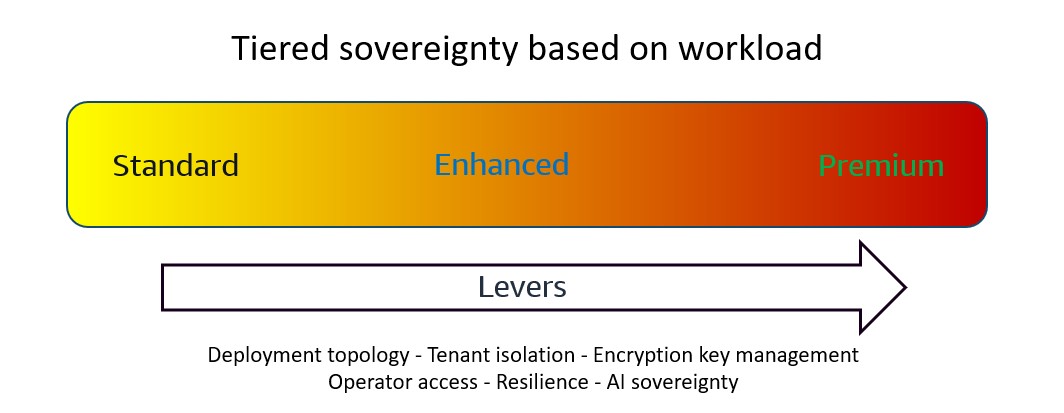
Figure 2: Tiered sovereignty based on workload
Additionally, we recommend further configurations that can be add-ons to these tiers. These add-ons can be enabled based on requirements not covered by the tiers. This tiered approach preserves SaaS economics for most tenants while offering premium tiers that command higher price points, turning compliance into a revenue lever.
Conclusion
Sovereignty doesn’t have to mean giving up SaaS. By treating sovereignty as a set of tunable design levers rather than a binary choice between cloud and on-premises, SaaS providers can expand into public sector and regulated industries, and build deeper customer trust while preserving the agility and scale economics that make SaaS compelling in the first place.
AWS provides a broad set of sovereignty building blocks, from Regions to AWS Dedicated Local Zones, from Nitro backed isolation to AWS External Key Store, from AWS Control Tower guardrails to the purpose-built AWS European Sovereign Cloud. The architectural patterns in this post give you a playbook to combine them into a sovereign SaaS offering that doesn’t compromise on innovation.
For additional resources, refer to Digital Sovereignty at AWS and Framework for platform expansion to Europe, Middle East and beyond.