AWS Public Sector Blog
Streamlining public health data integration with AWS visual workflows
Public health departments nationwide are drowning in data complexity. With healthcare data volumes surging and each integration requiring significant engineering time, traditional solutions are creating bottlenecks. This presents a problem when it’s speed that saves lives. During the COVID-19 pandemic, departments that could rapidly integrate and process data from multiple sources could respond hours—sometimes days—faster than those struggling with legacy systems.
An open source Amazon Web Services (AWS) visual workflow is transforming how public health departments approach data integration, combining familiar drag-and-drop interfaces with the power and scalability of serverless architecture.
The current state of public health data integration
Public health departments face unprecedented challenges that make effective data integration both critical and increasingly difficult to achieve. Resource constraints are intensifying as small IT teams, already stretched thin, must manage complex integration solutions while supporting surge capacity during health emergencies. On a monthly basis, the average public health department spends considerable time maintaining existing integrations during hours that could be redirected toward core public health activities.
Meanwhile, infrastructure costs are escalating beyond sustainable levels. Traditional integration solutions require significant ongoing investment in infrastructure management, representing major portions of already constrained budgets. With post-pandemic funding sources drying up, departments desperately need solutions that use managed cloud services to reduce operational overhead.
Perhaps most critically, emergency scalability demands remain unpredictable and unforgiving. When a health crisis strikes, data volumes increase dramatically overnight. Manual scaling processes and infrastructure limitations create dangerous bottlenecks precisely when rapid response capabilities become a matter of life and death.
A new approach with an AWS visual workflow builder
This message router solution addresses these systemic challenges through an approach that democratizes integration development while using AWS serverless infrastructure for significant scalability and cost efficiency. The offering fundamentally reimagines how public health professionals interact with complex data integration requirements.
Automatically Scaling, Managed Architecture
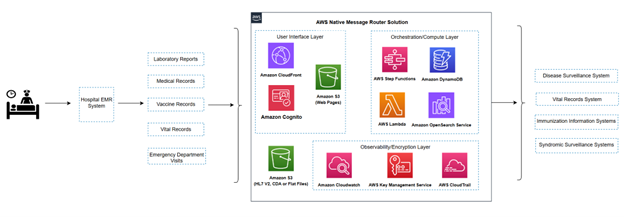
Figure 1 – High-Level Architecture of the AWS Native Message Router Solution
The reference architecture shown in Figure 1 provides a high-level overview of the AWS Native Message Router Solution for secure and scalable public-health data exchange
The solution receives clinical messages from hospital systems in multiple formats, such as HL7 v2 and CDA, and stores them in Amazon Simple Storage Service (Amazon S3) through secure ingestion channels. Each uploaded message triggers an AWS Step Functions workflow that orchestrates message processing using AWS Lambda and records processing and routing metadata in Amazon DynamoDB.
A browser-based user interface, hosted on Amazon S3 and delivered through Amazon CloudFront enables users to design and manage routing workflows, with user authentication provided by Amazon Cognito. To support traceability and operational review, the input, output, and transformation history of each processed message is indexed in Amazon OpenSearch Service, enabling users to perform natural-language searches to quickly understand how a specific patient message was processed . All data is encrypted using AWS Key Management Service (KMS), while operational visibility and traceability are provided through Amazon CloudWatch and AWS CloudTrail.
Familiar interface meets modern architecture
The core innovation lies in combining the intuitive drag-and-drop web interface that healthcare IT professionals already know and trust with the robust capabilities of AWS Cloud services. Healthcare professionals can build sophisticated integration workflows without requiring deep coding expertise or extensive training programs that strain already limited resources.
The visual workflow design experience feels natural and approachable. Users drag AWS services such as Amazon Simple Storage Service (Amazon S3), AWS Lambda functions, and transformation components onto a visual canvas, then connect these services through seamless point-and-click operations. Each component can be configured through user-friendly property panels, while clear workflow boundaries are established through intuitive start and end nodes.
Consider the common scenario of processing incoming Health Level 7 International (HL7) laboratory results. What once required extensive coding and configuration becomes as straightforward as dragging an Amazon S3 onto the canvas, connecting it to a processing AWS Lambda, and linking to subsequent routing steps. The process flows visually, making complex integration logic transparent and manageable.
When workflows are ready for deployment, the service seamlessly handles complex backend orchestration. The system automatically converts visual designs into optimized AWS Step Functions state machines and deploys custom business logic as efficient Lambda functions. The system configures the necessary security roles and permissions on the backend and sets up sophisticated monitoring infrastructure without requiring manual intervention.
This approach replaces the traditional complexity barrier that has prevented many public health departments from fully using cloud capabilities while providing access to enterprise-grade functionality.
Advanced monitoring and operational intelligence
Beyond streamlining workflow creation, the Message Router for Public Health solution provides significant visibility into data processing operations. Each message that flows through the system generates thorough execution tracking, offering real-time status updates for active workflows alongside detailed execution logs that capture input and output data for each processing step.
The visual process tracing capability represents a significant advancement in operational transparency. Users can trace message processing directly through the workflow interface, seeing exactly where each message currently sits in the processing pipeline and immediately identifying bottlenecks or failures. This level of transparency into data transformations facilitates regulatory compliance while enabling rapid troubleshooting when issues arise.
The system maintains thorough error tracking with actionable diagnostic information coupled with detailed performance metrics and processing time analysis. This operational intelligence transforms reactive problem-solving into proactive system optimization.
Intelligent search with Amazon OpenSearch Service
Perhaps the most transformative feature lies in the solution’s intelligent search capabilities powered by Amazon OpenSearch Service. Execution details and message content are automatically indexed, creating a searchable repository of public health data processing activities that can be queried using natural language.
Public health analysts can now ask questions like, “Show me all lab results for patient John Smith processed last week,” or conduct content-based searches to find messages containing specific clinical codes or demographic data. The system supports sophisticated temporal analysis to locate messages processed during particular time periods, while pattern recognition capabilities help identify trends and anomalies across data flows.
This operational intelligence capability becomes invaluable when managing large-scale data processing operations. Among thousands of processed messages, teams can instantly answer critical operational questions such as which lab results failed processing yesterday, or quickly locate the original HL7 message that generated a specific surveillance alert.
The transformation from reactive troubleshooting to proactive monitoring and quality assurance represents a fundamental shift in how public health departments can manage their data operations.
Serverless architecture benefits
The solution’s serverless foundation delivers automatic scaling capabilities that handle message volumes ranging from dozens to thousands without manual intervention. During quiet periods the system scales down to minimize costs, but it can respond instantly to emergency surge requirements without advance planning or infrastructure provisioning.
The fully managed approach provides substantial cost optimization potential through pay-per-use pricing models that do away with fixed infrastructure costs. Perhaps more importantly, the approach requires no upfront infrastructure investments, making advanced integration capabilities accessible to departments regardless of budget constraints.
From an operational perspective, the serverless architecture does away with server management and maintenance requirements. AWS automatically applies security updates and patches, while built-in high availability and disaster recovery capabilities provide enterprise-grade reliability without operational overhead.
Security and compliance by design
Recognizing the sensitive nature of public health data, the solution implements security controls from the ground up. Data is encrypted at rest using AWS Key Management Service, while encryption in transit is enforced through VPC-level network security controls, including TLS-enabled service endpoints and secure communication between components. Detailed audit trails capture data access and processing activities to support regulatory and compliance requirements.
The solution leverages AWS HIPAA-eligible services, as documented in the AWS HIPAA Eligible Services Reference. Fine-grained access controls and role-based permissions enable departments to implement appropriate data governance policies. Network isolation and a compliance-ready architecture ensure that sensitive health information remains protected throughout all processing operations.
Getting started with the solution
Public health departments ready to explore modern integration infrastructure can begin testing this solution immediately. We’ve built a thorough demonstration that shows the full capabilities of the visual workflow design, intelligent search, and seamless AWS integration.
The solution uses AWS Cloud Development Kit (AWS CDK) templates, which are available in our open source repository, for rapid deployment for evaluation and testing. The intuitive drag-and-drop interface means teams can begin designing workflows immediately, while thorough documentation can help staff learn about visual workflow creation and monitoring capabilities.
AWS is actively seeking public health departments and other organizations that manage complex message routing requirements to pilot this solution. We’re ready to provide hands-on support for organizations interested in exploring how cloud-based visual workflows can transform their data integration capabilities.
Looking forward
This AWS visual workflow solution represents far more than technology modernization. This paradigm shift toward democratized integration capabilities empowers public health professionals to build sophisticated data processing systems without requiring deep technical expertise or extensive training investments.
The combination of intuitive visual design, natural language search capabilities, and process traceability facilitate faster emergency response times and more effective ongoing surveillance operations. When every hour matters during a public health crisis, the ability to rapidly process, search, and analyze incoming data can literally save lives.
Most importantly, the open source approach means innovations and improvements benefit the entire public health community rather than individual organizations. This collaborative model fosters shared advancement in public health technology capabilities, creating a rising tide that lifts departments regardless of their individual resource constraints.
By tearing down traditional barriers of complexity and scalability limitations through fully managed cloud services, departments can redirect precious resources from infrastructure management toward their core mission of protecting community health through better data-driven decision making.
The future of public health data integration is visual, intelligent, and built specifically for the challenges that lie ahead. As health departments nationwide grapple with evolving threats and increasing data complexity, solutions like this AWS visual workflow offering provide the foundation for more resilient, responsive, effective public health infrastructure.
Ready to explore this solution for your organization? Contact us to discuss pilot opportunities and hands-on support for implementing cloud-based visual workflows in your data integration environment.