Artificial Intelligence
Aderant transforms cloud operations with Amazon Quick
This guest post is co-written by Angela Mapes and Adam Walker of Aderant.
Aderant, a leading global provider of comprehensive business management software for the legal industry, transformed how its 38-person Cloud Engineering team supports Expert Sierra, its cloud-based legal practice management solution. By implementing Amazon Quick, Aderant has accelerated documentation processes and empowered its Cloud Engineering team to deliver faster, more responsive support to clients who rely on Expert Sierra for their daily operations.
In this post, we share how Aderant used the AI-powered capabilities of Amazon Quick to unify search across six vendor systems and automate documentation workflows, achieving 90 percent faster search times and 75 percent documentation acceleration, and how others can apply these approaches to their operations.
The challenge: Information scattered across six systems
Aderant’s Cloud Operations team faced a common but significant challenge: essential information was scattered across multiple disconnected systems. Engineers supporting the Expert Sierra platform needed to search through multiple dashboards to find the answers that they needed. This fragmentation created significant operational friction. Manual searches across these systems consumed 30–45 minutes per task, slowing issue response and troubleshooting times. With more than 200 support tickets arriving and a commitment to all day global operational support, these delays compounded quickly. Engineers spent valuable time hunting for information rather than solving problems, and they risked missing critical context from scattered documentation. Aderant needed a solution that could unify search across their six knowledge systems, automate repetitive documentation tasks, and integrate with their existing tools, without requiring months of custom development.
The solution: AI-powered search and workflow automation
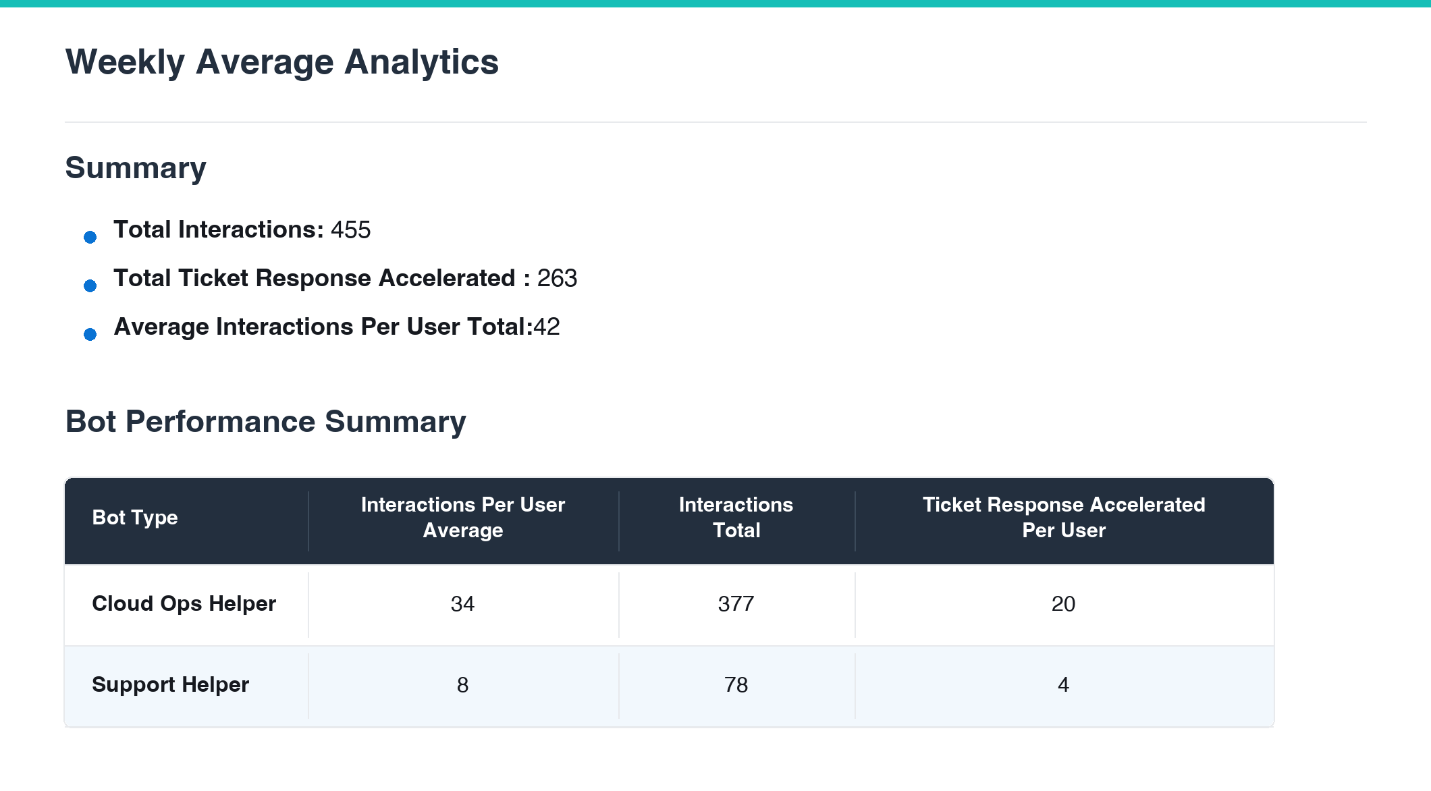
In October 2025, Aderant deployed Quick, beginning with a pilot of the CloudOps Helper bot. The implementation was fast, with full deployment and Chrome extension rollout completed by November 2025. By February 2026, success with the CloudOps team led to expansion with a Support Helper bot for the Product Support organization, bringing Quick capabilities to 86 additional team members.The CloudOps Helper bot became the centerpiece of the solution, providing unified AI-powered search across their six core knowledge systems. Engineers could now ask natural language questions and receive relevant answers drawn from Confluence documentation, SharePoint files, Git repositories, Jira tickets, Teams conversations, and Quick Sight dashboards, all from a single interface.
The team connected their six major systems plus three MCP servers using pre-built integrations, becoming operational within weeks rather than the months. The platform’s built-in security management, including support for Okta SSO and IAM, removed the need for custom access controls, while the unified search capability worked out of the box without requiring custom UI development.
Important note on data usage: CloudOps Helper analyzes only Aderant’s internal operational and infrastructure data sourced from Confluence, SharePoint, Git repositories, Jira, Microsoft Teams, and Quick Sight dashboards. This data is strictly limited to AWS infrastructure and CloudOps team resources used to support and maintain the Expert Sierra platform. Aderant doesn’t access or analyze any client application data or client business information.
Beyond search, Aderant implemented Amazon Quick Flows to automate knowledge base article creation. The automated workflow includes duplicate detection to prevent redundant content, reducing article creation time from one hour to 15 minutes—a 75 percent time savings. This automation maintained quality through a human-in-the-loop approach, ensuring engineers reviewed and approved content before publication.
The team also used Amazon Quick Research for on-demand root cause analysis and pattern discovery, such as to analyze bot usage patterns across both the CloudOps Helper and Support Helper bots, identifying the most common topics queried by the team. These insights directly informed knowledge base development, highlighting areas where documentation needed further elaboration or coverage. Amazon Quick Spaces was also used to consolidate knowledge bases, and integrated Amazon Quick Sight dashboards for Amazon CloudWatch alarm analysis and tenant health monitoring. The Quick Chrome extension became a daily tool, providing access to these capabilities across the team’s workflow
Real-world impact: Resolving critical infrastructure issues
The value of Quick became clear almost immediately during a major networking issue. A client experienced a domain trust failure—the connection between networks that allows users to authenticate and log in. When that trust broke, users couldn’t access the systems or services that they relied on. The problem quickly spread, causing widespread authentication failures across multiple services and locking users out at scale. Because the issue involved many tickets, meetings, and engineers, it was hard to piece together the full troubleshooting history without repeating work.
An engineer turned to the CloudOps Helper bot, asking it to analyze the complete client engagement history. The bot used the Microsoft Teams MCP Server to access meeting transcripts and the Jira integration to pull information from related tickets. Within minutes, it synthesized the complete engagement history, providing a full breakdown of meetings across tickets, discussion summaries that removed the need to review hours of recordings, a chronological timeline of all troubleshooting steps attempted, and recommended next actions based on complete context. What would have taken hours of manual research was completed in minutes. Engineers focused on untried solutions right away, accelerating resolution and improving the customer experience. This single issue showed how unified, AI-powered search can improve complex technical support scenarios.
Quantifiable results: Significant efficiency gains
Querying multiple data sources at once and automating straightforward Cloud Engineer tasks removed duplicate effort and sped up investigations. These per‑query time savings scale across hundreds of weekly support tickets, driving faster resolution and better results.
Specific workflow improvements include a 95 percent reduction in client history research time, dropping from 2–4 hours down to 2–3 minutes. Cross-platform search improved by more than 90 percent, falling from 30–45 minutes to 3–5 minutes. Documentation creation accelerated by 75–85 percent, and root cause analysis became 60–70 percent faster.The documentation impact has been particularly striking. The team increased output by 200 percent, producing three times more knowledge base articles than before. The documentation backlog dropped from more than 40 articles to fewer than 10. With article creation time reduced from approximately one hour to 15 minutes, engineers can capture knowledge immediately while context is fresh, improving documentation quality and completeness.
Adoption rates reflect the solution’s value to the team. The CloudOps Helper achieved 95 percent active use among the 38-person engineering team, while the Support Helper reached approximately 80 percent adoption during its pilot phase. The Chrome extension sees daily global use, and Quick maintains more than 99 percent uptime.
Transformation beyond efficiency
Quick has made capabilities possible that were previously impossible or impractical. The team now conducts deeper analysis of Amazon CloudWatch alarm patterns, identifies historical trends across clients, and makes data-backed infrastructure improvement decisions. Quick Flows automates documentation while maintaining quality through human review and duplicate detection. Quick Research provides cross-platform intelligence that was previously unattainable, facilitating client engagement analysis across multiple tickets and proactive issue resolution before escalation.Knowledge management changed in fundamental ways. The fragmented knowledge landscape was removed, and streamlined documentation processes encourage immediate knowledge capture. The human-in-the-loop approach maintains quality while accelerating output significantly. Collaboration has improved across the all day global team. Unified communication context from Teams, cross-ticket visibility that removes information silos, and faster handoffs without lengthy status meetings all contribute to more efficient operations. Consistent knowledge access across time zones helped the global team operate with the same information regardless of location.
Looking ahead: Expanding automation and integration
Aderant’s success with Quick has created momentum for further expansion. The Support Helper is moving from 10 percent testing toward full deployment, and cross-team collaboration between CloudOps and Support continues to increase.The team has identified three new Quick Flows for development. Note-taking automation will auto-generate structured meeting notes from Teams conversations. Jira ticket creation will automate ticket generation from conversations and events. A ticket question screener will pre-screen CloudOps tickets for completeness before queue entry, so engineers have the information they need to resolve issues efficiently.
Conclusion
Aderant’s journey with Quick is a testament to why search alone isn’t enough. While faster information retrieval was the starting point, the true transformation came from combining AI-powered search with intelligent workflow automation removing information fragmentation, automating repetitive tasks, and providing unified access to knowledge across multiple systems. Together, these capabilities helped Aderant reclaim thousands of hours annually, accelerate support response times, and fundamentally improve how their global team collaborates and shares knowledge. The addition of Quick Flows proved especially impactful, enabling the team to automate multi-step processes that once required significant manual effort from documentation generation to ticket routing and resolution tracking.
The results speak for themselves: 90 percent faster search, 75 percent faster documentation, 95 percent adoption, and minimal in costs over seven months. For organizations that have tried search and still feel the friction, Aderant’s experience makes the case clearly: the real breakthrough comes when search and automation work together.
To learn more about Amazon Quick and how it can transform your organization’s operations, visit the Amazon Quick website.