Artificial Intelligence
Category: Advanced (300)

Run multiple deep learning models on GPU with Amazon SageMaker multi-model endpoints
As AI adoption is accelerating across the industry, customers are building sophisticated models that take advantage of new scientific breakthroughs in deep learning. These next-generation models allow you to achieve state-of-the-art, human-like performance in the fields of natural language processing (NLP), computer vision, speech recognition, medical research, cybersecurity, protein structure prediction, and many others. For […]

Reduce deep learning training time and cost with MosaicML Composer on AWS
In the past decade, we have seen Deep learning (DL) science adopted at a tremendous pace by AWS customers. The plentiful and jointly trained parameters of DL models have a large representational capacity that brought improvements in numerous customer use cases, including image and speech analysis, natural language processing (NLP), time series processing, and more. […]

Enable CI/CD of multi-Region Amazon SageMaker endpoints
Amazon SageMaker and SageMaker inference endpoints provide a capability of training and deploying your AI and machine learning (ML) workloads. With inference endpoints, you can deploy your models for real-time or batch inference. The endpoints support various types of ML models hosted using AWS Deep Learning Containers or your own containers with custom AI/ML algorithms. […]

Model hosting patterns in Amazon SageMaker, Part 4: Design patterns for serial inference on Amazon SageMaker
As machine learning (ML) goes mainstream and gains wider adoption, ML-powered applications are becoming increasingly common to solve a range of complex business problems. The solution to these complex business problems often requires using multiple ML models. These models can be sequentially combined to perform various tasks, such as preprocessing, data transformation, model selection, inference […]

Use Amazon SageMaker Canvas for exploratory data analysis
Exploratory data analysis (EDA) is a common task performed by business analysts to discover patterns, understand relationships, validate assumptions, and identify anomalies in their data. In machine learning (ML), it’s important to first understand the data and its relationships before getting into model building. Traditional ML development cycles can sometimes take months and require advanced […]

Host code-server on Amazon SageMaker
Machine learning (ML) teams need the flexibility to choose their integrated development environment (IDE) when working on a project. It allows you to have a productive developer experience and innovate at speed. You may even use multiple IDEs within a project. Amazon SageMaker lets ML teams choose to work from fully managed, cloud-based environments within […]

Encode multi-lingual text properties in Amazon Neptune to train predictive models
Amazon Neptune ML is a machine learning (ML) capability of Amazon Neptune that helps you make accurate and fast predictions on your graph data. Under the hood, Neptune ML uses Graph Neural Networks (GNNs) to simultaneously take advantage of graph structure and node/edge properties to solve the task at hand. Traditional methods either only use […]
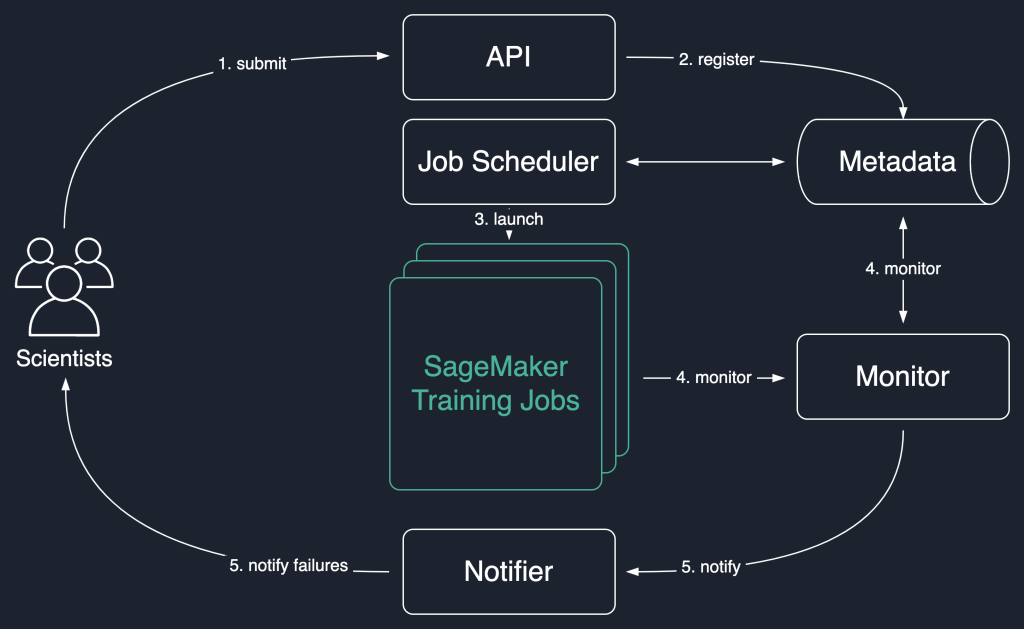
How Amazon Search runs large-scale, resilient machine learning projects with Amazon SageMaker
If you have searched for an item to buy on amazon.com, you have used Amazon Search services. At Amazon Search, we’re responsible for the search and discovery experience for our customers worldwide. In the background, we index our worldwide catalog of products, deploy highly scalable AWS fleets, and use advanced machine learning (ML) to match […]

Customize business rules for intelligent document processing with human review and BI visualization
A massive amount of business documents are processed daily across industries. Many of these documents are paper-based, scanned into your system as images, or in an unstructured format like PDF. Each company may apply unique rules associated with its business background while processing these documents. How to extract information accurately and process them flexibly is […]

Automate classification of IT service requests with an Amazon Comprehend custom classifier
Enterprises often deal with large volumes of IT service requests. Traditionally, the burden is put on the requester to choose the correct category for every issue. A manual error or misclassification of a ticket usually means a delay in resolving the IT service request. This can result in reduced productivity, a decrease in customer satisfaction, […]