Artificial Intelligence
How Thomson Reuters built an Agentic Platform Engineering Hub with Amazon Bedrock AgentCore
This post was co-written with Naveen Pollamreddi and Seth Krause from Thomson Reuters.
Thomson Reuters (TR) is a leading AI and technology company dedicated to delivering trusted content and workflow automation solutions. With over 150 years of expertise, TR provides essential solutions across legal, tax, accounting, risk, trade, and media sectors in a fast-evolving world. AI plays a critical role at TR. It’s embedded in how it helps create, enhance, connect, and deliver trusted information to customers. It powers the products used by professionals around the world. AI at TR empowers professionals with professional-grade AI that clarifies complex challenges.
This blog post explains how TR’s Platform Engineering team, a geographically distributed unit overseeing TR’s service availability, boosted its operational productivity by transitioning from manual to an automated agentic system using Amazon Bedrock AgentCore.
Business challenge
Platform engineering teams face significant challenges in providing seamless, self-service experiences to its internal customers at scale for operational activities such as database management, information security and risk management (ISRM) operations, landing zone maintenance, infrastructure provisioning, secrets management, continuous integration and deployment (CI/CD) pipeline orchestration, and compliance automation. At TR, the Platform Engineering team supports multiple lines of business by providing essential cloud infrastructure and enablement services, including cloud account provisioning and database management. However, manual processes and the need for repeated coordination between teams for operational tasks created delays that slowed down innovation.
“Our engineers were spending considerable time answering the same questions and executing identical processes across different teams,” says Naveen Polalmreddi, Distinguished Engineer at TR. “We needed a way to automate these interactions while maintaining our security and compliance standards.”
Current state
The Platform Engineering team offers services to multiple product teams within TR including Product Engineering and Service Management. These teams consume their internal home-grown solutions as a service to build and run applications at scale on AWS services. Over a period, these services are offered not only as tools but also through TR’s internal processes, following Information Technology Infrastructure Library (ITIL) standards and using third party software as a service (SaaS) systems.
Some of these services rely on humans to execute a predefined list of steps and are repeated many times, creating a significant dependency on engineers to execute the same tasks repeatedly for multiple applications. Current processes are semi-automated and are:-
- Repetitive and labor intensive – Because of the nature of the workflows and multi-team engagement model, these operational processes tend to be labor intensive and repetitive. The Platform Engineering team spent a lot of time doing work that is undifferentiated heavy lifting.
- Longer time to value – Because of process interdependencies, these operational workflows aren’t fully autonomous and take a long time to realize the value compared to fully automated processes.
- Resource and cost intensive – Manual execution requires dedicated engineering resources whose time could be better spent on innovation rather than repetitive tasks. Each operational request consumes engineer hours across multiple teams for coordination, execution, and validation.
The Platform Engineering team is solving this problem by building autonomous agentic solutions that use specialized agents across multiple service domains and groups. The cloud account provisioning agent automates the creation and configuration of new cloud accounts according to internal standards, handling tasks such as setting up organizational units, applying security policies, and configuring baseline networking. The database patching agent manages the end-to-end database patching lifecycle, version upgrades. Network service agents handle network configuration requests such as VPC setup, subnet allocation, and connectivity establishment between environments. Architecture review agents assist in evaluating proposed architectures against best practices, security requirements, and compliance standards, providing automated feedback and recommendations. AgentCore serves as the foundational orchestration layer for these agents, providing the core agentic capabilities that enable intelligent decision-making, natural language understanding, tool calling and agent-to-agent (A2A) communication.
Solution overview
TR’s Platform Engineering team built this solution with scalability, extensibility, and security as core principles and designed it so that non-technical users can quickly create and deploy AI-powered automation. Designed for a broad enterprise audience, the architecture is designed so that business users can interact with specialized agents through basic natural language requests without needing to understand the underlying technical complexity. TR chose Amazon Bedrock AgentCore because it provides the complete foundational infrastructure needed to build, deploy, and operate enterprise-grade AI agents at scale without having to build that infrastructure from scratch. The Platform Engineering team gained the flexibility to innovate with their preferred frameworks while designing their autonomous agents operate with enterprise-level security, reliability, and scalability—critical requirements for managing production operational workflows at scale.
The following diagram illustrates the architecture of solution:
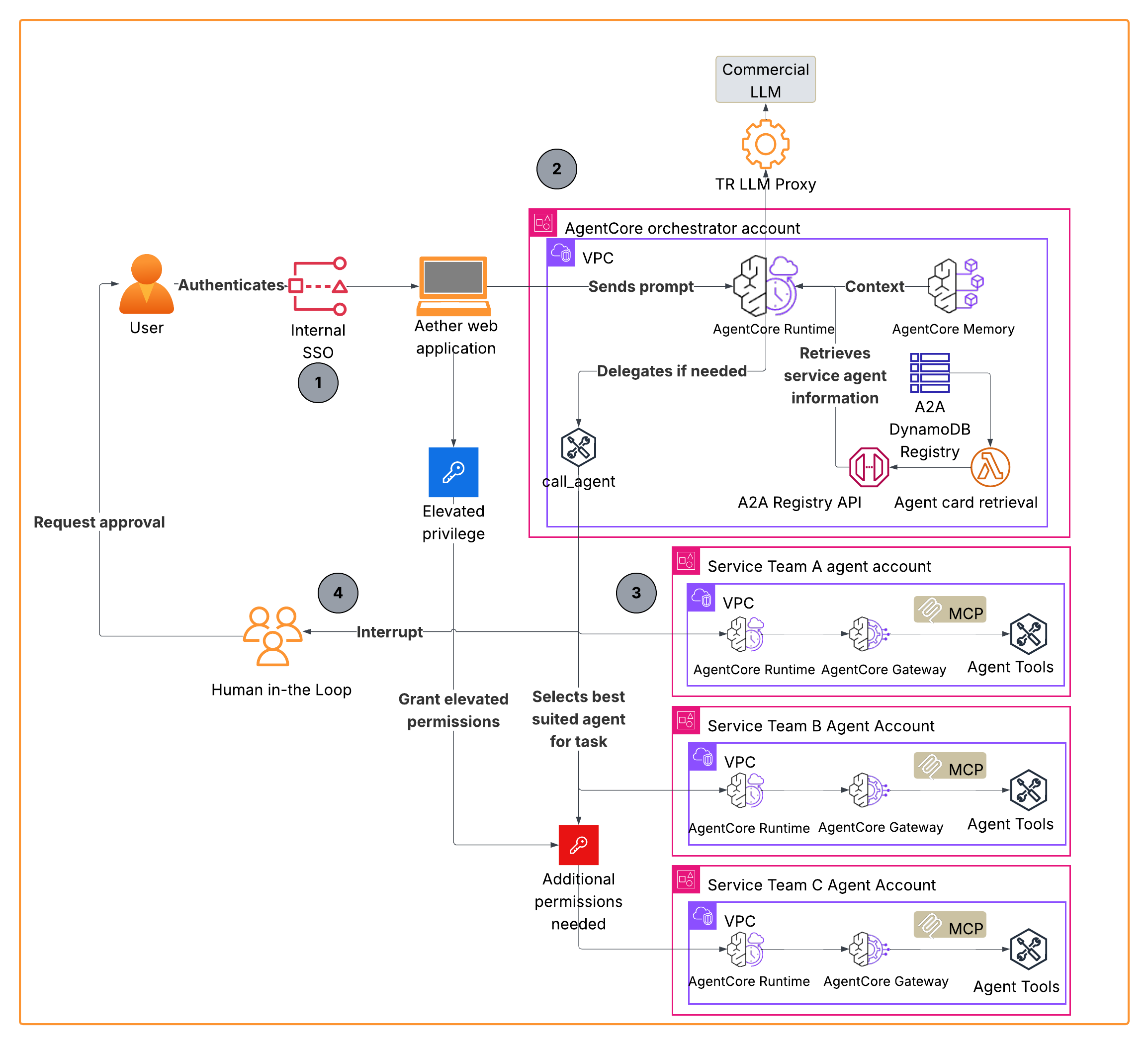
TR built an AI-powered platform engineering hub using AgentCore. The solution consists of:
- A custom web portal for more secure agent interactions
- A central orchestrator agent that routes requests and manages interactions
- Multiple service-specific agents handling specialized tasks such as AWS account provisioning and database patching
- A human-in-the-loop validation service for sensitive operations
TR decided to use AgentCore because it helped their developers to accelerate from prototype to production with fully managed services that minimize infrastructure complexity and build AI agents using different frameworks, models, and tools while maintaining complete control over how agents operate and integrate with their existing systems.
Solution workflow
The team used the following workflow to develop and deploy the agentic AI system.
- Discovery and architecture planning: Evaluated existing AWS resources and code base to design a comprehensive solution incorporating AgentCore, focusing on service objectives and integration requirements.
- Core development and migration: Developed a dual-track approach by migrating existing solutions to AgentCore while building TRACK (deployment engine), enabling rapid agent creation. Implemented a registry system as a modular bridge between the agent and the orchestrator.
- System enhancement and deployment: Refined orchestrator functionality, developed an intuitive UX , and executed a team onboarding process for the new agentic system deployment.
Building the orchestrator agent
TR’s Platform Engineering team designed their orchestrator service, named Aether, as a modular system using the LangGraph Framework. The orchestrator retrieves context from their agent registry to determine the appropriate agent for each situation. When an agent’s actions are required, the orchestrator makes a tool call that programmatically populates data from the registry, helping prevent potential prompt injection attacks and facilitating more secure communication between endpoints.
To maintain conversation context while keeping the system stateless, the orchestrator integrates with the AgentCore Memory service capabilities at both conversation and user levels. Short-term memory maintains context within individual conversations, while long-term memory tracks user preferences and interaction patterns over time. This dual-memory approach allows the system to learn from past interactions and avoid repeating previous mistakes.
Service Agent Development Framework
The Platform Engineering team developed their own framework, TR-AgentCore-Kit (TRACK), to simplify agent deployment across the organization. TRACK, which is a homegrown solution utilizes a customized version of the Bedrock AgentCore Starter Toolkit. The team customized this toolkit to meet TR’s specific compliance alignment requirements, which include asset identification standards and resource tagging standards. The framework handles connection to AgentCore Runtime, tool management, AgentCore Gateway connectivity, and baseline agent setup, so developers can focus on implementing business logic rather than dealing with infrastructure concerns. AgentCore Gateway provided a straightforward and more secure way for developers to build, deploy, discover, and connect to tools at scale. TRACK also handles the registration of service agents into the Aether environment by deploying agent cards into the custom-built A2A registry. TRACK maintains a seamless flow for developers by offering deployment capabilities to AWS and registration to the custom-built services in one package. By deploying the agent cards into the registry, the process to fully onboard an agent built by a service team can continue to make the agent available from the overarching orchestrator.
Agent discovery and registration system
To enable seamless agent discovery and communication, TR implemented a custom A2A solution using Amazon DynamoDB and Amazon API Gateway. This system supports cross-account agent calls, which was essential for their modular architecture. The registration process occurs through the TRACK project, so that teams can register their agents directly with the orchestrator service. The A2A registry maintains a comprehensive history of agent versions for auditing purposes and requires human validation before allowing new agents into the production environment. This governance model facilitates conformance with TR’s ISRM standards while providing flexibility for future expansion.
Aether web portal integration
The team developed a web portal using React, hosted on Amazon Simple Storage Service (Amazon S3), to provide a more secure and intuitive interface for agent interactions. The portal authenticates users against TR’s enterprise single sign-on (SSO) and provides access to agent flows based on user permissions. This approach helps ensure that sensitive operations, such as AWS account provisioning or database patching, are only accessible to authorized personnel.
Human-in-the-loop validation service
The system includes Aether Greenlight, a validation service that makes sure critical operations receive appropriate human oversight. This service extends beyond basic requester approval, so that team members outside the initial conversation can participate in the validation process. The system maintains a complete audit trail of approvals and actions, supporting TR’s compliance requirements.
Outcome
By building a self-service agentic system on AgentCore, TR implemented autonomous agents that use AI orchestration to handle complex operational workflows end-to-end.
Productivity and efficiency
- 15-fold productivity gain through intelligent automation of routine tasks
- 70% automation rate achieved at first launch, dramatically reducing manual workload
- Continuous reliability with repeatable runbooks executed by agents around the clock
Speed and agility
- Faster time to value: Accelerated product delivery by automating environment setup, policy enforcement, and day-to-day operations
- Self-service workflows: Empowered teams with clear standards and paved-road tooling
Security and compliance
- Stronger security posture: Applied guardrails and database patching by default
- Human-in-the-loop approvals: Maintained oversight while automating verification of changes
Cost and resource optimization
- Better cost efficiency: Automated infrastructure usage optimization
- Strategic talent allocation: Freed engineering teams to focus on highest-priority, high-value work
- Reduced operational toil: Removed repetitive tasks and variance through standardization
Developer experience
- Improved satisfaction: Streamlined workflows with intuitive self-service capabilities
- Consistent standards: Established repeatable patterns for other teams to adopt and scale
Conclusion
This agentic system described in this post establishes a replicable pattern that teams across the organization can use to adopt similar automation capabilities, creating a multiplier effect for operational excellence. The Aether project aims to help enhance the experience of engineers by removing the need for manual execution of tasks that could be automated to support further innovation and creative thinking. As Aether continues to improve, the team hopes that the pattern will be adopted more broadly to begin assisting teams beyond Platform Engineering to break-through productivity standards organization wide, solidifying TR as a front-runner in the age of artificial intelligence.
Using Amazon Bedrock AgentCore, TR transformed their platform engineering operations from manual processes to an AI-powered self-service hub. This approach not only improved efficiency but also strengthened security and compliance controls.
Ready to transform your platform engineering operations:
- Explore AgentCore
- Explore AgentCore documentation
- For additional use cases, explore notebook-based tutorials
About the Authors
 Naveen Pollamreddi is a Distinguished Engineer in Thomson Reuters as part of the Platform Engineering team and drives the Agentic AI strategy for Cloud Infrastructure services.
 Seth Krause is a Cloud Engineer on Thomson Reuters’ Platform Engineering Compute team. Since joining the company, he has contributed to architecting and implementing generative AI solutions that enhance productivity across the organization. Seth specializes in building cloud-based microservices with a current focus on integrating AI capabilities into enterprise workflows.
 Pratip Bagchi is an Enterprise Solutions Architect at Amazon Web Services. He is passionate about helping customers to drive AI adoption and innovation to unlock business value and enterprise transformation.
 Sandeep Singh is a Senior Generative AI Data Scientist at Amazon Web Services, helping businesses innovate with generative AI. He specializes in generative AI, machine learning, and system design. He has successfully delivered state-of-the-art AI/ML-powered solutions to solve complex business problems for diverse industries, optimizing efficiency and scalability.