AWS Public Sector Blog
How Pariveda built real-time clinical voice notes for Henry Schein One using Amazon Nova and Amazon Bedrock AgentCore
Clinical documentation takes time away from patient care. In dentistry, that burden is amplified by fast-paced visits, practice-specific note formats, and the need to enter information directly into existing practice management systems. Henry Schein One (HS1) wanted to reduce that burden without asking clinicians to leave their workflow or adopt a separate application.
In this post, we show how Pariveda and Amazon Web Services (AWS) worked with HS1 to build real-time voice documentation for dental visits. The solution uses Amazon Transcribe for streaming speech recognition and Amazon Bedrock for structured note generation and orchestration. We also explain the architectural choices required to support real-time performance, template-driven output, security controls, and production scale.
The challenge of real-time voice notes at scale in healthcare
Generating a clinical note from a recorded conversation is one problem. Generating usable documentation during the visit is a different one.
HS1 needed output to appear in real time, while the clinician was still with the patient. The generated note also had to conform to structured formats such as subjective, objective, assessment, plan (SOAP) and to practice-specific templates that can vary across workflows and providers. At the platform level, the solution had to satisfy security and compliance requirements, integrate with existing systems, and scale to millions of encounters per month.
Those constraints made this an application architecture problem rather than a model-selection problem.
Henry Schein One: The problem and the opportunity
HS1 supports more than 75,000 dental practices worldwide through two practice management systems: Ascend, its cloud-centered platform, and Dentrix, its widely used on-premises platform. Its goal was straightforward: reduce documentation overhead by giving clinicians a hands-free way to produce structured clinical notes inside the systems they already use.
That goal came with several design constraints:
- The experience had to work across two different product architectures.
- The note output had to adapt to practice-level template variation.
- The platform had to operate at enterprise volume, with roughly 1.35 million exams per month.
- The implementation couldn’t disrupt existing release cycles for either platform.
Early pilot results indicated a 65–70 percent reduction in clinical documentation time, with documentation produced during the visit rather than afterward. That created an additional benefit: clinicians could spot missing information and correct it before the encounter ended.
“This collaboration represents a pivotal moment for dentistry. Cutting-edge AI is finally meeting clinical expertise. We’re not just improving workflows, we’re reimagining how dental care is delivered, documented, and optimized around the world.” — Dr. Ryan Hungate, Chief Clinical and Strategy Officer, Henry Schein One
Solution overview: Building real-time clinical AI with Amazon Nova and Amazon Bedrock
Pariveda worked with AWS to design the solution as an embedded product capability, not as a standalone chatbot. The architecture integrates directly into the HS1 practice management systems and combines streaming transcription, structured extraction, validation, and auditable writeback.
At a high level, the platform uses Amazon Transcribe to convert streaming speech to text and Amazon Bedrock to generate and validate structured clinical content. It applies safety and sensitive-information controls through Amazon Bedrock Guardrails, manages access with AWS Identity and Access Management (IAM), and supports operational visibility through Amazon CloudWatch and AWS CloudTrail.
End-to-end flow
The platform processes each visit through the following steps:
- Start the visit – A dental provider begins a visit in Dentrix or Ascend. The patient management system (PMS) supplies patient context and a note template and launches the AI Scribe experience.
- Stream and transcribe – The provider’s voice streams in real time over a secure WebSocket to an Amazon Elastic Container Service (Amazon ECS) transcribe proxy, which forwards audio to Amazon Transcribe for speech-to-text note generation. Amazon Transcribe returns partial and stabilized transcript segments as the conversation unfolds.
- Orchestrate and extract – The orchestrator, built on Amazon Bedrock AgentCore processes these segments through Amazon Nova 2 Lite in Amazon Bedrock, progressively extracting structured fields and validating them against the active template.
- Filter and protect – Each inference call passes through Amazon Bedrock Guardrails for content filtering and protected health information (PHI) redaction.
- Update in real time – Progressive updates, including checklist items, extracted data, and gap indicators, display to the clinician as the visit continues.
- Validate and finalize – At encounter completion, a stricter validation pass produces the final clinical note for clinician review and sign-off.
- Write back with an audit trail – The approved note writes back to the PMS with a full audit trail, secured by Amazon Key Management Service (AWS KMS) encryption and logged through CloudWatch and CloudTrail.
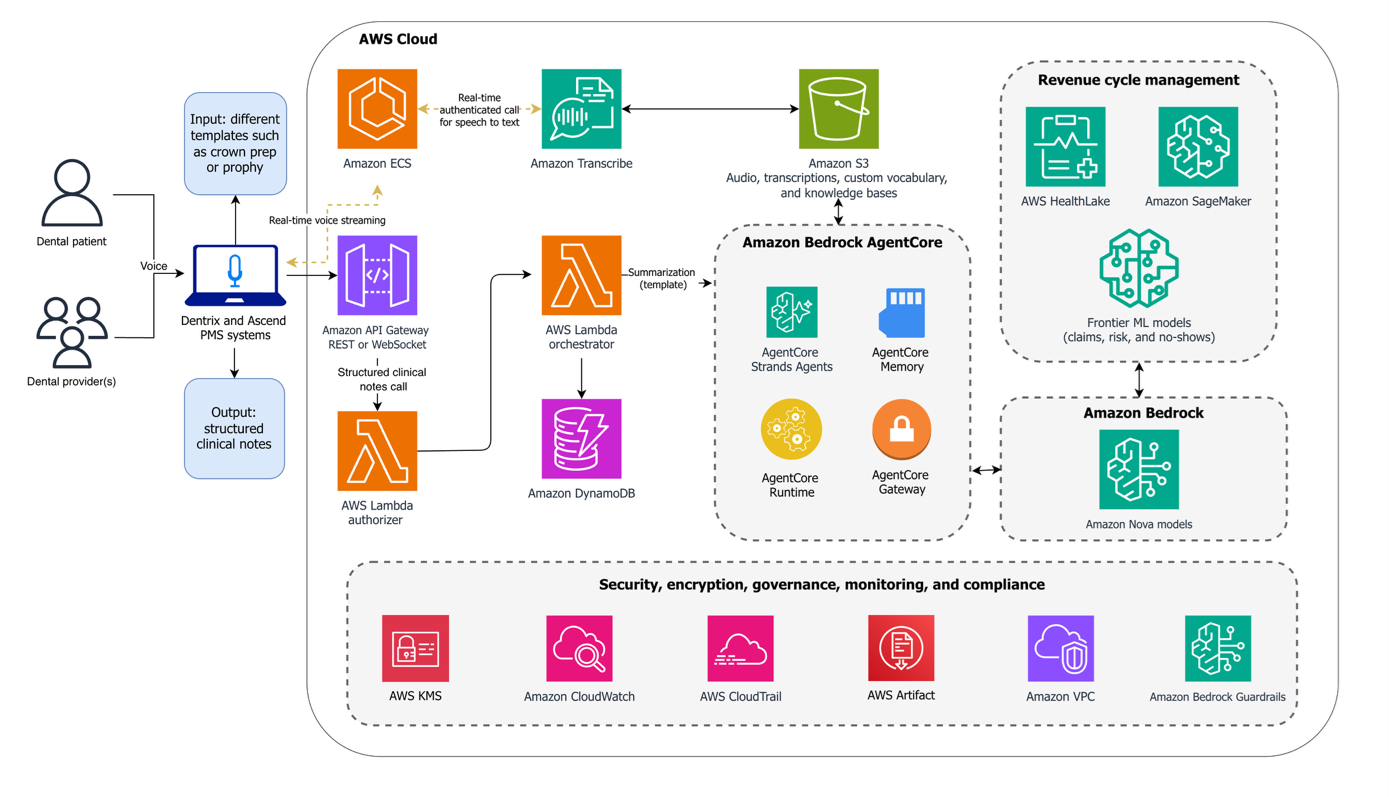
Figure 1: Real-time clinical AI architecture for transcription, orchestration, validation, and auditable writeback
At production scale, this flow handles approximately 1.35 million exams per month with peak loads of 300–400 model invocations per minute. Processing on finalized phrase segments, rather than reprocessing full transcripts, keeps token costs bounded and latency predictable regardless of appointment length.
How voice notes fit into Ascend and Dentrix
One of the most important design decisions was to keep the experience inside the existing practice management systems.
Ascend is browser-based and cloud-centered. Dentrix is an established on-premises platform. Instead of asking clinicians to open a separate application alongside either product, HS1 embedded the voice documentation experience directly into the existing PMS shell. That preserved workflow continuity for clinicians and avoided the friction that often comes with sidecar tools.
This decision shaped the architecture in two ways: the team needed a user interface that could be reused across both platforms, and it needed a backend that could centralize orchestration, validation, and governance regardless of where the frontend experience was hosted.
The solution consists of two layers. Layer one is the user interface embedded in the PMS. Layer two is an AI backend. The next sections explain these layers.
Micro frontend
The user-facing experience is delivered as a self-contained micro frontend embedded inside the PMS shell. This gave the team three advantages:
- A built-in in-product experience with no context switching
- Independent release velocity from the underlying PMS platforms
- Reuse across Ascend and Dentrix through an adapter layer
That reuse model reduced platform-specific divergence and made it possible to support both products with the same core experience.
AI backend
Behind the micro frontend is an AI backend responsible for session management, orchestration, validation, security controls, and writeback.
This layer runs on Amazon Bedrock AgentCore, a production-oriented approach to connecting agentic workflows to tools, systems, and controls while maintaining traceability and operational discipline. In this implementation, the backend coordinates workflows such as note generation, periodontal charting, and voice navigation while enforcing validation and governance requirements.
The same layer also centralizes the application of Amazon Bedrock Guardrails, IAM based access control, auditable writeback patterns, and operational monitoring. That matters in regulated environments because compliance can’t depend on frontend behavior alone; it has to be enforced in the system design.
Why we chose Amazon Nova
Model selection was a critical decision. HS1 established quality as their number one priority. They wanted a structured clinical output that clinicians could trust enough to sign off on with minimal edits, and they needed predictable latency at scale.
The team reviewed more than 14 foundation models (FMs), including Amazon Nova Pro, Claude 3.7 Sonnet by Anthropic in Amazon Bedrock, Meta’s Llama 3.x in Amazon Bedrock, and Mistral AI in Amazon Bedrock. They evaluated the models for schema adherence, content similarity, response time, and cost at production volume. Structured output quality was comparable across the leading candidates. Amazon Nova 2 Lite stood out on the two criteria that mattered most at the scale HS1 needed: latency and cost. The following table outlines the reasons the team selected Amazon Nova 2 Lite as the primary production model.
| Criterion | Why Amazon Nova 2 Lite |
|---|---|
| Latency | Meets real-time requirements fast enough for progressive updates without perceptible delays |
| Cost efficiency | Token pricing enables volume economics at approximately 9.8 billion tokens per month |
Conclusion
This implementation shows that real-time clinical voice AI can run inside existing practice management systems at production scale when the architecture is designed for low-latency processing, structured output, and operational control.
A few design principles were especially important:
- Embed the experience inside the core product instead of adding a separate tool.
- Optimize for the real-time window through chunk-level processing rather than repeatedly reprocessing full transcripts.
- Orchestrate extraction and validation using patterns aligned to Amazon Bedrock AgentCore.
- Select models based on production latency and cost, not only offline quality metrics.
HS1 and Pariveda are extending the platform to additional note types and templates, expanded periodontal charting, voice-driven navigation commands, and predictive intelligence for no-show prediction and automated claims validation, all built on the same AgentCore orchestration layer.
To learn more about how Pariveda helps healthcare organizations design and scale production-ready generative AI on AWS, visit the Pariveda Healthcare and Life Sciences page.