How was this content?
- Learn
- Build AI agents that scale: A practical lifecycle for startup agent architecture
Build AI agents that scale: A practical lifecycle for startup agent architecture

Most startups overbuild their agents. Before they have 100 users, they jump straight to multi-agent orchestration, memory graphs, runtimes, and policy engines. Agents don’t start as platforms; they start as product features. If you think about agent development through a lifecycle lens, aligned to customer growth, the architecture becomes obvious. And it’s usually simpler than the ecosystem noise suggests.
Here’s a practical maturity model for building agents without over-architecting too early.
The agent lifecycle at a glance
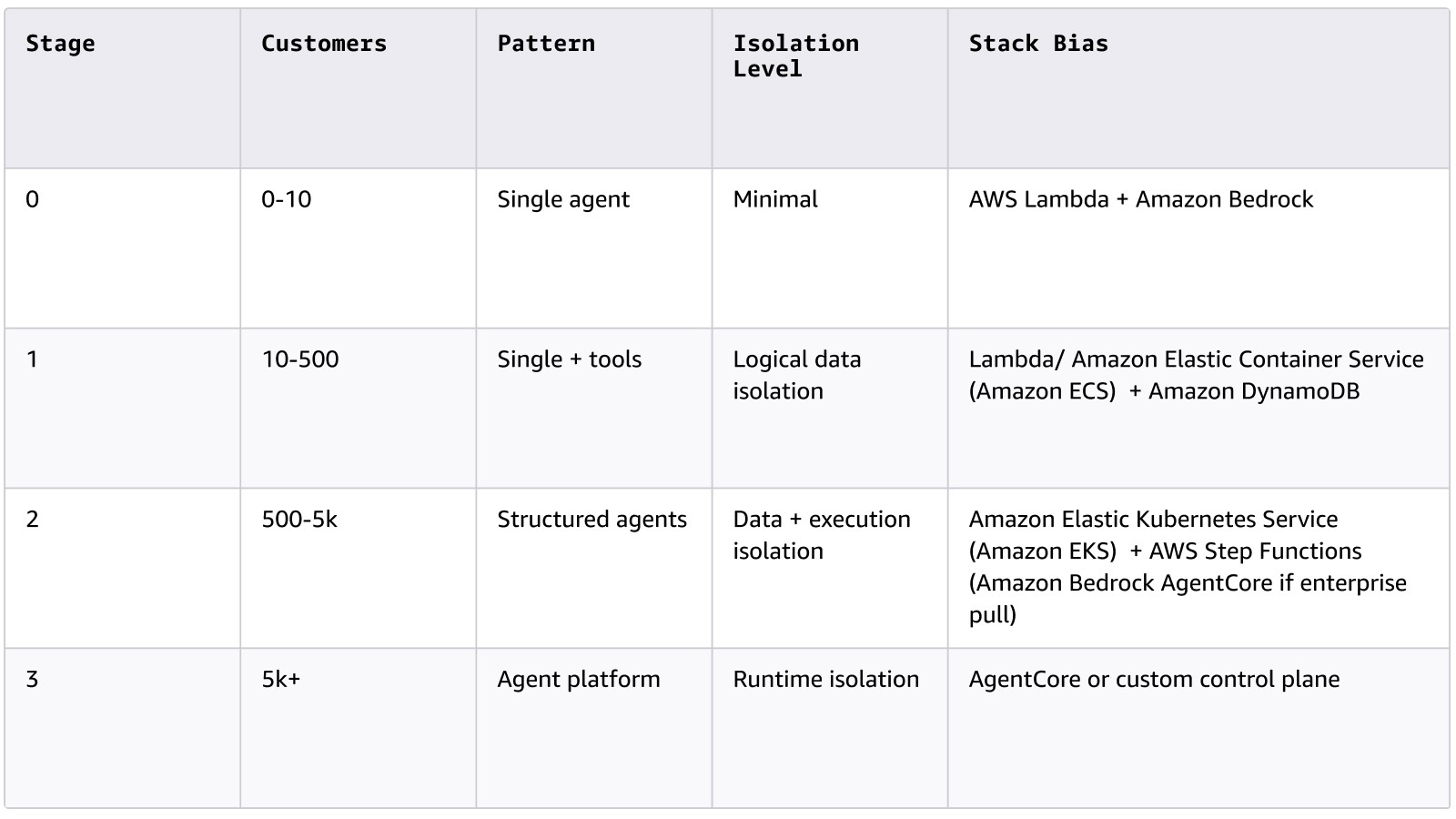
Stage 0: “Does This Even Work?”
0–10 customers | Pre-PMF
At this stage you’re not building an agent system, you’re building a single agent focused on a single outcome. It usually relies on just a few tools and runs with stateless execution. At its core, it’s a reasoning loop with tool calling.
Architecture
User → API Gateway → Compute (AWS Lambda) → LLM (Amazon Bedrock) → Tool → Response
No durable identity, no long-term memory, and no orchestration engine.
Recommended Stack
Model
Use built-in evaluation tools to compare performance, cost, and accuracy across models, with the flexibility to switch models as you evolve.
Execution
- AWS Lambda (default)
- Amazon
Elastic Container Service (Amazon ECS)/AWS Fargate if container-based
Storage (if needed)
Frameworks
- Raw SDK calls
- Light Strands Agents SDK(an open-source agent SDK for reasoning loops and
tool orchestration) or LangChain for structured tool handling
Avoid multi-agent frameworks and runtimes here.
Goal: To validate the reasoning loop delivers real value.
Stage 1: “It’s Getting Used”
10–500 customers | Early traction
As real usage begins, new requirements emerge. Users expect session continuity, edge cases surface quickly, prompts prove fragile, and the system must handle concurrent usage. You still likely have one primary agent, but it now needs structure.
So, what needs to change? First, you should introduce session memory, structured outputs, and clearer tool abstractions. Guardrails and basic observability also become critical for you to understand and stabilize the system under real usage.
Recommended Stack
Execution
- AWS Lambda or Amazon ECS
- Amazon
Elastic Kubernetes Service (Amazon EKS) only if you’re already Kubernetes-native
State
- DynamoDB (session persistence)
- Amazon S3 (artifacts)
- Vector database, like Amazon S3 Vectors, only if retrieval is core
Frameworks
- Strands Agents SDK (clean reasoning structure)
- LangChain (tool composition)
- LlamaIndex (retrieval-heavy use cases)
Observability
- Amazon CloudWatch (metrics and logs)
- AWS X-Ray (distributed tracing)
- Amazon Managed Grafana (data visualization)
Still avoid swarms. Most products here benefit from one disciplined reasoning loop.
Goal: Reliability under real user load.
Stage 2: “This Is a System Now”
500–5,000 customers | Scaling complexity
At stage two, the system starts behaving like real infrastructure. You’re dealing with concurrent sessions, long-running workflows, and asynchronous execution. Outputs may now be business-critical, costs grow more sensitive, and enterprise customers start asking serious questions. This is the first real inflection point.
To operate effectively at this stage, you need durable workflows, clear tenant and session isolation, versioned prompts and tools, and evaluation pipelines to continuously test and improve the system.
Isolation: What You Actually Need
At this stage, isolation is not optional. But isolation has layers:
1. Data Isolation (Mandatory)
- Tenant-scoped DynamoDB partitions
- Per-tenant vector namespaces
- Amazon S3 prefixes/buckets per tenant
- AWS Identity and Access Management (IAM)-scoped tool credentials
- Encryption with AWS Key Management Service (KMS)
This is table stakes.
2. Execution Isolation (Often Required)
- Per-tenant concurrency limits
- Separate worker pools for premium tenants
- Rate limiting and circuit breakers
- Possibly separate AWS accounts for large customers
This protects against noisy neighbors.
3. Runtime-Level Isolation (Sometimes Required)
- Strong sandboxing
- Centralized policy enforcement
- Standardized audit controls
- Clear tenancy boundaries at execution layer
This is where managed agent runtimes enter.
Default Architecture Path
For most startups in Stage 2:
Workflow
- AWS Step Functions
- Amazon EventBridge
- Temporal (if external orchestration
preferred)
Execution
- Amazon EKS becomes common here
- Amazon ECS for simpler models
Frameworks
- Strands Agents SDK for structured reasoning
- LangGraph for explicit control flow
- CrewAI only if real multi-agent specialization is needed
Workflow primitives are flexible. They let you iterate quickly on product logic while still giving you durable execution and retries.
When to Adopt AgentCore in Stage 2
Amazon Bedrock AgentCore is an agentic platform for building and operating AI agents quickly, securely, and at scale. It provides runtime services like secure tool access, memory, policy enforcement, and operational monitoring, so your team can focus on agent performance without having to build their own infrastructure layer.
Move to AgentCore earlier if 2+ of these are true:
- Enterprise deals hinge on isolation guarantees
- Security reviews demand formal audit and tenancy models
- You’re hand-building policy enforcement and isolation glue
- Multiple agents/products need a shared runtime layer
- High concurrency requires standardized execution controls
Rule of thumb:
- Use workflow primitives while shaping the product
- Use AgentCore when you’re standardizing operations
Goal: Dependable infrastructure with appropriate isolation.
Stage 3: “You’re Running an Agent Platform”
5,000+ customers | Enterprise exposure
By stage three you’re no longer building an agent, you’re operating many agents across many tenants. Compliance requirements, cost attribution, and Service Level Agreement
(SLA) expectations are now part of the system. Now, runtime-level isolation has become a rational architectural choice.
Recommended Stack
Agent Runtime
- AWS AgentCore Runtime
- Or custom control plane on Amazon EKS
Security
- AWS IAM-scoped tool permissions
- Strong tenant boundaries
- Virtual Private Cloud (VPC) segmentation
Governance
- Per-tenant cost attribution
- Audit logging
- Centralized policy enforcement
You’ve graduated from feature to platform.
AWS vs. Frameworks: Keep the Boundaries Clean
Use AWS for:
- Durable execution
- Isolation
- Identity
- Observability
- Governance
Use frameworks (Strands Agents SDK, LangChain, LangGraph, CrewAI) for:
- Structuring reasoning
- Tool composition
- Planning/execution patterns
Infrastructure problems belong to cloud primitives, while reasoning problems belong to agent frameworks. Mixing those layers often creates unnecessary complexity.
To find out more about AWS tools designed to build AI and agentic workflows, watch Matt Garman’s introduction to Amazon Q Developer at AWS re:Invent 2025. Amazon Q is a developer-focused AI agent platform that helps you build and deploy unique applications faster.
The Core Principle
Don’t build an agent platform. Build an agent that earns the right to become a platform. Isolation, orchestration, and governance should be forced by customer growth, not architectural ambition. Agents are distributed systems with reasoning loops inside them. Add complexity only when reality demands it.
If you’re an early-stage startup looking to innovate with agentic AI, AWS Activate can help you advance from prototype to production. Our flagship startup program provides AWS credits, technical guidance, and architecture support, so you can focus on building agents that deliver value and evolving the platform as your business grows. Join our network of over 350,000 global startups and start scaling with AI agents today.
How was this content?