Amazon S3 Glacier storage classes
Long-term, secure, durable storage classes for data archiving at the lowest cost and milliseconds access
Overview
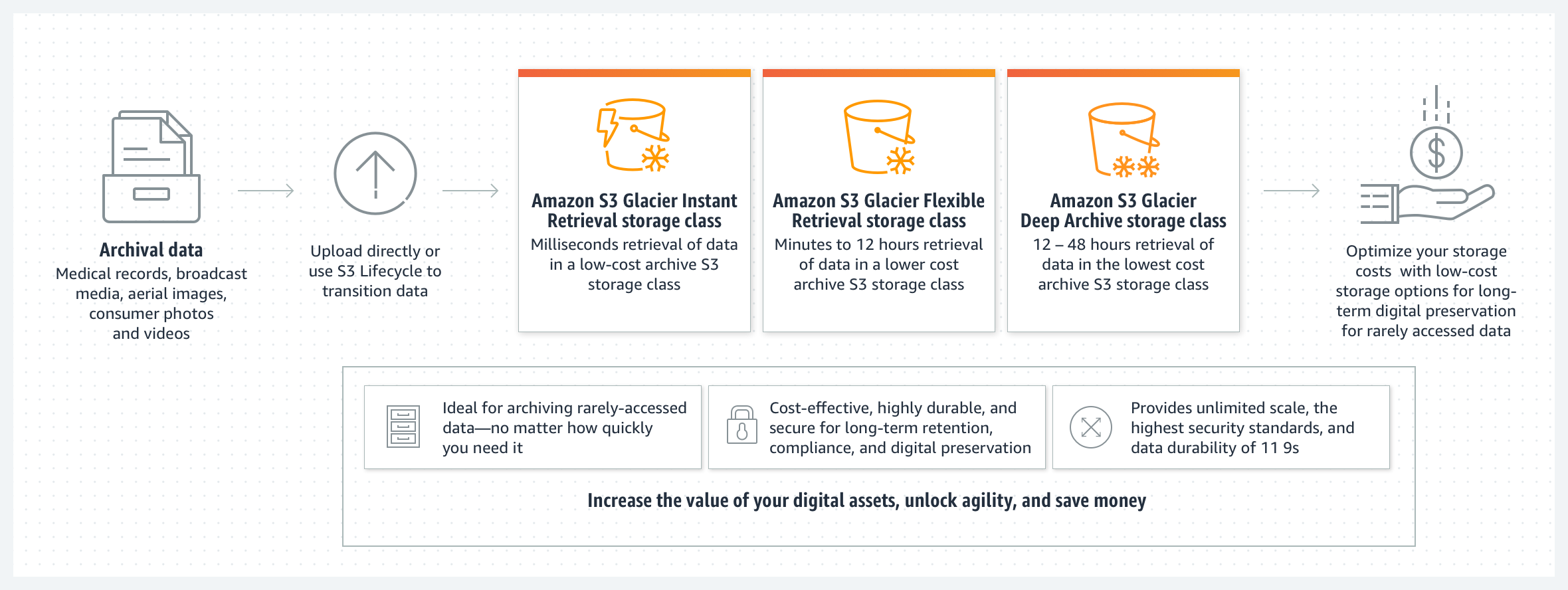
The Amazon S3 Glacier storage classes are purpose-built for data archiving, providing you with the highest performance, most retrieval flexibility, and the lowest cost archive storage in the cloud. All S3 Glacier storage classes provide virtually unlimited scalability and are designed for 99.999999999% (11 nines) of data durability. The S3 Glacier storage classes deliver options for the fastest access to your archive data and the lowest-cost archive storage in the cloud.
You can choose from three archive storage classes optimized for different access patterns and storage duration. For archive data that needs immediate access, such as medical images, news media assets, or genomics data, choose the S3 Glacier Instant Retrieval storage class, an archive storage class that delivers the lowest cost storage with milliseconds retrieval. For archive data that does not require immediate access but needs the flexibility to retrieve large sets of data at no cost, such as backup or disaster recovery use cases, choose S3 Glacier Flexible Retrieval, with retrieval in minutes or free bulk retrievals in 5-12 hours. To save even more on long-lived archive storage such as compliance archives and digital media preservation, choose S3 Glacier Deep Archive, the lowest cost storage in the cloud with data retrieval within twelve hours.
Benefits
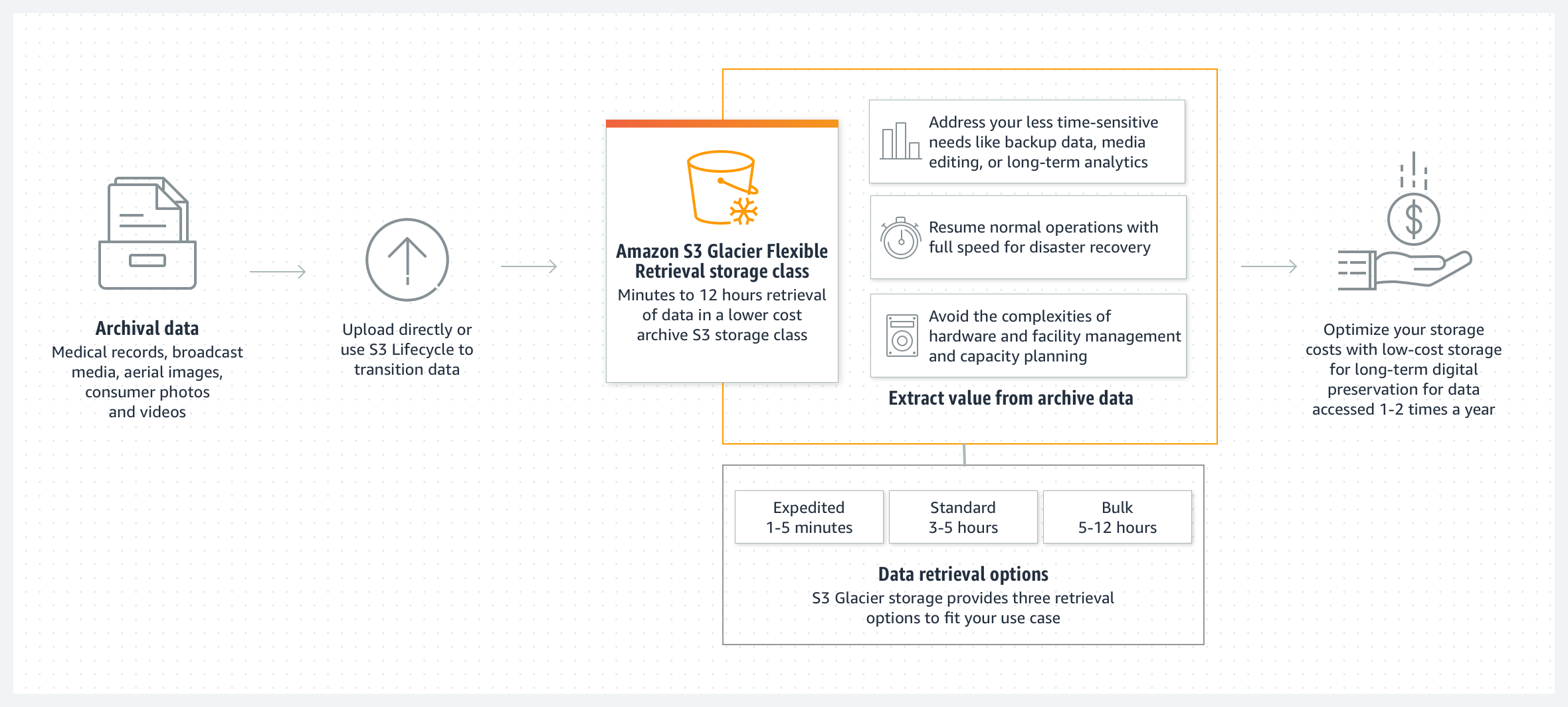
The Amazon S3 Glacier storage classes provide retrieval options from milliseconds to hours to fit your performance needs. The S3 Glacier Instant Retrieval storage class delivers milliseconds retrieval for archives that need immediate access, such as medical images or news media assets. S3 Glacier Flexible Retrieval provides three retrieval options: expedited retrievals that typically complete in 1–5 minutes, standard retrievals that typically complete in 3–5 hours and start within minutes when initiated using S3 Batch Operations, and free bulk retrievals that return large amounts of data typically in 5–12 hours. The Amazon S3 Glacier Deep Archive storage class provides two retrieval options ranging from 12-48 hours.
Learn more about Amazon S3 Glacier retrieval options
Learn more about Amazon S3 Glacier Deep Archive retrieval options
The Amazon S3 Glacier storage classes run on the world’s largest global cloud infrastructure with virtually unlimited scalability and are designed for 99.999999999% (11 nines) of durability. Data is redundantly stored across multiple Availability Zones that are physically separated within an AWS Region.
The S3 Glacier storage classes offer sophisticated integration with AWS CloudTrail to log, monitor, and retain storage API call activities for auditing, and they support three different forms of encryption. These storage classes also support security standards and compliance certifications, including SEC Rule 17a-4, PCI-DSS, HIPAA/HITECH, FedRAMP, EU GDPR, and FISMA. Amazon S3 Object Lock enables WORM storage capabilities, helping satisfy compliance requirements for virtually every regulatory agency around the globe.
All S3 Glacier storage classes are designed to be the lowest-cost storage for specific access patterns, allowing you to archive large amounts of data at a very low cost. This makes it feasible to retain all the data you want for use cases like data lakes, analytics, Internet of Things (IoT), machine learning, compliance, and media asset archiving. You pay only for what you need, with no minimum commitments or upfront fees.
In addition to integration with most AWS services, Amazon S3 object storage services include tens of thousands of consulting, systems integrator, and independent software vendor partners, with more joining every month. AWS Partner Network partners have adapted their services and software to work with Amazon S3 storage classes for solutions such as backup and recovery, archiving, and disaster recovery. No other cloud provider has more partners with solutions that are pre-integrated to work with their service.
How it works: S3 Glacier storage classes
Overview
The Amazon S3 Glacier storage classes are purpose-built for data archiving, providing you with the highest performance, most retrieval flexibility, and the lowest cost archive storage in the cloud. You can now choose from three archive storage classes optimized for different access patterns and storage duration.
Amazon S3 Glacier Instant Retrieval
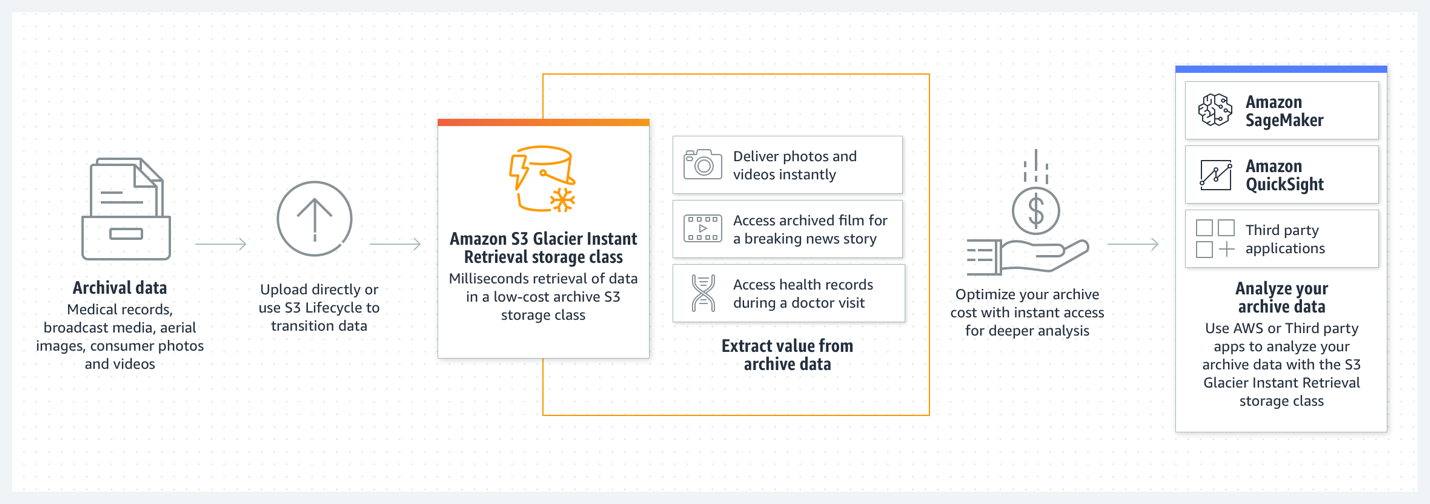
S3 Glacier Instant Retrieval delivers the lowest cost storage, up to 68% lower cost (than S3 Standard-Infrequent Access), for long-lived data that is accessed once per quarter and requires millisecond retrieval. It is designed for rarely accessed data that still needs immediate access in performance-sensitive use cases like image hosting, online file-sharing applications, medical imaging and health records, news media assets, and satellite and aerial imaging. S3 Glacier Instant Retrieval offers the high durability, high throughput, and similar low latency of S3 Standard-IA, with a lower per-GB storage price and slightly higher per-GB retrieval price. S3 Glacier Instant Retrieval is designed for 99.999999999% (11 9s) of data durability and 99.9% availability by redundantly storing data across multiple physically separated AWS Availability Zones in a given year.
Amazon S3 Glacier Flexible Retrieval
S3 Glacier Flexible Retrieval delivers low-cost storage, up to 10% lower cost (than S3 Glacier Instant Retrieval), for archive data that is accessed 1-2 times per year and is retrieved asynchronously. S3 Glacier Flexible Retrieval is the ideal storage class for archive data that does not require immediate access but needs the flexibility to retrieve large sets of data at no cost, such as backup or disaster recovery use cases. S3 Glacier Flexible Retrieval delivers the most flexible retrieval options that balance cost with access times ranging from minutes to hours and with free bulk retrievals. It is an ideal solution for backup, disaster recovery, offsite data storage needs, and for when some data needs to occasionally retrieved in minutes, and you don’t want to worry about costs. S3 Glacier Flexible Retrieval is designed for 99.999999999% (11 9s) of data durability and 99.99% availability by redundantly storing data across multiple physically separated AWS Availability Zones in a given year.
Amazon S3 Glacier Deep Archive
S3 Glacier Deep Archive delivers the lowest cost storage, up to 75% lower cost (than S3 Glacier Flexible Retrieval), for long-lived archive data that is accessed less than once per year and is retrieved asynchronously. At just $0.00099 per GB-month (or $1 per TB-month), S3 Glacier Deep Archive offers the lowest cost storage in the cloud, at prices significantly lower than storing and maintaining data in on-premises tape or archiving data off-site. S3 Glacier Deep Archive is a cost-effective and easy-to-manage alternative to tape. It is designed for customers — particularly those in the financial services, healthcare, media and entertainment and public sector — that retain data sets for 7-10 years or longer to meet customer needs and regulatory compliance requirements. S3 Glacier Deep Archive is designed for 99.999999999% (11 9s) of data durability and 99.99% availability by redundantly storing data across multiple physically separated AWS Availability Zones in a given year.
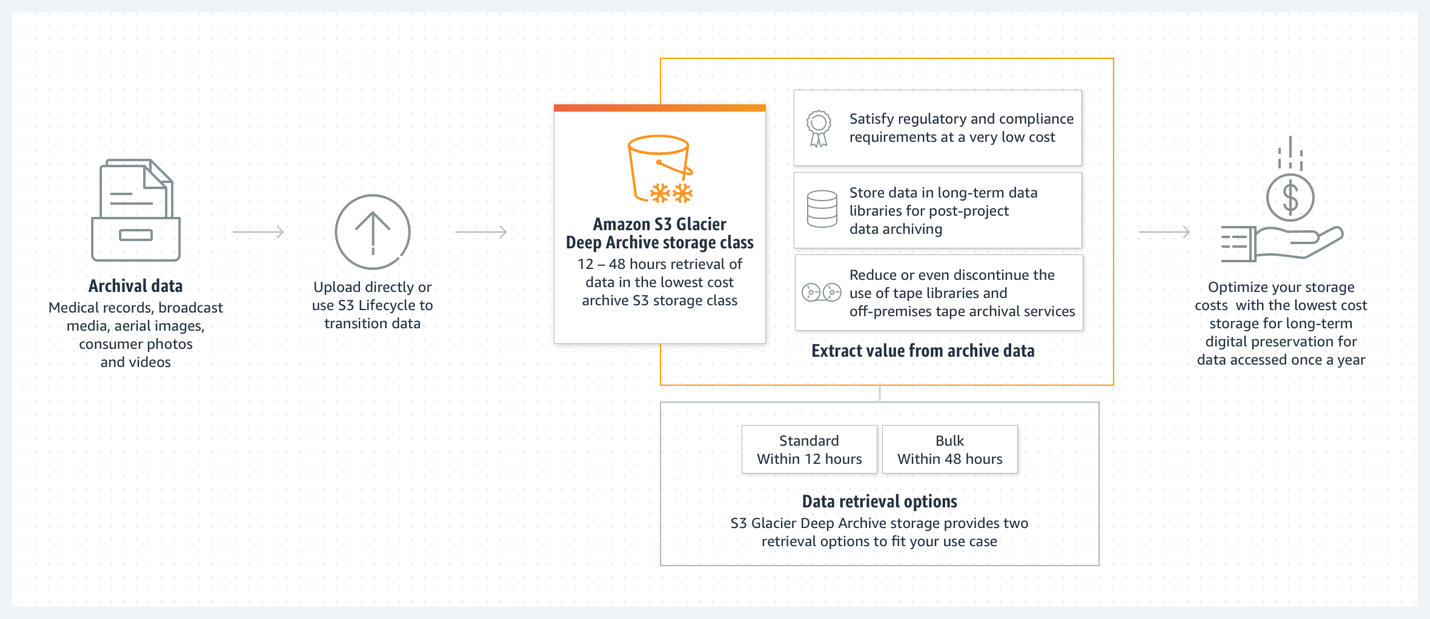
Use cases
Media and entertainment assets such as video and news footage require durable storage and can grow to many petabytes over time. Much of this data needs to be available immediately for breaking news events, video rendering, or content development. The Amazon S3 Glacier Instant Retrieval storage class allows you to archive older media content affordably while still making it available in milliseconds when it’s needed. To save even more on storage costs for media archives that don’t require milliseconds access, you can use S3 Glacier Flexible Retrieval or S3 Glacier Deep Archive.
Hospital systems need to retain petabytes of patient records (such as LIS, PACS, and EHR) for decades to meet regulatory requirements. The Amazon S3 Glacier Flexible Retrieval and S3 Glacier Deep Archive storage classes help you reliably archive patient record data securely at a very low cost. The Amazon S3 Glacier Instant Retrieval storage class is ideal for medical images or genomics, where milliseconds retrieval is required.
Many enterprises like financial services and healthcare must retain regulatory and compliance archives for extended durations. Amazon S3 Object Lock helps you set compliance controls to meet your objectives, such as SEC Rule 17a-4(f). Company policies can also require record retention of several years or indefinitely for data such as finance, tax, HR, or email records that can use S3 Glacier storage classes for a long-term content archive.
As part of backup plans, businesses store large data backups for many years on expensive on-premises storage systems. The S3 Glacier storage classes deliver the lowest-cost archive storage for these backups, while also making the data available when needed.
S3 Glacier customers
 Learn how Snap optimizes cost savings while storing over 1.5 trillion photos and videos on Amazon S3 Glacier Instant Retrieval
 Learn how Electronic Arts optimizes storage costs and operations using Amazon S3 Intelligent-Tiering and the S3 Glacier storage classes
 Learn how Electronic Arts optimizes storage costs and operations using Amazon S3 Intelligent-Tiering and the S3 Glacier storage classes »

 Learn how Warner Bros. uses S3 Glacier to preserve the world’s most important and extensive collections of movies and television

 Learn how PGA Tour is using archived data in S3 Glacier to create an entirely new experience for their fans »
 Learn how Pinterest uses S3 Glacier Deep Archive to manage storage for its visual discovery engine
 Learn how Conan O'Brien's team archives and preserves 25 years of late night legacy on AWS
 Learn how Ryanair saves 65% in backup costs by switching tape backups to the cloud using AWS Storage Gateway and storing them in S3 Glacier



 Learn how SysCloud reduces costs and increases performance at scale for SaaS data backups on AWS
 Learn how Webair addresses unique backup needs with AWS Storage Gateway and S3 Glacier Deep Archive
 Joyn readies exclusive content for audiences with Amazon S3 Intelligent-Tiering and Amazon S3 Glacier

 CloudWave modernizes EHR disaster recovery and provides fast, secure access to archived imaging data on AWS
 King Hamad University Hospital and Bahrain Oncology Center use Amazon S3 to store millions of medical images
 Ancestry uses Amazon S3 Glacier to restore terabytes of images in mere hours instead of days »
 How Canva saves over $3 million annually in Amazon S3 costs using S3 Glacier Instant Retrieval

 Learn how Photobox optimizes storage costs for over 12 billion photos with Amazon S3 Glacier Instant Retrieval
 Learn how Nasdaq uses Amazon S3 lifecycle policies to archive data to S3 Glacier and meet regulatory compliance requirements
 Learn how Indus OS transitioned billions of small objects to archive storage and saved 75% on costs