AWS for Industries
Accelerating Chip Tape-out with AWS Unified Operations
For semiconductor companies running Electronic Design Automation (EDA) workloads on AWS, infrastructure availability and performance directly impact chip delivery timelines. A verification regression that fails undetected over a weekend can add days to a tape-out schedule. An unexpected cost spike during crunch can erode confidence in cloud economics. A security incident targeting design IP can compromise years of R&D investment.
AWS Unified Operations is AWS’s top-tier support level. It provides a designated team of cloud operations experts who maintain deep, continuous context about your EDA environment. The team delivers proactive architecture guidance, rapid incident response, financial optimization, and security monitoring mapped to how semiconductor companies actually work.
In this post, you learn how each AWS Unified Operations capability addresses the operational realities of semiconductor chip design, from early architecture reviews through tape-out crunch and post-silicon wrap-up. You also see how the engagements map to a typical 12-month tape-out lifecycle.
An extension to your team
Unified Operations assigns a named team that becomes an extension of your engineering organization. This is a persistent relationship; the team maintains context about your architecture, workload patterns, and tape-out calendar across quarters.
Your Technical Account Manager (TAM) serves as the strategic coordinator. The TAM ensures the Domain Specialist Engineers (DSEs) have visibility into your upcoming verification ramps, the Senior Billing Account Specialist (SBAS) understands your project phase transitions, and your Incident Detection and Response (IDR) alarm coverage evolves as your environment changes. Rather than managing multiple disconnected support relationships, you work with one team that maintains full context.
The DSEs provide deep technical expertise through architecture reviews and continuous consultation. The SBAS builds cost models and commitment strategies aligned to your EDA project phases. Incident Management Engineers (IMEs) monitor your critical infrastructure 24/7 and respond within 5 minutes to issues. Security Incident Response (SIR) engineers provide automated threat monitoring and expert response to protect design IP.
The following sections explain how each team member’s capabilities map to EDA operational challenges.
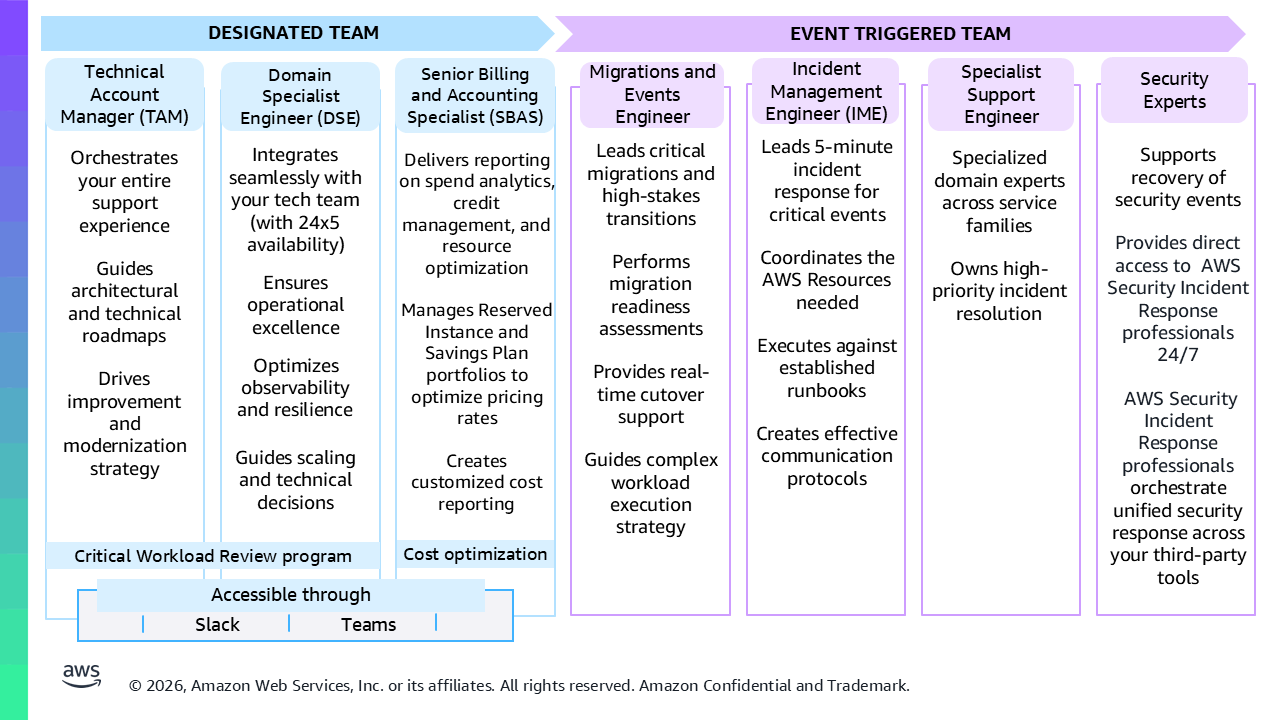
Figure 1: The Designated Team
Critical Workload Reviews: proactive architecture assessments
EDA clusters are complex multi-service environments where compute, storage, networking, licensing, and scheduling all interact. Misconfiguration in any layer can silently degrade tape-out timelines. The problem is often subtle: everything appears healthy until mid-crunch, when you discover that your Amazon FSx for NetApp ONTAP (FSx for ONTAP) throughput cannot sustain the I/O load, or your Auto Scaling policy does not react quickly enough to a verification spike.
DSEs conduct Critical Workload Reviews (CWRs) that evaluate your EDA cluster across resilience, performance, security, and observability.
On the resilience side, the review team assesses Slurm head node redundancy, FSx for ONTAP durability settings, Auto Scaling policies for regression spikes, and license server high-availability configurations. They identify single points of failure that could turn a hardware event into a schedule-impacting outage.
For performance, the team validates that compute instance selection aligns with each EDA stage. Place and Route workflows benefit from memory-optimized instances such as r7iz or x2iezn. Verification runs perform well on compute-optimized families like c7i. The DSE identifies where newer instance generations could improve runtime or reduce cost for your specific workload profile.
The security assessment evaluates Amazon Virtual Private Cloud (Amazon VPC) segmentation for design data isolation, AWS Identity and Access Management (IAM) least-privilege policies for GDSII data access, and encryption posture across storage and network layers. For semiconductor companies, a misconfigured Amazon Simple Storage Service (Amazon S3) bucket policy is not a compliance finding; it is a potential exposure of proprietary design IP.
On observability, the review identifies gaps in Amazon CloudWatch alarm coverage (FSx for ONTAP saturation, scheduler queue depth), recommends EDA-specific custom metrics, and establishes dashboards that correlate infrastructure health with workflow progress. The goal: when something degrades, your team knows within minutes rather than days.
Beyond formal reviews, DSEs provide continuous consultation. When AWS launches a new instance type optimized for memory-intensive workloads, your DSE evaluates whether it benefits your Place and Route stage and quantifies the expected improvement. After production incidents, the team conducts structured post-issue reviews that update runbooks and harden the environment for future tape-out cycles. Each review builds on the last, accumulating institutional knowledge about your specific workload patterns.
Incident Detection and Response (IDR): 5-Minute Response, 24/7
A verification regression running over a weekend represents thousands of compute-hours. If the cluster fails mid-run and no one detects the issue until Monday, the result is not just re-running tests, it is explaining a schedule slip to stakeholders who planned product launches around your tape-out date.
AWS Incident Detection and Response (IDR) provides 24/7 proactive monitoring with a 5-minute target response time for critical incidents. The service eliminates the gap between when infrastructure fails and when someone responds.
During onboarding, you define critical alarms with the IDR team: FSx for ONTAP throughput saturation, Slurm scheduler health, Amazon Elastic Compute Cloud (Amazon EC2) instance degradation, license server availability, and compute-to-storage network latency. IMEs monitor these alarms 24/7 through CloudWatch or third-party tools (Datadog, Splunk, Dynatrace) integrated through Amazon EventBridge.
When a critical alarm fires or you raise a critical case, the IME responds within 5 minutes. They validate the issue, create a support case, establish a bridge call, and begin triage using pre-built runbooks specific to your environment. Your DSE joins with full architecture context, eliminating discovery time. Escalation to AWS service teams happens directly as needed.
After each incident, the team conducts root cause analysis and updates runbooks with preventive architecture improvements. This means each incident makes the next response faster.
Consider this scenario: a 48-hour regression run across 2,000 instances hits hardware degradation at 3 AM on a Saturday. Without IDR, the failure goes undetected until Monday, and 30 percent of tests need re-running adding 2-3 days to the schedule. With IDR, the alarm fires, the IME responds in minutes, drains affected nodes, and re-queues failed jobs. By Saturday morning, the regression is back on track. The difference is a multi-day schedule slip versus a 4-hour recovery.
The compounding value is worth noting. Every incident generates runbook updates. Every runbook update accelerates future response. After several cycles, your environment’s operational maturity improves measurably, not because you hired a larger operations team, but because institutional knowledge accumulates in the system.
Cost Optimization for Burst Workloads
EDA compute spend does not behave like typical enterprise workloads. It can swing from hundreds of instances during RTL development to tens of thousands during verification peaks. This volatility creates challenges beyond unexpected bills.
Semiconductor companies plan budgets quarters in advance. When engineering leaders cannot predict next quarter’s cloud spend within a reasonable margin, the conversation shifts from optimizing cloud cost to questioning whether on-premises capacity with fixed costs would be more predictable. Cost volatility, left unmanaged, is how cloud adoption stalls.
The SBAS helps semiconductor teams manage this volatility through a structured approach that aligns financial strategy with engineering decisions.
The centerpiece is the Workload Cost Optimization Plan (WCOP), which maps commitment strategies to EDA project phases. Baseline infrastructure like head nodes and license servers gets covered by Savings Plans for maximum discount. Predictable verification capacity uses Reserved Instances or Compute Savings Plans. Burst capacity during tape-out crunch uses On-Demand and Spot Instances, with Spot providing up to 90 percent savings for fault-tolerant regression workloads.
On the storage side, the SBAS right-sizes FSx for ONTAP capacity based on actual I/O profiles, applies S3 Intelligent-Tiering for scratch data, and implements Amazon S3 lifecycle policies for tape-out archives. Real-time cost anomaly detection alerts the team to unexpected spikes from misconfigured Auto Scaling or runaway jobs before they become budget surprises.
The SBAS also conducts periodic Cost Optimization Workshops that bridge engineering decisions (instance selection, storage configuration) with financial impact. These sessions are particularly valuable before tape-out projects, where the team can model expected costs under different scenarios and set expectations with finance before the bills arrive.
After each tape-out crunch, the SBAS compares actual versus forecasted costs. This retrospective analysis improves predictability for future projects giving semiconductor companies the budget confidence to continue expanding cloud workloads rather than reverting to on-premises alternatives.
Security Incident Response: protecting the design IP
A single GDSII file can contain the complete blueprint for a processor representing years of R&D investment. For semiconductor companies, the security stakes extend beyond compliance requirements.
Semiconductor design IP is among the highest-value targets in the current threat landscape. Nation-state actors, supply chain attacks, and industrial espionage specifically target chip designs because a single breach can compromise a company’s competitive position for an entire product generation. The attack surface spans design files in Amazon S3, compute environments running proprietary EDA tools, and network paths carrying simulation data.
AWS Security Incident Response (SIR) is included with Unified Operations at no additional fee. SIR continuously monitors your environment using Amazon GuardDuty and third-party tools, filtering findings with customer-specific metadata (known IPs, expected IAM entities) to reduce alert volume and surface genuine threats.
When a high-fidelity alert fires for example, anomalous Amazon S3 access to design data, the AI Investigative Agent gathers evidence from Amazon GuardDuty, AWS CloudTrail, Amazon VPC Flow Logs, and AWS threat intelligence feeds. It steers the investigation toward root cause, reducing investigation time from days to hours. SIR engineers are available 24/7 to provide containment steps (isolate Amazon EC2 instances, revoke credentials, block Amazon S3 access) or take action on your behalf with authorization.
Beyond reactive response, SIR evaluates your security posture against more than 250 best practices with maturity scoring across IAM, detection, logging, infrastructure protection, data protection, and incident response.
The reduction in investigation time matters enormously for semiconductor companies. Without SIR, a security event involving design IP can take days of forensic analysis before you know what was accessed. With automated evidence gathering and expert triage, that timeline compresses to hours critical when the question is whether next-generation chip designs were compromised.
Unified Operations Across the Tape-out Lifecycle
The following table shows how Unified Operations engagements map to a typical 12-month tape-out timeline. Engagement intensity increases as you approach tape-out when the stakes are highest and your engineering team has the least capacity to deal with infrastructure issues.
Architecture reviews, incident response, cost modeling, and security monitoring, each capability maps to a specific phase of your tape-out timeline. One team carries the context from kickoff through crunch, so there’s no ramp-up when it matters most.
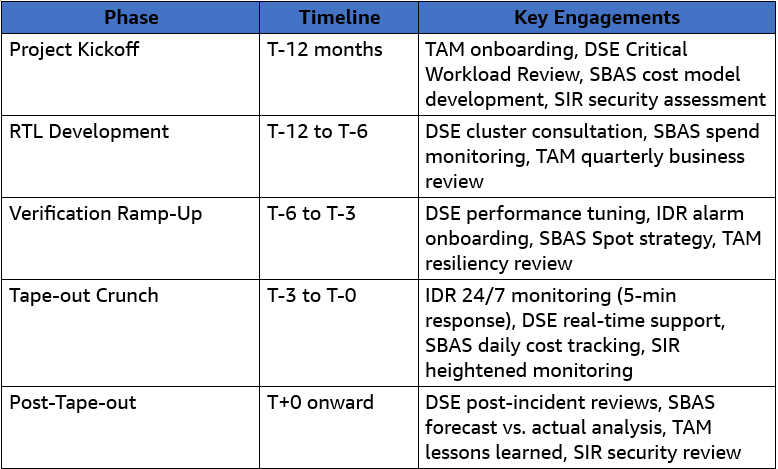
Figure 2: Unified Operations engagements mapping to a typical 12-month tape-out timeline
Getting Started
Each section above showed a different angle on the same idea: operational support that understands semiconductor tape-out timelines. Architecture reviews before crunch, fast incident response during crunch, cost modeling that matches your project phases, and security monitoring tuned to your environment. One team, continuous context, no ramp-up time.
Unified Operations is designed for organizations running workloads that cannot tolerate downtime. EDA tape-out environments are a natural fit. To begin:
- Engage your AWS account team. Contact your account manager or solutions architect to discuss Unified Operations scope. Prepare a summary of your EDA environment (services used, workload patterns, tape-out timeline) to accelerate the conversation.
- Identify your critical workloads. Start with the EDA cluster and storage environment supporting your highest-priority tape-out. Not every workload needs full coverage.
- Plan for onboarding (4-6 weeks). The team conducts an architecture review, defines critical alarms collaboratively, establishes communication channels, and performs the initial Critical Workload Review.
- Align to your tape-out calendar. Share design milestones and projected peak periods so the team can prepare monitoring configurations and coordinate DSE availability ahead of critical phases.
The teams that get the most from Unified Operations engage during project planning not after something breaks during tape-out crunch. Every week of proactive engagement before peak load translates to faster, more confident response when it matters most.
To learn more about AWS Unified Operations, visit the AWS Unified Operations Team page or contact your AWS account team to discuss eligibility.
Related Resources
AWS Unified Operations: Building Resilient Operations for Mission-Critical Workloads
AWS Incident Detection and Response