AWS for Industries
How publishers can prepare their content for AI monetization on AWS
AI systems are consuming publishers’ content on a massive scale while traditional web traffic search referrals decline. This pattern is accelerating as AI systems shift from a crawl-and-refer model to a crawl-and-consume model. Traditional search engines sent web traffic back to publishers. Large language models (LLMs) synthesize publishers’ content without attribution or referral.
The decision you face as a publisher is whether to build the infrastructure to capture web traffic value. The new model creates an urgent need to prepare your content for direct AI monetization using Amazon Web Services (AWS).
The data from the last 12–24 months paints a clear picture:
- Almost half of internet traffic is now non-human, according to the 2024 Imperva Bad Bot Report. AI crawlers are the fastest-growing segment of internet traffic.
- AI bots now make 1 visit for every 93 human visits on the median North American publisher site, and 1 for every 33 in Europe, according to TollBit’s State of the Bots report for Q1–Q2 2026.
- AI chat assistants drive 95.7 percent fewer referrals compared to traditional search. They deliver a 0.37 percent referral rate versus 8.63 percent from organic search, according to TollBit data reported by Nieman Lab.
- As AI-mediated answers replace direct site visits, Google Search referrals to publishers fell 40 percent from July 2025 to July 2026, according to Chartbeat data reported by the Reuters Institute.
The risk of losing human traffic is existential for publishers, but the opportunity to become a part of AI’s information economy is real. If you build structured content licensing infrastructure now, you can capture a revenue stream that didn’t exist 2 years ago. The early movers are already signing commercial deals with AI companies.
In this post, we describe the capabilities you need for effective AI content monetization and how AWS edge services such as Amazon CloudFront and AWS WAF deliver immediate revenue from bot traffic. We also outline a strategic approach that unlocks multi-marketplace distribution and contextual advertising. Finally, we introduce the new Guidance for Monetizing Publisher Content for AI Agents on AWS, which brings these capabilities together in a reference architecture with sample code that you can deploy in your own AWS account.
Five capabilities publishers need for effective AI content monetization
Effective AI content monetization requires five interconnected capabilities. These capabilities form a maturity path from visibility to optimization. This framework is effective whether you’re starting to understand your AI traffic or already building a full marketplace operation:
- Prepare – Position your content for AI discovery and distribution. This means creating AI-optimized formats that AI agents can parse, cite, and pay for; reducing the serving costs associated with delivering heavy HTML to machines; and structuring your catalog for multi-marketplace listing.
- Observe – Observation gives you visibility into AI bot traffic patterns, including knowing which bots are hitting your site, what content they consume, and at what volume. With this knowledge, you can make informed monetization decisions.
- Control – With Control, you can serve allowlisted bots in a cost-optimal way. Flexible access control rules mean you can define policies per path and per bot, graduated from open access through throttling to full blocking.
- Monetize – Maximize your earnings using content category and recency rules. You can set static pricing (fixed per request), dynamic pricing (based on content value signals), or recommended pricing. The recommended option uses algorithmic optimization based on demand patterns.
- Measure – Track revenue and consumption patterns and inform your optimization strategies. Without measurement, you can’t iterate on pricing, identify your highest-value content, or understand which AI consumers generate the most return.
You can activate Observe, Control, Monetize, and Measure immediately using Amazon CloudFront and AWS WAF. Preparation is a strategic investment that unlocks multi-marketplace distribution and higher citation rates across AI answer engines.
Observe, Control, Monetize, and Measure with AWS edge services
Starting a new revenue stream with AWS doesn’t require much preparation. Most publishers using Amazon CloudFront can activate these capabilities today without new infrastructure or origin changes.
Observe features are generally available on existing Amazon CloudFront distribution. By activating it, you gain visibility into which AI bots are hitting your site, what content they consume, and at what volume. Amazon CloudFront maintains a bot catalog with more than 650 AI bots and agents identified and classified. For most publishers, this can be a revelation as the scale of non-human consumption becomes visible for the first time. Amazon CloudFront identifies AI crawlers using a continuously updated catalog that the AWS threat intelligence team maintains, which matches request signatures against known bot fingerprints.
With generally available Control features in AWS WAF, you can see the traffic and define granular per-path, per-bot access policies enforced at the edge with no latency impact on human visitors. You might allow a search engine crawler full access while limiting an AI training bot to your press releases only. You can make your policies as fine-grained as you need.
On June 15, 2026, AWS launched AWS WAF AI traffic monetization with US dollar stablecoin (USDC) payouts. When an AI bot requests monetized content, AWS WAF returns an HTTP 402 Payment Required response. This response contains the content price in USDC, accepted payment networks (for example, Base and Solana), and the publisher’s wallet address. The agent signs a payment authorization and resubmits the same request with a payment-signature header. AWS WAF verifies the payment and settles it on-chain using the x402 facilitator service. The content is then served in the same response.
On November 5, 2026, AWS added Stripe as a payout option. Agents still pay in stablecoin, but publishers can now have each payment settle as fiat in their Stripe balance through Stripe Connect without holding stablecoins or managing a crypto wallet.
The standard flow and the transaction typically happen synchronously in the request path, with payment settled in USDC to the publisher’s wallet or as fiat in the publisher’s Stripe balance. The AWS WAF Monetize dashboard provides real-time revenue tracking, showing detailed breakdowns of earnings by bot, content type, and time. You can see which bots are paying, which content generates the most revenue, and how consumption patterns change over time. These insights can inform your pricing strategy and access rules.
AWS offers AI traffic monetization in all edge locations where AWS WAF web ACLs are associated with Amazon CloudFront distributions, at no additional charge. Standard AWS WAF and Stripe processing fees apply. For details, you can visit the AWS WAF Pricing page. You can begin earning from AI traffic shortly after activation.
Prepare: Positioning your content for AI discovery and distribution
Although monetization can start immediately, publishers who strategically prepare their content can unlock significantly more value. Just as search engine optimization (SEO) positioned content for search engine discovery, standards-based preparation positions your content for AI agent discovery across multiple marketplaces rather than one bilateral relationship.
Why your website alone doesn’t serve AI agents well
Serving your existing website to AI agents can introduce real problems:
- Your content’s citation ranking takes a hit because raw HTML with navigation, sidebars, and interstitials isn’t structured for machine consumption
- AI agents parsing your CSS, JavaScript, and ad creatives consume unnecessary compute at the edge
- Your ad slots and paywalls need special handling to avoid showing irrelevant interruptive experiences to bots
- AI transactions can bloat your analytics pipelines, corrupt your A/B tests, and pollute the backend data systems you’ve carefully tuned for human visitors
- The infrastructure investment you’ve made for your human audience now needs to account for AI consumers also
Generative engine optimization
This is where generative engine optimization (GEO) comes in and structures your content so AI agents can consume it effectively and cite it. The principle is the same as SEO, but applied to generative engines. A landmark study entitled GEO: Generative Engine Optimization from Princeton, IIT Delhi, and Georgia Tech tested nine optimization strategies across 10,000 queries. Content enriched with statistics gained over 33 percent visibility in AI-generated responses.
Content with expert quotations gained more than 41 percent, and content citing credible sources gained over 28 percent. Pages using FAQPage schema, such as in the AI Answer Engine Citation Behavior An Empirical Analysis of the GEO16 Framework study, achieve a 41 percent citation rate as opposed to 15 percent without, a 2.7-fold improvement. According to Conductor research, AI referral traffic converts at 14.2 percent compared to Google’s 2.8 percent. Your content shows up where AI agents look (Perplexity, ChatGPT, Gemini) and gets cited rather than merely consumed.
Standards-based distribution with CoMP and RSL
Content Monetization Protocols (CoMP) is Interactive Advertising Bureau (IAB) Tech Lab’s standardized marketplace API. It lists your content in a universal protocol that AI buyers can query. Discovery endpoint (comp.json), negotiation, authentication, and content delivery happen through standardized interfaces. No proprietary integrations or one-off deals. It’s multi-marketplace distribution with interoperability at scale.
RSL (Really Simple Licensing) means you can declare your licensing terms once in a machine-readable format. Compliant AI systems discover them automatically through robots.txt, HTTP Link headers, or HTML elements. Like robots.txt scaled web crawling, RSL scales content licensing. You maintain control over your terms without negotiating bilateral deals with every AI company. Publishers can make RSL terms publicly discoverable, independent of the payment flow, and configurable through Amazon CloudFront response headers policies.
On November 19, 2026, AWS Marketplace launched Data as a Service, a new product type for third-party datasets and licensed content. Publishers can list their content, set their own prices and license terms (a contract, pay-as-you-go, or a contract with consumption pricing, with an optional free trial), and deliver it through an API, a real-time feed, an Amazon S3 bucket, or another method. Buyers subscribe through public or private offers, and charges appear on their existing AWS invoice, so enterprise teams can license your content without adding a new supplier or negotiating a separate contract. AWS Marketplace also now lets AI agents buy x402-enabled content through Amazon Bedrock AgentCore payments. To get started, see the AWS Marketplace Seller Guide.
A sequence for preparing your content
Preparation follows a sequence: Start by generating RSL declarations for your most valuable content tiers, then deploy the GEO enrichment pipeline to classify and restructure that content. Finally, register your catalog in a CoMP discovery endpoint so AI buyers can find you across multiple marketplaces.
Strategically investing in Prepare capabilities activates more reach (multiple marketplaces find your content), gives you better control (you own the terms and can update them anytime), and better discoverability (AI agents prefer and cite your structured content).
Reusing classification for contextual advertising
The Prepare capability could support your contextual advertising efforts also. When your GEO pipeline classifies a page with IAB Content Taxonomy categories, extracts entities (people, organizations, events), and generates topic signals, those structured metadata outputs are identical to what you need to enrich your OpenRTB (the IAB Tech Lab real-time bidding protocol) ad requests.
Your ad server or supply side platform (SSP) can consume those signals from the API and add as key-value pairs in OpenRTB ad requests. You can classify once, and that single classification event feeds AI content licensing revenue using CoMP and contextual advertising yield using OpenRTB simultaneously.
End-to-end architecture on AWS
The following reference architecture shows how to build an end-to-end AI monetization stack on AWS. It includes AWS edge services that deliver Observe, Control, and Monetize capabilities, the GEO pipeline that prepares content for effective consumption, and a portal interface for ongoing management:
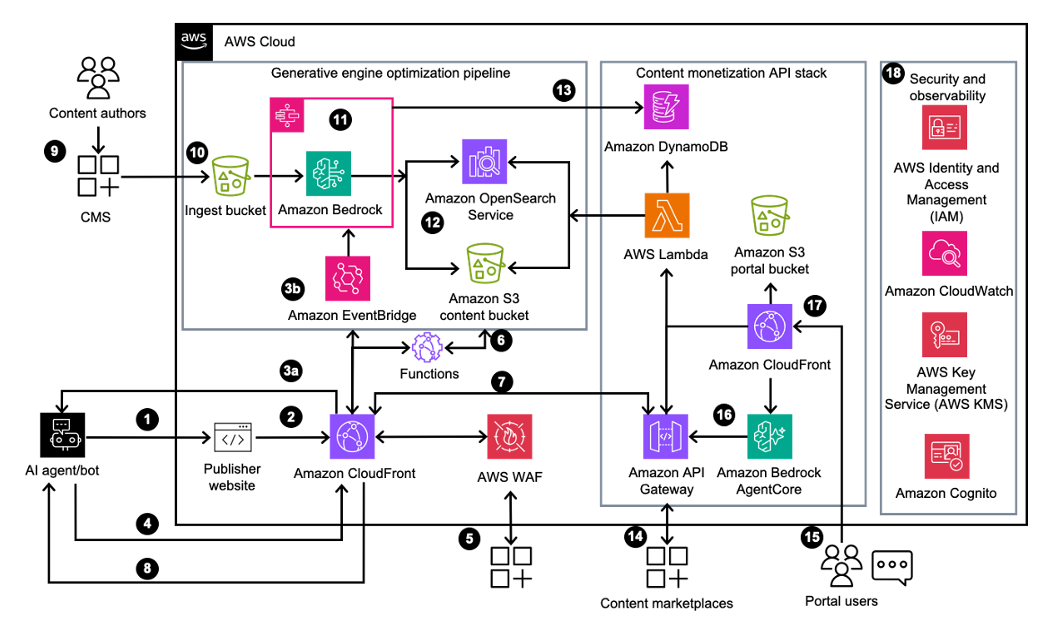
Figure 1: Reference architecture for AI content monetization on AWS
AI agent access and payment
These steps show what happens when an AI agent requests a monetized page, from bot identification through payment and settlement. The step numbers match the numbered labels in Figure 1.
- AI agent/bot accesses publisher’s HTML page through the publisher’s website URL.
- Request passes through Amazon CloudFront, the content delivery network (CDN), as the entry point.
- AWS WAF identifies the bot from its crawler catalog (over 650 AI bots and agents), applies monetization rules, and returns an HTTP 402 response with the price and the payment credential types it accepts (x402 with USDC). RSL terms stay discoverable through robots.txt and Amazon CloudFront headers.
- Amazon EventBridge triggers the GEO pipeline asynchronously for URLs that haven’t been pre-processed, meaning AI-optimized content is prepared on demand.
- The agent signs a payment authorization using its wallet and resubmits the same request with a payment-signature header.
- AWS WAF verifies the payment, then settlement is completed on-chain through the x402 facilitator (for example, Coinbase Developer Platform). Funds settle to the publisher’s USDC wallet or as fiat in the publisher’s Stripe balance, and Amazon CloudFront serves the content.
AI-optimized content delivery
After payment, Amazon CloudFront serves the agent a lightweight, AI-optimized version of the page instead of the full HTML.
- Amazon CloudFront Functions rewrites the URL to point to the corresponding AI-optimized markdown (.md) version of the page.
- When a URL rewrite isn’t viable, Amazon API Gateway receives the request and invokes an AWS Lambda function. The function retrieves the URL mapping from Amazon DynamoDB to locate the corresponding AI-optimized markdown (.md) file in the Amazon Simple Storage Service (Amazon S3) content bucket.
- The response chain serves structured, GEO-optimized content (FAQ schema, answer capsules, clean metadata) back to the agent.
Content preparation pipeline
In the background, a pipeline turns each published page into AI-optimized content and metadata to ready it before an agent asks for it.
- Content authors publish through their content management system (CMS).
- Content lands in an Amazon S3 ingest bucket using HTTPS/TLS upload, triggering the GEO pipeline.
- AWS Step Functions and Amazon Bedrock process each page, including classifying with IAB taxonomy, extracting entities, generating embeddings, and restructuring into AI-optimized markdown format.
- Amazon OpenSearch Service indexes the embeddings for discovery and search. This embedding vector store supports other internal search use cases such as article research. The pipeline writes the optimized .md output to the Amazon S3 Content bucket. In a multi-brand publisher scenario, this delivers the unified content monetization data store.
- The pipeline registers the URL mapping (HTML path to .md path) in Amazon DynamoDB, which the content delivery lookup uses.
Multi-marketplace distribution
The same prepared content can reach buyers beyond your own site through standards-based marketplace APIs.
- The marketplace-agnostic content API hosted on Amazon API Gateway follows the CoMP object model and delivers the content, its metadata, and its licensing terms to external content marketplaces so Publishers can unify and monetize multi-brand content. Amazon API Gateway manages the API keys for content buyers.
Publisher portal
Your business and technical teams manage the stack from a single internal portal.
- With a React-based internal web portal, users can view pipelines, search content, test access paths, analyze monetization data, maintain RSL licenses and other business and technical management functions.
- Amazon Bedrock AgentCore powers AI-assisted UI features so users can interact with the functions and get insights related to content monetization.
- Amazon S3 and Amazon CloudFront host the internal web portal, with Amazon Cognito handling user authentication
Security and observability
Security and monitoring services run across every layer of the architecture.
- AWS Identity and Access Management (AWS IAM), Amazon CloudWatch, and AWS Key Management Service (AWS KMS) provide security, monitoring (AI traffic and revenue metrics, pipeline health, API usage), and encryption.
Next steps
To get started, activate the Observe and Monetize features on your existing Amazon CloudFront distribution. You can gain visibility into AI bot traffic and begin earning from content access within minutes. To receive payouts in fiat, connect your Stripe account to AWS WAF through Stripe Connect in the AWS WAF console.
As a near-term investment, define RSL licensing terms and configure them using Amazon CloudFront Response Header Policies. Deploy a GEO enrichment pipeline to classify the content catalog and restructure it for AI consumption. Register content in a CoMP discovery endpoint so AI marketplaces can find it.
Strategically, expand to multiple AI marketplaces, including AWS Marketplace Data as a Service, and optimize pricing based on Measure insights. Use your classification data for contextual advertising yield through the same IAB taxonomy that powers your marketplace listing.
Leading publishers are already on this path: People Inc. moved from letting partners crawl its sites to delivering content through Amazon S3 to building custom APIs that give AI agents article text in Markdown along with authorship and publication dates. Time Magazine and Forbes are also creating Markdown versions of their content for agents.
To start building, visit Guidance for Monetizing Publisher Content for AI Agents on AWS. The guidance packages the patterns in this post, including edge monetization, AI-optimized content, and a marketplace-ready content API, into a working reference architecture so you don’t have to build from scratch. You can deploy the sample code from the GitHub repository and adapt it to your content catalog and pricing. To plan your rollout, contact your AWS account team.