AWS Public Sector Blog
How UTHealth Houston built HIPAA-compliant generative AI at scale: iDFax’s 2-year journey with Amazon Bedrock
Every day, clinical staff at UTHealth Houston spent up to 2.5 minutes on a single medical fax, reviewing, categorizing, routing, and manually entering data into their electronic health record (EHR) system. Multiply that by hundreds of thousands of faxes a year, and the toll on staff time and patient care becomes impossible to ignore. In June 2023, UTHealth Houston set out to change that.
This post is a follow-up to our March 2025 blog post, UTHealth Houston’s iDFax transforms medical fax management with Amazon Bedrock, which introduced the iDFax pilot and its early results. Here, we document the full 2-year journey from that initial deployment to enterprise-scale production—and the lessons learned along the way.
What began as a pilot program has evolved into a compelling example of how generative AI can transform medical document processing at enterprise scale while maintaining strict Health Insurance Portability and Accountability Act (HIPAA) compliance.
UTHealth Houston is a leading academic medical center comprising seven schools and two hospitals. It’s home to two organizations at the forefront of digital healthcare innovation. The McWilliams School of Biomedical Informatics is one of the largest biomedical and health informatics programs globally, with an entire department focused on AI and data science. The Center for Digital Healthcare Innovation drives the development and implementation of clinical technologies to enhance patient care, education, and research across the institution.
The transformative journey from pilot to production
In June 2023, UTHealth Houston launched iDFax, a solution powered by Amazon Bedrock, a fully managed service for building and scaling generative AI applications with foundation models (FMs), designed to transform medical fax management. What started as a pilot processing 2,800 faxes monthly has scaled to an enterprise deployment handling over 100,000 faxes monthly by February 2026, representing an approximately 3,500% increase in processing volume over 32 months.
The numbers tell a compelling story of successful AI adoption at scale:
- More than 1.2 million faxes processed annually at full deployment across UT Physicians clinics
- Over 1,200 registered users, including doctors and clinic staff, across more than 100 clinics
- More than $2 million in annual cost savings through processing time reductions and workflow automation
- More than 95% optical character recognition (OCR) accuracy maintained consistently throughout the scaling process
- 50–70% reduction in processing times, from 82–150 seconds per fax to only 28–68 seconds
Manual processing at scale
Before iDFax, UTHealth Houston’s legacy fax-based communication workflow consumed 82–150 seconds of staff time per fax. Healthcare staff manually reviewed, categorized, routed, and entered data into the Epic EHR system, creating costly bottlenecks that delayed patient care. With hundreds of thousands of medical faxes flowing through the system annually, this manual approach was unsustainable.
UTHealth faced a clear challenge. They needed to build an intelligent, HIPAA-compliant automation system that could dramatically reduce processing time and costs while scaling to handle over one million faxes annually across a complex academic medical center environment.
Why Amazon Bedrock and AWS?
UTHealth Houston chose Amazon Web Services (AWS) because Amazon Bedrock provided highly accurate, cost-effective document classification without requiring custom machine learning (ML) infrastructure. Several key factors drove the decision:
- HIPAA-compliant AI at scale – Amazon Bedrock offers HIPAA-eligible services with built-in security guardrails. This meant the team could build a compliant AI solution from day one. The secure landing zone environment provides comprehensive security guardrails and centralized observability to help meet strict healthcare compliance requirements.
- EHR integration – AWS services enabled direct integration with UTHealth Houston’s Epic EHR system through AWS Direct Connect, allowing automatic extraction of physician and patient data for identity retrieval and record assignment, eliminating manual data entry that previously consumed 2–3 minutes per fax.
- Elastic scalability – The comprehensive AWS managed services offerings, including Amazon Simple Storage Service (Amazon S3), Amazon Elastic Compute Cloud (Amazon EC2), Amazon Simple Queue Service (Amazon SQS), and Amazon DynamoDB, provided the elastic scalability needed to grow from 2,800 faxes monthly to over 100,000 faxes monthly without performance degradation.
- Rapid deployment – The managed services approach reduced operational overhead while enabling rapid deployment, which meant the team could move from pilot to production scale in under 2 years.
High-level architecture
The iDFax architecture uses a sophisticated eight-step processing pipeline that orchestrates multiple AWS services:
1. Ingestion – iDFax uploads inbound electronic fax data to AWS at near real-time speed over AWS Direct Connect links to an Amazon Simple Storage Service (Amazon S3) bucket in a secure AWS account.
2. Queueing – Amazon Simple Queue Service (Amazon SQS) queues the data for reliable, ordered processing.
3. Processing – The team packages iDFax applications as Docker containers running on Amazon Elastic Compute Cloud (Amazon EC2) instances, which process faxes from the queue.
4. Metadata management – The system stores and tracks processing metadata in Amazon DynamoDB tables.
5. EHR integration – Automatic extraction of physician and patient data enables direct Epic integration.
6. AI classification – Amazon Bedrock FMs handle classification tasks and generative AI–driven analysis for intelligent document processing (IDP).
7. Referral automation – The system uses automated order transcription to improve accuracy and accelerate the referral process in Epic.
8. Storage and routing – iDFax routes results to integrated systems like Epic or stores them in the AWS environment for data retention and retrieval.
The following diagram shows the solution architecture.
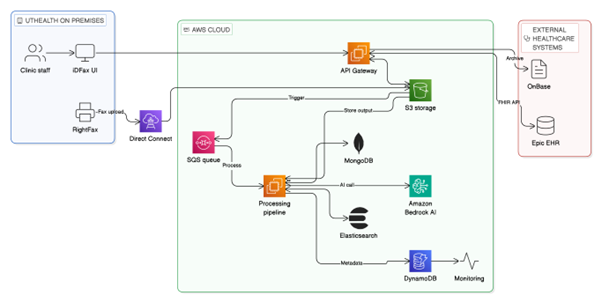
Figure 1: iDFax solution architecture
iDFax key features and benefits
iDFax reduces fax processing times by 50–70%, from the legacy system’s 82–150 seconds per fax to only 28–68 seconds. At current processing volumes exceeding 100,000 faxes monthly, this time savings means that clinical staff can redirect approximately 19,000 staff hours annually from administrative tasks to direct patient care. This is the equivalent of roughly 57,000 patient appointments at 20 minutes each.
The system maintains over 95% OCR accuracy through advanced image correction and handwriting recognition capabilities, exceeding industry benchmarks for AI-assisted document processing.
The solution automates key processes such as document categorization, splitting, and de-duplication, improving document organization quality while reducing processing errors.
iDFax connects fax content to patient records through automatic extraction of physician and patient data for identity retrieval and record assignment with Epic. This integration eliminates the manual data entry that previously consumed 2–3 minutes per fax.
A dynamic monitoring dashboard provides users with actionable insights into system usage, document types processed, and overall operational efficiency.
The team built iDFax using HIPAA-eligible AWS services throughout its entire architecture, maintaining the highest standards of protected health information (PHI) security.
The following bar graph the dramatic increase over time in processing metrics for faxed data.
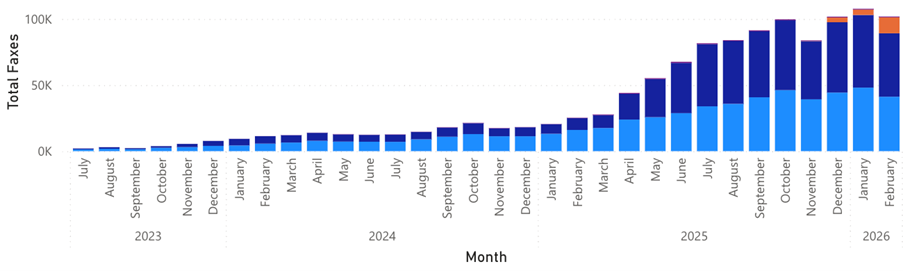
Figure 2: Faxed data processing metrics
Phased deployment strategy
The success of iDFax demonstrates the value of a methodical, phased deployment approach.
Phase 1: Pilot implementation (June–December 2023)
- Initial deployment to selected sites within UTHealth Houston
- Processed over 220,000 faxes during the pilot phase
- Monthly volumes grew from 2,800 to 7,800 faxes
- Validated system capabilities and established performance baselines
Phase 2: Systematic expansion (January–December 2024)
- Primary scaling period with monthly volumes growing from 9,100–23,400 faxes
- Systematic rollout to additional UT Physicians clinics and departments
- Processed 253,920 faxes total during 2024
- Established a scalable operational foundation, including cloud deployment to support enterprise growth and reliability
Phase 3: Production deployment (January–December 2025)
- Full-scale deployment across UT Physicians clinics
- Monthly processing volumes reaching more than 100,000 faxes
- Serving over 1,200 active users across more than 100 clinic locations
- On track to process more than one million faxes annually
Phase 4: Optimization and enhancement (January 2026–present)
- Transition from deployment to continuous improvement and workflow optimization
- Implementation of the Transcribe Order feature, enabling faster referral processing with significantly reduced manual entry
- Driving efficiency through continuous optimization and automation
Financial impact and ROI
The financial returns have exceeded initial projections, with the system delivering more than $2 million in annual cost savings.
The 68-second average time savings per fax across one million annual faxes represents approximately $908,000 annually in labor cost savings alone, calculated at healthcare administrative labor costs of $48.05 per hour.
Conservative return on investment (ROI) analysis indicates net annual returns of more than 220%—calculated by comparing total annual cost savings against implementation and operational costs—with payback periods of approximately 3–4 months.
The financial impact spans multiple categories including labor efficiency, operational overhead elimination, error reduction, and compliance risk mitigation, creating a strong financial case for strategic healthcare AI investment.
Clinical impact and workflow transformation
Beyond the metrics, iDFax has fundamentally transformed clinical workflows at UTHealth Houston. Healthcare providers report increased confidence in document processing accuracy and reduced administrative burden, allowing better focus on patient care.
The system’s near real-time processing capability delivers critical clinical information to providers quickly, supporting timely clinical decision-making and reducing delays in patient care. The automated document categorization and routing capabilities have improved document organization quality while reducing processing errors.
At current processing volumes, the time savings allow clinical staff to redirect substantial hours from administrative tasks to direct patient care—a transformation that directly impacts the quality of healthcare delivery across UTHealth Houston’s extensive network.
Technical leadership and innovation
The implementation reflects sophisticated technical leadership and collaborative execution. Led by the McWilliams School of Biomedical Informatics and the Center for Digital Healthcare Innovation, with technical leadership and major development contributions from Dr. Omer Anjum, the project brought together clinical informatics expertise, digital healthcare innovation capabilities, and AWS technical support. Krystal Goff, serving as project manager, drove cross-functional alignment across infrastructure, cloud, development, customer, and leadership teams to support successful execution.
The system operates within UTHealth Houston’s AI governance framework, led by Dr. Xiaoqian Jiang as associate vice president for medical AI and chair of the Department of Health Data Science and Artificial Intelligence. This leadership structure helps align iDFax’s evolution with institutional strategic priorities and emerging AI capabilities.
Lessons learned and best practices
The 2-year journey from pilot to production has yielded valuable insights for healthcare organizations considering similar AI implementations:
1. Start with clinical leadership – Projects succeed when clinicians who understand workflow challenges lead them and champion adoption.
2. Design for compliance from day one – Building HIPAA-compliant architecture from project inception prevents costly retrofitting.
3. Prioritize EHR integration – Direct integration with existing systems is critical for user adoption and workflow efficiency.
4. Deploy in phases – Phased implementation enables risk mitigation while demonstrating value incrementally.
5. Measure rigorously – Clear performance metrics and baseline measurements facilitate organizational buy-in and demonstrate ROI.
6. Invest in change management – Comprehensive training programs and ongoing support infrastructure are essential for sustained user adoption.
7. Listen early and often – Continuous user feedback helps solutions align with real workflows, builds trust, and drives stronger adoption.
Looking forward
The success of iDFax provides a foundation for UTHealth Houston’s broader digital transformation strategy. The system’s proven capabilities in document processing and workflow automation create a platform for expanding AI initiatives across the organization, including the recently launched Transcribe Order feature, which enables faster referral processing with significantly reduced manual entry.
The robust, scalable architecture also positions iDFax to address similar document management challenges in other highly regulated industries. Sectors such as insurance, legal, and mortgage frequently contend with high volumes of sensitive fax communications and stringent compliance requirements. iDFax’s success in healthcare demonstrates its potential to streamline operations, strengthen security, and reduce costs for organizations across these fields.
Conclusion
UTHealth Houston’s iDFax implementation demonstrates that healthcare organizations can achieve transformative AI adoption at enterprise scale while maintaining strict HIPAA compliance and delivering strong financial returns. The journey from 2,800 faxes monthly in a pilot program to processing over 1 million faxes annually represents more than technological success—it’s a blueprint for healthcare AI transformation.
By using Amazon Bedrock foundation models and AWS comprehensive cloud services, UTHealth Houston built a solution that improves productivity, reduces costs, and improves care delivery. Processing over 1 million faxes annually while generating more than $2 million in cost savings and maintaining more than 95% accuracy provides a replicable model for healthcare organizations seeking AI-powered document management solutions.
The 2-year production journey demonstrates that with proper planning, technical architecture, clinical leadership, and organizational support, healthcare AI can deliver both immediate operational improvements and long-term strategic value. As healthcare continues its digital transformation, iDFax stands as a benchmark implementation for HIPAA-compliant generative AI at scale.
To learn how AWS can help your organization modernize document workflows with generative AI, contact your AWS representative or visit Amazon Bedrock product page to explore HIPAA-eligible AI solutions for regulated industries.
Further reading
- UTHealth Houston’s iDFax transforms medical fax management with Amazon Bedrock
- AWS for healthcare – Cloud solutions for healthcare and life sciences
- HIPAA Eligible Services – AWS services that are eligible to create, receive, process, maintain, or transmit electronic protected health information (ePHI)