AWS Partner Network (APN) Blog
Scaling agentic AI for governed banking operations with Apexon and AWS
By: Sandeep Singh, Vertical Head – BFSI – Apexon
By: Sanjoy Ghosh, Principal Architect & VP – BFSI – Apexon
By: Hamdy Eed, Sr. Partner Solutions Architect – AWS
By: Kripa Dixit, Sr. Partner Solutions Architect – AWS
 |
| Apexon |
 |
Banking, financial services, and insurance (BFSI) institutions need AI systems that can act autonomously, executing decisions across high-volume workflows at market speed. But autonomy without governance is a nonstarter in an industry defined by regulatory intensity and operational risk.
This post presents an architecture-first perspective on how BFSI organizations can operationalize agentic AI on Amazon Web Services (AWS) with governance built in from the start, not bolted on after deployment. Drawing on the deep BFSI engineering experience of Apexon and the AWS governance and orchestration stack, we outline a practical path from experimentation to enterprise-scale agentic operations.
Why architecture needs to come before autonomy
Generative AI has the potential to deliver $200 billion–$340 billion in new value to banks, according to a McKinsey report. In banking, generative AI has proven useful across customer service, analytics, and internal productivity. Yet most implementations remain bounded; a model produces an insight, and a human decides what happens next. At scale, that dependency becomes the gap between AI’s potential and its realized impact.
Agentic AI addresses this gap. These systems autonomously plan, act, and adapt within defined guardrails, pursuing business outcomes rather than waiting for the next prompt. In some cases, they operate through human decision-makers, in others through downstream systems and guardrails that keep actions bounded without human intervention.Before they adopt agentic capabilities, BFSI leaders must determine how to govern systems that act independently. Every autonomous action must be traceable, every decision boundary enforced, every escalation path auditable. This requires purpose-built cloud architecture for governed autonomy, separating decision-making from execution and enforcing policy at every layer.
AWS architecture for governed agentic AI in BFSI
A governed agentic system in BFSI is built on three architectural layers, each enforcing a different dimension of control.
Intelligence layer
The intelligence layer provides reasoning capabilities for planning, interpretation, and decision-making. Amazon Bedrock provides access to foundation models (FMs) suited for different banking tasks, including summarization, reasoning, and information extraction. Organizations can use Amazon Bedrock AgentCore to build and operate agents at scale with managed runtime environments and session isolation critical for BFSI workloads where agents handling different customers or transactions must be securely separated.
Amazon Bedrock Knowledge Bases ground agent outputs in enterprise data, regulatory documents, policy manuals, and customer records, so decisions are based on authoritative sources rather than model hallucinations. Amazon Bedrock Guardrails enforce policy controls around model behavior, filter sensitive information, and prevents compliance-violating outputs before they reach downstream systems. Agents improve over time by incorporating outcome data into their decision context through short-term and long-term memory, context graphs, and enriched retrieval grounding that reflects evolving business rules, improving accuracy without requiring model retraining.
Orchestration and execution layer
Agentic systems don’t operate in isolation. They coordinate workflows across core banking platforms, payment systems, and compliance engines. AWS Step Functions coordinates multistep agentic workflows with built-in error handling, retries, and human approval gates, essential for regulated processes like credit decisioning or Know Your Customer (KYC) escalation. Amazon EventBridge routes events across banking systems in near real time, triggering agent actions when exceptions or thresholds are met.
AWS Lambda and Amazon API Gateway provide serverless execution with precisely scoped permissions that restrict each agent’s actions to authorized systems and data. Amazon Bedrock AgentCore Observability provides visibility into agent execution, so teams can trace reasoning paths and monitor production performance across complex multi-agent workflows.
Governance, security, and audit layers
Governance is the layer that makes autonomy viable in regulated industries. Amazon Bedrock AgentCore Identity provides verifiable agent identities and credential management for enterprise system interactions; each agent has a distinct, auditable identity, just as human operators do. Policy in Amazon Bedrock AgentCore enforces action-level controls, evaluating agent-tool interactions against defined policies before execution. AWS Identity and Access Management (IAM) manages fine-grained access control, which restricts agents’ access to authorized resources.
AWS CloudTrail creates an immutable audit trail of every agent’s action, which supports regulatory examinations and internal audit. AWS Security Hub and AWS Config continually monitor security posture and configuration compliance, flagging drift or violations in near real time. Well-designed agentic systems operate with clear decision boundaries, escalation rules, and audit trails. Every action is traceable, every outcome reviewable. Human oversight is embedded where risk thresholds demand it, which aligns naturally with BFSI regulatory expectations and the AWS Shared Responsibility Model.
The following diagram illustrates this layered capability model.
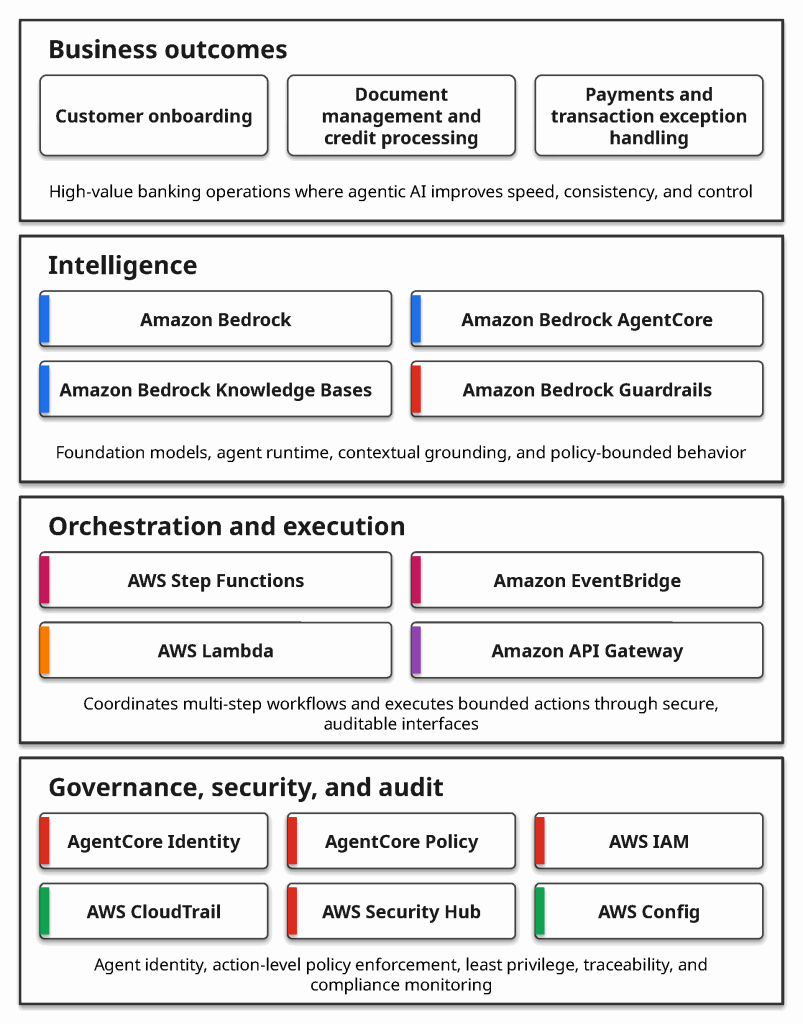
Figure 1: Key AWS layers for governed agentic AI in BFSI
Governed agentic patterns in BFSI operations
Across large BFSI institutions, governed agentic patterns emerge across core workflows. In each case, the AWS architecture layers work together to enable autonomy while preserving control.
In customer onboarding, agents coordinate identity verification, risk assessment, and compliance checks across multiple platforms. Straightforward cases progress autonomously with built-in verification against authoritative data sources, whereas complex scenarios escalate with full context and audit trails. One banking client reduced onboarding cycle time by 48 percent for institutional clients while maintaining compliance pass rates. This freed relationship managers to focus on higher-value advisory activities. To learn more, read the Apexon whitepaper.
For document management and credit processing in lending and trade finance, agents classify documents, validate completeness, extract key data, and trigger downstream processing. An agent reviewing a letter of credit validates against Uniform Customs and Practice (UCP) 600 rules and triggers payment instructions within scoped execution boundaries enforced by AWS Lambda and Policy in AgentCore. Discrepancies that exceed risk thresholds escalate with full reasoning captured in CloudTrail. One banking client achieved a 50 percent reduction in manual effort and 95 percent document classification accuracy. You can read about it in the Apexon case study.
For payments and transaction exception handling, AWS EventBridge routes payment events to agents that identify root causes, initiate corrections, and coordinate with downstream systems. Amazon Bedrock AgentCore Observability gives operations teams visibility into how agents resolve exceptions. For one of the top five global payments operators, Apexon integrated a real-time payments platform that reduced processing time by over 50 percent while supporting threefold transaction growth, demonstrating how agentic patterns can scale without compromising controls.
Where Apexon fits in the agentic AI journey
Agentic AI is an engineering challenge, not a model deployment exercise. As an AWS Advanced Tier Services Partner, Apexon brings an engineering-first perspective to agentic AI adoption. We help BFSI organizations design and operationalize agentic systems that deliver measurable business outcomes while maintaining trust. This includes building the data foundations agents depend on, engineering workflows that integrate across platforms and embedding governance mechanisms that help achieve transparency and control. It also includes validating systems through rigorous quality engineering so that autonomy strengthens resilience rather than introducing unintended risk.
Together, Apexon and AWS give BFSI organizations the tools they need to move beyond isolated AI use cases and toward enterprise-grade agentic operations that are practical, scalable, and regulatory-ready.
What BFSI leaders should do next
Agentic AI is a logical extension of generative AI. BFSI leaders should identify processes where decision latency creates operational risk or customer friction. Assess data readiness and integration complexity. Engage partners who understand both BFSI realities and cloud-scale engineering and start small but design for scale. Pilot agentic workflows with clear success metrics and governance, then expand with confidence.
We encourage you to explore the Apexon AI solutions in AWS Marketplace or AWS offerings on the Apexon website.
Closing perspective
The real question for enterprises is how to move from AI that informs to AI that acts without compromising trust, compliance, or control. Agentic AI provides that path. When engineered responsibly and deployed on a secure, scalable cloud foundation such as AWS, organizations can operate with autonomy that matches the speed and complexity of today’s financial services operations.
Apexon brings the combination of capabilities this transition requires. As a digitally native engineering firm with deep BFSI experience across retail banking, lending, mortgage, and payments, Apexon understands the regulatory constraints, legacy system realities, and risk thresholds that define the sector. Governance is part of the design, not added after deployment.
For financial institutions ready to move beyond the ceiling of rules-based automation, Apexon delivers the engineering depth to build AI that acts and the domain experience to help verify it does so responsibly.

Apexon – AWS Partner spotlight
Apexon is an AI-first technology services firm that engineers intelligent enterprises across three interconnected disciplines: domain and strategy, cognitive architecture, and harness engineering. As an AWS Advanced Tier Services Partner, Apexon helps BFSI and other regulated organizations build the data foundations agents depend on, engineer workflows that integrate across enterprise platforms, and embed governance for transparency and control. It designs and operationalizes production-grade agentic AI on AWS across the intelligence, orchestration, and governance layers, validated through rigorous quality engineering so autonomy strengthens resilience rather than introducing risk.