AWS Partner Network (APN) Blog
Accelerate vendor evaluation with AWS Specializations and AWS Marketplace
By: Soonam Kurian, Global Tech Leader, AWS Specializations – AWS
By: Kelly Costlow, Global Program Manager, AWS Specializations – AWS
AWS Specializations and AWS Marketplace Vendor Insights make your vendor evaluation more efficient by surfacing pre-validated technical capabilities and transparent, up-to-date security postures, allowing faster, more confident vendor selection decisions aligned to your unique requirements.
Traditional vendor assessment takes 8–12 weeks across procurement, security, and technical teams. You spend 6 weeks—50% of evaluation time—researching partners. Your teams manually collect compliance documentation, assess architectures, and validate controls. Retail, healthcare, and financial services organizations face additional challenges verifying solutions meet security standards and industry frameworks such as Payment Card Industry Data Security Standard (PCI DSS), Health Insurance Portability and Accountability Act (HIPAA), or AWS System and Organization Controls (SOC) 2.
A multilayered validation framework addresses these challenges through objective, standardized assessments. In this post, you’ll learn how two complementary mechanisms, AWS Specializations and AWS Marketplace Vendor Insights, can help you perform vendor evaluation due diligence more efficiently.
AWS Specializations: Finding the right partner
Identifying AWS Partners with specialized expertise for your specific business use cases is a significant challenge. AWS Specializations helps you identify partner solutions vetted through objective, Amazon Web Services (AWS) defined technical validations across more than 115 solution areas spanning industries, use cases, workloads, and AWS services. This helps you focus your evaluation on partners who have already met rigorous, standardized criteria. A total of 87% of AWS customers rank AWS Specializations as a top three selection criterion, and 96% expect partner directory listings to have undergone validation (AWS Customer Survey, 2024, n=556).
When a partner holds an AWS Specialization, it means they have passed objective technical validations AWS defines for that specific domain, provided examples of successful customer engagements, and demonstrated a solution validated by AWS. To earn and maintain a Specialization, partners must also sustain a strong team of trained and certified technical individuals. Partners undergo rigorous assessment across organizational practices, solution architecture, customer success demonstration, and domain-specific requirements. For example, the AWS Retail Competency evaluates retail-specific use cases such as personalization engines, and the AWS Data and Analytics Competency assesses data lake architectures, real-time processing capabilities, and analytics optimization.
AWS prioritizes the following aspects when evaluating partner capabilities:
- Architecture excellence – Assess multi-AZ deployment, scalability mechanisms, disaster recovery strategies, and native AWS service integration patterns. Validate solutions against the AWS Well-Architected Framework, examining AWS service leverage, integration patterns, deployment automation, monitoring capabilities, and issue response procedures.
- Security and compliance – Verify that solutions meet industry standards and implement encryption, access controls, and issue management practices. Assess IAM policies, encryption implementations, network segmentation, and monitoring capabilities against compliance frameworks.
- Proven customer success – Demonstrate production deployments with quantifiable business outcomes. Qualify partner solutions through customer case studies demonstrating real-world effectiveness, including architecture diagrams, AWS services utilized, and measurable outcomes.
- Domain expertise – Evaluate domain-specific expertise for AWS Specializations through Validation Checklists (VCLs), tailored assessment frameworks unique to each Specialization area. VCLs define specific technical criteria, solution requirements, and best practices that partners must demonstrate for their target domain.
AWS imposes a rigorous Specialization validation process that verifies partners meet proven technical standards and customer success criteria, giving you a strong, objective foundation to build on. The due diligence required to identify the right partner for your specific workloads and business outcomes depends on your unique requirements.
Your benefits
Being able to use AWS Specializations to identify AWS Partners with the right expertise for your specific business use cases offers several advantages:
- Efficient partner discovery – You identify partners with AWS validated technical expertise across specific domains, focusing your evaluation on prequalified candidates rather than starting from scratch.
- Objective validation baseline – You use the AWS standardized assessment work as a credible starting point, directing your team’s effort toward evaluating fit for your specific requirements.
- Targeted partner discovery – You quickly locate partners with proven domain expertise that directly aligns with your specific business requirements.
These benefits accelerate procurement cycles. AWS Specialization criteria give you a reliable signal of partner capability, freeing your teams to focus evaluation time on what matters most: fit for your unique workloads, scale, and business context.
The following graphic illustrates the evaluation aspects and customer benefits of using AWS Specializations to find the right partner.
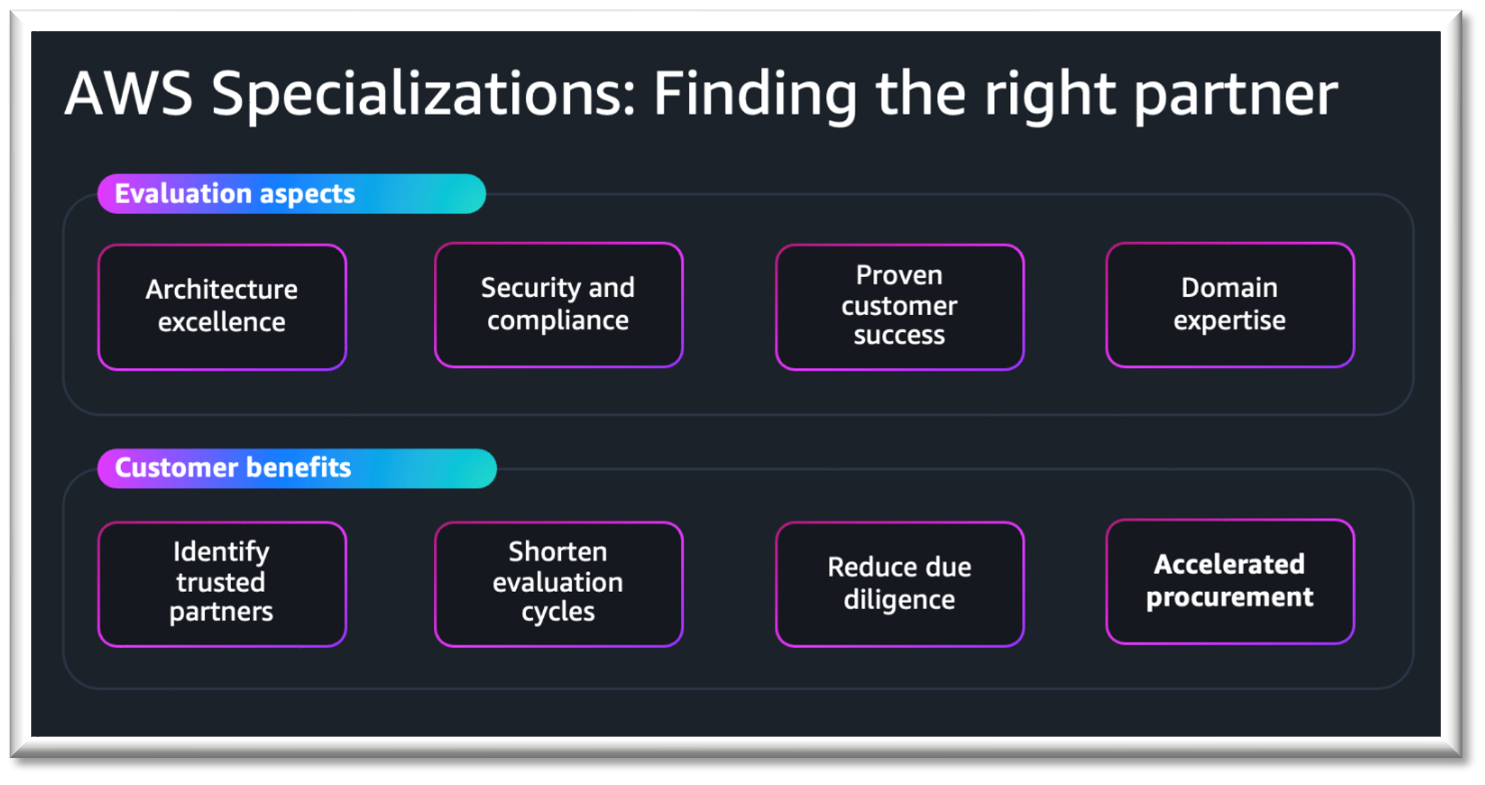
Figure 1: AWS Specializations: Finding the right partner
AWS Marketplace Vendor Insights: Security transparency
AWS Marketplace is a curated digital catalog where you find, buy, deploy, and manage third-party software, data, and services that that you need to build solutions and run your businesses.
AWS Marketplace Vendor Insights streamlines software risk assessments to support your procurement process and help verify solutions meet your standards. After you discover products addressing specific business requirements, identify products with available Vendor Insights by filtering results under Refine results and choosing Security profiles. Then access detailed security information from the Vendor Insights section on the product details page. You can use Vendor Insights to monitor product security profiles in near real time from a single console, reducing IT security approval time from months to hours.
Vendor Insights compiles security and compliance information from three complementary sources:
- Industry standard audit reports – ISO 27001, AWS System and Organization Controls (SOC) 2 Type II, Payment Card Industry Data Security Standard (PCI DSS), and other compliance certifications provide third-party validated evidence of security controls and compliance adherence.
- Self-assessment and Consensus Assessment Initiative Questionnaire (CAIQ) – Seller-reported security practices and controls.
- AWS Audit Manager – Automated evidence collection from seller production environments using AWS Config rules provides continuous, real-time security posture monitoring.
This multilayered approach provides continually updated security postures rather than static, point-in-time assessments, giving your security teams the current, structured information they need to complete assessments efficiently.
Your benefits
The up-to-date information provided by Vendor Insights offers you these benefits:
- Rapid assessments – Complete software risk assessments in hours instead of weeks.
- Continuous monitoring – Track post-procurement security controls with automated notifications for compliance certificate expirations and data residency changes.
- Centralized visibility – View a single dashboard across your AWS Marketplace software purchases.
Real-world application
A multinational retailer with more than 500 stores across North America seeks a customer data platform (CDP) to consolidate customer interactions across ecommerce, mobile apps, point-of-sale systems, and loyalty programs. The retailer faces regulatory requirements that include PCI DSS Level 1 for payment data.
Evaluation process
Agent mode combines the AWS Marketplace product catalog with specialized knowledge from trusted third parties through a conversational interface purpose-built for software procurement. The retailer uses agent mode’s conversational interface to describe CDP requirements in natural language or upload requirement documents, receiving instant product recommendations. The retailer then selects from preset tasks, such as comparing specific products. The product comparison feature creates summaries of overall fit for each of the top three product recommendations based on customer reviews, features, and AWS integration capabilities. The following screenshot shows the product comparison screen agent mode.
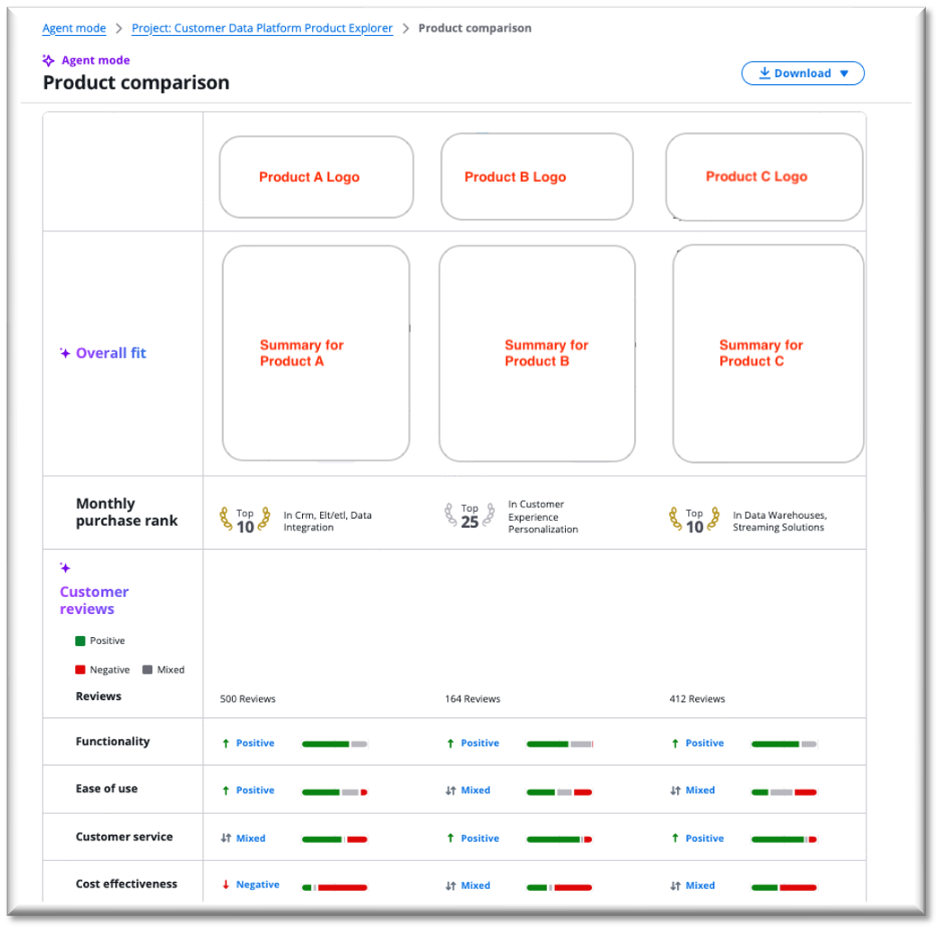 Figure 2: Agent mode for AWS Marketplace product discovery
After the retailer identifies promising CDP candidates, they access Vendor Insights directly from product detail pages to monitor security profiles and compliance artifacts in near real time from a single console. The Overview tab shows the product’s security certifications. The retailer requests subscription to Vendor Insights to view the detailed security profile, including data security, access management, and business resiliency.
The following screenshot shows a partner overview in Vendor Insights.
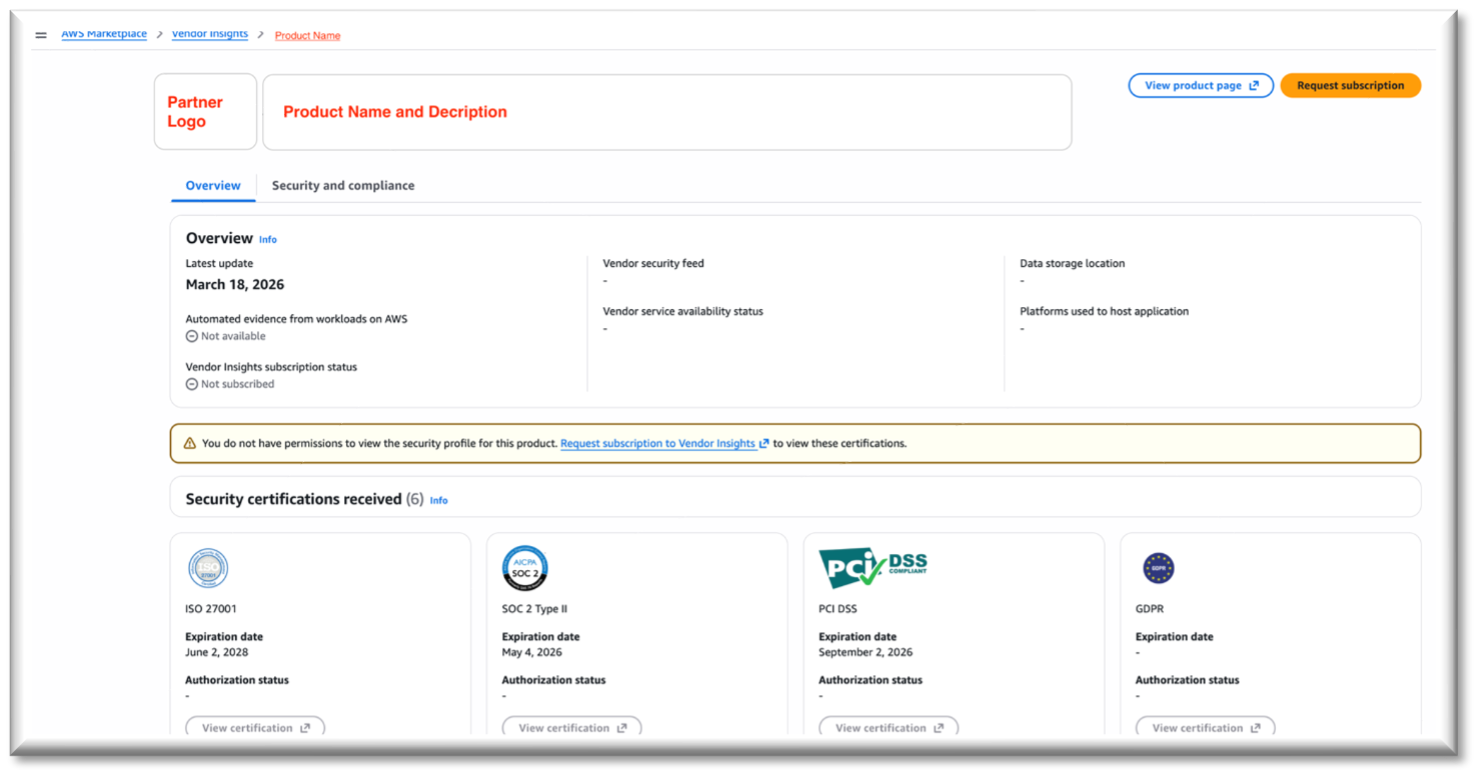 Figure 3: AWS Marketplace Vendor Insights overview
The retailer uses AWS Partner Solutions Finder to evaluate partners’ technical capabilities through the AWS Specializations they hold. The partner profile highlights AWS Specializations such as Competencies and Service Validations the partner attained, AWS Partner programs they participate in, and validated solutions and customer case studies.
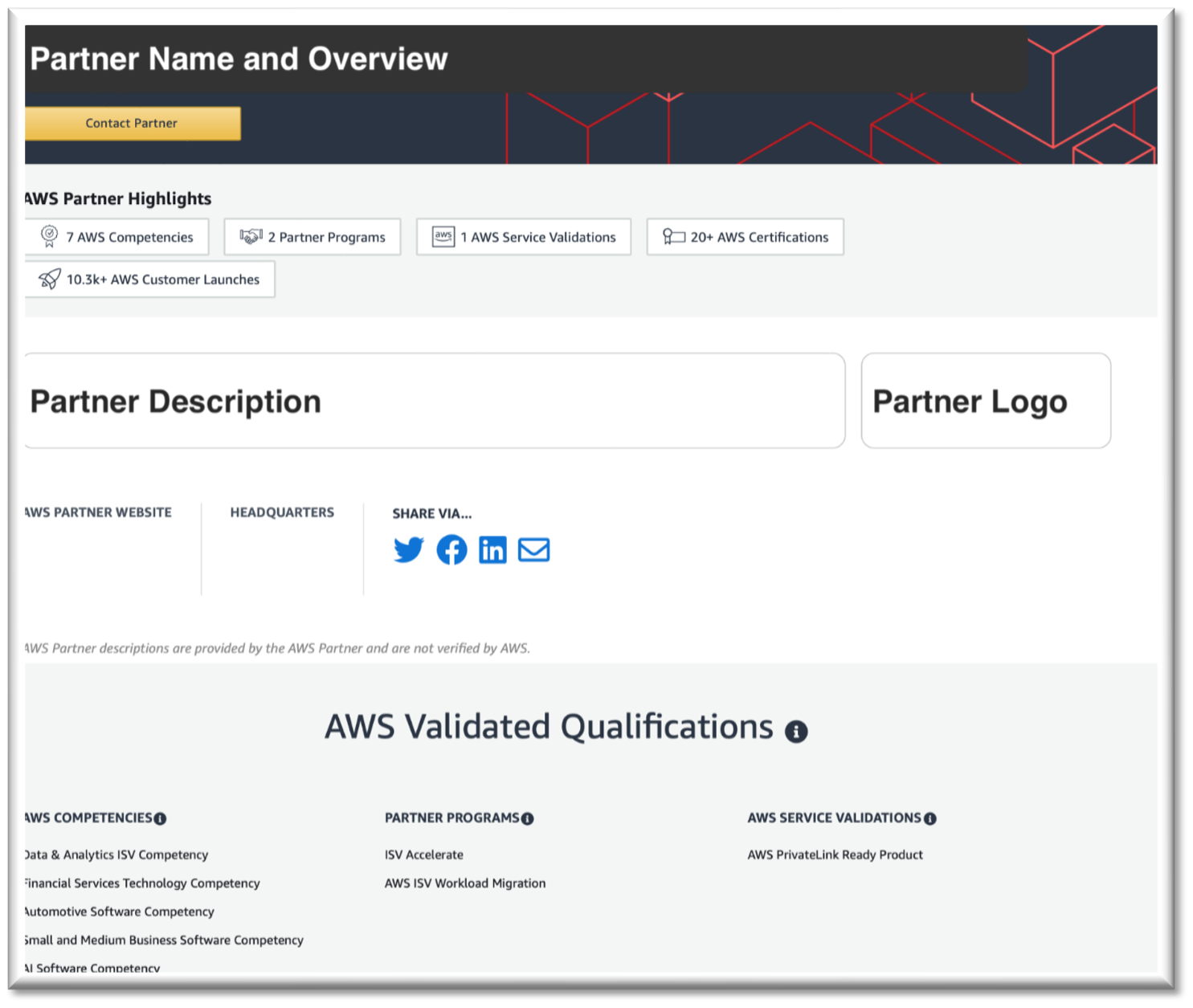 Figure 4: AWS Partner Solution Finder
For example, a retailer uses a combination of Vendor Insights and Partner Solution Finder to identify three vendors that we’ll call Vendor A, Vendor B, and Vendor C.
Vendor A holds AWS Retail and AWS Data and Analytics Competencies. Vendor Insights shows SOC 2 Type II, ISO 27001, and PCI DSS Level 1 certifications current within 90 days. Solution resources available on AWS Marketplace demonstrate Amazon Kinesis for real-time ingestion, Amazon Simple Storage Service (Amazon S3) with encryption for data lake storage, Amazon Redshift for analytics, and AWS Lambda for event processing. Four retail customer case studies show implementations for companies with similar scale, including a national grocery chain achieving 360-degree customer view with 99.9% uptime.
Vendor B lists AWS Data and Analytics Competency but lacks retail-specific validation. Vendor Insights profile shows SOC 2 Type II, but PCI DSS certification expired 120 days prior. Customer case studies demonstrate financial services and healthcare expertise, but no retail implementations.
Vendor C displays AWS Retail Competency without AWS Data and Analytics Competency. Vendor Insights shows current compliance certifications, but solution documentation reveals limited real-time processing capability, relying primarily on batch ETL processes.
The AWS Marketplace agent also generates purchase proposals with insights gathered throughout the discovery process, supporting you to confidently engage pre-vetted solutions without investing time and resources in redundant technical evaluations.
The retailer selects Vendor A based on dual Specialization alignment, current compliance posture, proven retail success, and technical architecture fit. Complementary vendor evaluation mechanisms from AWS reduced selection time from 10 weeks to 3 weeks (a 70% reduction).
How the framework works together
The integrated validation framework combines rigorous partner validation through Specializations, AI-powered discovery through AWS Marketplace agent mode, and continuous security monitoring through Vendor Insights. Together, these mechanisms streamline weeks of manual vendor research into an efficient evaluation workflow, giving your teams objective, structured inputs so you can focus evaluation effort on assessing fit for your unique requirements. The evaluation workflow consists of these steps:
- Identify your vendor selection need.
- Define your evaluation criteria.
- Search AWS Marketplace.
- Perform evaluations:
a. Evaluate the partner profile.
b. Evaluate Vendor Insights. - Compare the vendors’ technical capabilities and security profiles.
- Make a decision. If the vendor meets your criteria, proceed to step 7. If the vendor doesn’t meet your criteria, return to step 3.
- Select the vendor that meets your requirements.
- Continue to monitor security risk profile of the selected vendor.
These steps are illustrated in the following graphic.
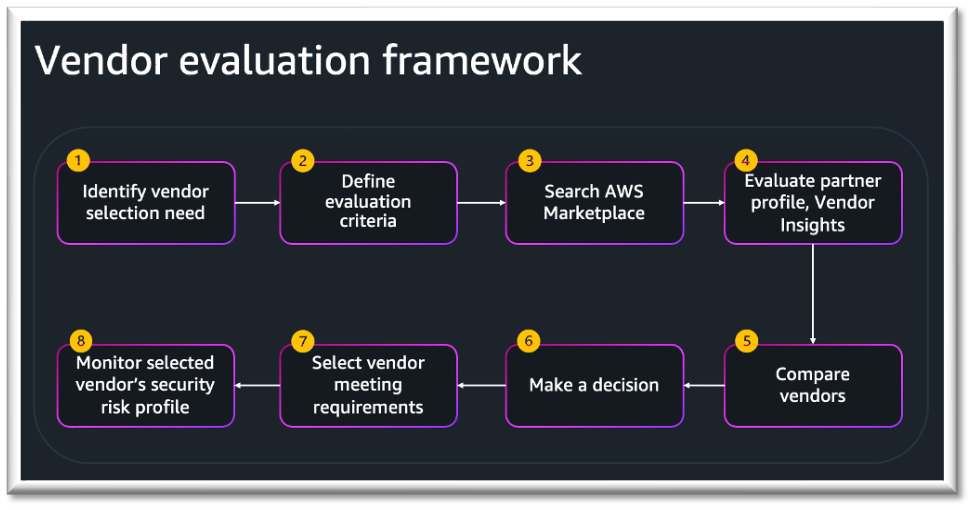 Figure 5: Vendor evaluation framework
Conclusion
AWS validates partners through rigorous assessment of specialized domain expertise, technical capabilities, and transparent security postures. AWS Specializations signal that a partner has passed objective, domain-specific technical validations defined by AWS, completed AWS verified customer engagements, and maintained a certified and trained technical team. Vendor Insights provides continuous security transparency through standardized dashboards and current compliance attestations.
These mechanisms make your vendor evaluation more efficient, surfacing credible, structured information faster so your teams can direct effort where it matters most: evaluating which partner best fits your specific workloads, requirements, and business context.
Use Vendor Insights to evaluate vendors and take advantage of these benefits:
- Accelerated evaluation cycles – AWS validated partner criteria and centralized security profiles reduce time spent on baseline research, which means your teams can focus on fit assessment.
- Increased confidence – Objective, AWS defined validation criteria provide a credible foundation; 87% of AWS customers actively use Specializations in selection processes.
- Accelerated procurement – Standardized information facilitates rapid comparison across multiple vendors.
- Maintained compliance – Continual monitoring maintains ongoing security posture visibility.
Get started today
Start by exploring AWS Marketplace agent mode to discover solutions for your business requirements through natural conversation. Then evaluate partners using AWS Specializations badging on AWS Partner Solution Finder and AWS Marketplace Vendor Insights security profiles to identify vendors meeting your technical and security requirements. Finally, filter specific specializations using AWS Partner Solution Finder to discover the right partners and their solutions by industries, use cases, AWS Partner Program participation, AWS service usage, and geographical presence.