AWS Public Sector Blog
How Singapore’s National Precision Medicine program runs population-scale SV discovery on AWS HealthOmics
Singapore’s National Precision Medicine (NPM) program in partnership with the SG100K consortium has sequenced more than 100,000 participants to generate a population-scale structural variant (SV) catalog using GATK-SV, the community-standard framework from the Broad Institute. The A*STAR-PRECISE Genome Innovation Team (GIT) at the A*STAR Genome Institute of Singapore (A*STAR GIS) ported and ran that pipeline on AWS HealthOmics at population scale, and the Broad Institute’s own GATK-SV team confirmed the results are functionally equivalent to the reference implementation. The resulting architecture and deployment code are published as open source, giving any team a reproducible blueprint for running community-standard population genomics workflows on AWS without redesigning the underlying science.
In this post, we explain the architecture, the work required to make the Workflow Description Language (WDL) implementation ready for AWS HealthOmics, and how we validated functional equivalence against the reference pipeline.
Why this matters for genomics
To date, understanding of SVs (large genetic alterations of at least 50 base pairs) has been derived largely from studies of predominantly European-ancestry populations. This limits understanding of SV diversity and its implications for biology and health in individuals of non-Caucasian ancestries, whose genomic variation can differ substantially. This is particularly important for Asian populations given the relatively limited availability of Asian genomic data in large SV resources.
Reliable SV discovery is also technically demanding. Because of the complexity and diversity of SVs, no single short-read caller captures every class equally well, so discovery depends on combining evidence from several callers at the single-sample level and across sample collections. Reproducibility becomes as important as throughput: when different groups use the same community-standard analytical framework, their SV resources are easier to compare and combine. For that reason, A*STAR-PRECISE GIT selected GATK-SV, developed by the Broad Institute and widely adopted by the genomics community, to generate Singapore NPM’s SV catalog.
The deployment challenge
GATK-SV was initially developed for Terra, a platform deployed on Google Cloud for biomedical data analysis, using the Cromwell workflow engine and the cross-engine-compatible WDL. In accordance with the program’s operational and data governance requirements, NPM’s genomics data and downstream analyses must be hosted and executed within Singapore for data sovereignty reasons. The availability of AWS HealthOmics in the AWS Asia Pacific (Singapore) Region turned this requirement into an advantage: the entire 17-stage pipeline ran in-region, meeting data-residency obligations without architectural compromise. This point is especially relevant for other programs in the Asia Pacific region under similar governance rules.
Even so, deploying GATK-SV to generate an SV catalog from more than 100,000 sequenced genomes involved more than porting the reference WDL workflow to a different execution engine. It required a secure, compliant cloud architecture encompassing data storage, access controls, compute infrastructure, networking, and workflow execution.
The design principle was to treat the Broad Institute’s published GATK-SV workflow as the source of scientific truth. We made only the changes required for execution, orchestration, storage, security, and monitoring on AWS. We did not change the caller parameters, filtering thresholds, or joint-calling logic as part of the cloud port.
The GATK-SV pipeline comprises 17 stages. Some run at sample level, others merge samples into batches, and later stages operate across batches at cohort level. Multiple runs can finish at different times, but downstream stages must start only when all required upstream work is complete. HealthOmics provides a managed WDL execution environment, and a lightweight, event-driven layer coordinates the work for each run.
Solution
The architecture separates scientific execution from operational control. HealthOmics runs the WDL workflows and provisions task compute, removing the need to operate Cromwell as a separate service. Amazon Simple Storage Service (Amazon S3) holds aligned genome files, reference data, intermediate evidence, logs where applicable, and final Variant Call Format (VCF) outputs. Amazon DynamoDB tracks the live state of every run and stage: standard states (submitted, running, succeeded, failed) plus custom states that coordinate sample-, batch-, and cohort-level merging. Amazon DynamoDB Streams and Amazon EventBridge Pipes turn those state changes into events, avoiding constant polling, and route them to AWS Lambda functions that submit new HealthOmics runs, standardize status updates, advance eligible stages, record failures, and connect the pipeline to surrounding PRECISE systems. Amazon CloudWatch captures logs and metrics throughout. Infrastructure is deployed through AWS infrastructure as code (IaC) tooling, including the AWS Serverless Application Model (AWS SAM) and AWS CloudFormation.
Beyond removing the need to operate Cromwell as a separate service, the team never had to provision clusters, manage scaling, or maintain idle infrastructure between cohort batches. For a multi-year program processing thousands of genomes in bursts, the per-task compute model of AWS HealthOmics meant capacity existed only while stages were actually running. This is the real operational win for a workload of this shape and duration.
A single HealthOmics run is only one part of the population pipeline. The orchestration layer needs to know which sample, batch, or cohort stage a run belongs to, whether all dependencies have completed, and what should happen next. The core execution sequence is:
-
Inputs, reference versions, workflow parameters, and the intended pipeline stage are registered for a run.
-
A Lambda function submits the corresponding WDL workflow to HealthOmics.
-
HealthOmics stages declared inputs from Amazon S3, runs the tasks, and writes declared outputs back to S3.
-
Run and stage status are written to DynamoDB. DynamoDB Streams and Amazon EventBridge Pipes deliver relevant changes to Lambda functions.
-
The orchestration logic checks whether dependencies are satisfied, advances the next stage when appropriate, or records a terminal failure for operator follow-up.
The following diagram illustrates the solution architecture.
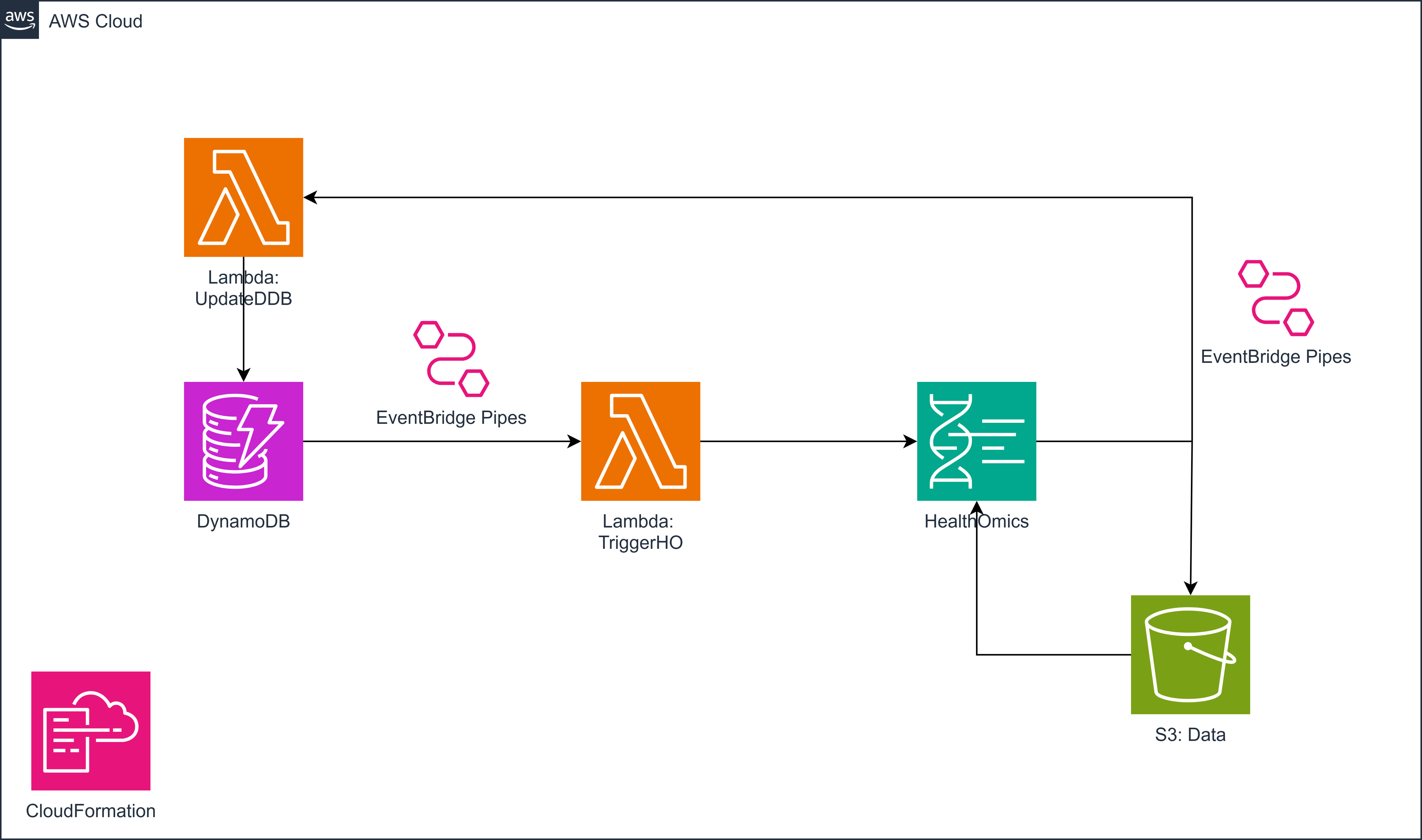
Figure 1: Simplified execution and orchestration path
The serverless layer doesn’t replicate what Cromwell does, which is to decide execution order and manage dependencies within a workflow. HealthOmics remains solely responsible for executing each WDL workflow. The serverless layer handles what happens between runs: coordination, state tracking, notifications, reporting, and integration with other systems.
Making the reference workflow ready for HealthOmics
HealthOmics supports WDL, but it isn’t a drop-in replacement for Cromwell. The work required was practical rather than scientific, and each change was assessed to confirm that analytical behavior remained unchanged:
-
File staging and paths – Cromwell and HealthOmics don’t stage files in the same manner. Tasks that assumed a particular scratch-directory layout or localized filename had to be checked against the HealthOmics Amazon S3 staging behavior. Inputs and outputs were made explicit, so tasks relied on declared WDL files rather than engine-specific directory assumptions.
-
Containers and dependencies – Task images were checked against HealthOmics requirements for registry access, CPU architecture, entry-point behavior and bundled dependencies. Images were republished where required while retaining the tool versions expected by the reference workflow. This reduced the risk that a seemingly small difference in container size would lead to a scientific discrepancy later.
-
Resource settings – GATK-SV’s WDL specifies CPU, memory, disk, and retry requirements using runtime attributes common to Cromwell. These requests were mapped to supported settings in HealthOmics. The team tested stages with many parallel tasks to confirm they finished within service and account limits. Operational settings were fine-tuned as needed, but caller settings and filtering rules remained unchanged.
-
Scatter-gather behavior and concurrency – Population workflows repeatedly fan out work and gather the results. The team tested batching, concurrency, and stage transitions across multiple cohorts rather than relying on a single successful run. This exposed edge cases that wouldn’t appear in a small development test, including delayed completions and partial batch failures.
-
Identity and access – Terra-specific credentials were replaced with AWS Identity and Access Management (IAM) roles. HealthOmics task roles, Lambda execution roles, and Amazon S3 policies were scoped to the resources and prefixes required by each component. Configuration and secrets were kept outside containers and WDL source files.
-
Reference data and version control – A reproducible run depends on more than the WDL. Reference assets, container versions, workflow versions, and input manifests must also be fixed. The implementation therefore uses versioned Amazon S3 locations and documented folder conventions for benchmark and production inputs. This makes it easier to reproduce a validation run and to diagnose the source of any future difference.
Failure handling, security, and observability
Retries and timeouts are handled at the level best able to interpret the failure. Task-level retry behavior remains with HealthOmics where supported. Submission errors, cross-stage coordination failures, and other operational conditions are handled by the orchestration layer. Temporary failures can be retried, and terminal failures are recorded in DynamoDB and published as events for operator follow-up. CloudWatch provides service logs and metrics for Lambda and HealthOmics diagnostics.
Security followed a least-privilege model. Terra-specific credentials were replaced with IAM roles: HealthOmics task roles, Lambda execution roles, and Amazon S3 policies were scoped to the specific resources and prefixes each component required. Configuration and secrets were kept outside containers and WDL source files. Governance extended beyond data residency to audit trails and data provenance, both of which factored into PRECISE’s platform decision. For auditability, AWS CloudTrail records API activity across HealthOmics, Amazon S3, Lambda, and IAM, giving a log of who accessed or changed data and infrastructure, and when. For provenance, every HealthOmics run, together with its inputs, reference and workflow versions, and stage status, is recorded in DynamoDB alongside versioned Amazon S3 locations, while CloudWatch retains service logs. Together, these give the program a traceable record of which data, workflow version, and parameters produced each callset, supporting both governance review and scientific reproducibility.
Validating Terra-Cromwell and HealthOmics GATK-SV functional equivalence
In short: across every SV class, the HealthOmics callsets showed high agreement with the Broad Institute’s reference outputs, with strong concordance for deletions, insertions, and inversions and duplications showing the most variability. The Broad’s own GATK-SV team externally confirmed the equivalence. The following sections show how we measured this.
Successful execution doesn’t confirm that the output of HealthOmics GATK-SV is functionally equivalent to that produced by the original Terra-Cromwell GATK-SV pipeline. Its functional equivalence was therefore treated as a core workstream. The team ran the HealthOmics implementation on the 156-sample benchmark dataset distributed with GATK-SV, which contains samples from the 1000 Genomes Project, and compared the resulting pass-only SV callsets with Broad Institute’s reference outputs.
Truvari was used for breakpoint-aware comparison. Precision measures the proportion of HealthOmics calls that match the reference, recall measures the proportion of reference calls recovered, and F1 balances the two. Results were examined overall and by SV class and size range. The plot also makes an important point clear: concordance should be assessed by class, not only as a single overall number, because short-read evidence varies across deletions, duplications, insertions, inversions, and complex events.
The objective was biological equivalence, not necessarily bit-for-bit identical files. Small execution-level differences can arise even when the downstream callsets are scientifically equivalent. Discrepancies were investigated through the infrastructure first: file staging, resource allocation, container contents, and operational logic. They were not resolved by changing scientific defaults to improve a score.
After iterative testing, the results were reviewed with members of Broad Institute’s GATK-SV team, who confirmed that the HealthOmics implementation was functionally equivalent to their implementation. That review provides an important external check that the port retained the behavior of the community-standard workflow.
The VCF file obtained from Broad Institute’s Terra platform was used as the truth VCF in the Truvari (v5.4.0) benchmark.
Bcftools v1.12.1 was used to subset the SV VCF file into the various SV type:
-
allsvtype – All SV.
-
DEL – deletion.
-
INS – insertion.
-
DUP – duplication.
-
CPX – complex.
-
INV – inversion.
The Truvari benchmark was done at various bins of SV length and parameters customized for the SV length, as outlined in the following table.
| Base pair | Truvari parameter |
| 50–100,000,000 | --refdist 500 |
| 50–1,000 | --refdist 500 |
| 1,001–10,000 | --refdist 500 |
| 10,001–50,000 | --refdist 2000 --chunksize 10000 --pctseq 0 --pctsize 0.50 --pctovl 0.50 --dup-to-ins |
| 50,001–100,000,000 | --refdist 5000 --chunksize 10000 --pctseq 0 --pctsize 0.30 --pctovl 0.30 --dup-to-ins |
These results are shown in the following graph. Agreement is high across most categories. Duplications show more variability in some bins.
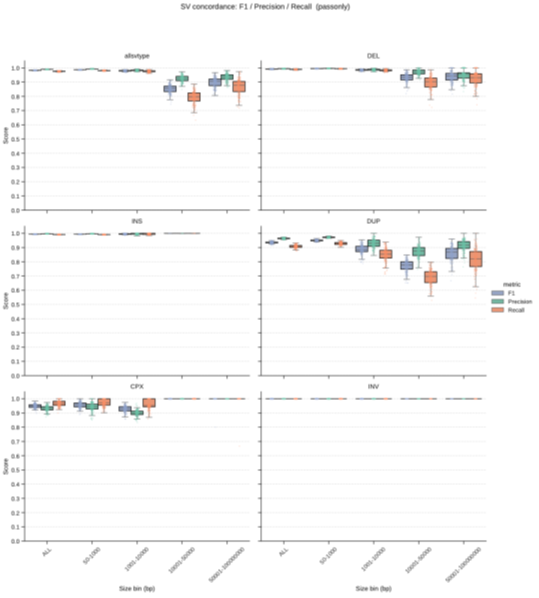
Figure 2: Pass-only SV concordance between the HealthOmics implementation and the GATK-SV benchmark output, shown by SV class and size bin
Deployment and source code
The supporting deployment code and configuration are available in a public GitHub repository. It includes the AWS SAM template for the serverless infrastructure, configuration examples, and instructions for deploying the event-driven orchestration components. It can serve as a starting point for teams that want to run GATK-SV through HealthOmics in their own AWS environment.
The repository contains A*STAR-PRECISE’s AWS infrastructure and deployment configuration. The GATK-SV workflow, scientific defaults, and authoritative documentation are maintained in Broad Institute’s GATK-SV repository.
Lessons for other teams
Deploying and validating the workflow in a production-scale, governed cloud environment surfaced several considerations relevant to other teams undertaking similar bioinformatics workflow migrations. These span cloud architecture, validation, operationalization, and collaboration with workflow developers:
-
Preserve the science, not the original infrastructure – The value of the port comes from retaining a community-standard analytical framework while changing only its execution environment.
-
Use a managed workflow service with a thin orchestration layer – HealthOmics removes the need to operate Cromwell, but a population pipeline still needs cross-run state, stage coordination, monitoring, and integration.
-
Treat validation as part of the implementation – A successful execution proves that the workflow ran. Concordance testing shows that it produced the expected scientific result.
-
Plan for operational detail – Container packaging, engine-specific file behavior, and reference-data versioning can consume more effort than editing WDL syntax.
-
Start validation early – Running small and benchmark cohorts alongside infrastructure development finds problems before they reach production scale.
-
Engage the workflow authors – Review by the original method developers adds confidence that internal metrics alone can’t provide.
Accelerating the port with Kiro
Much of the container-compatibility, file-staging, resource-tuning, and scatter-gather work described earlier was carried out with the HealthOmics power for Kiro. Building and migrating genomics workflows has traditionally been slow because bioinformaticians need to know biology, workflow languages like WDL or Nextflow, and cloud infrastructure. In addition, many errors only appear after costly compute runs. The team used the HealthOmics power for Kiro as a single environment to migrate, manage, troubleshoot, and analyze the HealthOmics workflows in this project. The power sets up the HealthOmics MCP server and gives Kiro built-in knowledge of HealthOmics best practices, so the team could describe pipeline changes in plain language and then migrate, manage, troubleshoot, and analyze them without leaving the IDE. This let them spend less time on infrastructure and trial-and-error and more on the science.
Conclusion
The A*STAR-PRECISE Genome Innovation Team successfully implemented Broad Institute’s GATK-SV pipeline developed for Terra and Cromwell to AWS HealthOmics. HealthOmics provides managed WDL execution, and a small set of serverless AWS services coordinates the 17-stage population workflow, tracks state, stores data, and supports monitoring and reporting. Validation with an open source 156-sample benchmark dataset derived from 1000 Genomes, followed by review with the Broad Institute GATK-SV team, showed that the HealthOmics implementation was functionally equivalent to the reference implementation.
This project demonstrates that established, community-driven genomics pipelines can be migrated across cloud platforms while maintaining scientific rigor, consistency, and reproducibility. Running GATK-SV on AWS without altering its underlying scientific methodology provides a blueprint for cloud-agnostic, population-scale genomic analysis. Researchers worldwide can now deploy and benefit from GATK-SV within AWS environments, eliminating dependency on a specific cloud provider and avoiding the need to redesign or redevelop a proven scientific pipeline merely because the underlying infrastructure has changed.
For the A*STAR-PRECISE team, this unlocks the full SG100K SV analysis on a reproducible, in-region, cloud-native foundation. The open-source repository turns that effort into a blueprint any genomics team can adopt. For the Asian genomics community, it means a community-standard SV catalog built on infrastructure that others can replicate, extend, and compare against. The pattern goes beyond a single pipeline: HealthOmics provides the managed, in-region execution foundation, and the HealthOmics power for Kiro speeds up how teams build, migrate, and troubleshoot workflows on it. Together, they shorten the path from a published method to a production-scale, validated workflow on AWS.
To see how HealthOmics and Kiro work together to accelerate workflow development, read From Prompt to Pipeline: AI-Powered Bioinformatics Workflow Development with Kiro and AWS HealthOmics.
To learn more about how AWS helps advance medical knowledge and improve population health, visit AWS for Healthcare & Life Sciences. To get started with HealthOmics, visit the AWS HealthOmics User Guide.