Artificial Intelligence
Accelerating your marketing ideation with generative AI – Part 1: From idea to generation with the Amazon Nova foundation models
Marketing teams face increasing pressure to create engaging campaigns quickly while maintaining brand consistency and creative quality. Traditional marketing campaign creation processes often involve multiple iterations between creative teams, stakeholders, and external agencies, leading to extended timelines and increased costs.
The advent and availability of generative models (especially image and video generation ones) has opened the possibility to quickly iterate through multiple campaign proposals in minutes. Nevertheless, efficient campaign creation aided by generative models still requires a high level of skills and mastery of generative tools such as prompt engineering, parameter fine-tuning, application of guardrails, and so on. Editing, scripting, and post-production skills are also important to create stunning stories.
In this post, the first of a series of three, we focus on how you can use Amazon Nova to streamline, simplify, and accelerate marketing campaign creation through generative AI. We show how Bancolombia, one of Colombia’s largest banks, is experimenting with the Amazon Nova models to generate visuals for their marketing campaigns.
The challenge of modern marketing campaigns
The challenges to create engaging marketing campaigns extend far beyond creative overhead, impacting businesses at operational, financial, and strategic levels. The conventional approach to marketing campaign creation typically involves a complex process of interactions between internal teams, external agencies, and stakeholders—each with their own priorities, feedback cycles, and approval processes.
One of the most significant pain points in traditional marketing campaign creation is the time-intensive nature of the work. From initial concept development to final asset production, campaigns often require weeks or even months to move from ideation to execution. This extended timeline might include multiple rounds of revisions, stakeholder approvals, and asset refinements that can represent an overhead in the internal process. However, when talking about the marketing business, the context in which campaigns are launched is what matters. External factors like recent news, fashion trends, new launched products, and season of the year can impact the user’s acceptance of the campaigns. That is why time is critical for marketing, and a delayed release for the campaign can mean missing critical windows or allowing competitors to capture audience attention first.
The financial implications of these traditional methods are equally concerning. Marketing teams frequently face budget constraints while being expected to deliver sophisticated campaigns across multiple channels and delivery formats such as social media posts, short videos, landing pages, and more. The costs associated with a campaign creation—including agency fees, production expenses, and the opportunity cost of delayed release—can quickly escalate. According to a Gartner survey, in 2024, companies reduced their marketing budget from 9.9% to 7.7% of their total budget, further constraining the resources and time allocated for creating marketing campaigns. This budget crunch is precisely why AI tools are becoming essential rather than optional for marketing teams.
Beyond time and cost considerations, marketing teams struggle with a fundamental tension. They must maintain consistent brand identity while creating fresh, engaging content at the pace the marketplace demands. This challenge gets even more complicated by content personalization across various systems and formats, each with their own technical requirements and best practices. In response, we’re seeing companies completely rethink how they allocate resources. Many are shifting toward paid media and cutting back on legacy technologies, reducing headcount, and scaling back agency relationships. This creates an interesting situation in which AI tools are both causing budget reductions (by making teams more efficient) and helping teams survive those same budget cuts.
The real-world impact is significant. Marketing teams using generative AI can now produce in hours what used to take days or weeks. These tools aren’t just creating efficiency—they’re enabling entirely new approaches to content creation. This technological shift has created perfect conditions for implementing advanced generative models that can produce high-quality images, videos, and other visual assets at a scale previously impossible with traditional methods.
Amazon Nova family of foundation models
Amazon Nova is a family of foundation models (FMs), available using APIs through Amazon Bedrock, created by Amazon, and differentiated by its great price-performance rate.
The family is composed of the following subfamilies:
- Amazon Nova Understanding Models – Understanding models that accept text, image, and video inputs and generate text output. They provide a broad selection of capability, accuracy, speed, and cost operation points. Composed of four models: Amazon Nova Micro, Amazon Nova Lite, Amazon Nova Pro, Amazon Nova Premier.
- Amazon Nova Creative Content Generation Models – Creative content generation models that accept text and image inputs and produce image or video outputs. Integrated by two models: Amazon Nova Canvas (image generation) and Amazon Nova Reel (video generation).
- Amazon Nova Speech-to-Speech Models – Includes only one model, Amazon Nova Sonic, a speech-to-speech model that accepts speech as input and generates speech and text as output. The model is designed to deliver real-time, humanlike voice conversations with contextual richness.
Image generation with Amazon Nova Canvas
With Amazon Nova Canvas you can generate realistic, studio-quality images by using text prompts. Amazon Nova Canvas is capable of generating images up to 2K x 2K. Amazon Nova Canvas is also capable of image editing existing images using text prompts to guide the edition. Refer to the Visual guide to Amazon Nova Canvas to explore the possibilities offered by the Nova Canvas model. To programmatically generate an image, enter the following code:
Find more Amazon Nova examples in the Amazon Nova samples GitHub repository.
You can learn about prompt engineering for Amazon Nova Canvas and Amazon Nova Reel at Image and video prompt engineering for Amazon Nova Canvas and Amazon Nova Reel in the AWS Artificial Intelligence Blog.
Accelerate the creation of visual assets for marketing campaigns using Amazon Nova
To streamline the generation of marketing campaign visual assets we propose an automated process, aided by generative AI, to transition from campaign idea to a set of visual assets for the campaign. Our proposed process is described as follows:
- You provide a description of your campaign
- The system automatically retrieves previous campaign images related to your current campaign, and you can select those that better represents the ideas for your new campaign
- The system will generate a reference prompt (using Amazon Nova Pro) to generate your campaign’s images using Amazon Nova Canvas. You can edit this prompt.
- The system will generate up to five images for your campaign.
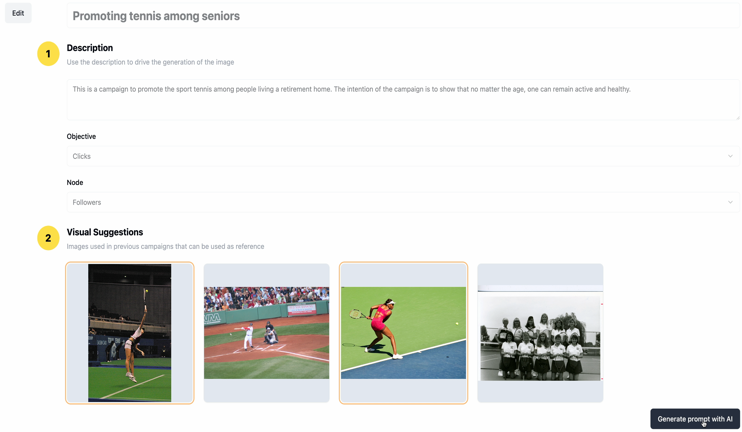
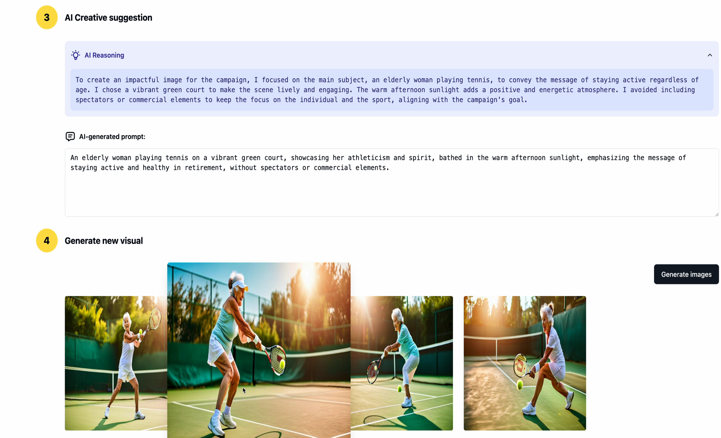
We now explore some of the key concepts of this solution.
Reference image recommendation
After providing the description of our image, we search for images related to our campaign within an image database. Such a search returns images closely related to the campaign topic that were used in previous campaigns and have proven successful in the past. The user can select some of the reference images to guide the creation of our new visual assets. This technique is the topic of discussion of the next installment in this series. We encourage you to read it to gain a deeper understanding of how we created an efficient search engine using multimodal embeddings models and vector databases.
Creating good image generation prompts using large language models (LLMs)
Although Amazon Nova creative models have some understanding of languages such as Spanish or German, English remains the only fully supported language. Therefore, users should craft their prompts in English to maximize the capabilities of Amazon Nova creative models. Moreover, prompting creative models effectively requires a different approach than when working with understanding models. Even experienced prompt engineers may need time to adapt their techniques to fully unlock a creative model’s potential. For newcomers to LLM-based content generation, this learning curve can be particularly steep.
To address these challenges, we use a technique called metaprompting. This approach involves instructing one LLM to generate effective prompts for other FMs. For example, we can use Amazon Nova Pro to craft high-quality prompts for Amazon Nova Canvas to generate images.
The following prompt template demonstrates how to instruct Amazon Nova Pro to generate optimized text-to-image prompts based on a simple image description (highlighted in bold):
The answer is:
As you can see, we get a prompt that is aligned with the requirements of Amazon Nova Canvas, and we get a high-quality image.

Out metaprompt template has four sections:
- We set the persona and the high-level task (efficient prompt creation).
- We set the rules we expect to be followed when writing the prompt. For example, we provide the character limits and instruct the model to answer only in English.
- We set guidelines that describe how we want the prompt to be constructed but are not mandatory. There are also some hints about keywords used in the final model, so the metaprompt encourages the model to use them in its output.
- We identify the final output.
If you want to explore more metaprompting ideas, the blog post Improve Amazon Nova migration performance with data-aware prompt optimization has good insights. For best practices for writing prompts for Amazon Nova understanding models, refer to the Amazon Nova User Guide.
Solution architecture
We now propose a reference architecture to implement the ideas discussed above. The architecture is as follows:
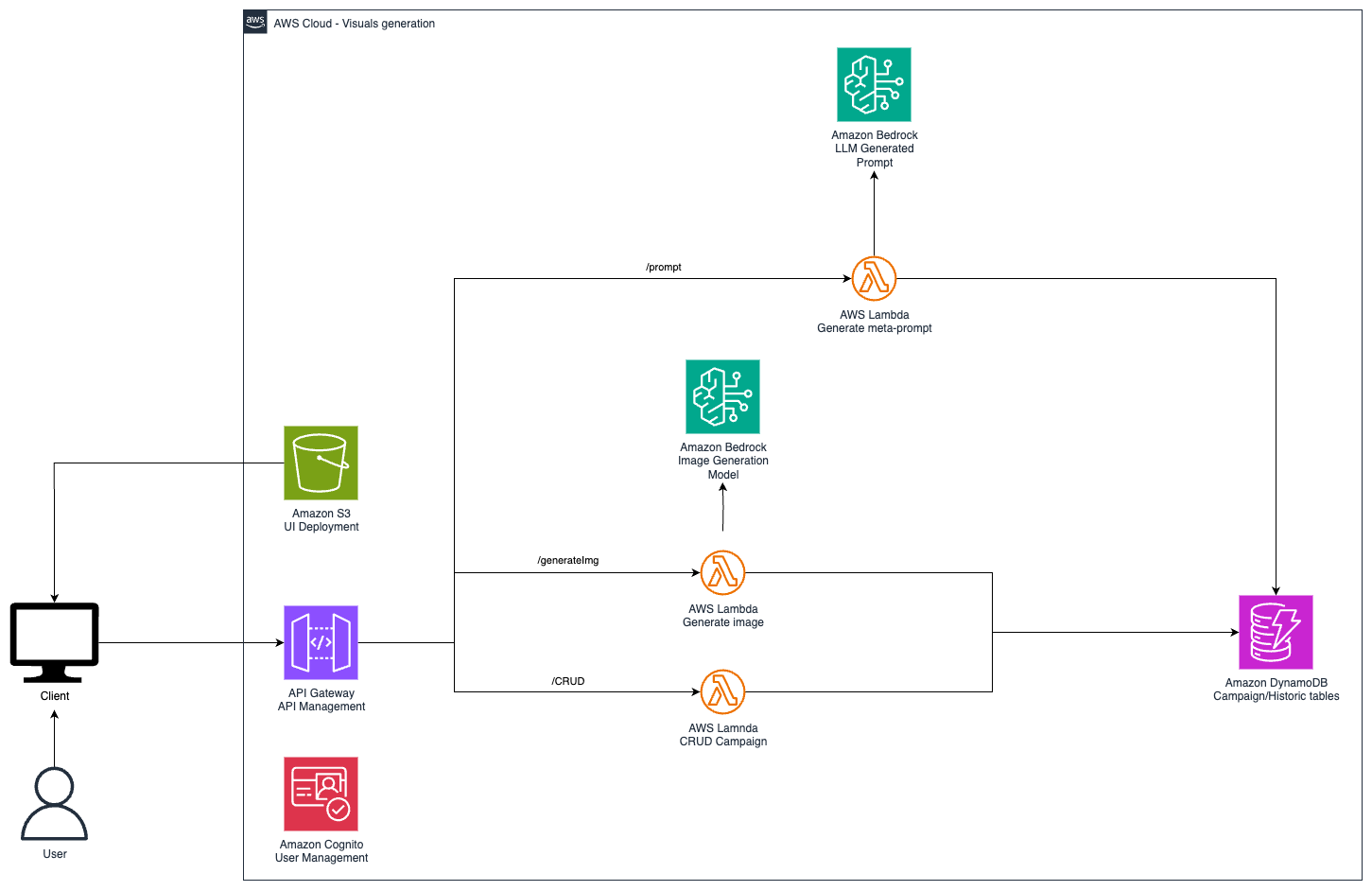
- Amazon Bedrock is used to invoke the Amazon Nova Pro and Amazon Nova Canvas models using a common API.
- Amazon Lambda functions are used to create metaprompts, generate images, retrieve related images and store the campaign in a database.
- The campaign’s information is stored in an Amazon DynamoDB database.
- APIs are managed using Amazon API Gateway.
- Amazon Cognito is used to manage the users of the application.
The following diagram shows the architecture.
How Bancolombia is using Amazon Nova to streamline their marketing campaign assets generation
Bancolombia, one of Colombia’s leading banks has been experimenting with this approach for over a year now. Usually, strategic marketing in Bancolombia starts with a brief that sets out the goals, target audience and main messages. A detailed brief, often containing visual examples and data analysis, can help streamline the workflow between the teams and stakeholders.
“There are often many meetings and rounds of changes needed between making the brief and getting all the stakeholders aligned”, said Juan Pablo Duque, Marketing Scientist Lead at Bancolombia. “This is where we realized we could bring in new technologies. The saying ‘a picture is worth a thousand words’ is very true. It would be great if marketing analysts could use generative AI to make visual references. Rather than just using text, they might draw a clear illustration of what they are thinking.”
“We started to experiment, and after every iteration, we found more options. For example, what if we looked at information from previous campaigns? Many previous initiatives had the same goals and how they performed can be used as useful information. Using visuals together with proven campaign elements would give the creative team a stronger foundation which would help them save time in the early stages of creating ideas.
As generative models keep improving, they could cover the entire design process by producing images and adjusting them for different digital uses. This means generating content following our platform’s guidelines. With this workflow, publishing can be done faster, teams can react to current trends, improve on content that is not doing well and offer messages that are more consistent.”
Implementation best practices
In this section, we propose a set of best practices for readers intending to automate the generation of marketing campaigns.The following are some technical considerations and guidelines:
- Modular architecture – Implement the solution using a modular approach, separating the image search engine and visual generation components. This allows for straightforward maintenance and future enhancements.
- Serverless first – Use serverless technologies such as AWS Lambda and Amazon API Gateway to reduce operational overhead and improve scalability.
- Model version control – Keep track of the specific versions of Amazon Nova models used in your implementation. This supports reproducibility and helps in troubleshooting.
For security best practices, consider these guidelines:
- Least privilege access – Use AWS Identity and Access Management (IAM) roles with the principle of least privilege for all components, especially when accessing Amazon Bedrock and other AWS services.
- Encryption in transit and at rest – Make sure all data, including campaign descriptions and generated images, is encrypted both in transit and at rest using AWS Key Management Service (AWS KMS).
- Input validation – Implement strict input validation for all user inputs to help prevent potential security vulnerabilities, especially in the campaign description and prompt editing stages.
- Secure API access – Use Amazon Cognito for user authentication and authorization to secure access to your API endpoints.
To optimize performance, follow these guidelines:
- Caching strategy – Implement a caching layer using Amazon ElastiCache to store frequently accessed data, such as popular campaign descriptions or commonly used reference images.
- Asynchronous processing – For image generation tasks that might take longer, implement asynchronous processing to improve user experience and system responsiveness.
- Auto scaling – Configure auto scaling for your Lambda functions and API Gateway to handle varying loads efficiently.
For error handling and monitoring, follow these guidelines:
- Comprehensive logging – Implement detailed logging using Amazon CloudWatch Logs to capture system events, user actions, and model interactions.
- Automated alerts – Set up CloudWatch alarms to monitor key metrics and send notifications for anomalies or errors.
- Graceful degradation – Design the system to gracefully handle failures, such as temporary unavailability of the Amazon Nova models, by implementing appropriate fallback mechanisms.
- Regular audits – Conduct periodic audits of your generated content to verify compliance with brand guidelines and ethical standards.
By following these best practices, you can maintain a reliable, secure, and efficient implementation of your generative AI marketing campaign solution. Regular monitoring and maintenance can help you identify areas for improvement and keep your system optimized as your campaign needs evolve.
Conclusion
In this post, we demonstrated how to use the Amazon Nova family of FMs to revolutionize marketing campaign creation through an automated, AI-driven approach. By combining Amazon Nova Pro for intelligent prompt generation and Amazon Nova Canvas for high-quality image creation, we’ve shown how marketing teams can dramatically reduce the time and resources required to produce compelling visual assets while maintaining brand consistency and creative quality.Looking ahead, this solution can be extended to support additional use cases such as:
- Integration with marketing automation services
- Advanced personalization using customer insights
- Multi-channel campaign asset generation
- A/B testing automation for visual content
In the next installment of this series, we will address how to incorporate information from previous campaign images to improve the creative process.
We also encourage you to explore the capabilities of the Amazon Nova family of models for your marketing workflows. You can get started by deploying the solution publicly available in the generative AI ML latam samples GitHub repository.
About the authors
 David Laredo is a Prototyping Architect at AWS, where he helps customers discover the art of the possible through disruptive technologies and rapid prototyping techniques. He is passionate about AI/ML and generative AI, for which he writes blog posts and participates in public speaking sessions all over LATAM. He currently leads the AI/ML experts community in LATAM.
 Josué Martínez is Sr Solutions Architect with +25 years of experience in IT. Last 10 in Cloud Technologies with focus on AI/ML solutions. Josue loves nature an spending time to its family knowing magic places. Still coding for fun.
 Dr. José Gardiazabal is a Solutions Architect at AWS, focused on Healthcare and Life Sciences. He is passionate about learning new technologies, and finding out how to help customers with them. He is also working with customers using IoT across Latin America.
 Arturo Minor is a prototyping solutions architect based in Mexico City. He enjoys the outdoors and traveling, and is interested in computer science, languages, and technology. He works at AWS helping clients innovate, develop, and visualize new solutions.
 Jorge Lopez is a Sr Solutions Architect at AWS with over 10 years of experience in technology. He is a technical leader in AI/ML at AWS.
 Juan Pablo Duque is a Marketing Science Lead at Bancolombia, where he merges science and marketing to drive efficiency and effectiveness. He transforms complex analytics into compelling narratives. Passionate about GenAI in MarTech, he writes informative blog posts. He leads data scientists dedicated to reshaping the marketing landscape and defining new ways to measure.