Artificial Intelligence
How bunq handles 97% of support with Amazon Bedrock
This post was co-authored with Benjamin Kleppe, Machine Learning Engineering Lead at bunq.
The integration of agentic AI is transforming the banking industry, marking a significant shift from traditional customer service systems. Agentic AI demonstrates autonomous decision-making capabilities in complex financial environments, enabling banks to provide round-the-clock multilingual support, process transactions, and deliver personalized financial insights at scale.
bunq is Europe’s second-largest neobank, built to make life easy for people and businesses who live an international lifestyle. Founded in 2012 by serial entrepreneur Ali Niknam, bunq has always put users at the heart of everything they do. The company helps its 20 million users across Europe spend, save, budget, and invest confidently, all within a single, user-friendly application built on user feedback
In this post, we show how bunq upgraded Finn, its in-house generative AI assistant, using Amazon Bedrock to transform user support and banking operations to be seamless, in multiple languages and time zones.
Business challenge
Banks face a major challenge to deliver consistent, high-quality customer support across multiple channels, languages, and time zones. Traditional support systems struggle with the complexity of financial products, regulatory requirements, and the growing expectation for instant, accurate responses. Customers expect instant access to essential banking functions like transaction disputes, account management, and financial advice, and banks need to maintain strict security protocols and compliance standards. As a user-centric bank, bunq’s users expect round-the-clock support for their banking needs, such as requesting a refund or seeking guidance on features. Traditional support models couldn’t keep up with this demand, creating frustrating bottlenecks and straining internal resources. Beyond direct support, bunq’s team also needed efficient ways to analyze incoming feature requests and bug reports to continuously improve their system. It was clear that bunq needed a smarter solution that could provide instant, accurate assistance around the clock and help the team turn valuable user feedback into action.
Solution overview
Launched in 2023, bunq’s generative AI assistant, Finn, is fully built in-house as part of bunq’s proprietary AI stack. Finn uses leading AI foundation models (FMs) and tooling, including Anthropic’s Claude models through Amazon Bedrock. Unlike generic chatbots, Finn processes natural language and provides real-time, intelligent answers. Finn can translate the bunq application into 38 languages and translate speech-to-speech calls to the support team in real time. It can also summarize complex banking information, provide financial insights and budgeting advice, and even recognize images, automating tedious tasks such as invoice processing. bunq’s approach uses AWS services to create a scalable AI agent infrastructure that can handle the demands of modern banking while maintaining security and compliance. The solution uses the following AWS services:
- Amazon Bedrock – A fully managed service that makes high-performing FMs from leading AI companies and Amazon available through a unified API. bunq uses Amazon Bedrock to access Anthropic’s Claude models with enhanced security features, scalability, and compliance—critical requirements for banking applications.
- Amazon Elastic Container Service (Amazon ECS) – A fully managed container orchestration service that makes it straightforward to deploy, manage, and scale containerized applications. Amazon ECS alleviates the need to install and operate container orchestration software or manage clusters of virtual machines, helping bunq focus on building Finn’s multi-agent architecture.
- Amazon DynamoDB – A fully managed, serverless, NoSQL database service designed to run high-performance applications at scale. DynamoDB delivers single-digit millisecond performance and stores agent memory, conversation history, and session data, enabling Finn to maintain context across customer interactions.
- Amazon OpenSearch Serverless – An on-demand, automatic scaling configuration for Amazon OpenSearch Service. OpenSearch Serverless automatically scales compute resources based on application needs and provides vector search capabilities for Finn’s Retrieval Augmented Generation (RAG) implementation, enabling semantic search across bunq’s knowledge base.
Building a multi-agent implementation with Amazon Bedrock
Users can interact with Finn through bunq’s application and web interface, using natural language for their requests, such as account information, transaction history, financial advice, and support issues. The system processes requests in real time, accessing only pertinent data to the request, while maintaining strict security and privacy controls. User support scenarios demand more than what a single AI agent can deliver. A multi-agent architecture allows specialized agents to handle distinct tasks—one agent might excel at understanding the user, another focuses on extracting relevant documentation, and a third handles transaction analysis or account operations. For Finn, this means a user asking about a failed payment can trigger a coordinated response: one agent interprets the question, another checks transaction logs, and a third suggests solutions based on similar cases. They all work together seamlessly to deliver a comprehensive answer in seconds, instead of bouncing the user between departments. The initial multi-agent support system for banking services followed a seemingly straightforward pattern: a central router agent directed user queries to specialized sub-agents. Each agent handled specific domains—technical support, general inquiries, transaction status, account management, and so on. However, as the system grew, so did the size and complexity of the demands. As bunq added more specialized agents to handle the new ecosystem, three issues became apparent:
- Routing complexity – With multiple specialized agents, the router needed increasingly sophisticated logic to determine the correct destination.
- Overlapping capabilities – Multiple agents required access to the same data sources and capabilities, forcing the router to predict not just the primary intent but also which secondary agents might be needed downstream—an impossible task at scale.
- Scalability bottleneck – Every new agent or capability meant updating the router’s logic. Adding a new specialized agent required comprehensive testing of all routing scenarios. The router became a single point of failure and a potential development bottleneck.
Rethinking the architecture
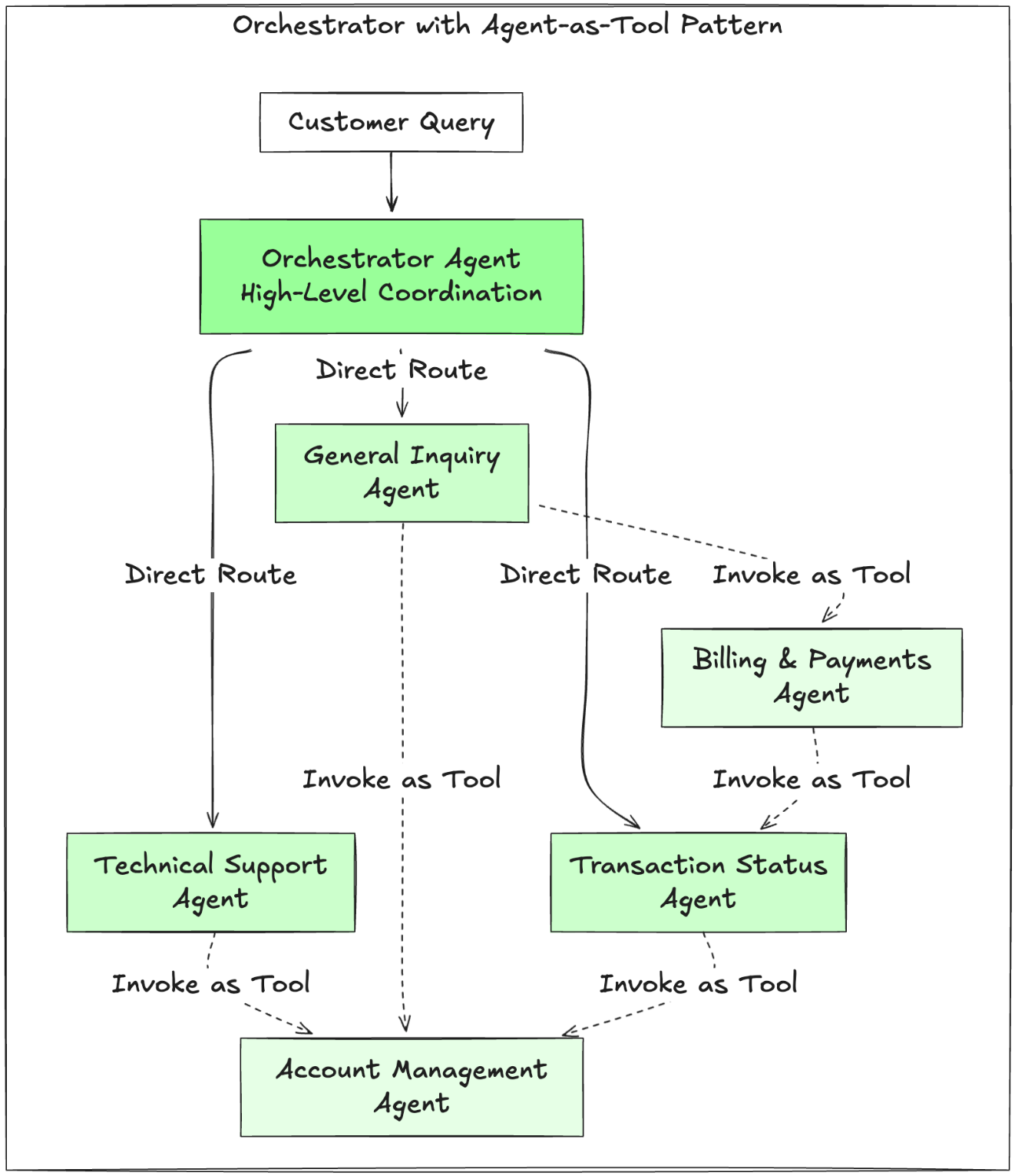
bunq redesigned its system around an orchestrator agent that works fundamentally differently from the old router. Instead of trying to route to all possible agents, the orchestrator performs the following actions:
- Routes queries to only three to five primary agents
- Empowers these primary agents to invoke other agents as tools when needed
- Delegates decision-making to the agents themselves
With this agent-as-tool pattern, primary agents detect when they need specialized help. Tool agents are invoked dynamically by primary agents. Agents can call other agents through a well-defined interface—they become tools in each other’s toolkits.
The following diagram illustrates this workflow.
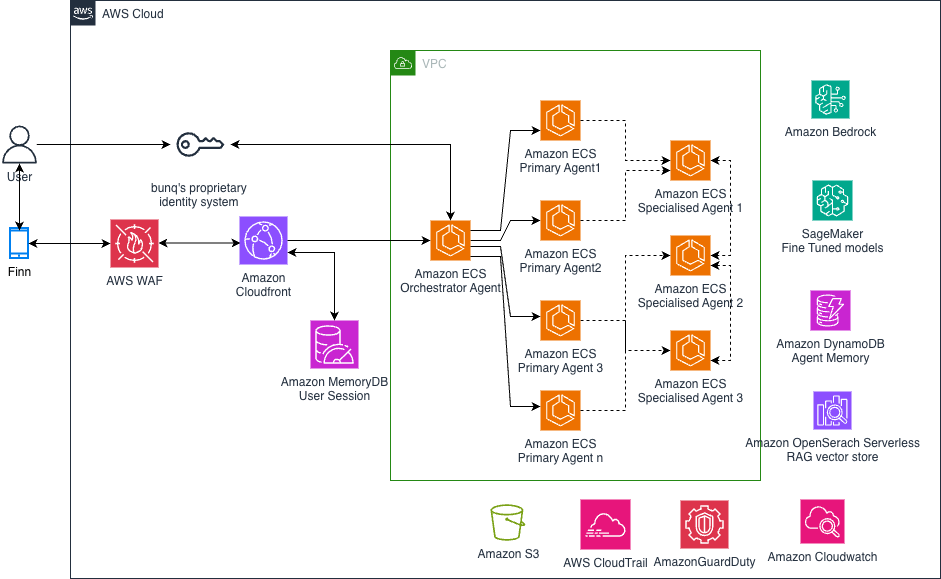
bunq’s Finn service uses a comprehensive AWS infrastructure designed for security, scalability, and intelligent orchestration. The following architecture diagram shows how multiple AWS services work together to deliver a multi-agent AI system.
Orchestration and agent architecture
At the core of the system is the orchestrator agent, running on Amazon Elastic Container Service (Amazon ECS). This orchestrator implements the agent-as-tool pattern, routing user queries to a limited set of primary agents rather than attempting to predict every possible scenario. The orchestrator maintains three to five primary agents (Primary Agent 1 through 5), each deployed as containerized services on Amazon ECS. This design provides horizontal scalability—as demand increases, additional agent instances can be spun up automatically. Each primary agent is empowered to invoke specialized agents as needed. These specialized agents (Specialized Agent 1, 2, 3, and so on) act as tools that primary agents can call upon for specific capabilities, such as analyzing transaction data, retrieving documentation, or processing complex queries. This hierarchical structure avoids the routing complexity bottleneck while maintaining flexibility.
Infrastructure details
The architecture is built on a robust foundation of AWS services that enable Finn’s performance. Users access the service through bunq’s application, with traffic secured by AWS WAF and Amazon CloudFront, while authentication flows through bunq’s proprietary identity system. Amazon Bedrock provides access to Anthropic’s Claude models for natural language understanding, complemented by Amazon SageMaker hosted fine-tuned models for specialized banking scenarios. Agent memory and conversation history are stored in DynamoDB, and OpenSearch Service serves as a vector store for RAG capabilities, enabling semantic search across bunq’s knowledge base. Amazon Simple Storage Service (Amazon S3) handles document storage, and Amazon MemoryDB manages user sessions for real-time interactions. Comprehensive observability through AWS CloudTrail, Amazon GuardDuty, and Amazon CloudWatch helps the team monitor performance, detect threats, and maintain compliance—all within a secure virtual private cloud (VPC).
Real-world impact
The transformation from bunq’s initial router-based architecture to the orchestrator pattern with Amazon Bedrock delivered measurable improvements across user support operations. The multi-agent deployment achieved significant operational efficiency gains:
- Finn now handles 97% of bunq’s user support activity, with over 82% fully automated. Average response times dropped to just 47 seconds, helping bunq deliver the real-time solutions users expect.
- The rapid deployment timeline highlights bunq’s focus on innovation. The team moved from concept to production in 3 months, starting in January 2025. bunq brought together a team of 80 people—from AI engineers to support staff—who worked together to test, learn, and deploy updates three times a day.
- Before implementing the orchestrator architecture, escalations were mainly manual processes. The new multi-agent system increased automation, transforming end-to-end support metrics. Beyond that, Finn expanded bunq’s reach by translating the application into 38 languages, making banking more accessible to millions of users across Europe.
- The solution enabled bunq to become Europe’s first AI-powered bank, offering capabilities no traditional support system could deliver: real-time speech-to-speech translation (a first in global banking), image recognition for receipt processing and document verification, and intelligent financial insights—all while maintaining the round-the-clock availability users demand.
“We went from concept to production in 3 months. Before the orchestrator architecture, escalations were mainly manual. Now Finn handles 97% of support with 70% fully automated and 47-second average response times.”
– Benjamin Kleppe, Machine Learning Engineering Lead at bunq.
Conclusion
bunq’s journey from manual support escalations to an intelligent multi-agent system shows how modern AI architecture can transform banking operations. By moving from a rigid router-based approach to a flexible orchestrator pattern with Amazon Bedrock, bunq avoided scalability bottlenecks while maintaining the agility needed to serve 20 million users across Europe. The orchestrator pattern with agent-as-tool capabilities proved essential to bunq’s success. Rather than predicting every possible user scenario upfront, the system empowers primary agents to dynamically invoke specialized agents as needed. This architectural shift reduced complexity, accelerated development cycles, and helped bunq deploy updates three times per day during the initial rollout. The results: 97% of support interactions handled by Finn, 70% fully automated, and average response times of just 47 seconds. Beyond efficiency gains, the solution expanded bunq’s reach to 38 languages and positioned the company as Europe’s first AI-powered bank. By freeing internal resources from manual processes, bunq can now focus on what it does best: building a bank that makes life easy for its users.
To learn more about building AI-powered applications with FMs, refer to Amazon Bedrock. Explore how Anthropic’s Claude on Amazon Bedrock can transform your customer experience with enhanced security features and scalability. Get started with the Amazon Bedrock documentation to build your own multi-agent solutions.
About the Authors
 Benjamin Kleppe is Machine Learning Engineering Lead at bunq, where he leads the development and scaling of AI-powered solutions that make banking smarter and more personal for 20 million users across Europe. He focuses on building intelligent systems that enhance user experience, improve product discovery, and automate complex banking processes. Benjamin is passionate about pushing the boundaries of AI innovation in banking, having led bunq to become Europe’s first AI-powered bank with the launch of Finn, their proprietary generative AI platform.
 Jagdeep Singh Soni is a Senior AI/ML Solutions Architect at AWS based in the Netherlands, specializing in generative AI and Amazon Bedrock. He helps customers and partners architect and implement intelligent agent solutions using Amazon Bedrock and other AWS AI/ML services. With 16 years of experience in innovation and cloud architecture, Jagdeep focuses on enabling organizations to build production-ready generative AI applications that use foundation models and agent frameworks for real-world business outcomes.
 Guy Kfir is a generative AI Lead at AWS with over 15 years of experience in cloud technology sales, business development, and AI/ML evangelism. He works with enterprise customers, startups, and partners across EMEA to accelerate adoption of generative AI solutions and execute go-to-market strategies.