AWS Architecture Blog
Scaling oncology patient support: How New York Cancer and Blood Specialists transformed customer experience with AWS and Pronetx, now part of Caylent
This post was cowritten with Mebin Robin, Principal CX Engineer from Caylent.
For a healthcare provider, every phone call is a touchpoint that can affect a patient’s care New York Cancer and Blood Specialists’ (NYCBS), one of the nation’s largest community oncology and hematology practices, runs a contact center that handles hundreds of thousands of calls each month across more than a hundred specialized queues. As the practice grew, two high-volume workflows were straining the team:
- Proactive outreach to patients enrolled in Chronic Care Management (CCM)
- Inbound prescription refill requests
Both workflows were almost entirely manual. Staff dialed CCM patients by hand, and refill requests tied up agents who had to verify each patient, look up their medications, and route the request downstream. With AWS partner Pronetx, now a part of Caylent, NYCBS built two solutions on Amazon Connect Customer, to automate these workflows while keeping clinical data accurate and protected. This post walks through the architecture of both, the AWS services that power them, and the design decisions behind them.
This post details how NYCBS partnered with Amazon Web Services (AWS) and AWS partner Pronetx, now a part of Caylent, to migrate to Amazon Connect Customer, the AWS cloud contact center service, achieving a 300% improvement in outreach efficiency, 145 patient enrollments in a single day, and 10,000+ daily attempt capacity (up from ~800), while dramatically reducing manual workload for clinical staff and improving call-to-bill ratios through consistent, automated documentation.
Solution overview
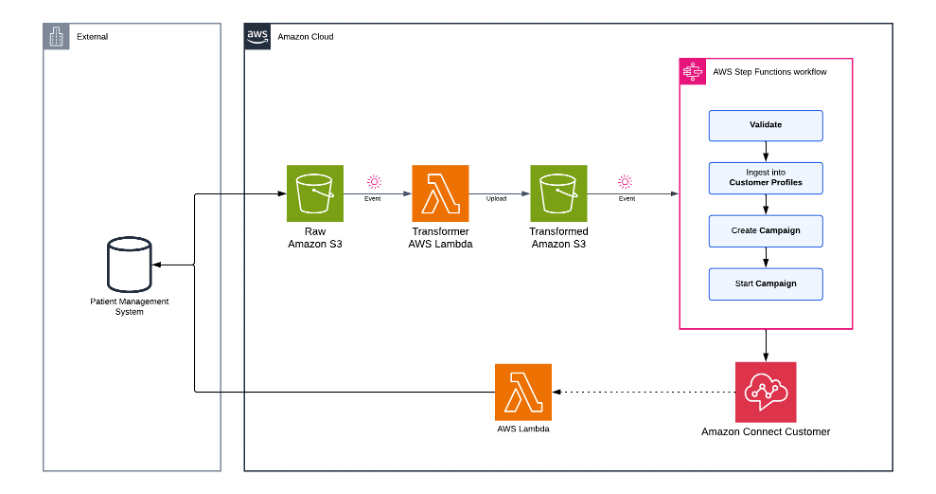
Figure 1: NYCBS automated Chronic Care Management outreach high-level solution architecture
Every night, NYCBS’s patient system exports a monthly check-ins and enrollment candidates list into an Amazon S3 bucket, kicking off an event-driven flow. The new file triggers an AWS Lambda function that normalizes the data, assigns priority so the most urgent patients are dialed first, and writes the result to a second location. That file triggers an AWS Step Functions workflow that runs campaign setup as one observable sequence: ingest the records into Amazon Connect Customer Profiles, build a targeting segment, create the outbound campaign, associate the Contact Flow, and start it. Outbound Campaigns then dial during business hours, using answering-machine detection to tell a live patient from voicemail. A single Contact Flow routes live answers to an agent with a screen pop of the patient’s record, and after every contact a Lambda function writes the outcome back to the patient system, so it stays current.
Using Amazon Connect Customer Outbound Campaigns with answering machine detection (AMD) let the practice raise dial throughput sharply while reserving agent time for live conversations.
Customer Profiles gave each call its patient context without custom lookups in the flow, and Step Functions made the multi-step setup resilient and easy to observe. Because the pipeline runs on S3 events and Lambda, there are no servers to manage and nothing runs except when a file arrives.
AI-powered prescription refills
Refill requests previously tied up an agent for even the most routine case. Now, patients complete a refill through an AI-driven self-service experience in Amazon Connect Customer, with a live agent as a fallback rather than the default.
It has two halves: a data layer that keeps patient and pharmacy information ready for fast lookup, and the runtime conversation that uses it.
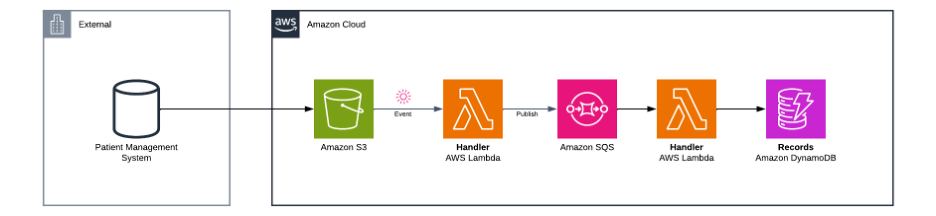
Figure 2: An external Patient Management System uploading content to the Amazon Cloud.
- NYCBS’s patient system uploads patient and pharmacy data to Amazon S3.
- An S3 event triggers a Lambda function that parses and validates each file and publishes records to Amazon SQS;
- A second Lambda function transforms them and writes them to Amazon DynamoDB.
The conversation itself follows a short, well-defined path.
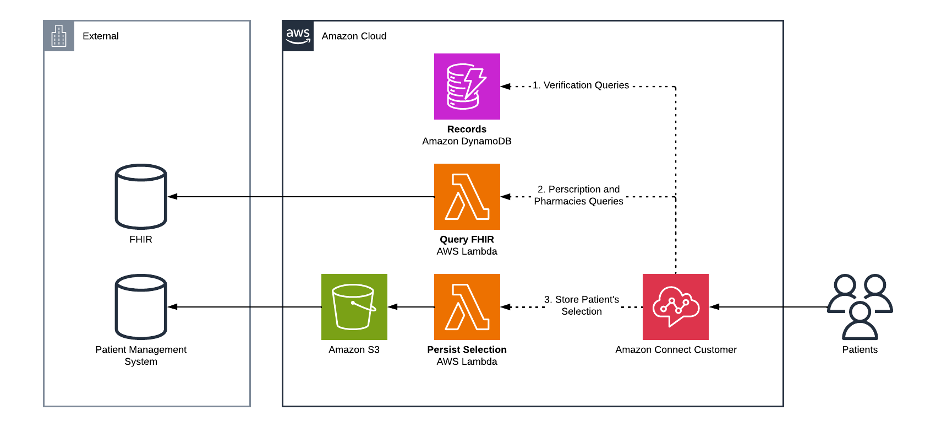
Figure 3: Patients interact directly with the Amazon Cloud which sends data to multiple places including external FHIR and Patient Management Systems.
Results
- 300% improvement in outreach efficiency. Automated dialing at 109 to 110 calls per minute replaced manual effort.
- 145 patient enrollments in a single day — an all-time CCM program record.
- 10,000+ daily attempt capacity, up from ~800, enabling 10,500+ monthly CCM calls and 1,100+ enrollments.
- Dramatically reduced manual workload for clinical staff as automated dialing, voicemail, and documentation replaced manual workflows.
- Improved call-to-bill ratio through consistent, accurate documentation.
- 24/7 prescription refill access via AI self-service reduced inbound call volume and wait times.
- Eliminated human errors — duplicate documentation, missed notes, and inconsistent records removed from the workflow.
Why It Matters
For an oncology practice, every minute a nurse spends manually dialing is a minute not spent on patient care. By automating outbound campaigns and prescription refills with Amazon Connect, NYCBS turned two of its most resource-intensive workflows into scalable, autonomous operations while keeping clinicians in control of the patient relationship and maintaining full HIPAA compliance.
Conclusion
If your healthcare organization manages complex, high-volume contact center operations, you can apply what NYCBS achieved. An Amazon Connect Customer Dedicated Instance provides the flexibility, security, and native feature access that healthcare-specific workflows demand. We recommend the following next steps to get started:
Start with a free trial: Create an Amazon Connect Customer instance and explore its capabilities at no cost for your first 12 months.
Download the reference architecture: Access the AWS reference architecture for healthcare customer experience centers to plan your migration.
Schedule a consultation: Connect with an AWS healthcare specialist or engage an AWS Partner such as Pronetx, now a part of Caylent to scope your engagement.
Explore AWS for Healthcare: Review HIPAA-eligible services, compliance guides, and customer success stories tailored for healthcare organizations.
Learn More
Amazon Connect Customer documentation and getting started guide
Amazon Bedrock overview and model catalog
Amazon Transcribe developer guide
AWS for Healthcare and Life Sciences
AWS Partner Network – Find a Healthcare Partner
AWS Partner Spotlight
Pronetx, now part of Caylent, an AWS Premier Tier Services Partner, specializes in Amazon Connect. We help organizations design, migrate, and operate customer engagement systems on AWS, with a focus on resilience and AI-driven customer experience.