Artificial Intelligence
AWS launches frontier agents for security testing and cloud operations
I’m excited to announce that AWS Security Agent on-demand penetration testing and AWS DevOps Agent are now generally available, representing a new class of AI capabilities we announced at re:Invent called frontier agents. These autonomous systems work independently to achieve goals, scale massively to tackle concurrent tasks, and run persistently for hours or days without constant human oversight. Together, these agents are changing the way we secure and operate software. In preview, customers and partners report that AWS Security Agent compresses penetration testing timelines from weeks to hours and the AWS DevOps Agent supports 3–5x faster incident resolution.
Build reliable AI agents with Amazon Bedrock AgentCore Evaluations
In this post, we introduce Amazon Bedrock AgentCore Evaluations, a fully managed service for assessing AI agent performance across the development lifecycle. We walk through how the service measures agent accuracy across multiple quality dimensions. We explain the two evaluation approaches for development and production and share practical guidance for building agents you can deploy with confidence.
Build a FinOps agent using Amazon Bedrock AgentCore
In this post, you learn how to build a FinOps agent using Amazon Bedrock AgentCore that helps your finance team manage AWS costs across multiple accounts. This conversational agent consolidates data from AWS Cost Explorer, AWS Budgets, and AWS Compute Optimizer into a single interface, so your team can ask questions like “What are my top cost drivers this month?” and receive immediate answers.
Building an AI powered system for compliance evidence collection
In this post, we show you how to build a similar system for your organization. You will learn the architecture decisions, implementation details, and deployment process that can help you automate your own compliance workflows.
Accelerating software delivery with agentic QA automation using Amazon Nova Act
In this post, we demonstrate how to implement agentic QA automation through QA Studio, a reference solution built with Amazon Nova Act. You will see how to define tests in natural language that adapt automatically to UI changes, explore the serverless architecture that executes tests reliably at scale, and get step-by-step deployment guidance for your AWS environment.
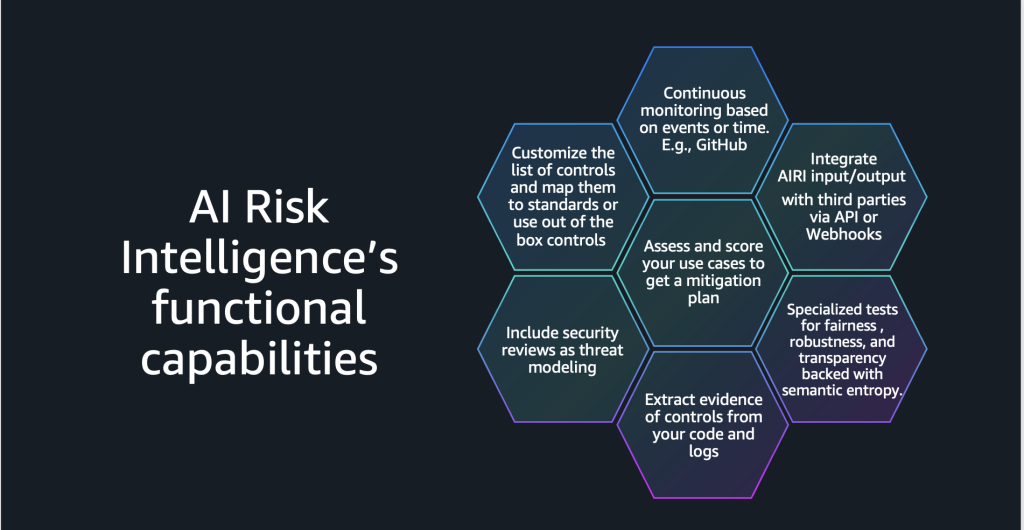
Can your governance keep pace with your AI ambitions? AI risk intelligence in the agentic era
Traditional frameworks designed for static deployments cannot address the dynamic interactions that define agentic workloads. AI Risk Intelligence (AIRI), from AWS Generative AI Innovation Center, provides the automated rigor required to govern agents at enterprise scale—a fundamental reimagining of how security, operations, and governance work together systemically.
How Ring scales global customer support with Amazon Bedrock Knowledge Bases
In this post, you’ll learn how Ring implemented metadata-driven filtering for Region-specific content, separated content management into ingestion, evaluation and promotion workflows, and achieved cost savings while scaling up.

Reimagine marketing at Volkswagen Group with generative AI
In this post, we explore the challenges that Volkswagen Group faced in producing brand-compliant marketing assets at scale. We walk through how we built a generative AI solution that generates photorealistic vehicle images, validates technical accuracy at the component level, and helps enforce brand guideline compliance alignment across the ten brands.
Build a solar flare detection system on SageMaker AI LSTM networks and ESA STIX data
In this post, we show you how to use Amazon SageMaker AI to build and deploy a deep learning model for detecting solar flares using data from the European Space Agency’s STIX instrument.
Deliver hyper-personalized viewer experiences with an agentic AI movie assistant using Amazon Bedrock AgentCore and Amazon Nova Sonic 2.0
In this post, we walk through two use cases that help enhance the user viewing experience using agentic AI tools and frameworks including Strands Agents SDK, Amazon Bedrock AgentCore, and Amazon Nova Sonic 2.0. This agentic AI system uses a Model Context Protocol (MCP) to deliver a personal entertainment concierge that understands user preferences through natural dialogue.