Artificial Intelligence
Category: Amazon Athena
Part 2: Amazon Bedrock cost attribution with Amazon Athena and CUDOS
Learn how to visualize and analyze Amazon Bedrock cost attribution using Amazon Athena and CUDOS dashboards. This post shows how to set up CUR 2.0 with IAM principal data, query Bedrock spend by principal, project, and team, and build dashboards to track AI costs across your organization.
Build a semantic layer for agentic AI on AWS with Stardog and Amazon Bedrock AgentCore
In this post we show how to build a semantic layer on AWS using Stardog’s Semantic AI Application over Amazon Aurora and Amazon Redshift, and how to run a Strands Agents agent on Amazon Bedrock AgentCore that queries the layer to answer customer 360 questions across both sources without extract, transform, and load (ETL). The same Stardog deployment works behind AWS computes (Amazon Elastic Kubernetes Service (Amazon EKS), Amazon Elastic Container Service (Amazon ECS), and AWS Lambda). We use AgentCore here because it bundles inbound auth, hosting, and tool credentials into one managed service.
Building agentic AI applications with a modern data mesh strategy on AWS
This post shows how to build a governed, serverless data mesh on AWS that provides the secure, scalable data foundation production agentic AI requires.
Build an enterprise observability solution for Amazon Quick
When hundreds to thousands of users are onboarded to an enterprise AI platform, business leaders and platform owners need visibility into who is using the platform, whether users are satisfied with the answers they receive, and which capabilities are driving the most engagement. Without a centralized observability solution, this data is scattered across multiple AWS […]

From siloed data to unified insights: Cross-account Athena Access for Amazon Quick
Today, we’re announcing cross-account Athena access for Amazon Quick. With this feature, customers can query Athena data in other AWS accounts using AWS Identity and Access Management (IAM) role chaining, with query costs billed to the account where the data resides.
Unleashing Agentic AI Analytics on Amazon SageMaker with Amazon Athena and Amazon Quick
This post demonstrates how agentic AI assistant from Amazon Quick transform data analytics into a self-service capability by using Amazon Simple Storage Service (Amazon S3) as a storage, Amazon SageMaker and AWS Glue for lakehouse, Amazon Athena for serverless SQL querying across multiple storage formats (S3 Table, Iceberg, and Parquet).
Unlock powerful call center analytics with Amazon Nova foundation models
In this post, we discuss how Amazon Nova demonstrates capabilities in conversational analytics, call classification, and other use cases often relevant to contact center solutions. We examine these capabilities for both single-call and multi-call analytics use cases.
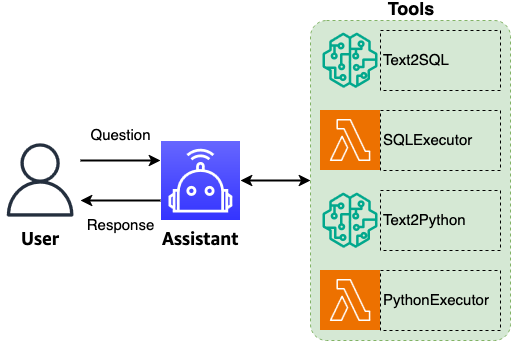
Natural language-based database analytics with Amazon Nova
In this post, we explore how natural language database analytics can revolutionize the way organizations interact with their structured data through the power of large language model (LLM) agents. Natural language interfaces to databases have long been a goal in data management. Agents enhance database analytics by breaking down complex queries into explicit, verifiable reasoning steps and enabling self-correction through validation loops that can catch errors, analyze failures, and refine queries until they accurately match user intent and schema requirements.
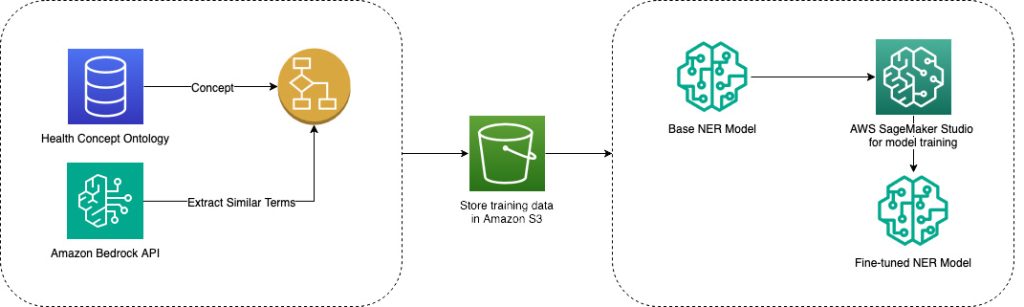
Learn how Amazon Health Services improved discovery in Amazon search using AWS ML and gen AI
In this post, we show you how Amazon Health Services (AHS) solved discoverability challenges on Amazon.com search using AWS services such as Amazon SageMaker, Amazon Bedrock, and Amazon EMR. By combining machine learning (ML), natural language processing, and vector search capabilities, we improved our ability to connect customers with relevant healthcare offerings.

Build a conversational natural language interface for Amazon Athena queries using Amazon Nova
In this post, we explore an innovative solution that uses Amazon Bedrock Agents, powered by Amazon Nova Lite, to create a conversational interface for Athena queries. We use AWS Cost and Usage Reports (AWS CUR) as an example, but this solution can be adapted for other databases you query using Athena. This approach democratizes data access while preserving the powerful analytical capabilities of Athena, so you can interact with your data using natural language.