AWS Public Sector Blog
Deep dive into FedRAMP 20x Key Security Indicators: Decoding the 63 KSIs
The Federal Risk and Authorization Management Program (FedRAMP) 20x program replaces hundreds of narrative control descriptions with Key Security Indicators (KSIs) organized across 12 themes.
In this post, we break down every KSI theme, categorize each indicator by validation approach, and provide a practical gap analysis framework so you can begin preparing your cloud service offering (CSO) for FedRAMP 20x authorization on Amazon Web Services (AWS).
What are Key Security Indicators?
In our first blog post, we introduced FedRAMP 20x and its shift from static documentation to automated evidence. KSIs are the building blocks of that shift. Each KSI represents a measurable, concrete security outcome, which cloud service providers (CSPs) must demonstrate through automated validation, documented processes, or both.
The Phase 2 pilot completeness requirements set a clear bar: Automated validation must cover at least 70% of KSIs, every KSI must be addressed, and evidence must be available in both human-readable and machine-readable formats. Understanding what each KSI requires is the first step toward meeting that bar.
The 12 KSI themes at a glance
The following table summarizes all 12 KSI themes, their associated KSI counts, and primary focus areas to help you quickly assess where your organization stands:
| Theme | Name | KSI count | Focus area |
| CSX | Cross-Cutting | 3 | Implementation summaries, Minimum Assessment Standard (MAS) scope, priority ordering |
| AFR | Authorization by FedRAMP | 10 | MAS, vulnerability disclosure, scanning/remediation, Plan of Action and Milestones (POA&M), significant change notification (SCN), authorization data, persistent validation, continuous monitoring |
| CNA | Cloud Native Architecture | 8 | Network segmentation, attack surface minimization, distributed denial of service (DDoS) protection, API security, automated posture enforcement |
| CMT | Change Management | 4 | Change control, immutable infrastructure, deployment validation |
| IAM | Identity and Access Management | 7 | Phishing-resistant multi-factor authentication (MFA), authentication without passwords, least privilege, just-in-time (JIT) access |
| MLA | Monitoring, Logging, and Auditing | 5 | Audit log generation, security information and event management (SIEM) integration, configuration evaluation |
| SVC | Service Configuration | 8 | Encryption at rest and in transit, Federal Information Processing Standards (FIPS) cryptography, secrets management, secure defaults |
| RPL | Recovery Planning | 4 | Recovery time objective (RTO), recovery point objective (RPO), backup procedures, recovery testing |
| PIY | Policy and Inventory | 5 | Asset inventory, software inventory, executive support, software development lifecycle (SDLC) security |
| INR | Incident Response | 3 | Incident response plan, procedures, post-incident review |
| CED | Cybersecurity Education | 4 | General training, role-specific training, developer training, response/recovery training |
| SCR | Supply Chain Risk | 2 | Supply chain risk assessment, third-party monitoring |
Table 1: The 12 KSI themes at a glance
Categorizing KSIs: Automate, document, or both
Not every KSI can be validated by a machine. Some require documented processes, executive attestations, or human judgment. We categorize each KSI into one of three buckets to help you plan your implementation approach:
- Fully automatable KSIs can be validated entirely through automated tooling, such as AWS Config rules, AWS Security Hub checks, or infrastructure as code (IaC) scanning. Examples include KSI-SVC-SNT (encrypt network traffic), KSI-CNA-RNT (restrict network traffic), and KSI-IAM-MFA (enforce phishing-resistant MFA).
- Process and documentation KSIs require written policies, procedures, or human review cycles. Examples include KSI-INR-AAR (after-action reports), KSI-PIY-RES (executive support review), and KSI-CED-RGT (general training review).
- Both KSIs have an automated component and a documented process component. For example, KSI-AFR-VDR (vulnerability detection and response) requires automated scanning tools and a documented methodology with defined service-level agreement (SLA) timelines.
The following figure illustrates how KSIs are distributed across these three categories and the validation lifecycle from preventive controls through runtime monitoring:
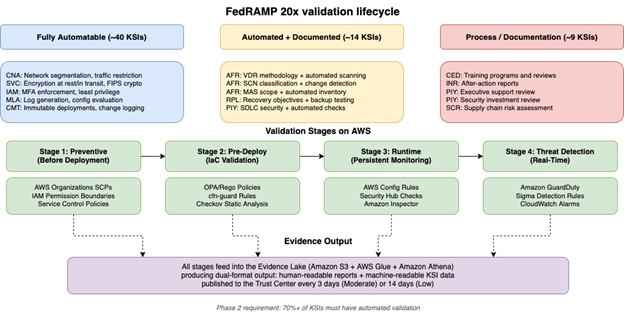
Figure 1: FedRAMP 20x KSI validation lifecycle showing the distribution of KSIs across automated, documented, and hybrid categories, with AWS services mapped to each validation stage
Theme-by-theme breakdown
In this section, we explore the areas relevant to each KSI theme and the AWS services related to that theme.
Authorization by FedRAMP (AFR), 10 KSIs
This is the most complex theme because each KSI ties to a FedRAMP-specific standard. KSI-AFR-MAS requires you to identify every information resource in scope, including people, budgets, and systems. KSI-AFR-VDR requires a complete vulnerability detection and response methodology with N1 through N5 severity ratings and defined remediation timelines. KSI-AFR-SCN requires classifying changes as routine, adaptive, or transformative, each with different notification timelines.
On AWS, services such as Amazon Inspector and AWS Security Hub can help address KSI-AFR-VDR. AWS CloudTrail and Amazon EventBridge support KSI-AFR-SCN by detecting and classifying infrastructure changes.
Cloud Native Architecture (CNA), 8 KSIs
These KSIs focus on network segmentation, attack surface minimization, and automated posture enforcement. KSI-CNA-MAT (minimize attack surface) and KSI-CNA-RNT (restrict network traffic) are strong candidates for automated validation using Amazon Virtual Private Cloud (Amazon VPC) security groups, network access control lists (ACLs), and AWS Network Firewall. KSI-CNA-EIS (enforce intended state) maps directly to AWS Config rules that detect drift from your desired configuration.
Identity and Access Management (IAM), 7 KSIs
KSI-IAM-MFA (phishing-resistant MFA) and KSI-IAM-ELP (least privilege) are foundational. AWS IAM Identity Center supports phishing-resistant MFA with FIDO2 security keys. AWS IAM Access Analyzer helps validate least privilege by identifying unused permissions. KSI-IAM-JIT (just-in-time access) can be addressed through temporary role assumption with time-bounded sessions.
Service Configuration (SVC), 8 KSIs
Encryption is the main idea of this theme. KSI-SVC-SNT (secure network traffic) and KSI-SVC-VRI (validate resource integrity) require FIPS 140-2 validated cryptographic modules. AWS Key Management Service (AWS KMS) provides FIPS-validated key management, and AWS Certificate Manager (ACM) automates Transport Layer Security (TLS) certificate provisioning. KSI-SVC-ACM (automate configuration management) aligns with IaC practices using AWS CloudFormation or Terraform.
Monitoring, Logging, and Auditing (MLA), 5 KSIs
KSI-MLA-OSM (operate SIEM capability) requires centralized, tamper-resistant logging. AWS CloudTrail with organization-level trails, Amazon CloudWatch logs, and AWS Security Hub provide the foundation. KSI-MLA-EVC (evaluate configurations) maps to AWS Config conformance packs that persistently evaluate resource configurations.
Change Management (CMT) 4 KSIs, Recovery Planning (RPL) 4 KSIs, Incident Response (INR) 3 KSIs, and remaining themes
The remaining themes align well with established cloud-based practices and are summarized here at a higher level. CMT KSIs favor immutable infrastructure patterns (KSI-CMT-RMV) where changes are deployed through redeployment rather than in-place modification, a natural fit for IaC workflows.
RPL KSIs require documented and tested recovery objectives. INR KSIs require both documented procedures and evidence of post-incident reviews. CED KSIs are entirely process-based, requiring evidence of training programs. SCR KSIs require supply chain risk assessments and automated monitoring of third-party dependencies.
Understanding persistent validation
A critical concept in FedRAMP 20x is the word persistent. FedRAMP defines it as “occurring in a firm, steady way that is repeated over a long period of time.” For moderate impact systems, machine-based KSI validation must run at least every 3 days. Non-machine KSIs must be validated at least every 3 months.
This means your validation infrastructure must be always-on, not a point-in-time assessment. On AWS, this translates to Amazon EventBridge scheduled rules triggering AWS Step Functions workflows that collect evidence from AWS Config, AWS Security Hub, Amazon Inspector, and other services on a recurring cadence.
Conducting your KSI gap analysis
Start your gap analysis with these steps:
- Assess your current state. For each of the 63 KSIs, document whether you have full coverage, partial coverage, or no coverage today. If you’re running the Landing Zone Accelerator on AWS (LZA) with the Universal Configuration, many CNA, MLA, and IAM KSIs already have partial coverage through AWS Security Hub, Amazon GuardDuty, AWS Config, and AWS CloudTrail.
- Identify automation candidates. Flag every KSI where AWS provides a service or feature that can produce machine-readable evidence. Target the 70% automated validation threshold.
- Catalog documentation gaps. For process-based KSIs, determine whether you have existing policies that can be adapted or whether new documentation is needed.
- Prioritize by theme. Follow the recommended priority order: AFR KSIs first (they define the framework), then CNA and IAM (foundational security posture), then SVC and MLA (operational security), and finally the remaining themes.
- Plan your evidence pipeline. Every KSI needs evidence in both human-readable clear summaries with context, timestamps, and plain-language explanations of what was verified, and machine-readable formats. Plan how each piece of evidence will be generated, stored, and published.
What comes next
With your gap analysis complete, the next step is implementing preventive controls that prohibit noncompliant configurations before they reach your environment. In our next blog, we cover how AWS Organizations service control policies (SCPs) enforce KSIs at the organizational level, reducing both your compliance burden and your assessment surface.
Next steps and resources
- Contact AWS Security Assurance Services – Get help with your FedRAMP authorization journey
- FedRAMP 20x overview – Program overview, goals, and phased delivery timeline
- FedRAMP 20x Phase 2 requirements – Completeness requirements and KSI-AFR discussion
- FedRAMP 20x goals – The five key goals driving the 20x program
- AWS Security Hub – Centralized security findings aggregation
- AWS Config – Persistent configuration evaluation and compliance
- Landing Zone Accelerator on AWS – Multi-account environment with built-in security controls
- Prepare for FedRAMP 20x with AWS automation and validation – Series introduction and architecture overview