AWS Public Sector Blog
Prepare for FedRAMP 20x with AWS automation and validation
This post shows you how to use Amazon Web Services (AWS) services to meet Federal Risk and Authorization Management Program (FedRAMP) 20x requirements, reducing authorization time from months to weeks through automated compliance pipelines and continuous validation. You’ll learn how to build a trust center, automate vulnerability detection, generate Key Security Indicators (KSIs), and implement change notification workflows, all using services you might have deployed.
If you’ve pursued FedRAMP authorization before, you know the challenges: 12- to 18-month timelines, mountains of static documentation, and point-in-time assessments that become outdated almost immediately. FedRAMP 20x changes this model fundamentally, and if you’re building on AWS, you’re well positioned to take advantage of it.
What is FedRAMP 20x?
FedRAMP 20x is a fundamental reimagining of cloud security authorization. The “20x” name signals an ambitious goal: making the authorization process roughly 20 times faster while maintaining or even improving security outcomes.
Instead of periodic, documentation-heavy assessments, FedRAMP 20x shifts toward continuous validation instead of point-in-time audits, machine-readable security evidence instead of static documents, automated compliance pipelines instead of manual evidence collection, and real-time security indicators instead of annual reports.
This isn’t just a faster version of the old process, it’s a different philosophy. FedRAMP 20x treats security as an engineering discipline with measurable, verifiable outputs rather than a documentation exercise.
FedRAMP 20x phases: Where you are today
FedRAMP 20x is rolling out in two phases:
- Phase 1 (completed) – Established the foundational concepts and gathered industry feedback. This phase defined the core 20x requirements, trust centers, Key Security Indicators (KSI), automated Vulnerability Detection and Response (VDR), and Significant Change Notification (SCN), and piloted them with select cloud service providers (CSPs).
- Phase 2 (current) – Operationalizes the Phase 1 concepts. You can now pursue 20x authorization using the refined requirements. The program is actively accepting participants, and the compliance system, which includes assessors, tooling vendors, and automation frameworks, is maturing rapidly.
Why you’re well positioned for FedRAMP 20x on AWS
Before diving into specific services and patterns, it’s worth understanding why building on AWS gives you a head start with FedRAMP 20x.
FedRAMP 20x favors organizations that operate cloud-centered architectures, automate security signals and evidence collection, use continuous integration and continuous deployment (CI/CD) for ongoing assurance, can report measurable machine-readable security indicators, and detect and respond to configuration and security changes automatically.
You have access to capabilities built into your AWS services. Here’s why:
- AWS services align to automation-first assurance – Logging, monitoring, configuration management, vulnerability scanning, and CI/CD capabilities are deeply integrated across AWS.
- Consistent security baselines across environments – Whether you’re using services in AWS GovCloud (US) or commercial AWS Regions, you build one time and inherit controls consistently through standardized cloud-based primitives while you configure services and implement specific controls under the AWS shared responsibility model.
- Proven experience with regulated workloads – AWS has years of experience supporting FedRAMP. Many 20x concepts, such as continuous monitoring, measurable security, and automated evidence, map directly to existing AWS best practices.
For you, enabling 20x readiness is less about rewriting controls and more about connecting existing AWS telemetry, security automation, and continuous monitoring tools into a centralized evidence workflow.
How AWS services map to FedRAMP 20x requirements
The following figure shows how AWS services work together to support FedRAMP 20x compliance. Your application feeds security data into three parallel processing tracks—detection and scanning, logging and monitoring, and configuration compliance. These tracks consolidate through AWS Security Hub, which then feeds automated evidence pipelines, response workflows, and change detection systems. The final outputs are machine-readable KSI, VDR, and SCN reports for your FedRAMP 20x authorization package.
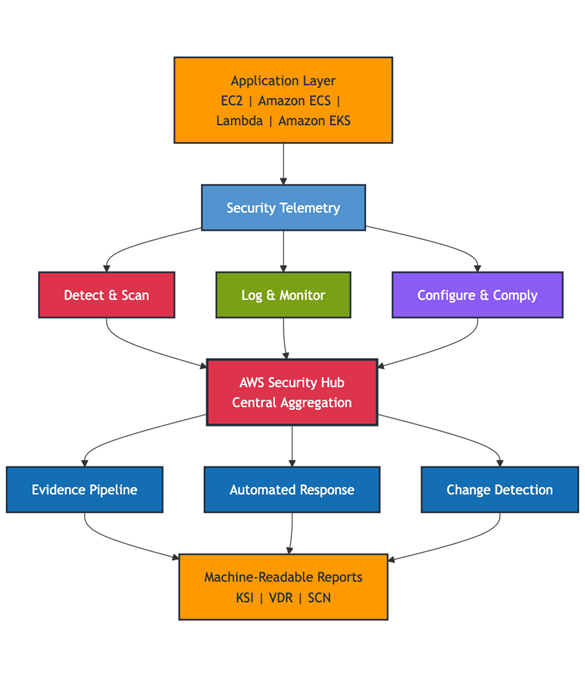
Figure 1: FedRAMP 20x compliance architecture on AWS
Building your trust center with AWS
FedRAMP 20x requires a centralized, automated trust center that produces machine-readable security evidence, such as the Open Security Controls Assessment Language (OSCAL). Security professionals can use this evidence to focus on real-world threats rather than spending valuable time on extensive documentation. Think of it as a continuously updated dashboard that proves your security posture, not through documents, but through data.
The following table shows how AWS services support your trust center implementation.
| Service | Role in trust center |
| AWS Security Hub | Consolidated security findings from across your environment |
| AWS Config | Continuous configuration state monitoring |
| AWS CloudTrail | Account and service-level API auditing |
| Amazon CloudWatch | Metrics, logs, and anomaly detection |
| AWS Audit Manager | Automated evidence collection against compliance frameworks |
| AWS Systems Manager | Patching, inventory, and configuration compliance |
| AWS Glue and Amazon Athena | Transform evidence into machine-readable formats for KSI reporting |
By combining these components, you create an automated evidence pipeline that aligns with the FedRAMP 20x Trust Repository model.
Automating vulnerability detection and response
FedRAMP 20x emphasizes continuous scanning and auto-remediation, not only finding vulnerabilities, but demonstrating that you find and fix them systematically.
The following table shows how AWS services support your VDR requirements.
| Service | VDR capability |
| Amazon Inspector | Automated scanning of Amazon Elastic Compute Cloud (Amazon EC2) instances and container images |
| Amazon Elastic Container Registry (Amazon ECR) | Container image vulnerability scanning |
| AWS Lambda | Automated remediation functions |
| Patch Manager, a capability of AWS Systems Manager | Patch compliance at scale |
| AWS Config rules and Security Hub | Continuous drift detection |
| Amazon GuardDuty | Threat detection aligned to runtime events |
By integrating these services into your CI/CD pipeline using AWS CodePipeline or GitHub Actions, you achieve continuous vulnerability detection aligned to 20x requirements.
Generating KSIs with AWS
KSIs are the measurable security signals that FedRAMP 20x requires authentication, authorization, encryption, boundary integrity, configuration state, and vulnerability status.
The following table shows how AWS services provide KSI signals.
| KSI category | AWS services |
| Authentication and authorization | AWS Identity and Access Management (IAM), IAM Access Analyzer |
| Encryption | AWS Key Management Service (AWS KMS) |
| Boundary integrity | VPC Flow Logs, AWS Network Firewall |
| Configuration state | AWS CloudTrail, AWS Config |
| Aggregated compliance | Security Hub compliance scores |
You can export these signals to Amazon Simple Storage Service (Amazon S3), process them with AWS Glue, and publish machine-readable KSI output for your FedRAMP 20x package.
Implementing automated Significant Change Notification
FedRAMP 20x requires automated change detection and classification. When something changes in your environment, you need to know, and you need to know whether that change triggers reporting requirements.
The following table shows how AWS services support your SCN requirements.
| Service | SCN role |
| AWS Config and Amazon EventBridge | Detecting and routing configuration changes |
| AWS CodePipeline, AWS CodeDeploy, and AWS CodeBuild | Deployment tracking |
| AWS CloudFormation or Terraform | Infrastructure as code (IaC)-based change detection |
| AWS Lambda | SCN rule evaluation and payload generation |
You can implement an SCN-as-code workflow using EventBridge to automatically identify when a change requires submission under FedRAMP rules.
Aligning to the Minimum Assessment Standard
The Minimum Assessment Standard (MAS) simplifies assessment scope while preserving security rigor. You can use the Security pillar of the AWS Well-Architected Framework to meet MAS-aligned expectations, use AWS Organizations service control policies (SCPs) to enforce MAS technical requirements, and rely on AWS inherited controls through AWS Artifact to dramatically reduce your documentation burden.
The MAS is effectively a modernization signal: focus security where it matters. AWS architectures favor defense-in-depth aligned to these expectations.
A phased approach to FedRAMP 20x readiness
To bring your organization into line with FedRAMP 20x, follow this phased approach.
To assess and baseline your environment (Phase 1):
- Map your architecture to MAS requirements.
- Inventory your existing AWS logging and monitoring configurations.
- Enable foundational services: AWS Config, AWS CloudTrail, AWS Security Hub, Amazon GuardDuty, and Amazon Inspector.
To automate evidence collection (Phase 2):
- Create a trust center built on Amazon S3, AWS Glue, Athena, AWS Config, and CloudTrail.
- Configure continuous scanning with Amazon Inspector and Patch Manager.
- Begin building KSI metric extraction pipelines.
To operationalize continuous validation (Phase 3):
- Implement SCN automation using EventBridge and AWS Lambda.
- Integrate your CI/CD deployments with KSI and VDR pipelines.
- Produce machine-readable evidence and test 20x package formats.
Conclusion
FedRAMP 20x represents a fundamental shift from documentation-based compliance to engineering-based assurance. When you build on AWS, this shift plays directly to your strengths.
AWS security services, continuous monitoring capabilities, and automation ecosystem position you to meet 20x requirements including machine-readable evidence generation, KSI reporting, automated vulnerability detection and response, continuous change monitoring, and persistent validation workflows.
As FedRAMP moves toward automation-first compliance, you have the advantage of working with a platform that embodies these principles of automation and continuous validation. By implementing these AWS automation patterns today, you’ll be well positioned for FedRAMP 20x modernization in weeks rather than months while maintaining continuous compliance through machine-readable evidence and automated validation.
Next steps
To learn more about FedRAMP 20x and AWS compliance capabilities, explore these resources:
- AWS Compliance Center – Access AWS compliance reports and certifications through AWS Artifact
- AWS Security Hub User Guide – Learn how to aggregate and prioritize security findings
- AWS Well-Architected Framework: Security pillar – Review security best practices aligned to MAS requirements
- FedRAMP 20x Overview – Official FedRAMP 20x program documentation and requirements
- Contact AWS Security Assurance Services – Get help with your FedRAMP authorization journey