
Sold by: SentinelOne
Deployed on AWS
SentinelOne Singularity AI SIEM revolutionizes your security operations on AWS. Eliminate the skyrocketing ingestion costs and data overloads of legacy SIEMs by utilizing Observo AI to filter data volumes. This provides a deeper, richer dataset, enabling smarter and more accurate detections, accelerated generative AI investigations, and precise responses with Singularity Hyperautomation. AI SIEM is fundamentally shifting the role of security analyst from manual, repetitive tasks to strategic defense. Empower your team to accelerate investigations and mitigate critical risks with a fast, scalable, and intelligent SIEM built for the Autonomous SOC.
4.2
Overview
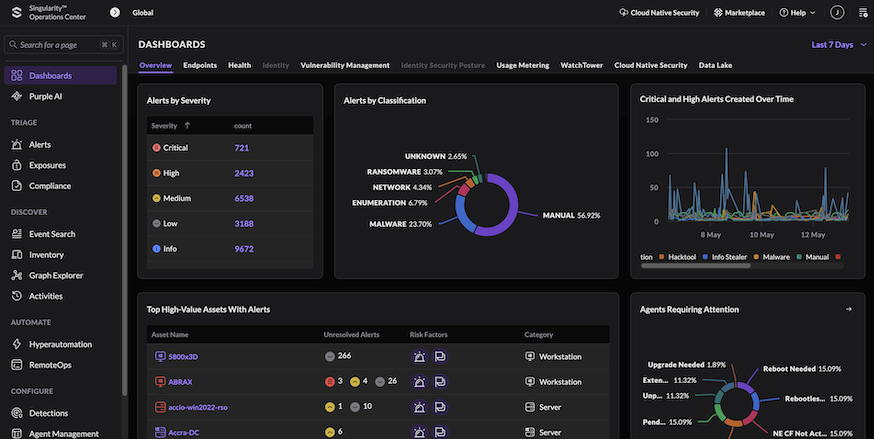
SentinelOne Singularity AI SIEM is a cloud-native SaaS solution that revolutionizes security operations by unifying cutting-edge generative and agentic AI with advanced hyperautomation. This fundamentally shifts the security analyst's role from repetitive, manual tasks to strategic threat analysis and proactive defense, enabling teams to operate with unprecedented speed and efficiency.
Unlike legacy SIEMs, our platform is built on an open, unified data lake designed for the scale and speed of modern cloud environments. It processes rich, unfiltered data to deliver autonomous threat mitigation, drastically reducing alert fatigue and mean time to resolution (MTTR) for AWS customers.
Key Features & Benefits
Autonomous & Agentic AI: Critical threats are autonomously mitigated by our AI, seamlessly augmenting human analysts for effective threat hunting and investigations.
Hyperautomation Workflows: Streamline security operations with no-code automation to design and deploy workflows that automate triage, investigation, and response processes.
Observo AI for Data Optimization: Our integration gives you an AI-native pipeline that ingests, enriches, and optimizes data before it reaches the SIEM. This reduces ingestion costs by ensuring you only pay for critical security posture data.
Purple AI for Accelerated SecOps: Our generative AI analyst is built into the platform to reduce manual effort. It provides instant summaries and automates threat hunting with natural language to accelerate investigations.
Seamless AWS Integrations
SentinelOne Singularity AI SIEM is designed to integrate seamlessly into your AWS security ecosystem, providing enhanced visibility and simplified operations.
Amazon Security Lake: Ingest high-fidelity security data from SentinelOne and other sources into Amazon Security Lake for a unified view, simplifying compliance and enabling in-depth threat hunting.
AWS Security Hub: Automatically send and receive security findings, allowing for centralized management and a comprehensive security posture assessment across your entire AWS environment.
Amazon GuardDuty: Enhance your threat detection by correlating SentinelOne data with findings from GuardDuty, gaining a deeper understanding of malicious activity in your AWS accounts.
AWS AppFabric: Get a unified, contextualized view of user activity across your SaaS applications and your AWS environment, improving your ability to detect and respond to insider threats and compromised accounts.
NEW - AWS Security Incident Response: Manage security incident response across AWS environments within Hyperautomation's no-code canvas, adding context from both external and internal sources and reducing MTTR.
Experience the Autonomous SOC
Break free from the limitations of legacy SIEMs and empower your security team to focus on what matters most. With SentinelOne Singularity AI SIEM on AWS, you can achieve faster threat detection, more efficient investigations, and a stronger security posture.
Highlights
- 100x faster than legacy SIEM
- 50% lower operational costs and 246% ROI compared to legacy SIEM
- 99% reduction in risk exposure, and 80% faster threat detection compared to AI SIEM
Details
New
Introducing multi-product solutions
You can now purchase comprehensive solutions tailored to use cases and industries.

Features and programs
Trust Center

Access real-time vendor security and compliance information through their Trust Center powered by Drata or Vanta. Review certifications and security standards before purchase.
Buyer guide
Gain valuable insights from real users who purchased this product, powered by PeerSpot.
Financing for AWS Marketplace purchases
AWS Marketplace now accepts line of credit payments through the PNC Vendor Finance program. This program is available to select AWS customers in the US, excluding NV, NC, ND, TN, & VT.

Pricing
Pricing is based on the duration and terms of your contract with the vendor. This entitles you to a specified quantity of use for the contract duration. If you choose not to renew or replace your contract before it ends, access to these entitlements will expire.
Additional AWS infrastructure costs may apply. Use the AWS Pricing Calculator to estimate your infrastructure costs.
Dimension | Description | Cost/12 months |
|---|---|---|
Contact us for pricing | Daily ingestion starting from $721 | $125,000.00 |
Dimensions summary
This listing uses a single contract-based pricing dimension. Your cost is driven by daily data ingestion volume, with pricing starting from the amount shown in the table. You pay based on how much security data you feed into the platform each day, so the price scales with your ingestion needs. Because pricing is quote-based, you contact the vendor to set final terms for your environment. There are no separate tiers or add-on line items in the Marketplace table — the daily ingestion rate is the one metric that determines your commitment.
Top-of-mind questions for buyers
Daily ingestion measures the volume of security data you feed into the platform each day. This includes telemetry from cloud, identity, endpoints, and third-party tools routed through one data pipeline. Your daily total across all these sources sets the metric your contract is priced against.
Your price scales with daily ingestion, so feeding more data each day raises your cost. The platform is built to ingest large volumes without forcing early filtering or moving older data to slow archives. Because pricing is quote-based, you contact the vendor to set terms for higher ingestion levels.
The Marketplace table shows one metric: daily ingestion. Data pipelines, Purple AI investigation, and Hyperautomation response run on the same platform foundation and share the same data. There are no separate line items in the table for these capabilities. Contact the vendor to confirm what your contract covers.
sentinelone.com+1
Helpful?
Vendor refund policy
Contact us for refund questions or concerns.
Custom pricing options
Request a private offer to receive a custom quote.

Legal
Vendor terms and conditions
Upon subscribing to this product, you must acknowledge and agree to the terms and conditions outlined in the vendor's End User License Agreement (EULA) .
Content disclaimer
Vendors are responsible for their product descriptions and other product content. AWS does not warrant that vendors' product descriptions or other product content are accurate, complete, reliable, current, or error-free.
Delivery details
Software as a Service (SaaS)
SaaS delivers cloud-based software applications directly to customers over the internet. You can access these applications through a subscription model. You will pay recurring monthly usage fees through your AWS bill, while AWS handles deployment and infrastructure management, ensuring scalability, reliability, and seamless integration with other AWS services.
Support
Vendor support
Support is available for these solutions via telephone or our customer support portal. Contact: 1-855-868-3733 General Inquiries: sales@sentinelone.com
AWS infrastructure support
AWS Support is a one-on-one, fast-response support channel that is staffed 24x7x365 with experienced and technical support engineers. The service helps customers of all sizes and technical abilities to successfully utilize the products and features provided by Amazon Web Services.
Similar products
Observo AI, a SentinelOne Company, helps you reduce security and observability costs by 50% or more while resolving incidents 40% faster.

Unlock enterprise-wide security for your AWS environment with SentinelOne Singularity Platform. This AI-powered solution provides real-time threat detection and automated response across your infrastructure, ensuring continuous protection at infinite scale. By autonomously securing endpoints, cloud workloads, and identity, SentinelOne delivers total visibility while eliminating security silos. Integrate seamlessly with AWS and leverage our unified data lake and Purple AI to accelerate investigations and gain deeper insights. Secure your AWS cloud and focus on innovation with the speed and efficiency of AI.

Block attacks and secure your entire cloud with SentinelOne Singularity Cloud Security, an AI-powered CNAPP providing deep visibility and robust, real-time protection to defend your AWS environment from initial access to mission target. It unifies proactive exposure management, and real-time protection to safeguard your AWS infrastructure, workloads (VMs, containers), and data with AI-powered detection and automated response. Try Cloud Security for free!

Purple AI Model Context Protocol (MCP) Server provides secure, seamless integration between the Singularity Platform and any AI framework or large language model. Acting as a universal translator and intelligence hub, it empowers developers and partners to build custom agentic AI experiences powered by the full context and analytics of the SentinelOne platform. The open-source Purple AI MCP Server is available today on GitHub and will also be deployable as an EKS and through Amazon Bedrock, using Agent Core. Users will need to have an active deployment of SentinelOne console and be able to obtain the SentinelOne Singularity Console token and url to be able to deploy and use the Purple AI MCP server.
Customer reviews
Likhith Varma
AI-driven investigations have improved real-time monitoring and simplified alert analysis
Reviewed on Sep 07, 2026
Review provided by PeerSpot
What is our primary use case?
SentinelOne Singularity AI SIEM is a tool that we use to support our clients. Our organization is a service-based organization, so we use SIEM to provide services to software-based clients. We are a partner with SentinelOne.
What is most valuable?
The best features of SentinelOne Singularity AI SIEM include its ability to give you a brief description of what the alert is about. When an alert is triggered with AI SIEM, we have a basic analysis of what the alert is about, and it will give you the understanding of what the alert is.
I especially value that analysis feature. If you get an alert in SentinelOne Singularity AI SIEM, we have an auto-investigate tab as well. If you click on that auto-investigate tab, it will correlate with all the products and data sources it has, and it will give you a deep analysis of what the alert is and what is happening, so everything is covered.
The real-time monitoring is pretty good. It correlates between all the different data sources that have been integrated with SentinelOne Singularity AI SIEM. It will correlate everything and give you a pretty good storyline of what the alert is about.
Overall, this affects my security posture positively because it improves it since it helps us in real-time monitoring, and it gives us automated investigation and also the auto-investigate tab, so it is pretty good.
What needs improvement?
My impression of the AI-driven threat detection capabilities is that it helps a little bit, but they need to tune it a bit because we are seeing too many false positives recently. Since we are a partner with SentinelOne, we are working along with them to tune those out.
I assess the efficiency of SentinelOne Singularity AI SIEM in improving our responses to sophisticated threats as not having improved a lot because, as I mentioned earlier, there are a few things that need improvement, including the false positive rate. Since we are seeing too many false positives, even if a true positive comes, it is harder for us to determine the difference between the false positive and true positive.
The effect on our SOC ability in reducing false positives has not been significant. We have opted for the possibility of doing some automation. Because of that automation, if SentinelOne Singularity AI SIEM already does the basic analysis, it will close out a few of the false positives, but not that much. I would say around ten to twenty percent of the alert volume is reduced.
The areas that need improvement with SentinelOne Singularity AI SIEM include faster responses. The tool is a bit slow since it is under development, so it is not that fast. They also need to improve on developing more use cases that will help determine the true positives.
I have not worked with any SIEM that is integrated with AI, but if I compare SentinelOne Singularity AI SIEM with Microsoft Sentinel, Sentinel has some use cases that are kind of true positives and all. Here, they need to improve on the tool functionality and faster responses.
For how long have I used the solution?
I have been using SentinelOne Singularity AI SIEM for the past one and a half years.
What do I think about the stability of the solution?
I rate the stability of SentinelOne Singularity AI SIEM as pretty stable unless there is an upgrade. But if you run too many queries, it will be down.
What do I think about the scalability of the solution?
The scalability of SentinelOne Singularity AI SIEM is pretty good; I would rate it around a nine.
How are customer service and support?
I would rate the technical support around five.
I rate it five because even if you raise a case with SentinelOne support, you will not get that fast of a response. Even if you raise a P1 or P2, you have to engage back-end support in order to get a response from them. That has been a major drawback in the tool. Also, even if you get a response, it will be a generic response.
What was our ROI?
The alert volume has been reduced by around ten to twenty percent.
What's my experience with pricing, setup cost, and licensing?
The pricing for SentinelOne Singularity AI SIEM is cheap when compared with other tools. I do not know the exact prices, but I heard it is cheap when compared with the other tools in the market.
What other advice do I have?
In my organization, approximately eighty people work with SentinelOne Singularity AI SIEM.
Our clients vary in size; we have small businesses, medium enterprises, and large enterprises as well.
SentinelOne Singularity AI SIEM does require maintenance in that we manage the integration and everything, but the tool UI and everything is updated by the SentinelOne team itself. We do not upgrade anything.
Doing updates for SentinelOne Singularity AI SIEM is easy.
I evaluate the efficiency in investigating alerts and responding to various incidents as pretty good; they have a pretty good collection of events. You will have all the events that you need to do an investigation, and I would say it is pretty good. Once you start working with the tool, you will have pretty good responses in the event search to investigate.
We are using the automated workflow feature in order to reduce the number of false positives. With that, benign threats and all will be there, so we are just closing them out. It is reducing the volume of alerts for now.
The advice I would give others looking to implement SentinelOne Singularity AI SIEM is that it has its pros and cons. If you are looking for a decent tool for investigation, it is good. But if you are a large enterprise and if you have loads of logs that are being ingested, I would say just think about it because we are having issues while handling large clients and pulling a larger number of logs. I would rate this product an eight out of ten.
reviewer2835498
AI-driven security workflows have transformed investigations and now reduce incident response times
Reviewed on Jul 23, 2026
Review from a verified AWS customer
What is our primary use case?
SentinelOne Singularity AI SIEM's main use case is to enhance cybersecurity by using AI to detect, investigate, and automatically respond across endpoints, cloud, and identities. It helps security teams reduce manual efforts, accelerate incident response, and improve overall security operations.
In my previous role, I used SentinelOne Singularity AI SIEM to investigate endpoint security alerts. Instead of manually using logs from multiple systems, I used the AI-powered investigation features to quickly identify the root cause of suspicious activities. SentinelOne Singularity AI SIEM automatically correlated related events and highlighted the affected endpoints while recommending response actions. We isolated the endpoints with a single click after verifying it was a malicious script, and we remediated the issue much faster than the previous manual process.
What is most valuable?
The best features of SentinelOne Singularity AI SIEM are AI-powered threat detections, unified security data, Purple AI assistant, automated investigations, hyper-automations, and fast threat hunting. These features include centralized log management, Purple AI for natural log investigations, automated alert correlations, and hyper-automations for incident response. These features help security teams detect threats faster, reduce manual effort, minimize false positives, and significantly improve mean time to detect and mean time to respond.
These features significantly improved our SOC workflow. Previously, analysts had to manually collect logs from multiple tools and correlate alerts, which was time-consuming. With SentinelOne Singularity AI SIEM, alerts were automatically correlated into a single incident with an attack timeline, making investigations much faster. Purple AI helped summarize the incident and answer natural language queries, reducing the time spent searching through logs.
SentinelOne Singularity AI SIEM has improved our overall security posture and is reducing the workload on the SOC team. Its AI-driven detection and automated response capabilities help us identify threats faster, reduce false positives, and shorten incident response times. The centralized visibility across endpoints and cloud environments also made investigations more efficient, while automation reduced repetitive manual tasks.
It has improved SOC efficiency by reducing time analysts spend on manual alert investigations and response. Previously, analysts had to collect information from multiple sources and manually correlate events. With SentinelOne Singularity AI SIEM's AI-driven alert prioritization, automated incident correlations, and investigation timelines provide better context quickly. The team can identify the root cause faster, reduce alert fatigue, and take response actions such as isolating affected endpoints more efficiently.
What needs improvement?
SentinelOne Singularity AI SIEM is a strong platform, but there are a few areas where it could be improved. First, the initial setup and integration with some third-party tools could be simpler. Second, more customizable dashboards and reporting would help the management team confirm their needs.
For how long have I used the solution?
I have been using SentinelOne Singularity AI SIEM for the last three years.
What other advice do I have?
My impression of SentinelOne Singularity AI SIEM's AI-driven threat detection capability is very positive. It uses behavioral analysis and machine learning to identify suspicious activity that may not be detected by traditional signature-based methods.
I used SentinelOne Singularity AI SIEM's automated workflow capability to reduce repetitive security tasks. For example, when a high-risk alert was detected, automated workflows helped with actions such as endpoint isolation, alert enrichment, and triggering response processes without requiring manual intervention at every step. This reduced the time analysts spent on routine tasks and has improved consistency in incident handling.
My advice would be to clearly define your security goals and use cases before deploying SentinelOne Singularity AI SIEM. Start with proper endpoint coverage, integrate with your existing security tools, and spend time tuning policies to reduce unnecessary alerts. I would also recommend training the SOC team on the AI investigations and automation features so they can fully benefit from the platform. Finally, continuously review detection results and response processes to ensure the platform is meeting the organization's security needs. I would rate this solution an eight out of ten.
Which deployment model are you using for this solution?
Public Cloud
If public cloud, private cloud, or hybrid cloud, which cloud provider do you use?
Amazon Web Services (AWS)
Dev Reshwal
Automation has reduced workload and real-time monitoring provides faster incident response
Reviewed on Jul 20, 2026
Review from a verified AWS customer
What is our primary use case?
In my daily work, the main use case for SentinelOne Singularity AI SIEM is creating rules, fine-tuning, source recording, rule creations, and when any alerts are triggered. We can raise them to the client side, continuously monitoring any alerts. We can raise them to the client side for early resolution, also creating the dashboards, checking the logs, and agents installation. Those are the day-to-day tasks in our SIEM tool.
Alert fighting is a specific example of a recent situation where I used SentinelOne Singularity AI SIEM for one of these tasks. Sometimes multiple alerts are triggered in the SIEM. At that time, we analyze what type of alert it is, whether it is a true positive or false positive. That is challenging for me.
Our day-to-day tasks include alert raising, continuous monitoring, raising the alerts, dashboard managing, creating the dashboard, rule creating, and decoder creating. If there is any requirement from the client side, we will also do these types of activities, creating any new rule.
When I have those multiple alerts and I need to figure out if they are true positives or false positives, I usually check in Deep Visibility if it belongs to any suspicious fields or anything malicious, or if it is a true positive belonging to our organization. I also check if it belongs to any suspicious sites, IPs, or IOCs such as malicious IPs or malicious hashes, or if it belongs to any malicious paths. I will check the source, the destination, and what it is doing. We can check if the path belongs to a genuine path or a suspicious path. We will do that type of analysis and then I will specify if it belongs to a true positive or a false positive. We can follow those types of steps.
What is most valuable?
SentinelOne Singularity AI SIEM offers the best features that belong to the AI. This includes automated alerts. We can also do the automated alerts on these fields. I can create multiple types of use cases. It means we will create multiple types of use cases for our requirements. For example, if we have blocked any suspicious or malicious app in the environment, we can block these. That is a best feature, and Purple AI is also a best feature in SentinelOne Singularity AI SIEM tools. Deep Visibility is also a best feature because we can check multiple types of activity, such as what it is doing, what activities it is currently performing, and what the steps are. There are multiple types of best features in there.
I will give an example of how Deep Visibility has helped me in my investigations or daily work. If any suspicious or malicious malware types of alerts are triggered in SentinelOne Singularity AI SIEM, then I will check the source of this with the help of Deep Visibility. Deep Visibility is basically for when any alerts are triggered on any endpoint. You can see what types of activity are being done, what is being downloaded, and what types of history there are. You can check the source, the destination, and what systems are doing this activity. I will check that type of feature in Deep Visibility.
SentinelOne Singularity AI SIEM has impacted my organization positively because I am observing some improvement. There are multiple tool alerts in our organization, but SentinelOne Singularity AI SIEM feature is real-time monitoring and real-time threat detection. With the help of our and the client's organization, it is secure. There are improvements. Those types of improvements are better for securing our organization from anything suspicious or any malicious types of alerts.
There are faster response times available with SentinelOne Singularity AI SIEM. Also, there is the automation alert. We can set any parameter on SentinelOne Singularity AI SIEM source, and it will automatically raise an alert to the client side. We can also integrate that type of feature with SentinelOne Singularity AI SIEM. With the help of alert raising, there is the fastest way to raise an alert. That is the best feature and there is a very big improvement.
What needs improvement?
SentinelOne Singularity AI SIEM is the best, but sometimes the dashboards are a little simple compared to other tools. The custom dashboard is not available in their features. Therefore, I would suggest adding the custom dashboard for any of our requirements.
The AI-driven analytics from SentinelOne Singularity AI SIEM has not affected our ability to reduce false positives.
SentinelOne Singularity AI SIEM has affected my SOC's efficiency in investigating alerts and responding to incidents. If we receive any alerts, we can observe what activity is being done. We can see if it is malicious or something suspicious, or a true positive. We can analyze the path, the hash, and whether the signature is verified or not. We can see if it is an alert triggered by any engine. We can see the source of this. We will do that type of analysis and raise it to the client side. Also, if I identify anything suspicious or malicious in the alert, I will forcefully kill and quarantine it immediately.
For how long have I used the solution?
I have been working in my current field for the last two years and five months.
What do I think about the stability of the solution?
SentinelOne Singularity AI SIEM is stable.
What do I think about the scalability of the solution?
The pricing for SentinelOne Singularity AI SIEM is best, and it has very easy features for understanding. There are multiple tools with various types of features, but SentinelOne Singularity AI SIEM provides some features, maybe fewer features, but they are very useful features. We can say that to the client. Also, the integration parts are easy. It is cloud-based, and there are multiple automation activities also being done. It is an easy way to work, and minimum workers are needed. SentinelOne Singularity AI SIEM is doing multiple types of activities because there are automated tools with AI features. There are also Deep Visibility and multiple Purple AI types. It has multiple best features. We can suggest those types of things to the client for purchasing SentinelOne Singularity AI SIEM.
I will give SentinelOne Singularity AI SIEM a ten out of ten on scalability.
I rate SentinelOne Singularity AI SIEM a ten out of ten because there are the best features in there. There are multiple types of features such as auto-raising, automation, AI features, and the Deep Visibility feature. There is an improvement in our organization to be faster to secure our organization's safety. That is why I will give it a ten out of ten. The integration part is also best. It is a ten out of ten from my side. That is why I give it a ten out of ten.
How are customer service and support?
The customer support for SentinelOne Singularity AI SIEM is also the best because we have raised tickets to the support center multiple times. The support team gives an immediate answer, within ten to fifteen minutes. They also schedule calls and troubleshoot the alerts and solve the issue. The support team is very best.
I rate the customer support for SentinelOne Singularity AI SIEM a ten out of ten.
Which solution did I use previously and why did I switch?
In our organization, we previously used the CrowdStrike solution.
We switched from CrowdStrike to SentinelOne Singularity AI SIEM because our organization is an MSSP organization. That means I provide services to the client. We had twenty to thirty clients in our organization that we managed. Twenty-seven or twenty-eight clients were using SentinelOne Singularity AI SIEM, but only one or two clients were on CrowdStrike. Their client also switched to SentinelOne Singularity AI SIEM. That is why, at this time, we are only managing SentinelOne Singularity AI SIEM.
How was the initial setup?
The integration part for SentinelOne Singularity AI SIEM is very easy. Any fresher can easily do this. The agent installation is also so easy. Within one to two minutes, we can install SentinelOne Singularity AI SIEM agents in the environment or client environment network. It is the best, fastest installation.
What was our ROI?
I have seen a return on investment with SentinelOne Singularity AI SIEM. The tool also saves our money and time. The pricing is very medium, and time is also saved because there are automation features available. That is why multiple alerts are raised by the automated process. In those times, manual alerts are less frequent compared to other tools. It is helpful. Sometimes, in our organization, two people are working on these AI-driven features in SentinelOne Singularity AI SIEM. But when the automation features are started, one person can also manage the console. It is money saved, and the automation and those types of activities are doing the automated alerts. One person is only managing and checking if the alerts are going properly. That is why it is also money-saving. It is a money-saving tool, and the pricing is also low. Any small or startup organization can also buy it easily.
What's my experience with pricing, setup cost, and licensing?
My experience with pricing, setup cost, and licensing for SentinelOne Singularity AI SIEM is that the setups are very easy for any fresher. Any basic knowledge can also do the setups. Regarding the pricing, it is not heavy. It is in the middle, not high, not low. Any small organization can also purchase this. Compared to another SIEM tool's pricing, the pricing is the best, from my side.
Which other solutions did I evaluate?
Before choosing SentinelOne Singularity AI SIEM, I did not evaluate other options because SentinelOne Singularity AI SIEM is the best according to me. We have used other tools, but SentinelOne Singularity AI SIEM has multiple types of features and it is an easy-to-understand tool. That is why I am choosing SentinelOne Singularity AI SIEM.
What other advice do I have?
The accuracy and reliability of output from SentinelOne Singularity AI SIEM are very high. SentinelOne Singularity AI SIEM is very accurate. It is also very reliable. We have not found any glitching. It is faster, and it also has real-time threat hunting and real-time detection. That is the capability in there.
The real-time monitoring feature of SentinelOne Singularity AI SIEM helps with Deep Visibility. If any malicious or suspicious alerts are triggered, I will check the alert. We can analyze this alert with the help of Deep Visibility. We can see its source, its destination, what it is trying to do, and if the path is genuine or not. We receive the alerts and we can do this type of investigation. Then, if anything malicious happens, we can raise it to the client side for notification purposes. We can say we observed this type of alert at this time, and it is this type of malicious activity.
My impression of the AI-driven threat detection capabilities of SentinelOne Singularity AI SIEM is that it is the best feature because multiple alerts can be happening, but the AI-driven features immediately block them. Any alerts are blocked before they happen. And it gives the action, such as killing and quarantining the threat.
I give SentinelOne Singularity AI SIEM an overall rating of ten out of ten.
Which deployment model are you using for this solution?
Public Cloud
If public cloud, private cloud, or hybrid cloud, which cloud provider do you use?
Amazon Web Services (AWS)
Md Rafique
Centralized monitoring has transformed investigations and now reduces incident response time
Reviewed on Jul 17, 2026
Review from a verified AWS customer
What is our primary use case?
My main use case for SentinelOne Singularity AI SIEM is centralized log management, threat detection and correlation for incident investigation, automated response, cloud security monitoring, and endpoint plus SIM correlations.
My primary use case for SentinelOne Singularity AI SIEM is centralized security monitoring and incident investigation. I ingest logs from Microsoft Entra ID, Active Directory, Microsoft 365, firewall, VPNs, and SentinelOne EDR into the AI SIEM. Instead of checking each platform individually, I use SIEM to correlate events, identify suspicious activity, and investigate incidents from a single console.
What is most valuable?
The best features SentinelOne Singularity AI SIEM offers include centralized log management, AI-powered threat detection, Purple AI, AI Security Assistant, unified investigation timeline, and threat hunting. Hyper automation, fast search and investigation, cloud, and identity visibility are also standout features.
Out of those features, the centralized console is the one I find myself using the most, and it has made a big difference in my daily work.
SentinelOne Singularity AI SIEM has positively impacted my organization by improving visibility, reducing investigation time, and helping the security team respond to incidents faster.
What needs improvement?
Overall, SentinelOne Singularity AI SIEM is a strong platform, but there are a few areas where it could be improved. One area is customization. While it provides many built-in decorations and dashboards, creating highly customized decoration rules and reports can sometimes require additional efforts. Another area is third-party integrations. Although it integrates with many security products, expanding native integration and simplifying onboarding for less common vendors would make deployment easier.
From a usability perspective, I think the platform could make advanced investigation more intuitive. New analysts can face a learning curve when building complex searches, custom detection rules, or dashboards. Improving the user experience with more guided workflow templates and contextual recommendations would help teams become productive more quickly.
For how long have I used the solution?
I have been using SentinelOne Singularity AI SIEM for about one year.
What do I think about the stability of the solution?
In my experience, SentinelOne Singularity AI SIEM has been a stable platform. It has been reliable for day-to-day SOC operations, including log ingestion, real-time monitoring, threat detection, and incident investigation.
What do I think about the scalability of the solution?
In my experience, SentinelOne Singularity AI SIEM is highly scalable. As my organization grows, it is able to ingest and analyze logs for additional cloud services, identity providers, and network devices without requiring major changes to my security operations. This makes it well-suited for organizations with hybrid or multi-cloud environments.
I would rate the scalability of SentinelOne Singularity AI SIEM very high. It is designed to handle growing log volumes and supports environments that include on-premises infrastructure, cloud services, endpoints, identity platforms, and network devices.
How are customer service and support?
My experience with the support has been very responsive and knowledgeable, particularly for technical issues and troubleshooting. I would rate the customer support eight out of ten.
Which solution did I use previously and why did I switch?
I previously used another SIM solution. The main reason for moving to SentinelOne was to improve centralized visibility, simplify security options, and take advantage of AI-driven event correlations. With the previous solution, investigation often required switching between multiple tools and manually correlating events.
How was the initial setup?
Overall, my experience with pricing, setup cost, and licensing has been positive. While SentinelOne Singularity AI SIEM is an enterprise-grade platform and not the lowest cost option, I think the pricing is reasonable considering the capabilities it provides. Features such as centralized log management, AI-driven analytics, automated workflow, and integrated security options can reduce operational overhead and improve SOC efficiency, which helps justify the investment.
What was our ROI?
I have seen a positive return on investment primarily through operational efficiency rather than reducing headcount. The biggest measurable benefit has been the reduction in investigation time. Before using SentinelOne Singularity AI SIEM, investigating a moderately complex alert took around thirty to sixty minutes because analysts had to collect logs from multiple security tools. With centralized log management and AI-driven correlation, I can often understand the scope of an incident in about ten to fifteen minutes.
What's my experience with pricing, setup cost, and licensing?
Overall, my experience with pricing, setup cost, and licensing has been positive. While SentinelOne Singularity AI SIEM is an enterprise-grade platform and not the lowest cost option, I think the pricing is reasonable considering the capabilities it provides. Features such as centralized log management, AI-driven analytics, automated workflow, and integrated security options can reduce operational overhead and improve SOC efficiency, which helps justify the investment.
Which other solutions did I evaluate?
I considered other enterprise SIEM platforms such as Sentinel, Splunk, Enterprise Security, IBM, and Google Security Operations. I evaluated them based on integration with my existing environment, AI-assisted threat detection, scalability, ease of investigation, automation capabilities, and total cost of ownership. SentinelOne stood out because of its strong integration between EDR and AI SIEM, centralized visibility, and AI-driven event correlations.
What other advice do I have?
My advice would be to spend time planning the deployment and identifying the log resources that provide the most value. SentinelOne Singularity AI SIEM is most effective when it is integrated with key systems such as Entra ID, 365, VPN, and endpoints. I would rate this product eight out of ten overall.
Which deployment model are you using for this solution?
Hybrid Cloud
If public cloud, private cloud, or hybrid cloud, which cloud provider do you use?
Amazon Web Services (AWS)
Vanshika
Centralized security data has improved AI-driven threat correlation and faster incident response
Reviewed on Jul 17, 2026
Review from a verified AWS customer
What is our primary use case?
SentinelOne Singularity AI SIEM serves as our centralized platform for security data across our environments, enabling real-time threat detection and accelerated incident response. I use it to collect and analyze logs from endpoints, cloud workloads, identity providers, firewalls, and SaaS applications.
We initially used SentinelOne Singularity AI SIEM to identify and investigate a potential account compromise. The platform correlated unusual login activities from our identity provider, multiple authentication attempts, and suspicious PowerShell execution on an endpoint. Rather than having analysts manually check logs from different tools, the AI SIEM automatically connected these events into a single incident. This allowed our SOC team to quickly determine that the credentials were compromised and isolate the affected endpoint.
Our primary use case focuses on improving SOC efficiency by centralizing security telemetry and using AI to correlate alerts from endpoints, cloud identity, and network sources. Instead of investigating isolated alerts, analysts receive prioritized incidents with the full attack timeline. This helps reduce alert fatigue, speed up investigations, and enable faster response to threats such as phishing, credential compromise, and lateral movement.
What is most valuable?
The best feature is that it collects and correlates logs, which is very helpful. We also use it for AI-powered investigations. The platform provides unified visibility, AI-driven alert correlations, threat hunting, automated response, and AI-driven data pipelines. These are the features I found most valuable.
We have been using the AI-driven alert correlation feature extensively. Without AI-driven alert correlation, an employee clicking on a phishing email could exploit our entire organization. The AI automatically recognizes that all of these events are connected because they involve the same user, endpoint, and timeframe. We use it when somebody receives a phishing email or clicks a link, credentials are used from an unusual location, PowerShell is launched, connections are made to a malicious server, and persistence attempts occur. The correlation feature helps us identify and correlate these attacks, determine where the attack started, and find the threat so we can fix it.
The platform brings together AI, automation, and unified visibility in a way that helps security teams work more efficiently. Rather than switching between multiple tools and manually correlating alerts, analysts can investigate incidents from a single console with AI-assisted context. Features such as automated alert correlation, threat hunting, and response workflows help reduce investigation time and improve overall SOC productivity.
One of the biggest positive impacts has been improved operational efficiency for the security team. By centralizing telemetries from multiple sources and using AI to correlate related alerts, we have reduced the time spent on manual investigation. Analysts can focus on higher priority incidents. We have also noticed faster incident detection and response, better visibility across endpoints, cloud, and identity environments, as well as improved collaboration because everyone works from the same incident view.
What needs improvement?
Overall, SentinelOne Singularity AI SIEM is a very strong platform, but there are a few areas where I would like to see improvements. The AI-generated investigations can occasionally require manual validation for complex incidents. Increasing the precision and explainability of AI recommendations would be valuable. I would also appreciate even broader out-of-the-box integrations with third-party security tools and more pre-built detections and response playbooks. Additionally, making dashboards and reporting even more customizable would help organizations tailor the platform to different teams and executive reporting needs.
SentinelOne Singularity AI SIEM is a very strong platform, so I do not have much to suggest for improvement. Those are the main areas I would highlight. Overall, the platform is quite mature, and the improvements I would like to see are more about enhancing usability than addressing major shortcomings. Continued investigation into AI accuracy and explainability, additional native integrations with third-party tools, richer pre-built automation playbooks, and more flexible dashboards and reporting would be beneficial.
For how long have I used the solution?
I have been working in this field for one year.
What do I think about the stability of the solution?
I have experienced no issues with SentinelOne Singularity AI SIEM. It is the best product I have ever used. The platform has been very stable in my experience. I have worked with it, and it is very handy, easy to manage, and excellent with its AI-driven capabilities.
What do I think about the scalability of the solution?
From what I have seen, I have not personally encountered scalability issues, so I cannot point to any specific challenge in a production environment. As with any enterprise SIEM, the main considerations tend to be planning data ingestion, tuning detection rules to minimize noise, and integrating new data sources as the environment expands. Those are common operational considerations rather than unique limitations of the platform.
How are customer service and support?
I have not reached out to customer support yet and have not experienced it directly. However, I have heard from my organization that their customer support is very good. Several of my colleagues have spoken with customer support, and their experience was great.
Which solution did I use previously and why did I switch?
I have only worked with SentinelOne Singularity AI SIEM because I have recently started working. I have seven to eight months of experience, so I have never used any different solution.
How was the initial setup?
My advice would be to plan the deployment carefully, integrate all relevant security data sources, and invest time in tuning detection and automation. SentinelOne Singularity AI SIEM delivers the most value when AI supports experienced analysts by reducing manual work and improving investigation speed rather than operating without human oversight.
What about the implementation team?
My organization is currently a partner of SentinelOne.
What was our ROI?
I cannot provide verified metrics because I was not directly involved in measuring ROI, so I would not want to speculate. My experience is that the value comes from improved analyst productivity, faster investigations, and reduced operational overhead rather than a specific percentage of cost savings.
What's my experience with pricing, setup cost, and licensing?
We actually had a great experience with pricing, setup cost, and licensing. I was not directly involved in pricing or contract negotiation, so I cannot comment on exact licensing costs. My understanding is that SentinelOne offers enterprise licensing based on factors such as the product selected, deployment size, and required capabilities. The platform appears to provide good value because it consolidates multiple security functions into a single platform.
Which other solutions did I evaluate?
I was not directly involved in the product evaluation or selection process, so I cannot accurately state which vendors were formally evaluated. In general, organizations looking at AI-powered SIEM solutions consider options such as Microsoft Sentinel, Google Security Operations, IBM, Falcon Next-Gen SIEM, and Microsoft Defender. However, I have not worked on those solutions, so I only have knowledge of SentinelOne Singularity AI SIEM.
What other advice do I have?
AI-driven analytics can reduce false positives by providing better context and correlating related alerts into meaningful incidents. This helps analysts spend less time investigating false activity and more time responding to genuine threats.
My impression is that the AI-driven threat detection capabilities are one of the platform's key strengths. Overall, I have a positive impression. The AI-driven threat detection helps identify suspicious behavior, correlate related events into meaningful insights, and prioritize higher-risk threats. This enables analysts to investigate and respond more quickly while reducing alert fatigue. Human validation is still important, but the AI provides valuable decision support.
From my perspective, SentinelOne Singularity AI SIEM appears very suited for organizations with growing data volumes and increasingly complex IT environments. The visibility to ingest and correlate telemetry from endpoints, cloud workloads, identity systems, and third-party security tools provides a centralized view as the environment expands. Real-time monitoring impacts our threat identification process significantly.
Based on its capability, SentinelOne Singularity AI SIEM can improve SOC efficiency by correlating alerts, summarizing incidents, and helping analysts prioritize genuine threats. This reduces manual investigation and enables faster incident response while analysts still validate the AI's recommendations for critical decisions.
I think SentinelOne has taken a strong approach to AI governance and security. The platform uses AI to assist analysts with tasks such as alert correlation, investigations, and incident summarization while still allowing human analysts to validate findings before taking actions. From a governance perspective, having role-based access control, audit logs, and centralized visibility helps organizations maintain oversight. It is important to have clear governance policies, regularly review AI-generated recommendations, and ensure automated response workflows are appropriately validated.
Overall, I would rate the accuracy and reliability of the AI capabilities as good. The AI is effective at correlating related alerts, summarizing incidents, and helping analysts prioritize investigations, which can significantly reduce manual effort. However, AI outputs should not be treated as infallible, and for higher impact security decisions, it is still important for analysts to validate the AI findings and recommendations. I would rate this review as an eight out of ten overall.
Which deployment model are you using for this solution?
Hybrid Cloud
If public cloud, private cloud, or hybrid cloud, which cloud provider do you use?
Amazon Web Services (AWS)