
Sold by: Fortinet Inc.
Deployed on AWS
Free Trial
Fortinet FortiGate allows mitigation of blind spots to improve policy compliance by implementing critical security controls within your AWS environment. FortiGate includes all of the security and networking services common to FortiGate physical appliances.
4.2
Overview
Video
Video 1
Video
Video 2

Video
Product video
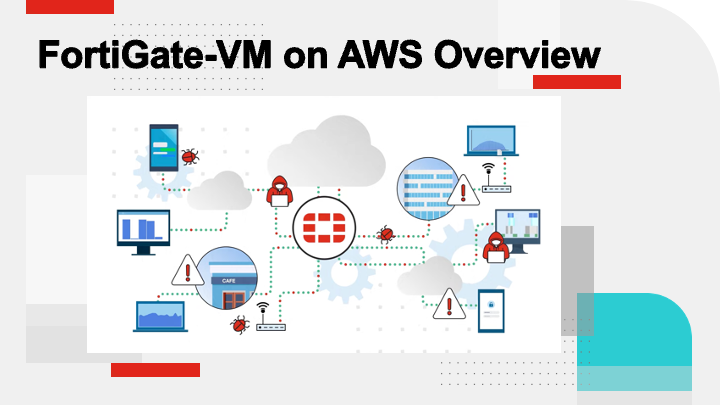
FortiGate-VM on AWS delivers next-generation firewall and VPN/SD-WAN capabilities for organizations of all sizes. It enables broad network protection and automated security management for consistent enforcement and visibility across your AWS VPCs and hybrid cloud infrastructure. FortiGate natively integrates with AWS Gateway Load Balancer, AWS Transit Gateway and other AWS security services to simplify and deliver enterprise-class security for applications and workloads running on AWS.
FortiGate-VM reduces complexity by combining secure connectivity with advanced threat protection capabilities such as powerful intrusion prevention (IPS), malware detection and protection, and continuous threat intelligence from FortiGuard Labs security services. It offers a management console that provides comprehensive network automation and unified visibility across multi-cloud environments.
FortiGate-VM, in concert with other elements of the Fortinet Security Fabric, enables common deployment scenarios such as cloud security services hub, secure remote access, container security, web application security, and critical workload protection.
Visit the FortiGate-VM on AWS Community Resource Hub to find onboarding, deployment, and technical information and join in discussions: https://community.fortinet.com/t5/FortiGate-VM-on-AWS/gh-p/fortigate-vm-on-aws
Please contact awssales@fortinet.com with any questions.
Highlights
- FortiGate offers protection from a broad array of threats, with support for all of the security and networking services offered by the FortiOS operating system.
- Delivers complete content and network protection by combining stateful inspection with a comprehensive suite of powerful security features to meet PCI DSS compliance.
- IPS technology protects against current and emerging network-level threats. In addition to signature-based threat detection, IPS performs anomaly-based detection which alerts users to any traffic that matches attack behavior profiles.
Details
Sold by
Categories
Delivery method
Delivery option
64-bit (x86) Amazon Machine Image (AMI)
Latest version
Operating system
OtherLinux 7.4.12
Deployed on AWS
New
Introducing multi-product solutions
You can now purchase comprehensive solutions tailored to use cases and industries.

Features and programs
Buyer guide
Gain valuable insights from real users who purchased this product, powered by PeerSpot.

Financing for AWS Marketplace purchases
AWS Marketplace now accepts line of credit payments through the PNC Vendor Finance program. This program is available to select AWS customers in the US, excluding NV, NC, ND, TN, & VT.

Pricing
Free trial
Try this product free for 30 days according to the free trial terms set by the vendor. Usage-based pricing is in effect for usage beyond the free trial terms. Your free trial gets automatically converted to a paid subscription when the trial ends, but may be canceled any time before that.
Pricing is based on actual usage, with charges varying according to how much you consume. Subscriptions have no end date and may be canceled any time. Alternatively, you can pay upfront for a contract, which typically covers your anticipated usage for the contract duration. Any usage beyond contract will incur additional usage-based costs.
Additional AWS infrastructure costs may apply. Use the AWS Pricing Calculator to estimate your infrastructure costs.
Dimension | Cost/hour |
|---|---|
c6in.xlarge Recommended | $1.02 |
c6in.4xlarge | $3.29 |
c7i.16xlarge | $5.16 |
c5d.12xlarge | $4.10 |
c5d.9xlarge | $4.10 |
c6i.16xlarge | $5.16 |
c4.xlarge | $1.02 |
c5.9xlarge | $4.10 |
c5n.2xlarge | $1.60 |
c6a.xlarge | $1.02 |
Vendor refund policy
You may terminate the instance at anytime to stop incurring charges.
Custom pricing options
Request a private offer to receive a custom quote.

Legal
Vendor terms and conditions
Upon subscribing to this product, you must acknowledge and agree to the terms and conditions outlined in the vendor's End User License Agreement (EULA) .
Content disclaimer
Vendors are responsible for their product descriptions and other product content. AWS does not warrant that vendors' product descriptions or other product content are accurate, complete, reliable, current, or error-free.
Delivery details
64-bit (x86) Amazon Machine Image (AMI)
Amazon Machine Image (AMI)
An AMI is a virtual image that provides the information required to launch an instance. Amazon EC2 (Elastic Compute Cloud) instances are virtual servers on which you can run your applications and workloads, offering varying combinations of CPU, memory, storage, and networking resources. You can launch as many instances from as many different AMIs as you need.
Version release notes
Additional details
Usage instructions
Please ensure the connectivity to FortiCare (https://directregistration.fortinet.com:443 ) by checking all related setup on security groups, ACLs, IGW, route tables, public IP address...etc.
After deploying the instance, click on Manage in AWS Console to see the running instance and public DNS address to continue the configuration of the FortiGate-VM. Connect to the secured Web UI via the public DNS address: https:// <public DNS address>. For any CLI configuration/settings, SSH is required to log into the CLI. Default login credentials are with a username of admin and the AWS Instance ID value as the password. The FortiGate-VM AWS Install and Configure guide is located at https://docs.fortinet.com/document/fortigate-public-cloud/7.4.0/aws-administration-guide/
Support
Vendor support
This product is intended for On-Demand subscription. Please contact Customer Support with the following information instead of trying to register in FortiGate management GUI:
- The serial number of your FortiGate instance
- The email ID of your Fortinet account. If you do not have an account yet, please sign using the link below
AWS infrastructure support
AWS Support is a one-on-one, fast-response support channel that is staffed 24x7x365 with experienced and technical support engineers. The service helps customers of all sizes and technical abilities to successfully utilize the products and features provided by Amazon Web Services.
Updated weekly
By Fortinet Inc.

By Check Point Software Technologies

By Palo Alto Networks
Sentiment is AI generated from actual customer reviews on AWS and G2
Functionality
Ease of use
Customer service
Cost effectiveness
Positive reviews
Mixed reviews
Negative reviews
AI generated from product descriptions
Intrusion Prevention System
IPS technology with signature-based and anomaly-based detection to protect against current and emerging network-level threats and attack behavior profiles
Threat Protection Capabilities
Advanced threat protection including intrusion prevention, malware detection and protection, and continuous threat intelligence from FortiGuard Labs security services
AWS Native Integration
Native integration with AWS Gateway Load Balancer, AWS Transit Gateway, and other AWS security services for VPC and hybrid cloud infrastructure protection
Stateful Inspection and Content Filtering
Stateful inspection combined with comprehensive security features including content and network protection to meet PCI DSS compliance requirements
Unified Management and Visibility
Management console providing comprehensive network automation and unified visibility across multi-cloud environments
Advanced Threat Prevention Capabilities
Includes firewall, Data Loss Prevention (DLP), Intrusion Prevention System (IPS), application control, IPsec VPN, URL filtering, antivirus, and anti-bot features for multi-layered network security.
Traffic Inspection and Control
Inspects and controls encrypted data flows between on-premises networks and AWS VPCs, including North-South traffic entering and exiting private subnets and East-West traffic between VPCs.
Infrastructure-as-Code Integration
Integrates with infrastructure-as-code tools including Terraform and Ansible for policy automation, with dynamic security policy adaptation based on real-time cloud metadata.
AWS Service Integration
Supports integration with Gateway Load Balancer, AWS Security Hub, VPC Ingress Routing, AWS Traffic Mirroring, AWS Transit Gateway, AWS Outposts, and Amazon Macie.
Centralized Security Management
Provides unified, centralized management through Check Point Security Management Server with consistent policy, logging, and reporting across AWS, hybrid, and on-premises environments.
Traffic Identification and Classification
Powerful traffic identification technology for complete visibility and control over network traffic
Malware Prevention
Malware prevention capabilities to protect applications and data from known and unknown attacks
Dynamic Policy Management
Dynamically updated whitelisting and segmentation policies based on AWS tags for reduced attack surface
High-Performance Processing
DPDK support on C5, C5n, M5, and M5n instances running on AWS Nitro System for efficient traffic processing
Cloud-Native Integration
AWS Auto Scaling, ELB integration, Transit VPC with AWS Transit Gateway, and Gateway Load Balancer support for large-scale deployments
Standard contract
No
No
No
Customer reviews
Vincent Gunawan
Unified security platform has improved multi-site VPN access and simplified network management
Reviewed on Apr 23, 2026
Review provided by PeerSpot
What is our primary use case?
My main use case for Fortinet FortiGate is as a UTM to distribute our IP DHCP, to segment our VLAN, and to manage our network infrastructure.
I also use Fortinet FortiGate as a VPN and for site-to-site connection between our multiple sites, such as my head office, our developer office, and data center. It acts as a network security tool where we use an IPS to filter attacks from the outside public to our server.
Regarding my main use cases, I would like to add that it has quite a good GUI and dashboard, making it easy to use. Additionally, we use DNS filtering and application filtering to filter the applications that users can access to the internet.
What is most valuable?
The best features Fortinet FortiGate offers include reliability and a good user interface and user experience.
The user interface is the most valuable to me because it is easy to use, easy to manage, and quite easy for a newcomer to operate. The features are quite good for filtering applications and for addressing our needs, such as blocking social media or other unwanted content.
Fortinet FortiGate has positively impacted our organization by improving our security workflow and network security, as it is quite reliable compared to traditional routers or traditional switch cores from MikroTik or Cisco.
A specific example of how my workflow and network security has improved is that because we have multiple sites, Fortinet FortiGate has a multitude of signature-based features and multiple default policies, so we only have to add that to the profile. It is quite simple and easy to manage.
What needs improvement?
I think Fortinet FortiGate is quite good for now, though it could improve with the virtual IP, as it occasionally has a bug. They have a lot of CVE and updates to their system, and they need to be more concerned about their security.
For how long have I used the solution?
I have been using Fortinet FortiGate for about one year.
What do I think about the stability of the solution?
In my experience, Fortinet FortiGate is quite stable.
When the RAM or memory reaches 70% or 80%, the firewall is more likely unstable and may struggle to forward traffic. I think that is one of the areas where Fortinet FortiGate has room for improvement.
What do I think about the scalability of the solution?
Fortinet FortiGate's scalability is limited because it is on-premises, so we would have to change the type of Fortinet FortiGate as we grow.
How are customer service and support?
The customer support is really helpful for their principle, but they lack technical competency at layer one, as they tend to only look for logs before promoting issues to layer two for resolution.
Which solution did I use previously and why did I switch?
Previously, we used Aruba as a firewall and switch core, but it lacked security features, so we had to move to the next-generation firewall.
What was our ROI?
I am afraid I cannot say that I have seen a return on investment.
What's my experience with pricing, setup cost, and licensing?
My experience with pricing, setup cost, and licensing is that I think the price is quite good besides the leader in Gartner's next-generation firewall.
Which other solutions did I evaluate?
Before choosing Fortinet FortiGate, we evaluated a lot of competitors at that moment, and we chose Fortinet FortiGate.
What other advice do I have?
My advice to others looking into using Fortinet FortiGate is that you need to think carefully about your usage and calculate your business needs. If you miscalculate, you might end up buying a Fortinet FortiGate that cannot meet your needs, leading to potential downtimes or failures.
I have no additional thoughts about Fortinet FortiGate except that I mentioned the easy user interface and experience for beginners. However, I noted that when the memory reaches up to 80%, the firewall does not function as well. I would rate this product a 9 out of 10.
ChandanKumar
Strong content filtering has isolated lab traffic and has reduced security costs significantly
Reviewed on Apr 16, 2026
Review provided by PeerSpot
What is our primary use case?
My main use case for Fortinet FortiGate is content filtering, and content filtering is the primary function. I am also doing East and West traffic filtering.
I use content filtering and East-West traffic filtering by creating groups based on separate projects in Active Directory, and on the firewall side, I create policies, web application profiles, and category-based profiles tailored to each project's requirements.
We have separate projects, and I isolate those subnets from one subnet to another so that both subnets do not communicate directly and only communicate via Fortinet FortiGate itself, with policies created to manage the East and West traffic.
What is most valuable?
Some of the best features of Fortinet FortiGate are its ease of use compared to other vendors, and from a troubleshooting point of view, it is also very useful and easy to troubleshoot. It stands out as easy to use and troubleshoot because I do not need to create separate NAT policies; with Fortinet FortiGate, I align my NAT policies and content filtering within a single policy, making management straightforward, and the logs are clearly visible, making troubleshooting much easier.
Compared to other firewalls, Fortinet FortiGate offers easily manageable features such as vulnerability profiles and threat profiles, which I believe is one of its main advantages.
Fortinet FortiGate has positively impacted my organization with its cost-effectiveness because it provides features that are very similar to others, but at a much lower cost, and everything my organization needs is available with Fortinet FortiGate.
Being cost-effective has allowed us to save a lot of money, which is particularly useful since I was exploring firewalls to secure my internal labs, and finding Fortinet FortiGate was a revelation as I could achieve my requirements without the additional costs of other firewalls.
What needs improvement?
I wish Fortinet would explore SASE solutions more, as it has become very popular and people are increasingly using it.
For how long have I used the solution?
I have been using Fortinet FortiGate for around the last seven years.
What do I think about the stability of the solution?
Fortinet FortiGate is stable, and I have never experienced issues similar to those from the ASA .
What do I think about the scalability of the solution?
Fortinet FortiGate's scalability is very good, and I believe there are no issues.
How are customer service and support?
I have faced challenges related to support, as I have encountered issues where support engineers are not aligned within the time frame, and sometimes they request multiple logs unnecessarily, causing delays and leaving a bad impression on my end users.
I have had a bad experience with customer support many times.
Which solution did I use previously and why did I switch?
I previously used a Cisco ASA but switched due to certain performance-related issues.
How was the initial setup?
My experience with pricing, setup cost, and licensing went smoothly, with no issues related to licensing or installation, and the overall cost is definitely cheaper than other prominent firewalls along with phenomenal features.
What about the implementation team?
I do not have a business relationship with the vendor other than being a customer, but I do have partners to buy network equipment such as firewalls and switches.
What was our ROI?
I cannot share exact numbers for ROI, but I saved a lot of money, which made management very happy, especially knowing that I achieved my functional goals with Fortinet FortiGate that might have incurred more costs with other firewalls.
What's my experience with pricing, setup cost, and licensing?
Fortinet FortiGate has positively impacted my organization with its cost-effectiveness because it provides features that are very similar to others, but at a much lower cost, and everything my organization needs is available with Fortinet FortiGate.
My experience with pricing, setup cost, and licensing went smoothly, with no issues related to licensing or installation, and the overall cost is definitely cheaper than other prominent firewalls along with phenomenal features.
Which other solutions did I evaluate?
I evaluated options including Palo Alto, Cisco, and other products before choosing Fortinet FortiGate.
What other advice do I have?
I would rate Fortinet FortiGate a nine overall, as I only deduct one point for the support issues I have experienced.
I selected nine because, feature-wise, the product is excellent and cost-effective compared to others, but I deducted a point due to the disappointing support from Fortinet.
I advise others looking into using Fortinet FortiGate to check their requirements first, as it provides all kinds of services other firewalls do and is very cost-effective.
People looking for a firewall should definitely evaluate Fortinet FortiGate, as it is very cost-effective and offers all the features they are likely looking for. I gave this review a rating of nine out of ten.
Abhinandan Yadav
Unified security and sd-wan have improved uptime and cut wan costs for multi-site branches
Reviewed on Mar 31, 2026
Review provided by PeerSpot
What is our primary use case?
I have been using Fortinet FortiGate for the last two years, specifically models like 60F and 200F.
My main use case for Fortinet FortiGate involves using models like 60F, 100F, and 200F, while not utilizing models 48, 49, and 50F.
In day-to-day operations for tickets, Fortinet FortiGate is much more than just a basic firewall; it functions as full unified threat management. I use it to configure security policy, layer 2, layer 7, SNAT, DNAT, zone-based and policy-based routing, complete series management, and VPN management, including IPsec. I have multiple branches, so I create IP site-to-site tunnels, and some users require remote access VPN.
What is most valuable?
The best features Fortinet FortiGate offers include secure SD-WAN, intelligent ISP selection, and load balancing with application awareness.
These features have made a significant difference for my organization by improving day-to-day user experience and business continuity. At SD-WAN load balancing, we experience the real impact. Fortinet FortiGate distributes traffic across multiple ISPs using load balancing, link health checks, and application awareness. Before implementing SD-WAN, when one ISP became slow, the internet performance suffered or failover was manual and delayed, leading to user complaints about slow internet. After SD-WAN completion, traffic automatically shifts to the best performing link, with critical application-to-application traffic using the lower latency path and backup link. If the primary link fails, it switches immediately to the secondary link with no business impact or losses. ISP issues are now better handled for the applications.
Regarding additional features, they do not always get highlighted by big vendors, but in real deployment, the all-in-one simple operation advantage is evident. Instead of a separate firewall, a separate SD-WAN, and separate devices, this firewall provides all capabilities in a single appliance, with all abilities available on one device.
Fortinet FortiGate has positively impacted my organization in three major areas: security, efficiency, and cost. Security has become stronger with fewer malware and phishing incidents, IPS blocking attacks in real time, and web filtering that stops risky user behavior. The real impact is in blocking users from clicking malicious links, shifting from firefighting by the IT team to threat blocking at the firewall level, resulting in minimal endpoint infection and lower security incidents, reduced downtime, and a better overall security posture. Operation efficiency has improved due to centralized control policy, VPN logging, SD-WAN automation failover, load balancing, and faster troubleshooting through visibility tools, replacing manual ISP failover and time-consuming debugging with automated traffic steering, quick root cause analysis, and better logs plus dashboard. User experience has also improved, which is often overlooked. With stable internet provided by SD-WAN, priority for business applications, and a reliable VPN connection, we no longer experience frequent internet slow complaints, allowing smooth video calls with Teams and Zoom, and consistent access to SaaS applications, resulting in happier users and improved productivity over time.
What needs improvement?
Users report stability issues in certain versions, which requires regular updates. Real-world attacks have also highlighted the need for urgent patching of vulnerabilities.
Fortinet FortiGate, while a powerful and feature-rich web firewall, could improve in areas like firmware stability, documentation, and ease of use. The learning curve can be steep for some users. For beginners, support quality can vary, and frequent updates with occasional vulnerabilities call for careful patch management. However, once Fortinet FortiGate is configured, it remains highly reliable and efficient. Customer support needs improvement, as I find it very slow, with reports from other users reflecting that customer support is inadequate.
For how long have I used the solution?
I have been working in my current field for the last three years.
What do I think about the stability of the solution?
We have seen specific numbers indicating that with SD-WAN plus high availability, there is typically a 60 to 90 percent reduction in internet-related downtime. For example, before implementation, I had two days of downtime per month due to ISP issues, but now it is reduced to one to two hours a month with auto failover. Regarding network performance and user experience, we are seeing 30 to 50 percent faster application performance, a 70 to 90 percent reduction in malware and phishing incidents after applying security measures, and troubleshooting that is 40 to 60 percent faster in resolution.
Fortinet FortiGate is stable.
What do I think about the scalability of the solution?
Fortinet FortiGate's scalability is one of its strong areas, designed to scale from small branch offices all the way to high-scale data centers and cloud environments.
How are customer service and support?
Customer support is poor. Sometimes I open a critical ticket only to have customer support respond in four to five hours, reflecting that customer support is very weak. I rate customer support a seven out of ten.
Which solution did I use previously and why did I switch?
Before using Fortinet FortiGate, I was using a SonicWall firewall, and I switched mainly due to the need for SD-WAN capabilities, which SonicWall did not provide.
Before choosing Fortinet FortiGate, I evaluated other options including Sophos firewall and Palo Alto. With Palo Alto, the challenge was the cost, and Fortinet was the lower-cost solution, leading me to choose Fortinet.
How was the initial setup?
My experience with pricing for Fortinet FortiGate includes hardware and subscription, with typical costs ranging from about seven hundred dollars to one thousand five hundred dollars for a small firewall and one thousand five hundred dollars to four thousand dollars or more for mid-size SMB. The initial setup cost, which requires an engineer for the initial partner network, is competitive compared to other vendors, particularly given the number of features included. However, the licensing model can be complex, and ongoing subscription costs require careful planning. The setup is straightforward for basic deployment, although advanced configurations like SD-WAN and VPN require expertise. Overall, it offers good value for money, but organizations should evaluate the total cost of ownership, including yearly licensing, with a typical pattern of 50 to 60 percent hardware cost and yearly subscription.
What was our ROI?
I evaluate the changes in return on investment after implementing Fortinet solutions for my SD-WAN and hybrid workforce as significant and valuable. Real metrics for management include reducing reliance on MPLS and shifting traffic to broadband links, typically resulting in a 30 to 50 percent WAN cost saving. For example, the impact of using hybrid MPLS and broadband SD-WAN for intelligent route traffic is to drive cheaper WAN with better performance. There is also security incident reduction leading to higher ROI. With IPS, web filter, and zero trust, we see a typical impact of 70 to 90 percent fewer security incidents. After implementing Fortinet FortiGate, Fortinet SD-WAN, and unified SASE , we observed significant ROI through reduced WAN costs by around 30 to 40 percent, improved uptime with nearly 70 to 80 percent reduction in downtime, and lower operational overhead by consolidating multiple security and networking functions into a single platform, which has also led to a reduction in total cost of ownership by 25 to 30 percent.
I have seen a strong ROI impact from Fortinet FortiGate SD-WAN, with reduced costs.
What's my experience with pricing, setup cost, and licensing?
My experience with pricing for Fortinet FortiGate includes hardware and subscription, with typical costs ranging from about seven hundred dollars to one thousand five hundred dollars for a small firewall and one thousand five hundred dollars to four thousand dollars or more for mid-size SMB. The initial setup cost, which requires an engineer for the initial partner network, is competitive compared to other vendors, particularly given the number of features included. However, the licensing model can be complex, and ongoing subscription costs require careful planning. The setup is straightforward for basic deployment, although advanced configurations like SD-WAN and VPN require expertise. Overall, it offers good value for money, but organizations should evaluate the total cost of ownership, including yearly licensing, with a typical pattern of 50 to 60 percent hardware cost and yearly subscription.
Which other solutions did I evaluate?
Before choosing Fortinet FortiGate, I evaluated other options including Sophos firewall and Palo Alto. With Palo Alto, the challenge was the cost, and Fortinet was the lower-cost solution, leading me to choose Fortinet.
What other advice do I have?
My advice for others considering Fortinet FortiGate is to properly size the appliance as the most important factor, design SD-WAN correctly from day one, enable security features gradually, and properly learn FortiOS concepts. Using centralized management tools like FortiAnalyzer and FortiManager is also crucial. Planning for high availability, whether active-passive or active-active, is important, as is monitoring properly and regularly. My advice would be to size the appliance correctly based on real traffic with security features enabled, design SD-WAN policy carefully, and enable features in phases, with a solid grasp of FortiOS and centralized management tools being vital for long-term success.
Fortinet FortiGate is a powerful, scalable, and cost-effective next-generation firewall solution that delivers excellent value, especially for SD-WAN and multi-site deployment. Achieving the best results depends on proper design, sizing, and ongoing optimization, making Fortinet FortiGate a reliable and feature-rich solution of great value for the money. I have rated this review a nine out of ten.
Sachin-Yadav
Unified security gateway has streamlined monitoring and troubleshooting for faster resolutions
Reviewed on Mar 30, 2026
Review provided by PeerSpot
What is our primary use case?
Fortinet FortiGate serves as my gateway device where I manage all my security. I use Fortinet FortiGate as a gateway for the NATing part for LAN to WAN communication. Along with that, I manage security profiles from the gateway only, and all my switches and Wi-Fi also work with Fortinet FortiGate.
I work on RE VPN and SSL RE VPN on Fortinet FortiGate.
What is most valuable?
In my opinion, the best features Fortinet FortiGate offers are monitoring and troubleshooting. Along with that, its security services are also a key point for me. For example, I need to manage features including IPS, antivirus, web filtering, and application control via Fortinet FortiGate only.
I appreciate the security feature of Fortinet FortiGate. For example, I can take real-time logs and session monitoring along with VPN, event logs, data usage monitoring, and related features.
I have noticed faster troubleshooting and reduced downtime of around fifty percent. My operational efficiency has improved. For a real example, a client experienced frequent internet drops, and this was resolved more efficiently.
What needs improvement?
One suggested improvement I would recommend is more simplified troubleshooting. Although logs are powerful, troubleshooting can sometimes be complex for new users. A more guided or AI-based troubleshooting feature would help reduce resolution time. Fortinet FortiGate should incorporate AI-based solutions to improve the troubleshooting experience.
For how long have I used the solution?
I have been using Fortinet FortiGate for two years.
What do I think about the stability of the solution?
Fortinet FortiGate is stable. It demonstrates excellent stability in various terms including network utilization.
What do I think about the scalability of the solution?
Fortinet FortiGate offers strong scalability and can support environments ranging from small businesses to large businesses. There is a wide range of models from entry level to high end levels. Flexible deployment options include physical appliances, virtual, and cloud deployments, which is beneficial.
How are customer service and support?
Customer support needs improvement. I have had to take the direct internal sources, such as sales contacts, and after that I rarely see support response.
I would rate the customer support at a six out of ten.
Which solution did I use previously and why did I switch?
I have used Sophos before, and several of my criteria were missing with that solution. Fortinet FortiGate achieved the features I was looking for, which is why I shifted to Fortinet FortiGate firewall.
How was the initial setup?
My experience is very positive regarding pricing, setup cost, and licensing for Fortinet FortiGate. The pricing is also competitive compared to other vendors in the market. Along with that, setup is very easy. I implemented it in my network myself. For the licensing part, it is somewhat confusing, but overall it is good.
What was our ROI?
Fortinet FortiGate has saved me both money and time. It is easy to manage and the troubleshooting part is also very easy, making it more time-saving than money-saving.
What's my experience with pricing, setup cost, and licensing?
In terms of cost savings, it has reduced the need for multiple tools. Fortinet FortiGate combines firewall, VPN, IPS, web filtering, and SD-WAN into a single device, which has given me lower operational overhead.
Which other solutions did I evaluate?
Before choosing Fortinet FortiGate, I tried various options. I obtained the POC from Palo Alto as well as Check Point. After that, I switched to Fortinet FortiGate because it was the best option for my network.
What other advice do I have?
My advice for others looking into using Fortinet FortiGate is that focusing on proper planning, sizing, and understanding of features before deployment will be a good approach.
Integrating SD-WAN with Fortinet FortiGate has allowed me to create an SLA according to which my ISPs define the traffic and the best path utilized.
I would rate this product a ten out of ten overall.
Nitin Yadav
Centralized security management has improved policy control and simplified daily operations
Reviewed on Mar 30, 2026
Review from a verified AWS customer
What is our primary use case?
I use Fortinet FortiGate in security and policy for security profiles, blocking and allowing for certification on a day-to-day basis.
I block Gmail and personal mail along with other applications. We block webmail and allow corporate mail, Microsoft 365, and block unwanted categories such as pornography and weapons while implementing URL filtering.
Global systems use standard Fortinet terminology. We use FortiManager and FortiAnalyzer, where FortiAnalyzer is used for logging and FortiManager is used for centralized management across multiple gateway devices.
By implementing Fortinet FortiGate in our organization, we can control applications and block unauthorized apps.
Control security platform features such as policy enforcement and SD-WAN streaming particularly improve our work by reducing manual configuration across multiple devices, allowing faster change implementation, and reducing troubleshooting time.
This control typically leads to measurable outcomes across operations, security, and performance.
We use Fortinet FortiGate on-premises and in the public cloud.
What is most valuable?
In my experience, the best feature Fortinet FortiGate provides is its impressive logging system, which is very easy to read to understand what the issue is.
The SD-WAN feature is very valuable for us. By integrating SD-WAN, we can manage our ISP links and SD-WAN rules.
Using SD-WAN on Fortinet FortiGate provides lower latency and stability improvements, critical application routing via lower latency links, reduction in jitter and packet loss, with both links actively used instead of one idle backup, leading to better bandwidth utilization.
The biggest strength is the consolidated platform that combines firewall, SD-WAN, VPN, and security stack in one device.
What needs improvement?
We can improve the UI readability when working with large configurations. I chose a rating of nine because of the troubleshooting power and launch issues. We need CLI debug capabilities in addition to the UI.
For how long have I used the solution?
I have been working in my current field for the last three years.
What do I think about the stability of the solution?
Fortinet FortiGate is a stable and scalable firewall.
What do I think about the scalability of the solution?
Fortinet FortiGate is manageable on one platform, but scalability depends on how we scale. Model ranges for small branches and high-end applications are delivered easily by moving to a higher model.
How are customer service and support?
Support is also good.
Which solution did I use previously and why did I switch?
I previously used Sophos firewall before moving to Fortinet FortiGate.
What about the implementation team?
We evaluated other options such as Palo Alto before choosing Fortinet FortiGate. We evaluated both Palo Alto and Sophos firewalls during our selection process.
What was our ROI?
It is a time-saving product.
What's my experience with pricing, setup cost, and licensing?
My experience with pricing, setup cost, and licensing for Fortinet FortiGate is generally positive from a value perspective.
What other advice do I have?
I advise others to use Fortinet FortiGate, considering the firewall size, throughput including IPS, SSL-VPN, web filtering throughput, VPN load, and UTM versus Enterprise bundle.
Which deployment model are you using for this solution?
Hybrid Cloud