AWS Partner Network (APN) Blog
Building trusted AI with data and AI governance partners on AWS
By: Jessica Enzi, WW Partner GTM Lead, Data & AI, Governance Strategy – AWS
By: Gitika Vijh, WW Partner Tech Lead, Data & AI – AWS
By: Vitor Freitas, WW Partner Tech Lead, Data & AI – AWS
A consensus is emerging. The next era of trusted AI won’t be defined by who builds the most agents, but by who governs them best. Effective agentic governance means addressing data governance and AI governance and the convergence of the two. Data governance establishes the foundation, providing classification, lineage, quality, and access controls. AI governance provides the oversight layer, which involves agent boundaries, observability, policy enforcement, and bounded autonomy. The order isn’t optional. You can’t govern AI outputs if you haven’t governed the data inputs. Most failed AI deployments trace back to governance gaps that weren’t designed for autonomous systems. Teams build a pilot, then hit a compliance or security blocker.
This scenario isn’t isolated. Adoption is outpacing governance maturity. Only 21% of companies have mature governance models for agents, despite 74% planning to deploy them by 2027 (Deloitte, January 2026). Gartner® takes this further. In Hype Cycle for Data and Analytics Governance (2026, Guido De Simoni, Sally Parker, 4 June 2026), they predict that: “By 2027, 60% of organizations will fail to realize AI value due to a lack of integration between data governance and AI governance.”
The governance challenge is navigational, not technical
Amazon Web Services (AWS) has invested in purpose-built data and AI governance capabilities across both layers. For the data foundation, Amazon SageMaker Catalog provides unified discovery and governance with business glossary and fine-grained access controls, while AWS Lake Formation enforces access at column and row level. AWS Glue Data Quality generates automated rule recommendations and validates them. Serving as the centralized metadata repository across your data estate, AWS Glue Data Catalog now supports business context enrichment and semantic search (preview) so agents can discover data by meaning rather than schema alone. For agent oversight, Amazon Bedrock Guardrails offers content safety, personal identifiable information (PII) redaction, and Automated Reasoning checks with mathematically verifiable policy compliance. Amazon Bedrock AgentCore includes Policy for enforcement of governance rules (using Cedar policy language) and Evaluations for automated agent quality assessment. AWS Agent Registry adds governed agent discovery.
The toolkit is significant. But for customers, the challenge is knowing how to connect the services into a strategy that satisfies legal, compliance, and security teams while keeping projects moving. Customers face three interrelated governance gaps for agentic systems: awareness, action, and trust. The awareness gap is closing because most customers now know governance is critical. However, the action gap remains; customers often don’t know how to operationalize these new governance requirements. The trust gap is hardest to solve because customers need confidence that their governance posture supports production scale. Partners who solve the action gap bridge the trust gap. When using accelerators to do so, they can compress months of trial and error into weeks of production-ready implementation. Governance embedded from the start becomes a force multiplier.
Solving the action gap with the GEAR initiative
Governance Enabling Agentic Readiness (GEAR) is an AWS initiative that identifies and amplifies partners who have built data and AI governance accelerators for AI deployment. A governance accelerator is a partner-built framework or tool that:
- Automates manual governance steps
- Standardizes repeatable patterns so governance isn’t reinvented
- Accelerates implementation timelines by front-loading governance in project planning
- Delivers durable governance outcomes that persist beyond the engagement itself
GEAR partners operate across three primary tracks:
- Governance of agents – Frameworks and controls for managing AI agents
- Governance by agents – AI-powered solutions that automate governance tasks themselves
- Practice and industry – Strategies for the people, processes, and regulatory requirements that technical controls alone can’t solve
These tracks reinforce each other. We designed GEAR around a governance adoption cycle, which has four stages. In the first stage, customers establish governance controls over their agents. Trust then builds through audit and oversight. That confidence allows more agents to be deployed at scale. More agents drive demand for more sophisticated controls, feeding the cycle. As deployments grow, organizations also become more likely to need governance by agents. In this fourth stage, enterprises apply agents to select governance tasks to manage the complexity that comes with scale. Not every organization will reach that stage immediately, and human-in-the-loop oversight remains present throughout. But partners who position across both tracks are ready for customers wherever they are in the cycle. The four stages of the governance adoption cycle are shown in the following graphic.
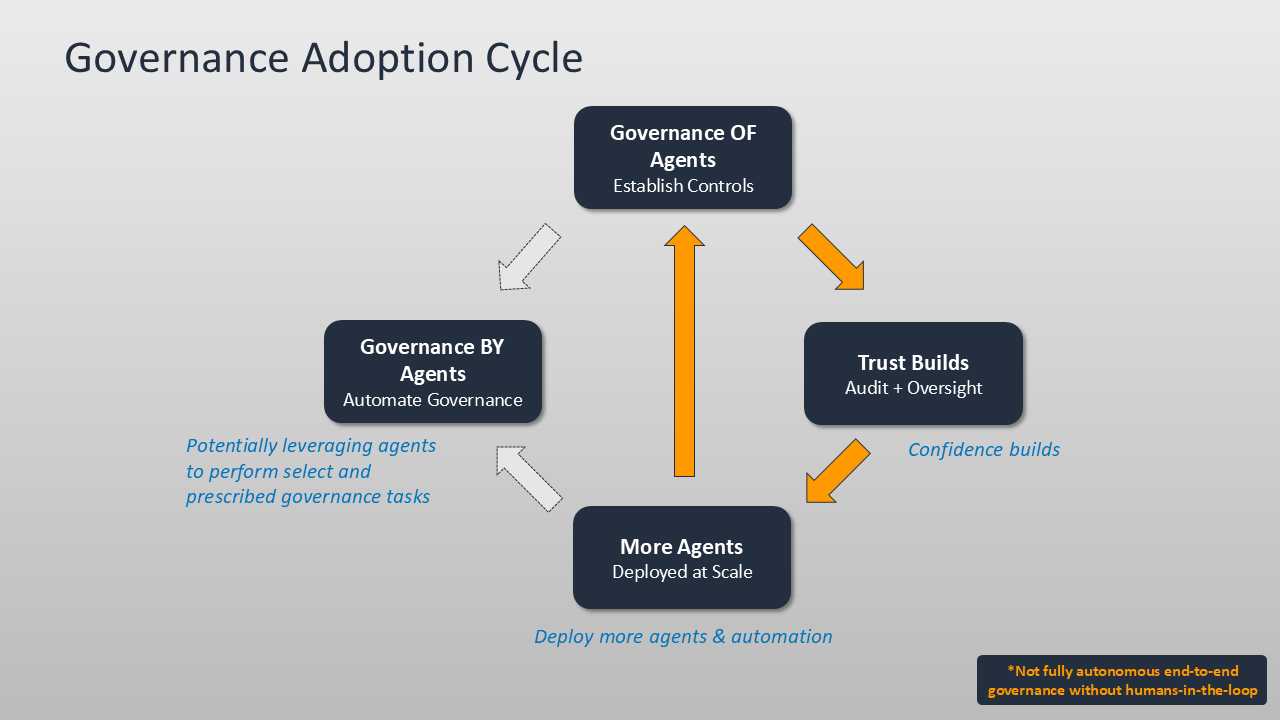
Figure 1: The governance adoption cycle
The first GEAR accelerators
The initial GEAR partners profiled in this section are turning governance uncertainty into structured engagements. They span GEAR’s three tracks, from frameworks that govern agents to AI-powered solutions that streamline governance tasks themselves.
Governance of agents
The first track addresses the governance gap at the agent layer. The partners in this section provide tools for managing agents.
Data Reply AgentOPS governs the full agent lifecycle (design, deployment, monitoring, improvement, and retirement) so controls, audit trails, and guardrails evolve with agents rather than going stale. UK digital bank thinkmoney brought a customer-facing agent to production in 22 weeks, reducing query resolution from 10–15 minutes to under 2 minutes.
DoiT GenAI Governance Accelerator embeds production-grade AI governance (guardrails, access controls, and audit trails) directly into system architecture. For healthcare provider Promptly, DoiT deployed a governed AI solution on Amazon Connect, Amazon Lex, and Amazon Bedrock, compressing a 3–4 month build into weeks and saving about $600K in annual cloud costs.
New Math Data Duet makes human-in-the-loop oversight a first-class control in each agent decision path, combining Cedar policies for role-based access, Amazon Bedrock AgentCore Observability for audit trails, and Amazon Bedrock Guardrails for prompt-injection and PII protection. In 6 weeks, logistics provider Senpex saw 117% more dispatches per dispatcher and 85% faster reassignment, with every decision logged.
Quantiphi Agent Manager deploys and scales multi-agent AI with governance built in. Amazon Bedrock Guardrails, Cedar policies, Amazon CloudWatch, and AWS CloudTrail combine to protect sensitive data, enforce policies, and give end-to-end visibility. See the Utah State Treasurer’s Office success story.
Additional governance of agents accelerators:
- Boomi Agent Control Plane – One control plane for agent observability, audit trails, and compliance; governs agents across hybrid environments. Visit Lexitas for their success story.
- IBM Enterprise Advantage on AWS – Enterprise-scale AI orchestration to remake workflows with built-in governance and policy controls, including agent-to-enterprise connectivity through A2A and an MCP gateway, end-to-end auditability, and full-stack observability.
- PwC – AI security control plane (AWS MP listing pending) with a set of modular accelerators that create a control layer including visibility, governance, and evidence of AI use.
- Tata Consultancy Services (TCS) – Agentic AI control plane (AWS MP listing pending) with centralized agent governance with early results showing agent onboarding compressed from 6 weeks to 3 days, 100% policy-compliant.
Governance by agents
The second track turns the equation around: instead of governing agents, these partners deploy agents that perform data governance tasks.
Data Reply Agentic AI for Data Foundations deploys six specialized agents, each with one governance job (profiling, remediation recommendations, validation, data modeling, lineage mapping, and policy enforcement), automating work that typically requires people. For YouGov Sport, it delivered row-level security and auditable lineage across 3.2 billion records from 17 systems in 11 weeks.
Atlan acts as the Context Layer for AI across Amazon Simple Storage Service (Amazon S3), Amazon Redshift, AWS Glue, and Amazon SageMaker. Its Context Agents translate metadata into organizational knowledge, allowing every agent to reason from one shared company brain. To read two success stories, visit How Enterprises Make AWS Data AI-Ready with Atlan.
The Precisely Data Integrity Suite runs AI agents on AWS to classify data, assess quality, and harmonize it, with no data movement required. Automated classification tags sensitive assets instantly, quality agents build rules, and normalization and standardization close the loop.
Practice and industry
Some governance gaps require expertise, not automation.
Adastra Data Governance Framework & Roadmap Design builds ownership, lineage, and access controls into the foundation. At a Canadian public sector entity, it replaced manual scripts with self-service, access-controlled data products so AI initiatives inherit guardrails by default.
Loka AI Governance Readiness Navigator works backward from the regulatory standard to the AWS implementation, mapping each gap to an owner and deliverable. With their three-phase engagement, customers get audit-ready artifacts and governance package aligned to the applicable standards (EU AI Act, ISO 42001, NIST AI RMF) and AWS controls.
GEAR partners include both consulting and technology partners, spanning Premier and Advanced Tier, with collective competencies across data and analytics, and generative AI and agentic AI. Individual accelerator AWS Marketplace listings are linked throughout.
The following graphic shows the logos of the GEAR accelerators.
Figure 2: Logos of GEAR partners
Conclusion
The current GEAR partners and their accelerators demonstrate that governance doesn’t slow AI down. It’s what gets it to production. The accelerators featured in this post are delivering measurable outcomes, and this is only the first set. Ready to close the governance gaps? Whether you’re a partner with a governance accelerator or a customer experiencing governance uncertainty, AWS is ready to meet you where you are.
For partners: The governance surface area for agentic systems is broad and still expanding, from data quality, lineage, and access governance to decision explainability, AI cost controls, compliance evidence, and purpose limitation. If you’ve built or are building a data or AI governance accelerator that automates manual steps, standardizes repeatable patterns, or compresses implementation timelines, GEAR is where your work gets amplified. Explore GEAR on AWS Partner Central. AWS provides the technical foundation; you bring the customer-facing tools that turn capability into confidence. Ask your partner development manager to nominate you at the GEAR Nomination Form.
For customers: If your AI initiatives are stalling at the action gap (governance matters, but you aren’t sure how to operationalize it), GEAR partners can address this through a structured engagement. If the trust gap is what’s holding back production deployment, these accelerators deliver auditable, durable governance outcomes designed to satisfy legal, compliance, and security concerns. And if awareness is still building across your organization, work with a GEAR partner to establish your governance foundation before scaling agents.
To learn more, refer to Architecting agentic AI for scale and trust from the start on the AWS Partner Network Blog.
GARTNER and HYPE CYCLE are trademarks of Gartner, Inc. and/or its affiliates.