AWS Big Data Blog
Category: AWS Glue
Securing client confidentiality at scale: Automated data discovery and governed analytics for legal workloads
In this post, we show you a reference architecture that automates sensitive data discovery across legal document repositories on Amazon Web Services (AWS), demonstrate how to capture structured findings as a compliance dataset, and guide you through building a governed analytics workspace that maintains your security boundaries. You walk away with a practical model for building security and analytics into the same lifecycle, without moving documents outside their system of record.
How to use streamlined permissions for Amazon S3 Tables and Iceberg materialized views
In this post, we walk through how to set up and manage S3 Tables in the AWS Glue Data Catalog, create and query Iceberg materialized views, and configure access controls that work across your analytics stack with IAM-based authorization.
Improve DynamoDB analytics with AWS Glue zero-ETL schema and partition controls
In this post, you learn how to replicate Amazon DynamoDB data to Apache Iceberg tables in Amazon S3 through a zero-ETL integration. We walk through the challenges that the DynamoDB nested, schema-flexible data model introduces for analytics workloads, and show you how to configure schema unnesting and data partitioning for a sample product catalog table. We also cover how to query the replicated data in Amazon Athena using standard SQL.

Using Apache Sedona with AWS Glue to process billions of daily points from a geospatial dataset
In this post, we explore how to use Apache Sedona with AWS Glue to process and analyze massive geospatial datasets.
Building unified data pipelines with Apache Iceberg and Apache Flink
In this post, you build a unified pipeline using Apache Iceberg and Amazon Managed Service for Apache Flink that replaces the dual-pipeline approach. This walkthrough is for intermediate AWS users who are comfortable with Amazon Simple Storage Service (Amazon S3) and AWS Glue Data Catalog but new to streaming from Apache Iceberg tables.
Build AWS Glue Data Quality pipeline using Terraform
AWS Glue Data Quality is a feature of AWS Glue that helps maintain trust in your data and support better decision-making and analytics across your organization. You can use Terraform to deploy AWS Glue Data Quality pipelines. Using Terraform to deploy AWS Glue Data Quality pipeline enables IaC best practices to ensure consistent, version controlled and repeatable deployments across multiple environments, while fostering collaboration and reducing errors due to manual configuration. In this post, we explore two complementary methods for implementing AWS Glue Data Quality using Terraform.
Extract data from Amazon Aurora MySQL to Amazon S3 Tables in Apache Iceberg format
In this post, you learn how to set up an automated, end-to-end solution that extracts tables from Amazon Aurora MySQL Serverless v2 and writes them to Amazon S3 Tables in Apache Iceberg format using AWS Glue.
Implement a data mesh pattern in Amazon SageMaker Catalog without changing applications
In this post, we walk through simulating a scenario based on data producer and data consumer that exists before Amazon SageMaker Catalog adoption. We use a sample dataset to simulate existing data and an existing application using an AWS Lambda function, then implement a data mesh pattern using Amazon SageMaker Catalog while keeping your current data repositories and consumer applications unchanged.
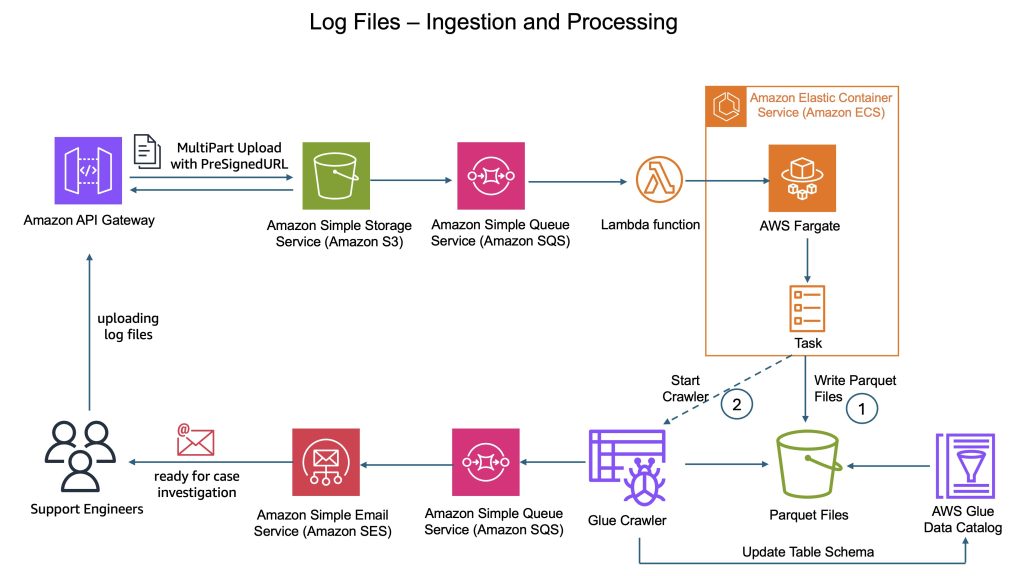
How CyberArk uses Apache Iceberg and Amazon Bedrock to deliver up to 4x support productivity
CyberArk is a global leader in identity security. Centered on intelligent privilege controls, it provides comprehensive security for human, machine, and AI identities across business applications, distributed workforces, and hybrid cloud environments. In this post, we show you how CyberArk redesigned their support operations by combining Iceberg’s intelligent metadata management with AI-powered automation from Amazon Bedrock. You’ll learn how to simplify data processing flows, automate log parsing for diverse formats, and build autonomous investigation workflows that scale automatically.

Build a data pipeline from Google Search Console to Amazon Redshift using AWS Glue
In this post, we explore how AWS Glue extract, transform, and load (ETL) capabilities connect Google applications and Amazon Redshift, helping you unlock deeper insights and drive data-informed decisions through automated data pipeline management. We walk you through the process of using AWS Glue to integrate data from Google Search Console and write it to Amazon Redshift.