AWS Public Sector Blog
Amplifying intelligence in ISR Data: Cloud-native streaming for FMV in an agentic AI era
Intelligence, Surveillance, and Reconnaissance (ISR) platforms have collected and disseminated Full Motion Video (FMV) to warfighters, first responders, and disaster recovery teams worldwide for more than two decades. Proven to be invaluable to their missions, many of these systems were designed with technologies once optimized for on-premises networks—now resulting in performance constraints, cost implications, selective data retention policies, limited user accessibility, and unrealized insights.
During this same period, digital transformation has continued to advance across multiple sectors. Cloud-native media services are revolutionizing how broadcasters transport, process, store, and deliver video content, while generative AI and agentic AI are dramatically enhancing how we extract meaningful insights from complex and vast amounts of data. In this post, we will explore how the combination of a modern Amazon Web Services (AWS) Cloud architecture, streaming media, and AI technologies are evolving the ISR landscape, establishing a new era of enhanced mission system capabilities.
Modernizing ISR with cloud-native architecture
At the core of a modern cloud-native ISR FMV architecture, lies AWS Media Services —purpose-built serverless cloud video infrastructure. These services support industry leading, standards-compliant media protocols, formats, and codecs to implement highly efficient and scalable video enterprises. AWS Media Services unifies video processing by adapting to legacy formats and protocols, while adding support for newer Adaptive Bit Rate (ABR) streaming renditions such as HTTP Live Streaming (HLS) or Dynamic Adaptive Streaming over HTTP (MPEG-DASH), commonly associated with today’s Media & Entertainment (M&E) platforms.
Recognizing the importance of ABR delivery, the Motion Imagery Standards Board (MISB) not only evaluated the technologies, but standardized community guidance under MISB ST 1910.1: Adaptive Bit Rate (ABR) Content Encoding as a unifying model to support delivery of mission video to a variety of end users and devices. These commercial and government standards work together, ushering in a modern HTTP pull model where authorized users can efficiently stream FMV on-demand and simplify content delivery across their enterprises. In addition to delivery improvements, AWS Media Services integrates seamlessly with Amazon Simple Storage Service (S3), establishing the foundation for a centralized media-optimized data lake (i.e. Media Lake) for content management, while connecting data with an extensible AI/ML framework.
Accelerating Intelligence with generative AI
Next, we’ll explore how generative AI capabilities complement media architectures by extracting actionable intelligence from assets and archives. When layering in generative AI technologies—particularly foundation models (FMs) for video understanding—users can benefit from all-new perspectives and interactions with their content. These specialized FMs can help users instantly discover specific objects of interest across archives with multimodal search including contextual text or relational images. Users can also perform deep analysis of clips and generate descriptions and timelines of events that simplify video into consumable content summarization. These types of capabilities are accessible through Amazon Bedrock, a platform for building generative AI applications and agents with choice of high-performing FMs from leading AI companies.
As organizations improve their multimedia framework through protocol sophistication, content cataloging, and advanced generative AI capabilities, end-user interfaces also become important. There are several approaches to this, but commonly we look to web-enabled Media Asset Management (MAM) solutions that organize and provide access to live streams and video on-demand (VOD). AWS Marketplace offers a wide range of cloud-based MAM solutions designed for common media workflows such as ingest, archive, search, tagging, distribution, playback, editing, and more. In other cases, builders may turn to emerging Agentic AI tools for rapid prototyping and development. KIRO, an agentic AI Integrated Development Environment (IDE), offers citizen developers the ability to produce custom applications using natural language prompts translating common application descriptions into guided specification and programmed behavior.
Solution overview
The following architecture and steps illustrate how the solution ingests FMV from a variety of sensor systems, leveraging cloud services for processing, then redistributing content to various end users and device types. The following figure shows a high-level operational view of the solution.
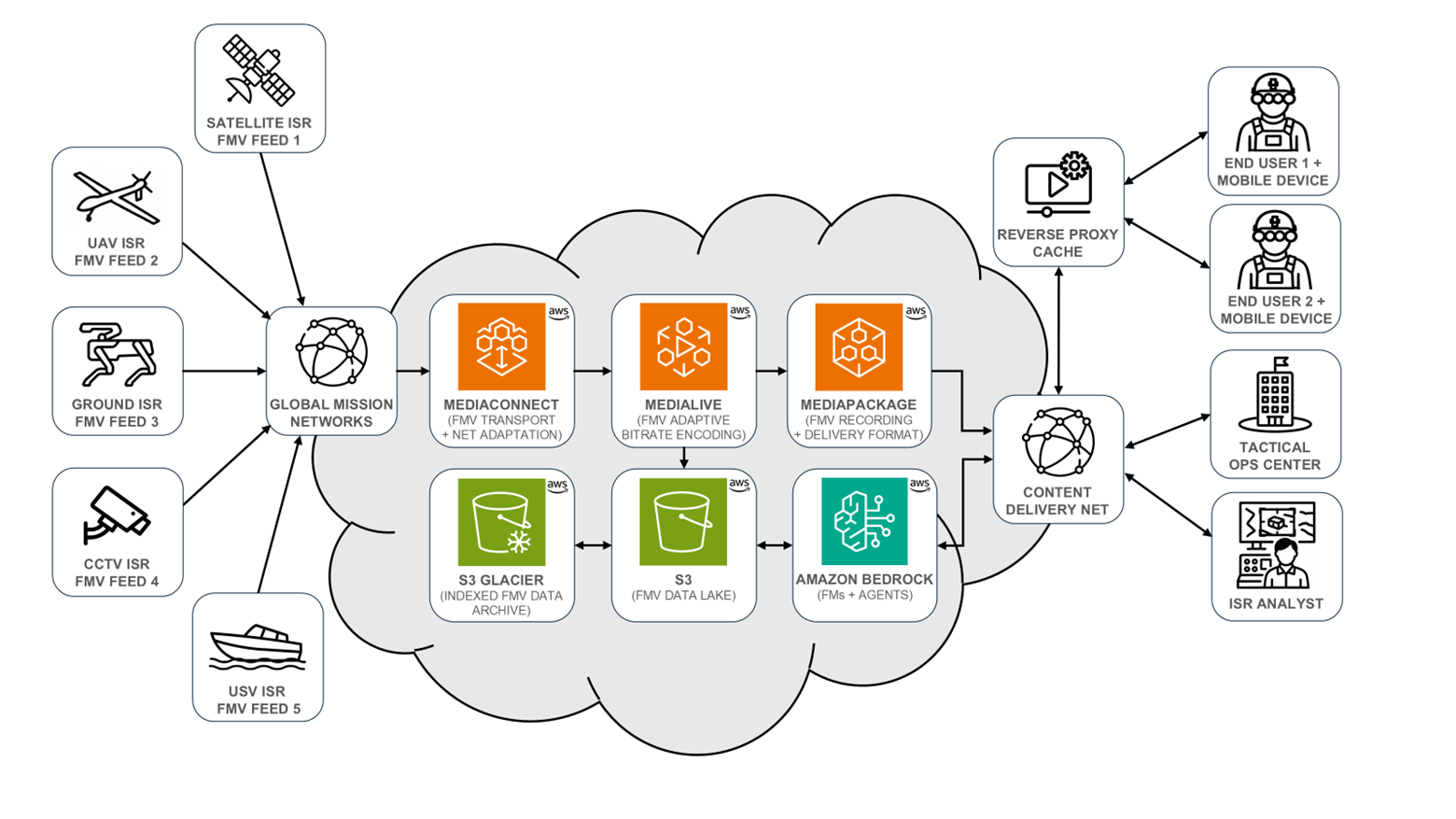
Figure 1: High-level operational view
- Multi-domain ISR sensors transport FMV across various hybrid global mission networks that connect into one or more AWS Regions. Optional, AWS Direct Connect circuits can be established for dedicated private connections between on-premises and Cloud.
- AWS Elemental MediaConnect adapts to a variety of ingest protocols for secure and reliable cloud contribution and point-to-point relays.
- AWS Elemental MediaLive encodes live broadcast-grade streaming media with traditional MPEG Transport Stream and/or ABR technologies.
- AWS Elemental MediaPackage facilitates recordings, repackaging, and delivery.
- Content Delivery Network (CDN), such as Amazon CloudFront, or reverse proxy cache is put in place to manage end user distributions. Edge caching policies can be applied to serve and store FMV to user communities.
- Storing media to an Amazon S3 data lake, (i.e. Media Lake on AWS), can be accomplished with AWS Elemental MediaLive or AWS Elemental MediaPackage generating an indexed catalog of FMV content.
- The Amazon S3 data lake can employ lifecycle policies to archive older content into Amazon S3 Glacier for longer-term archival requirements.
- Embed Amazon Bedrock APIs into applications to leverage an array FMs such as Twelve Labs in Amazon Bedrock for advanced video understanding.
Conclusion
Over twenty years ago, ISR organizations modeled video collection and delivery systems after the commercial broadcast and IPTV industry. Although this proved effective, the M&E industry has since undergone massive transformations, many embracing cloud services and streaming technologies. Today’s media subscribers access content through a variety of streaming options, over varying networks conditions, to virtually any device type on a global scale. This evolution in technologies, best practices, and reference implementations continues to play an important role for ISR organizations who are also considering cloud migrations for similar FMV workloads. By implementing cloud-native media processing and storage solutions, organizations can effectively position generative AI capabilities to transform years of stored assets into a backend of structured intelligence. The combination of a modern cloud architecture and AI systems working together builds new pathways for actionable, data-driven decision making at the speed of relevance for the next generation warfighters, emergency responders, and disaster recovery teams worldwide.
Learn more
- Media services implementation guide – Live Streaming on AWS
- AWS Lake Formation implementation guide – AWS Lake Formation: How it works
- AWS Solutions Library – Guidance for Media Lake on AWS
- Amazon Bedrock implementation guide – Get started with Amazon Bedrock
- Discover CMS solutions for M&E on AWS Marketplace
- Download, install and get started with the KIRO IDE