
Sold by: AppFactor
Deployed on AWS
Turn any REST, GraphQL, SOAP, or gRPC API into AI-ready, optimized MCP tools with zero code. Self-hosted, enterprise-grade security, full observability.
Overview
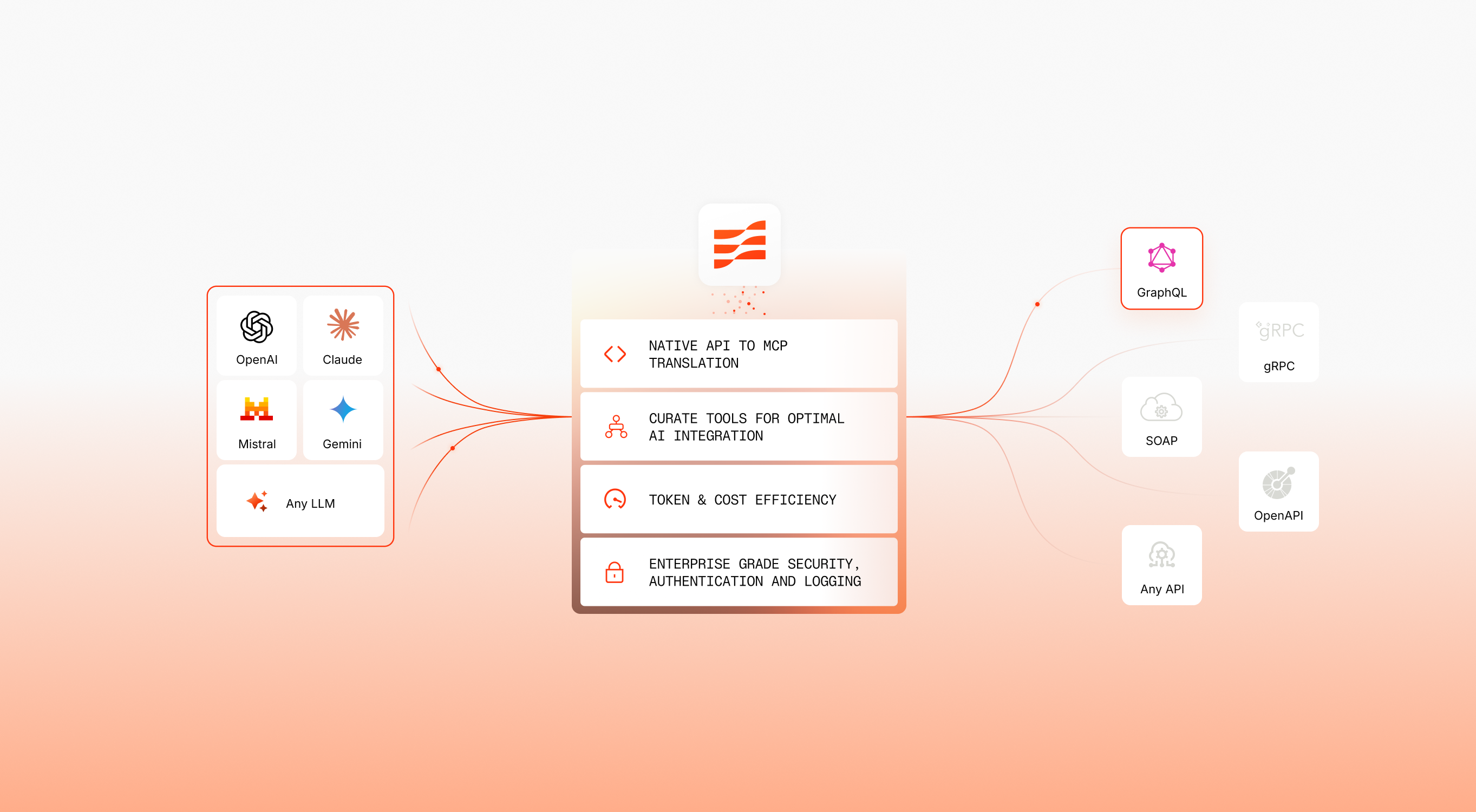
- MCP Bridge is a self-hosted enterprise grade platform that turns any existing API into AI-ready tools using the Model Context Protocol (MCP). Point it at a REST, GraphQL, SOAP, or gRPC endpoint, and it auto-generates fully described MCP tool definitions that any LLM client can discover and invoke - no custom integration code required. * THE PROBLEM: Connecting LLMs to enterprise APIs today requires writing bespoke tool definitions for every endpoint, maintaining parameter mappings by hand, and rebuilding when schemas change. For organisations with dozens of internal services and hundreds of endpoints, this is a significant engineering tax that slows AI adoption. Meanwhile, uncontrolled MCP server sprawl creates security blind spots, credential exposure, and governance gaps. * HOW IT WORKS: MCP Bridge imports API schemas (OpenAPI, GraphQL introspection, WSDL, gRPC .proto files), auto-generates typed MCP tools with input/output schemas, behavioural annotations, and documentation, then executes at runtime - validating inputs, mapping parameters, handling authentication (Bearer, Basic, API Key, OAuth2, AWS Cognito SRP), and post-processing responses to reduce token waste. For large APIs (100+ endpoints), Code Mode replaces the full tool catalogue with 3 meta-tools, cutting context window usage by approximately 98%. * KEY CAPABILITIES: Protocol translation across REST, GraphQL, SOAP, and gRPC. Per-tool response post-processing (filter, transform, aggregate). Tool curation with metadata enhancement for optimal LLM performance. Enterprise-grade authentication and authorisation. Centralised rate limiting, connection pooling, and retry logic. Comprehensive analytics dashboard with latency, throughput, token usage, and error tracking. Hybrid search with optional semantic similarity for tool discovery. Structured MCP logging with configurable verbosity. * WHO IT IS FOR: Platform teams exposing internal APIs to AI agents. AI engineers building agents that need a managed tool layer. Organisations adopting MCP as a standard and bridging their existing API portfolio. Security teams seeking centralised governance over AI-to-API connectivity. * WHY APPFACTOR: MCP Bridge eliminates the glue code tax, provides a single control plane for all AI-to-API connectivity, and gives security and platform teams the visibility and governance they need - without slowing down AI adoption.
Highlights
- Transform any REST, GraphQL, SOAP, or gRPC API into MCP tools with zero custom code. Auto-generate fully typed MCP tool definitions with input/output schemas, behavioural annotations, and documentation.
- Reduce LLM context window usage by ~98% with Code Mode for large API portfolios (100+ endpoints). Enterprise-grade security: OAuth2, Bearer, Basic, API Key, and AWS Cognito SRP authentication.
- Per-tool response post-processing to filter, transform, and aggregate API responses - cutting token waste from large payloads. Centralised analytics dashboard covering latency, throughput, token usage, error rates, and per-tool cost tracking.
Details
Sold by
Categories
Delivery method
Supported services
Delivery option
MCP Bridge v0.11.6
Latest version
Operating system
Linux
Deployed on AWS
New
Introducing multi-product solutions
You can now purchase comprehensive solutions tailored to use cases and industries.

Features and programs
Financing for AWS Marketplace purchases
AWS Marketplace now accepts line of credit payments through the PNC Vendor Finance program. This program is available to select AWS customers in the US, excluding NV, NC, ND, TN, & VT.

Pricing
Pricing is based on the duration and terms of your contract with the vendor. This entitles you to a specified quantity of use for the contract duration. If you choose not to renew or replace your contract before it ends, access to these entitlements will expire.
Additional AWS infrastructure costs may apply. Use the AWS Pricing Calculator to estimate your infrastructure costs.
Dimension | Description | Cost/12 months |
|---|---|---|
Starter Tier | 3 connected API's, 50 active tools, REST and GraphQL, 7-day log retention, analytics overview - only. | $5,400.00 |
Team Tier | 5 connected API's, 150 active tools, REST, GraphQL, SOAP, gRPC, 30-day log retention, analytics - full + Code Mode | $20,000.00 |
Enterprise Tier | 30 connected API's, 500 active tools, REST, GraphQL, SOAP, gRPC, 90-day log retention, analytics - full + Code Mode + OTel, high availability mode. | $67,000.00 |
Dimensions summary
MCP Bridge sells three contract tiers that scale by capacity and features. Each tier sets how many APIs you can connect and how many active tools you can run. Starter Tier supports 3 connected APIs and 50 active tools, with REST and GraphQL protocols and 7-day log retention. Team Tier raises limits to 5 APIs and 150 tools, adds SOAP and gRPC protocols, extends logs to 30 days, and includes Code Mode. Enterprise Tier scales to 30 APIs and 500 tools, keeps 90-day log retention, and adds OpenTelemetry analytics plus high availability mode. Higher tiers unlock more capacity, protocols, and retention.
Top-of-mind questions for buyers
A connected API is one backend service you link to the platform for protocol translation. An active tool is one callable function exposed to agents from those APIs. Each tier caps both counts. Starter allows 3 APIs and 50 tools; Enterprise allows 30 APIs and 500 tools.
Each tier sets fixed caps on connected APIs and active tools. When you hit those caps, you cannot add more within the same tier. Moving to a higher tier raises both limits. Tier changes are contract-based, so upgrading is a manual step, not an automatic overage charge.
Beyond API and tool counts, tiers differ by protocol support, log retention, and analytics. Starter covers REST and GraphQL with a 7-day log and analytics overview. Team and Enterprise add SOAP, gRPC, and Code Mode. Enterprise also adds OpenTelemetry analytics and high availability mode, with 90-day log retention.
appfactor.io
Helpful?
Vendor refund policy
non-refundable

Legal
Vendor terms and conditions
Upon subscribing to this product, you must acknowledge and agree to the terms and conditions outlined in the vendor's End User License Agreement (EULA) .
Content disclaimer
Vendors are responsible for their product descriptions and other product content. AWS does not warrant that vendors' product descriptions or other product content are accurate, complete, reliable, current, or error-free.
Delivery details
MCP Bridge v0.11.6
Supported services: Learn more
- Amazon ECS
Container image
Containers are lightweight, portable execution environments that wrap server application software in a filesystem that includes everything it needs to run. Container applications run on supported container runtimes and orchestration services, such as Amazon Elastic Container Service (Amazon ECS) or Amazon Elastic Kubernetes Service (Amazon EKS). Both eliminate the need for you to install and operate your own container orchestration software by managing and scheduling containers on a scalable cluster of virtual machines.
Version release notes
Multiple fixes related to AWS Marketplace Deployment
Additional details
Usage instructions
Use the provided Cloudformation stack to deploy.
Resources
Vendor resources
Support
Vendor support
AWS infrastructure support
AWS Support is a one-on-one, fast-response support channel that is staffed 24x7x365 with experienced and technical support engineers. The service helps customers of all sizes and technical abilities to successfully utilize the products and features provided by Amazon Web Services.
Similar products


Structured agent access to Elasticsearch: Query indices using natural language via a standardized protocol -- no custom APIs needed

AppFactor Core provides a rapid and automated approach to understand applications and their dependencies, automatically generate modernization candidates for cloud-native architectures and assess them for low level cloud readiness, security risks and tech debt.

Connect your favorite AI tools like GitHub Copilot, Claude, and Cursor directly to BrowserStack end-to-end testing stack, all from within your IDE. BrowserStack MCP Server is a secure, open-source bridge that enables natural language test management, execution, debugging, and accessibility scans seamlessly.
Customer reviews
No customer reviews yet
Be the first to review this product . We've partnered with PeerSpot to gather customer feedback. You can share your experience by writing or recording a review, or scheduling a call with a PeerSpot analyst.