Artificial Intelligence
Category: Application Services
Embed Amazon Quick Suite chat agents in enterprise applications
Organizations find it challenging to implement a secure embedded chat in their applications and can require weeks of development to build authentication, token validation, domain security, and global distribution infrastructure. In this post, we show you how to solve this with a one-click deployment solution to embed the chat agents using the Quick Suite Embedding SDK in enterprise portals.
Building a scalable virtual try-on solution using Amazon Nova on AWS: part 1
In this post, we explore the virtual try-on capability now available in Amazon Nova Canvas, including sample code to get started quickly and tips to help get the best outputs.
How Amazon uses Amazon Nova models to automate operational readiness testing for new fulfillment centers
In this post, we discuss how Amazon Nova in Amazon Bedrock can be used to implement an AI-powered image recognition solution that automates the detection and validation of module components, significantly reducing manual verification efforts and improving accuracy.
Accelerate agentic application development with a full-stack starter template for Amazon Bedrock AgentCore
In this post, you will learn how to deploy Fullstack AgentCore Solution Template (FAST) to your Amazon Web Services (AWS) account, understand its architecture, and see how to extend it for your requirements. You will learn how to build your own agent while FAST handles authentication, infrastructure as code (IaC), deployment pipelines, and service integration.
How AutoScout24 built a Bot Factory to standardize AI agent development with Amazon Bedrock
In this post, we explore the architecture that AutoScout24 used to build their standardized AI development framework, enabling rapid deployment of secure and scalable AI agents.
Build a proactive AI cost management system for Amazon Bedrock – Part 2
In this post, we explore advanced cost monitoring strategies for Amazon Bedrock deployments, introducing granular custom tagging approaches for precise cost allocation and comprehensive reporting mechanisms that build upon the proactive cost management foundation established in Part 1. The solution demonstrates how to implement invocation-level tagging, application inference profiles, and integration with AWS Cost Explorer to create a complete 360-degree view of generative AI usage and expenses.
Build a proactive AI cost management system for Amazon Bedrock – Part 1
In this post, we introduce a comprehensive solution for proactively managing Amazon Bedrock inference costs through a cost sentry mechanism designed to establish and enforce token usage limits, providing organizations with a robust framework for controlling generative AI expenses. The solution uses serverless workflows and native Amazon Bedrock integration to deliver a predictable, cost-effective approach that aligns with organizational financial constraints while preventing runaway costs through leading indicators and real-time budget enforcement.
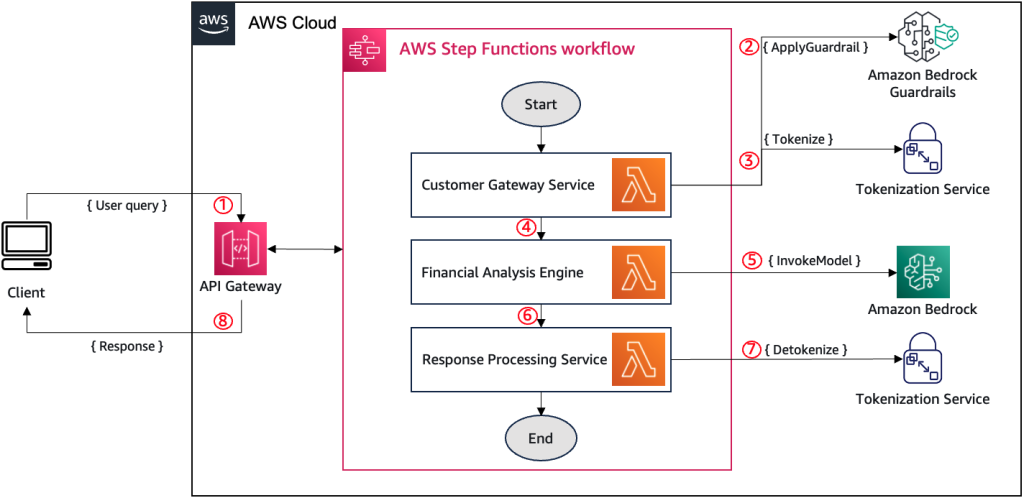
Integrate tokenization with Amazon Bedrock Guardrails for secure data handling
In this post, we show you how to integrate Amazon Bedrock Guardrails with third-party tokenization services to protect sensitive data while maintaining data reversibility. By combining these technologies, organizations can implement stronger privacy controls while preserving the functionality of their generative AI applications and related systems.
Whiteboard to cloud in minutes using Amazon Q, Amazon Bedrock Data Automation, and Model Context Protocol
We’re excited to share the Amazon Bedrock Data Automation Model Context Protocol (MCP) server, for seamless integration between Amazon Q and your enterprise data. In this post, you will learn how to use the Amazon Bedrock Data Automation MCP server to securely integrate with AWS Services, use Bedrock Data Automation operations as callable MCP tools, and build a conversational development experience with Amazon Q.
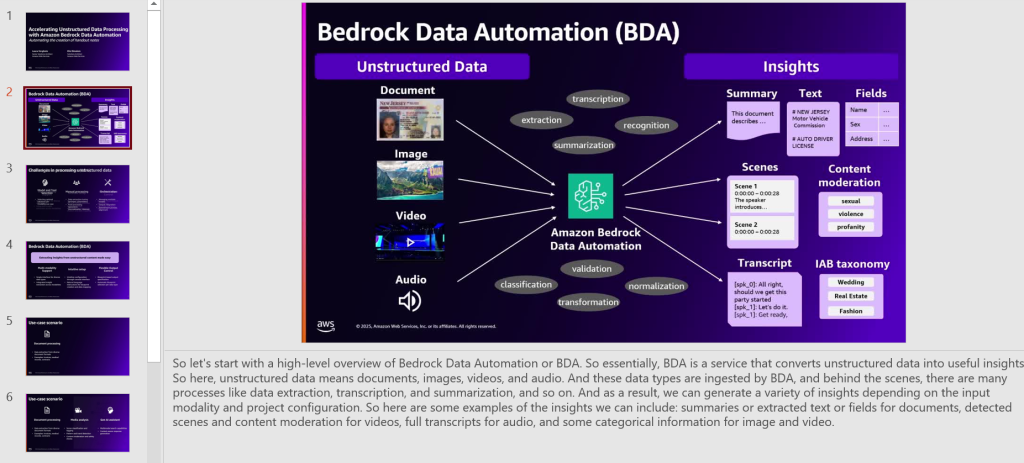
Automate the creation of handout notes using Amazon Bedrock Data Automation
In this post, we show how you can build an automated, serverless solution to transform webinar recordings into comprehensive handouts using Amazon Bedrock Data Automation for video analysis. We walk you through the implementation of Amazon Bedrock Data Automation to transcribe and detect slide changes, as well as the use of Amazon Bedrock foundation models (FMs) for transcription refinement, combined with custom AWS Lambda functions orchestrated by AWS Step Functions.