AWS for Industries
AI-Powered Collections: How EXL Uses AI on AWS for Debt Recovery at Scale
Learn how to transform collections operations for banks and fintechs with AI and ML on AWS
The Business Challenge
Financial institutions face mounting pressure in collections operations. Traditional debt collection operates on a simple playbook: aggressive phone calls, generic messaging, and rule-based workflows. Yet customers have unique capacity to pay (income, assets, competing obligations), willingness to pay (life circumstances, engagement patterns, motivation), and channel preferences (phone-averse digital natives vs. voice-preferring demographics).
Legacy collections platforms apply uniform strategies to customers, resulting in rising collection cost as phone-based strategies become less effective, poor customer experience damaging brand reputation and Net Promoter Score (NPS), regulatory scrutiny from Consumer Financial Protection Bureau (CFPB) and state regulators, and scale constraints as contact centers can’t grow proportionally with loan portfolios.
EXL recognized collections is fundamentally a data science and customer engagement problem: determining who to contact, when to contact, how to contact, and what to say. Building this at enterprise scale, supporting millions of daily customer interactions, requires secure, compliant cloud infrastructure, production-grade ML operations, omnichannel orchestration, and real-time customer engagement tracking.
To address these challenges, EXL developed PayMentor – an AI-powered collections platform built on AWS that uses machine learning to personalize customer outreach, optimize channel selection, and automate communication workflows at enterprise scale.
About EXL
EXL Service Holdings is a leading data analytics, AI, and digital solutions provider serving Fortune 500 organizations for over 25 years. With over 50,000 professionals globally, EXL brings deep expertise in insurance, healthcare, banking, capital markets, retail, media and communications, and energy to reimagine business models, deliver measurable outcomes, and speed up innovation.
Why AWS?
EXL selected AWS to build PayMentor for five critical reasons. First, AWS provides financial services compliance maturity through compliance certifications (PCI-DSS, SOC 1/2/3, ISO 27001), a breadth and depth of services to choose from, and regulatory audit support and documentation.
Second, AWS offers production-ready ML infrastructure with Amazon SageMaker for scalable model training and inference, an isolated account architecture for ML development versus production, and built-in security controls for financial data.
Third, AWS delivers omnichannel communication services through native integrations (Amazon Simple Email Service, AWS End User Messaging, Amazon Connect, Amazon Lex), pay-per-use pricing aligned with collections economics, and a global footprint for multi-region deployment.
Fourth, AWS enables real-time data processing with Amazon Kinesis for streaming customer engagement data, low-latency feedback loops for strategy optimization, and event-driven architecture with Step Functions.
Finally, AWS provides scalability and cost efficiency through serverless architecture using AWS Lambda, which eliminates over-provisioning and auto-scales from zero to millions of daily interactions.
Solution Objectives
EXL designed PayMentor with eight high-level objectives:
- Enhanced system performance for a cloud-based collections platform.
- Fault-tolerant deployment with multi-AZ resilience.
- Secure architecture with encryption and compliance controls.
- Self-healing features where possible, zero human intervention for deployments.
- Minimization of the total cost of ownership for customers.
- Acceleration of time to market for new financial institutions.
- Dynamic scalability to handle market volatility.
Architecture Overview
Design Principles
PayMentor’s AWS architecture reflects financial services requirements across five key dimensions. Achieve security by design through multi-account isolation, encryption everywhere (AWS Key Management Service), and zero-trust networking. Ensure regulatory compliance via audit trails (AWS CloudTrail), data lineage tracking. Build operational resilience with multi-AZ deployment on AWS Global Infrastructure. Deliver scalability through a serverless-first architecture and auto-scaling capabilities. Realize cost optimization through pay-per-use pricing and intelligent data tiering in Amazon Simple Storage Service (Amazon S3).
Phase 1: Secure Data Ingestion
The challenge in this phase was to ingest sensitive customer financial data from banks and fintechs securely and at scale. PayMentor implements three ingestion methods based on customer requirements.
For SFTP-based training and batch data, the platform handles one-time ML training data plus daily or monthly customer portfolio files. This approach uses end-to-end encryption with customer-provided public/private key pairs. AWS Glue ETL to validate schema, cleanse and load data to an Amazon S3 data lake, with a detailed audit trail via CloudTrail.
For REST API-based real-time data ingestion, PayMentor leverages AWS Lambda and Amazon API Gateway for serverless, auto-scaling capabilities. Amazon Cognito provides authentication with MFA (username + password + OTP), while AWS WAF offers protection including DDoS mitigation and rate limiting. It writes data to Amazon Relational Database Service (RDS) for operational queries and Amazon S3 for analytics, with TLS 1.2+ encryption in transit and KMS encryption at rest. For third-party integrations with credit bureaus and payment processors, the platform uses Amazon AppFlow for secure, managed integrations with pre-built connectors and audit logging.
Phase 2: ML Model Development (Isolated AWS Account)
The challenge in developing ML models on sensitive financial data while maintaining security isolation led EXL to adopt a critical architectural decision: separate AWS accounts for ML development versus production.
This separation matters for several reasons: From a security perspective, they isolated ML experimentation from production customer data. For compliance, there’s clear separation for audit. In terms of risk management, the production system remains unaffected by ML development changes. From a governance standpoint, artifact-based deployment enforces review and approval gates.
PayMentor develops two primary ML models. The Customer Ranking Model predicts the probability of payment within defined timeframes. Trained on payment history, engagement signals, and behavioral patterns using Gradient Boosted Trees (XGBoost on Amazon SageMaker), with weekly retraining using the latest customer engagement data. The Channel Preference Model predicts the optimal communication channel per customer, taking historical engagement data from Kinesis streams as input and producing channel recommendations ranked by predicted effectiveness.
Solution Architecture
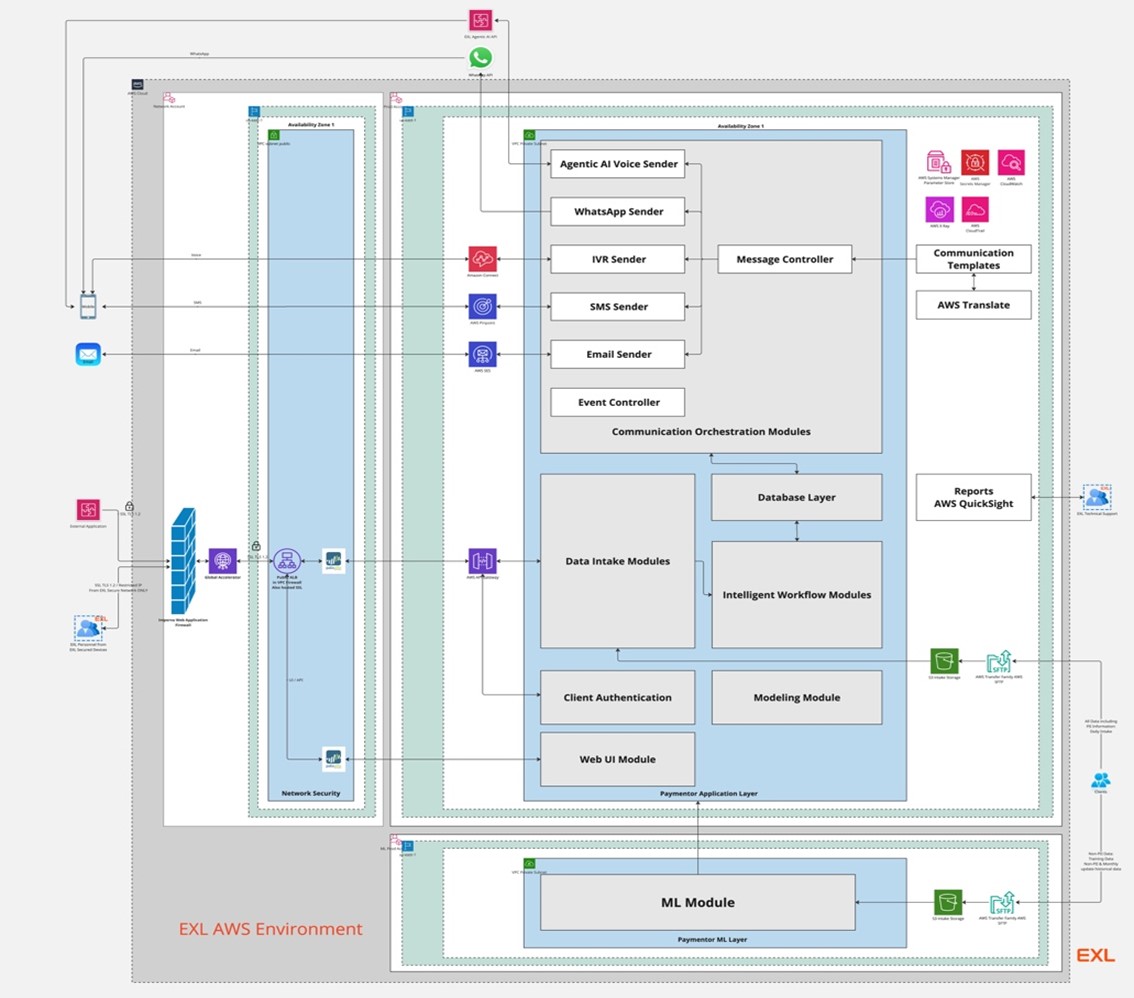
Figure 1 – EXL PayMentor Solution Architecture on AWS
Phase 3: Daily Scoring and Strategy Generation
Scoring accounts daily and generating personalized communication strategies is addressed through AWS Step Functions orchestrating SageMaker inference. The daily workflow begins when Amazon EventBridge triggers the AWS Step Functions workflow. The workflow then fetches the daily customer file from Amazon S3, invokes the SageMaker endpoint to generate customer rankings, saves rankings to Amazon RDS, runs the strategy engine to generate communication plans, writes actions to Amazon RDS, and sends a completion notification via Amazon Simple Notification Service.
They chose Step Functions for four key reasons: it provides visual workflows for debugging and audit trails, includes built-in retry logic with exponential backoff, enables parallel execution for independent tasks, and maintains state persistence for regulatory audit requirements.
Phase 4: Omnichannel Execution
Running personalized communication strategies across multiple channels at scale required AWS Lambda to orchestrate channel-specific services. PayMentor integrates multiple channels: Amazon SES for email-based payment reminders and account summaries and AWS End User Messaging for SMS urgent notifications and payment links. Third-party services with Lambda for WhatsApp conversational engagement. Amazon Connect with Amazon Polly and Amazon Lex for Interactive Voice Response (IVR) automated payment arrangements. Amazon Connect with Amazon Lex and Amazon Bedrock for natural language conversations, and API Gateway with Lambda for customer initiated self-service portal and account management.
Communication Templates leverage AWS Translate to deliver multi-language message support, extending PayMentor’s reach to non-English speaking customers.
Channel Integrations
| Channel | AWS Service | Use Case |
| Amazon SES | Payment reminders, account summaries | |
| SMS | AWS End User Messaging | Urgent notifications, payment links |
| Third-party + Lambda | Conversational engagement | |
| Voice IVR | Connect + Polly + Lex | Automated payment arrangements |
| Voice AI | Connect + Lex + Bedrock | Natural language conversations |
| Self-Service Portal | API Gateway + Lambda | Customer-initiated account management |
Phase 5: Real-Time Engagement Tracking
Capturing customer interactions to optimize strategies in real-time required processing engagement data within minutes rather than daily batches. Traditional batch processing delays strategy adjustments by up to 24 hours, reducing response effectiveness. PayMentor captures SMS, email, and voice interactions in real-time using an Amazon Kinesis streaming architecture.
For SMS interactions through AWS End User Messaging, customer interactions (reply, click, opt-out) flow into Amazon Data Firehose, which sends the data to Amazon S3 for archival and Amazon Kinesis Data Streams for processing. AWS Lambda then processes the stream and updates Amazon RDS, letting the strategy engine adjust in real time.
For email interactions through Amazon SES, customer interactions (open, click, bounce) follow a similar path through Amazon Data Firehose to both S3 and Kinesis Data Streams. Lambda then updates Amazon RDS, which feeds Amazon QuickSight for visualization.
This real-time architecture delivers four key benefits: strategy changes based on engagement happen immediately, channel optimization occurs per customer, compliance monitoring processes opt-out requests immediately, and operational visibility through QuickSight dashboards.
Phase 6: Analytics and Reporting
Providing real-time visibility to collections teams and executive leadership required QuickSight dashboards powered by Amazon RDS and Amazon S3. PayMentor delivers two primary dashboard types.
The Operational Command Center provides real-time metrics including messages delivered by channel, engagement rates (opens, clicks, replies), and cost per contact by channel. This dashboard queries Amazon RDS directly through QuickSight for immediate insights.
The Strategic Performance Analytics dashboard provides historical analysis, including cure rate trends (the percentage of delinquent accounts returning to current status) by customer segment, channel effectiveness over time, regulatory compliance metrics, and comparative analysis. This dashboard leverages QuickSight querying Amazon S3 through Amazon Athena for deep historical analysis.
Security and Compliance Architecture
Data Protection
Encryption
PayMentor implements end-to-end encryption strategies. At rest, AWS KMS customer-managed keys (CMK) protect Amazon S3, Amazon RDS, and SageMaker resources. In transit, TLS 1.2 secures API and data transfer communications. Key rotation occurs automatically annually with a detailed audit trail.
Network Security
EXL achieved network security through VPC isolation with private subnets, AWS WAF protection on API Gateway, security groups with least-privilege rules, and AWS PrivateLink for internal traffic.
Authentication and Authorization
For customer API access, Amazon Cognito provides multi-factor authentication with OTP delivery through SMS or email and temporary tokens with a 30-minute expiry. They control internal access through AWS Identity and Access Management (IAM) policies for role-based access control, AWS CloudTrail audit logging, and immutable logs for compliance.
ML Security (SageMaker Controls)
PayMentor implements multi-layered SageMaker security controls: endpoint encryption is enabled, notebooks have no direct internet access, KMS keys protect SageMaker endpoints and training jobs, no root access in notebook instances, and VPC isolation secures ML training and inference workloads. The platform maintains regulatory compliance with PCI-DSS and SOC 1/2/3 certifications.
Conclusion
Collections are no longer about volume of outreach—it’s about intelligence of engagement. The competitive advantage goes to institutions that can answer: Which customers need intervention versus digital nudges? What channel will they respond on? What message resonates with their situation?
AWS makes this possible at enterprise scale supporting millions of transactions daily. SageMaker provides production-grade ML infrastructure with built-in security for financial data. Native omnichannel services (Amazon SES, AWS End User Messaging, Amazon Connect, Amazon Lex) deliver integrated communication without multi-vendor integration overhead. Serverless architecture eliminates over-provisioning while scaling to millions of interactions daily. AWS financial services compliance framework provides PCI-DSS, SOC 1/2/3, multi-account isolation, and encryption, meaning security and regulatory requirements are architectural foundations, not afterthoughts.
Financial institutions looking to modernize collections need cloud infrastructure designed for regulated industries with ML capabilities at its core. That’s AWS.
To learn how AWS is transforming financial services, explore https://aws.amazon.com/solutions/financial-services/
Also see how AWS customers are innovating using AI ML services for regulated industries https://aws.amazon.com/financial-services/machine-learning/