
Sold by: Fortinet Inc.
Deployed on AWS
Free Trial
Fortinet FortiGate allows mitigation of blind spots to improve policy compliance by implementing critical security controls within your AWS environment. FortiGate includes all of the security and networking services common to FortiGate physical appliances.
4.2
Overview
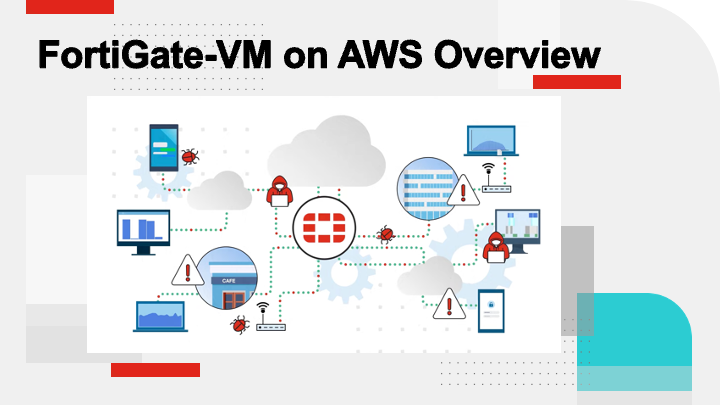
Video
Video 1
Video
Video 2

Video
Product video
FortiGate-VM on AWS delivers next-generation firewall and VPN/SD-WAN capabilities for organizations of all sizes. It enables broad network protection and automated security management for consistent enforcement and visibility across your AWS VPCs and hybrid cloud infrastructure. FortiGate natively integrates with AWS Gateway Load Balancer, AWS Transit Gateway and other AWS security services to simplify and deliver enterprise-class security for applications and workloads running on AWS.
FortiGate-VM reduces complexity by combining secure connectivity with advanced threat protection capabilities such as powerful intrusion prevention (IPS), malware detection and protection, and continuous threat intelligence from FortiGuard Labs security services. It offers a management console that provides comprehensive network automation and unified visibility across multi-cloud environments.
FortiGate-VM, in concert with other elements of the Fortinet Security Fabric, enables common deployment scenarios such as cloud security services hub, secure remote access, container security, web application security, and critical workload protection.
Visit the FortiGate-VM on AWS Community Resource Hub to find onboarding, deployment, and technical information and join in discussions: https://community.fortinet.com/t5/FortiGate-VM-on-AWS/gh-p/fortigate-vm-on-aws
Please contact awssales@fortinet.com with any questions.
Highlights
- FortiGate offers protection from a broad array of threats, with support for all of the security and networking services offered by the FortiOS operating system.
- Delivers complete content and network protection by combining stateful inspection with a comprehensive suite of powerful security features to meet PCI DSS compliance.
- IPS technology protects against current and emerging network-level threats. In addition to signature-based threat detection, IPS performs anomaly-based detection which alerts users to any traffic that matches attack behavior profiles.
Details
Sold by
Categories
Delivery method
Delivery option
64-bit (x86) Amazon Machine Image (AMI)
Latest version
Operating system
OtherLinux 8.0.2
Deployed on AWS
New
Introducing multi-product solutions
You can now purchase comprehensive solutions tailored to use cases and industries.

Features and programs
Trust Center

Access real-time vendor security and compliance information through their Trust Center powered by Drata or Vanta. Review certifications and security standards before purchase.
Buyer guide
Gain valuable insights from real users who purchased this product, powered by PeerSpot.

Financing for AWS Marketplace purchases
AWS Marketplace now accepts line of credit payments through the PNC Vendor Finance program. This program is available to select AWS customers in the US, excluding NV, NC, ND, TN, & VT.

Pricing
Free trial
Try this product free for 30 days according to the free trial terms set by the vendor. Usage-based pricing is in effect for usage beyond the free trial terms. Your free trial gets automatically converted to a paid subscription when the trial ends, but may be canceled any time before that.
Pricing is based on actual usage, with charges varying according to how much you consume. Subscriptions have no end date and may be canceled any time. Alternatively, you can pay upfront for a contract, which typically covers your anticipated usage for the contract duration. Any usage beyond contract will incur additional usage-based costs.
Additional AWS infrastructure costs may apply. Use the AWS Pricing Calculator to estimate your infrastructure costs.
Dimension | Cost/hour |
|---|---|
c6in.xlarge Recommended | $1.02 |
c8in.xlarge | $1.02 |
m7i.16xlarge | $5.16 |
t2.small | $0.36 |
c6a.4xlarge | $3.29 |
c8in.32xlarge | $6.19 |
c7a.4xlarge | $3.29 |
c6a.2xlarge | $1.60 |
m5.8xlarge | $4.10 |
c5n.xlarge | $1.02 |
Dimensions summary
You pay by the hour based on the AWS EC2 instance type you run the firewall on. Pricing is usage-based, so you are billed only for the hours each instance runs. The options span many instance families — general-purpose, compute-optimized, memory-optimized, and network-optimized — in sizes from large through 32xlarge. Larger instances offer more vCPUs and processing capacity for heavier traffic. Your hourly rate scales with the instance size and family you select. This lets you match capacity to your workload and scale up or down as traffic changes.
Top-of-mind questions for buyers
The hourly rate covers the firewall software running on your chosen EC2 instance. You pay this on top of the underlying AWS compute charges for that instance. This on-demand billing bundles the licence, so you do not need a separate purchased licence key to run it.
The software charge meters running hours only. A stopped instance stops accruing the hourly software fee. However, AWS may still bill you for attached storage or reserved resources while the instance is stopped. To halt software charges, stop or terminate the instance.
Larger instances add vCPUs and processing capacity for heavier traffic. Match the instance family and size to your expected throughput. You can move to a different instance type as traffic grows or shrinks, and your hourly rate adjusts to the new instance you run.
www.fortinet.com
Helpful?
Vendor refund policy
You may terminate the instance at anytime to stop incurring charges.
Custom pricing options
Request a private offer to receive a custom quote.

Legal
Vendor terms and conditions
Upon subscribing to this product, you must acknowledge and agree to the terms and conditions outlined in the vendor's End User License Agreement (EULA) .
Content disclaimer
Vendors are responsible for their product descriptions and other product content. AWS does not warrant that vendors' product descriptions or other product content are accurate, complete, reliable, current, or error-free.
Delivery details
64-bit (x86) Amazon Machine Image (AMI)
Amazon Machine Image (AMI)
An AMI is a virtual image that provides the information required to launch an instance. Amazon EC2 (Elastic Compute Cloud) instances are virtual servers on which you can run your applications and workloads, offering varying combinations of CPU, memory, storage, and networking resources. You can launch as many instances from as many different AMIs as you need.
Version release notes
Additional details
Usage instructions
Please ensure the connectivity to FortiCare (https://directregistration.fortinet.com:443 ) by checking all related setup on security groups, ACLs, IGW, route tables, public IP address...etc.
After deploying the instance, click on Manage in AWS Console to see the running instance and public DNS address to continue the configuration of the FortiGate-VM. Connect to the secured Web UI via the public DNS address: https:// <public DNS address>. For any CLI configuration/settings, SSH is required to log into the CLI. Default login credentials are with a username of admin and the AWS Instance ID value as the password. The FortiGate-VM AWS Install and Configure guide is located at https://docs.fortinet.com/document/fortigate-public-cloud/8.0.0/aws-administration-guide/
Support
Vendor support
This product is intended for On-Demand subscription. Please contact Customer Support with the following information instead of trying to register in FortiGate management GUI:
- The serial number of your FortiGate instance
- The email ID of your Fortinet account. If you do not have an account yet, please sign using the link below
AWS infrastructure support
AWS Support is a one-on-one, fast-response support channel that is staffed 24x7x365 with experienced and technical support engineers. The service helps customers of all sizes and technical abilities to successfully utilize the products and features provided by Amazon Web Services.
Updated weekly


By Check Point Software Technologies

By Palo Alto Networks
Sentiment is AI generated from actual customer reviews on AWS and G2
Functionality
Ease of use
Customer service
Cost effectiveness
Positive reviews
Mixed reviews
Negative reviews
AI generated from product descriptions
Intrusion Prevention System
IPS technology with signature-based and anomaly-based detection to protect against current and emerging network-level threats and attack behavior profiles
Stateful Inspection and Content Filtering
Stateful inspection combined with comprehensive security features including malware detection and protection for content and network protection
VPN and SD-WAN Capabilities
VPN and SD-WAN functionality for secure connectivity and remote access across hybrid cloud infrastructure
Cloud Platform Integration
Native integration with AWS Gateway Load Balancer, AWS Transit Gateway, and other AWS security services for VPC and multi-cloud environments
Threat Intelligence and Management
Continuous threat intelligence from FortiGuard Labs security services with unified management console providing network automation and visibility across multi-cloud environments
Advanced Threat Prevention Capabilities
Includes firewall, Data Loss Prevention (DLP), Intrusion Prevention System (IPS), application control, IPsec VPN, URL filtering, antivirus, and anti-bot features for multi-layered network security.
Traffic Inspection and Control
Inspects and controls encrypted data flows between on-premises networks and AWS VPCs, including North-South traffic entering and exiting private subnets and East-West traffic between VPCs.
Infrastructure-as-Code Integration
Integrates with infrastructure-as-code tools including Terraform and Ansible for policy automation, with dynamic security policy adaptation based on real-time cloud metadata.
AWS Service Integration
Supports integration with AWS Transit Gateway, Gateway Load Balancer, AWS Security Hub, VPC Ingress Routing, AWS Traffic Mirroring, AWS Outposts, and Amazon Macie.
Centralized Security Management
Provides unified, centralized management through Check Point Security Management Server with consistent policy, logging, and reporting across AWS, hybrid, and on-premises environments.
Traffic Identification and Classification
Powerful traffic identification technology for complete visibility and control over network traffic
Malware Prevention
Malware prevention capabilities to protect applications and data from known and unknown attacks
Dynamic Policy Management
Dynamically updated whitelisting and segmentation policies based on AWS tags for reduced attack surface
High-Performance Processing
DPDK support on C5, C5n, M5, and M5n instances running on AWS Nitro System for efficient traffic processing
Cloud-Native Integration
AWS Auto Scaling, ELB integration, Transit VPC with AWS Transit Gateway, and Gateway Load Balancer support for large-scale deployments
Standard contract
No
No
No
Customer reviews
reviewer2859012
Unified security platform has simplified daily network protection and accelerated troubleshooting
Reviewed on Oct 04, 2026
Review provided by PeerSpot
What is our primary use case?
Fortinet FortiGate is used primarily for network security and secure internet access, with primary applications in firewall policy management, VPN connectivity, SD-WAN, application and URL filtering, NAT, and protecting the internal network and servers from external threats.
A common example involves using Fortinet FortiGate to provide secure internet access for different departments by creating firewall policies based on the user, application, and destination while applying security profiles such as URL filtering, application control, and IPS. Traffic logs are monitored to identify and block suspicious activities. For VPN connectivity, IPsec VPN is used for site-to-site connectivity between offices and SSL VPN is used for remote user access when required. Recently, an IPsec VPN was configured and tested between a branch office and main office to securely access internal applications and servers over the internet.
Beyond secure internet access and VPN connectivity, Fortinet FortiGate is relied upon for day-to-day firewall policy management, NAT, SD-WAN, application control, URL filtering, traffic monitoring, and troubleshooting connectivity issues. It is also used for security monitoring, firmware upgrades, HA management, and checking CPU, memory, and interface utilization. Overall, Fortinet FortiGate is an important part of daily network security and operations.
How has it helped my organization?
Fortinet FortiGate has improved overall network security and made day-to-day network management more efficient. Better visibility into network traffic is available through detailed logs and monitoring, and features such as IPS, application control, URL filtering, and security policies help to control and protect internet access. Reliability has been improved through HA and SD-WAN capabilities, while VPN features make secure connectivity between sites and remote users easier to manage. Overall, faster troubleshooting, better control over network traffic, and more consistent security across the organization have been achieved.
One of the main improvements noticed is faster troubleshooting because Fortinet FortiGate provides detailed traffic logs, session information, and real-time monitoring. This helps to identify whether an issue is related to firewall policies, application or VPN connectivity, or network traffic much more quickly.
What is most valuable?
The features that stand out most are centralized policy management, IPS, application control, web and URL filtering, SSL or IPsec VPN, SD-WAN, and high availability. The traffic log and monitoring tools are very useful for troubleshooting and security analysis. Another strong point is the integration of multiple security capabilities in a single platform, which makes day-to-day network security management easier and more efficient.
Fortinet FortiGate's UI is intuitive and makes day-to-day administration easier, as firewall policies, interfaces, VPN, SD-WAN, security policies, and traffic logs can be quickly navigated without relying heavily on the CLI. The dashboard also gives a quick view of CPU, memory, session, and interface utilization, which helps with monitoring and troubleshooting. For high availability, Fortinet FortiGate HA is very useful because two firewalls can be configured in an active-passive cluster, and if the primary firewall experiences a failure, the secondary firewall takes over, which helps to minimize downtime.
Fortinet FortiGate combines multiple security functions into one platform, including firewall, IPS, application control, web filtering, VPN, and SD-WAN. The detailed logging and reporting are also helpful for troubleshooting and security analysis. Overall, these features provide good visibility and control over network traffic while reducing the need to manage multiple separate security solutions.
What needs improvement?
Fortinet FortiGate is generally easy to manage, but there are a few areas where it could be improved. The interface can become complex when managing a large number of firewall policies, and better policy search organization and reporting would be helpful. Firmware upgrades can also require careful planning and testing, especially in production environments. Troubleshooting some advanced issues may require deeper CLI knowledge or assistance from Fortinet support, and more advanced automation and AI-assisted troubleshooting within the management interface would be beneficial, such as clear recommendations for policy optimization, configuration issues, and security events. These improvements could make day-to-day administration even more efficient.
More AI-driven capabilities for day-to-day administration would be valuable, especially for troubleshooting, policy optimization, and identifying potential configuration issues. More intelligent recommendations based on traffic patterns and security events could help administrators respond faster. More advanced reporting and dashboards that can be easily customized for different teams and management requirements would also be helpful, while better automation for routine tasks, firmware planning, and configuration validation would further reduce manual effort.
For how long have I used the solution?
There is approximately two years of hands-on experience working with Fortinet FortiGate firewall, including configuration, troubleshooting, and managing firewall, SD-WAN policies, security profiles, and firmware upgrades.
What do I think about the stability of the solution?
Fortinet FortiGate is stable and working fine.
What do I think about the scalability of the solution?
Fortinet FortiGate has good scalability and can support different network sizes, from smaller branch offices to large enterprise networks with a range of hardware models and Fortinet FortiGate VM options for virtual and cloud deployment. It also scales well through features such as HA, SD-WAN, centralized management, and segmentation. As the organization grows, firewall capacity can be increased or additional Fortinet FortiGate devices can be deployed without completely redesigning the security architecture. The combination of different hardware options, cloud flexibility, and HA makes Fortinet FortiGate suitable for both current requirements and future network growth.
How are customer service and support?
Fortinet customer support is excellent overall. Fortinet technical support is useful for troubleshooting complex issues, firmware-related problems, and integration questions. The support team can also help with detailed log analysis and provide recommendations when an issue cannot be resolved through normal troubleshooting.
Which solution did I use previously and why did I switch?
Before using Fortinet FortiGate, other firewall platforms were used, including Check Point and Palo Alto, depending on customer requirements. The move to Fortinet FortiGate was mainly driven by the combination of security and networking features, straightforward management, VPN and SD-WAN capabilities, and the ability to manage multiple security functions from a single dashboard or single platform. The graphical user interface and the monitoring capabilities were found helpful for day-to-day administration and troubleshooting. Overall, Fortinet FortiGate provided a good balance of functionality, operational efficiency, and scalability for the environment.
What was our ROI?
A positive return on investment has been seen, mainly due to improved efficiency and reduced troubleshooting effort. Fortinet FortiGate combines firewall, VPN, SD-WAN, IPS, application control, and web filtering capabilities on one platform, so fewer separate security solutions need to be managed. The detailed logs, monitoring, and centralized management also help to identify and resolve network issues faster, which saves engineering time. HA and SD-WAN improve availability and reduce the potential impact of connectivity or firewall failures. An exact percentage for cost saving or reduction has not been formally calculated, but the time saved in daily administration and troubleshooting has been a clear benefit.
What's my experience with pricing, setup cost, and licensing?
The experience with Fortinet FortiGate pricing and licensing has been generally positive. The initial setup cost depends on the firewall model, required performance, and the security feature or subscription selected. The licensing is straightforward, with additional security services such as IPS, antivirus, web filtering, and application control available through subscription packages. The main consideration is the recurring cost of the security subscription and the support renewal, and for an organization using multiple Fortinet FortiGate devices, budgeting for this renewal is important. Overall, the pricing is reasonable considering the number of security and networking capabilities provided in a single platform.
Which other solutions did I evaluate?
Other firewall solutions were evaluated, mainly Check Point and Palo Alto, as well as Fortinet FortiGate. They were compared based on security capabilities, firewall and VPN functionality, SD-WAN, ease of management, monitoring and reporting capabilities, scalability, support, and overall cost. Fortinet FortiGate stood out because it provides a broad set of security and networking features in a single platform while being relatively straightforward to manage for day-to-day operations.
What other advice do I have?
The combination of reliability, security features, and ease of management stands out most. Fortinet FortiGate provides a single platform for firewall, security, SD-WAN, IPsec, IPS, application control, URL filtering, and traffic monitoring. The usability in day-to-day operations is valued, and the visibility provided through logs and dashboards makes troubleshooting much faster. HA capabilities are another important factor because they help to maintain network availability. Overall, the combination of strong security capabilities, reliable performance, and practical day-to-day management makes Fortinet FortiGate stand out.
Fortinet FortiGate's AI capabilities are useful when combined with strong security controls and governance. AI-driven threat detection and security analysis can help identify suspicious activity and provide useful insights, while administrators still have control over policies and security decisions. From the governance perspective, clear visibility into how AI-based recommendations are generated is important, along with strong access control, logging, and auditing. Security is especially important when AI is involved, so having control access and keeping human oversight in the decision-making process is crucial. Overall, AI is seen as a useful enhancement to Fortinet FortiGate's security capabilities, particularly for faster threat detection, analysis, and troubleshooting.
Fortinet FortiGate's AI-assisted capabilities can provide useful and relevant insights, particularly for identifying suspicious activity, analyzing security events, and supporting threat detection. The recommendations are helpful as a starting point and can reduce the time required to investigate issues. However, AI recommendations alone should not be relied upon for critical security decisions, as recommendations should still be validated against traffic logs, existing policies, and the actual network environment before making changes. Overall, the AI capabilities are useful and reliable for assisting security operations, while human validation remains important for production environments.
Fortinet FortiGate is primarily deployed on-premises in the organization, where it is used as a perimeter firewall for securing internet traffic, internal network segments, servers, and VPN connectivity. There is also experience with Fortinet FortiGate VM deployment in cloud environments when required. The on-premises deployment gives direct control over network security, firewall policies, monitoring, and HA, while virtual and cloud deployment provides flexibility for workloads hosted in cloud environments.
Fortinet FortiGate would be recommended to organizations looking for a comprehensive firewall and network security solution. Before purchasing, it is important to clearly define network requirements, expected traffic volume, VPN users, security features, and future scalability so the right Fortinet FortiGate model and licensing can be selected. Testing the required security policies, profiles, VPN, SD-WAN, and HA configuration in a lab or proof-of-concept environment before deploying them in production is also crucial. Proper planning, configuration, monitoring, and regular firmware upgrades are important to get the most value from the platform. A rating of 10 out of 10 would be given for Fortinet FortiGate.
Chetan-Jadhav
Integrated security and SD-WAN have improved network resilience and simplify daily operations
Reviewed on Jul 16, 2026
Review provided by PeerSpot
What is our primary use case?
Fortinet FortiGate is my primary firewall solution for firewall security, site-to-site and remote access VPNs, and SD-WAN. I use it to secure network traffic, manage connectivity between branch offices, enforce security policy, and optimize WAN performance across customer networks. I have not worked extensively with another platform.
What is most valuable?
My experience with Fortinet FortiGate has been very positive. In addition to firewall security, VPNs, and SD-WAN, I regularly perform firmware upgrades, troubleshoot network issues, implement high availability configuration, and manage security policy. Fortinet FortiGate provides multiple security and networking features within a single platform, which makes it easier to manage and maintain customer environments efficiently.
The best features of Fortinet FortiGate are SD-WAN, VPN capability, high availability, and integrated security features. I particularly appreciate the SD-WAN functionality because it provides intelligent traffic routing and better link utilization.
What stands out most about Fortinet FortiGate's SD-WAN functionality is its ability to intelligently use multiple internet links and automatically steer traffic based on link performance. In one deployment, I configured two ISP links in an SD-WAN setup. When one link experienced high latency or packet loss, traffic was automatically shifted to the healthier link without manual intervention.
The VPN and high availability features of Fortinet FortiGate make it easy to deploy and manage both site-to-site IPsec VPN and remote access VPN. The HA functionality provides redundancy and minimizes downtime during failure or maintenance activity. I also appreciate the integrated security approach where firewalling, VPN, application control, web filtering, and intrusion prevention are available on a single platform, which simplifies management and improves overall security.
Fortinet FortiGate has had a positive impact by improving network security, reliability, and operational efficiency. Features such as SD-WAN and VPNs have helped ensure stability and connectivity across sites, while high availability has reduced downtime during maintenance or unexpected failures. From an administrative perspective, the centralized management and integrated security features have simplified troubleshooting and reduced the time required to manage and secure the network.
We have seen reduced downtime through HA and SD-WAN deployment as traffic automatically switches to the healthy ISP link during outages. Fortinet FortiGate has also improved troubleshooting by providing centralized visibility into network traffic, VPN, and link performance, helping us resolve issues faster and manage the network more efficiently.
Fortinet FortiGate is moving in the right direction with its AI-driven security features. I appreciate how it helps with threat detection, security analysis, and identifying suspicious activity more quickly. From a governance and security perspective, it provides better visibility and helps security teams respond faster to potential threats.
What needs improvement?
Fortinet FortiGate is a strong solution overall, but I believe the reporting and analysis features could be improved to provide more detailed insights without relying on additional products. Additionally, some advanced configurations can have a learning curve for a new administrator. Simplifying certain workflows and enhancing troubleshooting visibility would make the platform even more user-friendly.
More detailed reporting often requires additional products such as FortiAnalyzer. The documentation for some advanced features could be more straightforward, especially for new users. While support is generally good, faster resolution for complex technical issues would be beneficial. Overall, these are minor improvements and the platform remains reliable and easy to manage.
For how long have I used the solution?
Recently, I used Fortinet FortiGate to implement SD-WAN for a customer with two ISP links. I configured SD-WAN load balancing, created firewall policy, and monitored link performance to ensure stable internet connectivity. This helped improve network availability and automatically distribute traffic across both links, reducing downtime and providing a better user experience.
What do I think about the stability of the solution?
Fortinet FortiGate is stable in my experience, providing very much faster troubleshooting.
What do I think about the scalability of the solution?
Fortinet FortiGate is highly scalable. I have worked with different Fortinet FortiGate models across various customer environments.
How are customer service and support?
I have worked with Fortinet FortiGate support on a few troubleshooting and upgrade-related cases. My experience has generally been positive and the support team is knowledgeable and helpful.
What was our ROI?
I have seen a positive return on investment, mainly through time saving and improved operational efficiency. Features such as centralized management, SD-WAN, and integrated security have reduced the time spent on troubleshooting and network management.
What other advice do I have?
My advice would be to clearly understand your network and security requirements before deploying Fortinet FortiGate's integrated features such as SD-WAN, VPN, and security profiles. Start with best practice configuration, keep the firmware up to date, and invest time in learning the platform. I would rate this product an 8 out of 10.
MohdParvez Khan
Integrated security has improved perimeter protection and simplifies centralized policy control
Reviewed on Jul 09, 2026
Review provided by PeerSpot
What is our primary use case?
The primary use case for Fortinet FortiGate is to secure the organization and network perimeters. I use it to control the inbound and outbound traffic and implement firewall policies, providing secure VPN access to remote users and protecting the network from cyber threats using features such as IPS and antivirus, web filtering, and application controls. It also helps me with segmenting the network and centrally managing the security policies, making day-to-day administration more efficient.
What is most valuable?
Fortinet FortiGate has positively impacted my organization by improving the overall security posture while simplifying network management. It has helped us reduce security incidents by blocking malicious traffic and enforcing security policies. It has also improved operational effectiveness because the IT team can manage firewall rules, VPN access, and security monitoring from a single platform. This has reduced manual effort, improved visibility into the network, and enabled us to respond to security events much more easily.
The best features of Fortinet FortiGate are its security fabric integration. It brings multiple security functions together, including firewall, IPS, antivirus, web filtering, VPN, and application controls, into a single platform, making security management much simpler. I also appreciate the centralized dashboard because it provides excellent visibility into the network traffic, security events, and user activity in real-time. It helps me identify and respond to potential threats quickly without switching between multiple tools.
The feature I rely on most is the real-time monitoring dashboard. It gives me a clear view of network traffic, active users, security events, VPN status, and blocked threats all in one place. I also frequently use the log and traffic analysis sections for troubleshooting and investigating security incidents. It makes it easier to identify unusual activity, check which firewall policy was triggered, and quickly determine the root cause of connectivity and security issues. This saves considerable time during day-to-day operations.
For user management, Fortinet FortiGate has also made things much easier. I integrated it with my Active Directory, so access policies are applied based on user groups instead of configuring each user individually. Whenever a new employee joins or changes departments, I simply update the AD group members and the correct network access is applied automatically. This has reduced my manual effort and minimized configuration errors.
What needs improvement?
Overall, Fortinet FortiGate is a strong secure solution, but there are a few areas that could be improved. The user interface can be overwhelming for new administrators because of the large number of configuration options. A more organized layout and simplified navigation would improve the overall experience. Another area is reporting and logging analysis. While the built-in reports are used, more customizable reports and dashboards would make it easier to generate management and compliance reports without relying on additional tools. Firmware upgrades could also be made smoother with fewer compatibility concerns across different versions. Additionally, the analyzer could be much better so that I can stop using third-party tools for analyzing logs for unused rules specifically.
If Fortinet FortiGate can offer such improvements in the dashboard and if I can get the unused rules that I submit to compliance and regulatory requirements from the Fortinet FortiGate dashboard itself, I would not need to rely on third-party tools. This could be improved.
If I had to add one more point, it would be better AI-driven reports and automations. More intelligent recommendations for policies, optimization, and automatic response to common security events would make day-to-day administration even more effective.
For how long have I used the solution?
I have been using Fortinet FortiGate for more than three to four years.
What other advice do I have?
From my experience, Fortinet FortiGate's AI capability has good governance and security. The AI-driven threats, detections, and analysis help in identifying suspicious activity faster and reduce the manual effort required by my security team. I also appreciate that the AI features are integrated into the existing security framework rather than operating as a separate tool. This allows me to maintain consistent security policies and gives me better visibility into potential threats, while keeping administrator controls in the hands of security teams. Overall, I find the AI capability useful, but there is still room for improvement.
My advice is to spend time planning the deployment and firewall policies before implementing. A well-designed network architecture and proper configuration of security policies make a significant difference in getting the best performance and protection from Fortinet FortiGate. I would also recommend enabling features such as IPS, web filtering, application control, and VPN, and keeping the firmware up-to-date. Additionally, make sure that administrators are properly trained, as Fortinet FortiGate offers many advanced features that can provide significant value when configured correctly. Overall, it is a solid choice for an organization looking for a competitive network security solution. I rate this product a 9 out of 10.
Karan Pichlangia
Integrated security has strengthened branch protection and simplifies daily VPN and threat management
Reviewed on Jun 13, 2026
Review provided by PeerSpot
What is our primary use case?
My main use case for Fortinet FortiGate is that I use it as the primary security gateway for protecting our branch and data center network. It is responsible for traffic inspection, application control, site-to-site VPN, connectivity, internet access control and threat prevention.
A quick specific example of how I use Fortinet FortiGate in my daily operations is that I monitor security events, manage VPN connectivity, and review internet usage and implement the security policies. The centralized visibility helps me to quickly identify suspicious traffic and respond before it affects business operations.
How has it helped my organization?
Fortinet FortiGate has positively impacted my organization by strengthening our overall security posture while simplifying network management. It has helped us gain better visibility into network traffic, secure remote access for users and reduce the time required to identify and respond to security incidents.
A specific outcome from using Fortinet FortiGate is that we have reduced VPN-related incidents by approximately 40% and improved visibility into network traffic. Troubleshooting connectivity issues is also significantly faster than before, around 50 to 60% faster.
Fortinet FortiGate has reduced the amount of manual troubleshooting required; security policy and VPN management and threat monitoring are handled through a single platform, making operations more efficient and easy to manage.
What is most valuable?
The best features Fortinet FortiGate offers for me are SD-WAN, SSL VPN, application control, web filtering and security fabric integration. Together they provide strong security while keeping network management straightforward.
The SD-WAN feature helps my organization specifically by optimizing traffic across multiple internet links, improving application performance and reducing dependency on a single ISP connection.
What needs improvement?
Overall, I am very satisfied with Fortinet FortiGate. If I had to suggest one improvement, it would be to have more flexible reporting and dashboard customization. While the existing features are good, additional customization options would make monitoring and reporting even more efficient for the administrator.
My suggestion is to customize the dashboard and have more advanced reporting.
For how long have I used the solution?
I have been using Fortinet FortiGate for more than one year.
What do I think about the stability of the solution?
Fortinet FortiGate is stable.
Fortinet FortiGate performs smoothly under heavy network loads or during peak traffic periods.
What do I think about the scalability of the solution?
Fortinet FortiGate is highly scalable. It scales effectively from small branch deployments to larger enterprise environments, accommodating our growth without requiring major architecture changes.
How are customer service and support?
Customer support for Fortinet FortiGate is very good. They are humble and knowledgeable, especially during complex deployment and troubleshooting scenarios.
Which solution did I use previously and why did I switch?
I did not previously use a different solution; from the start, we have been using Fortinet FortiGate firewall.
How was the initial setup?
Managing and configuring Fortinet FortiGate for my team is easy because the UI is user-friendly, which makes management and integration straightforward.
What was our ROI?
I have seen a return on investment with Fortinet FortiGate. Faster incident response, reduced downtime and simplified management have improved operational efficiency. The solution has helped save both time and administrative effort.
What's my experience with pricing, setup cost, and licensing?
My experience with pricing, setup cost, and licensing for Fortinet FortiGate is that the pricing is competitive compared to many enterprise firewall vendors. Initial deployment was straightforward and the licensing options provide flexibility based on business requirements.
Which other solutions did I evaluate?
Before choosing Fortinet FortiGate, I evaluated other options including Sophos, Palo Alto, and Check Point. Fortinet FortiGate is the best fit for my organization regarding price and advanced features.
What other advice do I have?
Fortinet FortiGate is deployed in my organization on-premises.
I would describe Fortinet FortiGate's integration capabilities with other security tools or platforms as effective since I am using Fortinet FortiGate on-premises.
Regarding Fortinet FortiGate's AI capabilities, I think its governance and security are enhanced by the AI-driven security insights, which are useful for identifying abnormal behavior and prioritizing potential threats. While human validation is still important, the recommendations help speed up the investigation.
I find that the accuracy and reliability of its output are generally good. The threat intelligence and security detection have been accurate, though false positives occur occasionally, but overall, the alerts are reliable and actionable.
My advice for others looking into using Fortinet FortiGate is that if you are looking for a security platform that combines firewalling, VPN, SD-WAN, and threat protection in a single solution, Fortinet FortiGate is definitely worth evaluating. Proper sizing and planning during deployment will help you get the best results from the platform. Additionally, Fortinet FortiGate's pricing is reasonable for small, medium, and large enterprises compared to other vendors. I give this solution a rating of 9 out of 10.
Hitesh Singh Thakur
Integrated security has strengthened our defenses and simplifies branch connectivity management
Reviewed on Jun 08, 2026
Review provided by PeerSpot
What is our primary use case?
Fortinet FortiGate is used to secure the organization's network perimeter, manage site-to-site and remote access VPN, control application traffic, and protect users from cyber threats through IPS, antivirus, web filtering, and application control features.
In my day-to-day work, I use Fortinet FortiGate for ongoing checks on online traffic from the user to the internet and from outside to inside to access the server. One example was when Fortinet FortiGate IPS detected and blocked suspicious traffic targeting internal servers, allowing our team to investigate before any impact occurred.
What is most valuable?
All the features Fortinet FortiGate offers are the best, but the standout feature for me is its next-generation firewall capability, which includes IPS, SSL VPN, SD-WAN for ISP load balancing, web filtering, application control, and centralized security management. Site-to-site VPN is the best feature for me because we use it for our branch connectivity.
Fortinet FortiGate's site-to-site VPN configuration is very user-friendly, allowing even new users to configure it easily. The troubleshooting is also excellent, and the logs provide valuable details.
The application control feature from Fortinet FortiGate is also valuable because we can manage user access. For example, we can allow users to access Facebook while restricting commenting, downloading, or uploading. Application control has many features, including controlling download, upload, and commenting.
Fortinet FortiGate has positively impacted our organization by strengthening our security posture, improving visibility into network traffic, simplifying security management, and providing reliable connectivity for both users and the branch office.
What needs improvement?
Although Fortinet FortiGate is excellent and comprehensive, I feel that reporting needs to be more customizable, with options for further simplification of some advanced configuration workflows. The main concern is reporting, as without FortiAnalyzer, we have limited reports and cannot customize them.
I have no major concerns regarding the needed improvements, as overall, the solution is mature, reliable, and meets our requirements well.
For how long have I used the solution?
I have been using Fortinet FortiGate for more than three years.
What do I think about the stability of the solution?
Fortinet FortiGate has been very stable and reliable in our environment.
What do I think about the scalability of the solution?
Fortinet FortiGate scales very well and supports growing network requirements without significant performance concerns.
How are customer service and support?
Customer support for Fortinet FortiGate is knowledgeable, responsive, and helpful during troubleshooting and implementation activities. I would rate customer support for Fortinet FortiGate a 10 out of 10.
Which solution did I use previously and why did I switch?
Before Fortinet FortiGate, we were using Cisco ASA, but we switched because Fortinet FortiGate has better pricing and is a next-generation firewall compared to the older Cisco ASA solution.
What was our ROI?
We have seen a positive return on investment through improved operational efficiency, reduced incident response time, and simplified management, with security operations being approximately 40 to 50 percent more efficient.
What's my experience with pricing, setup cost, and licensing?
Our experience with pricing, setup cost, and licensing for Fortinet FortiGate has been positive as the setup process was straightforward, the UI is user-friendly, and the license options provided flexibility based on organizational requirements. The overall value justifies the investment.
Which other solutions did I evaluate?
Before choosing Fortinet FortiGate, we evaluated other options such as Sophos firewall, SonicWall, and Check Point firewall, but Fortinet FortiGate fit better in our organization.
What other advice do I have?
My advice for others looking into using Fortinet FortiGate is to properly plan your security policy and architecture before deployment, as an organization that fully utilizes Fortinet FortiGate's integrated security features can achieve excellent visibility and security. I give this product a rating of 9 out of 10.