
Sold by: cloudimg
Deployed on AWS
Free Trial
AWS Free Tier
This product has charges associated with it for seller support. Pre-hardened OpenRefine AMI with HTTPS, unique per-instance authentication, and a dedicated data volume. Clean messy tabular data in your browser with 24/7 cloudimg support.
Overview
Image
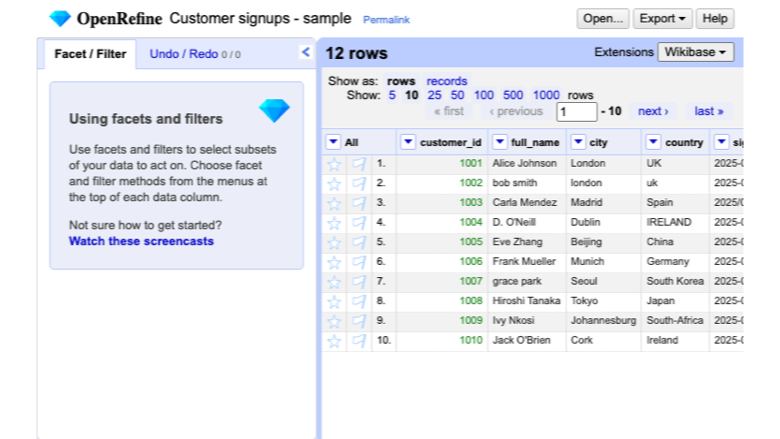
The OpenRefine data grid
Image
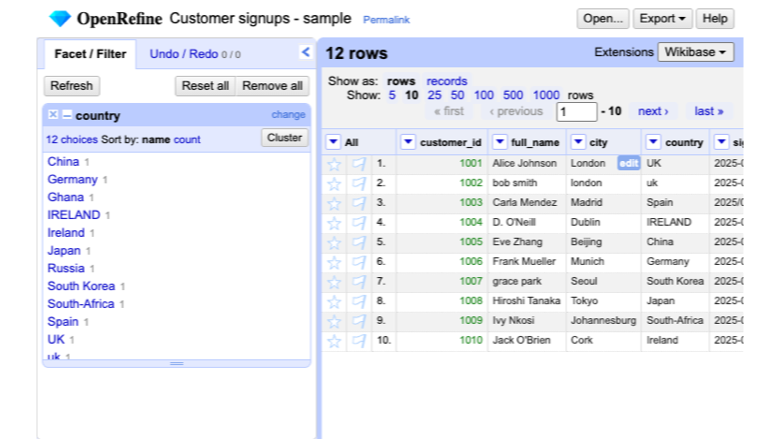
Faceting and clustering messy values
Image
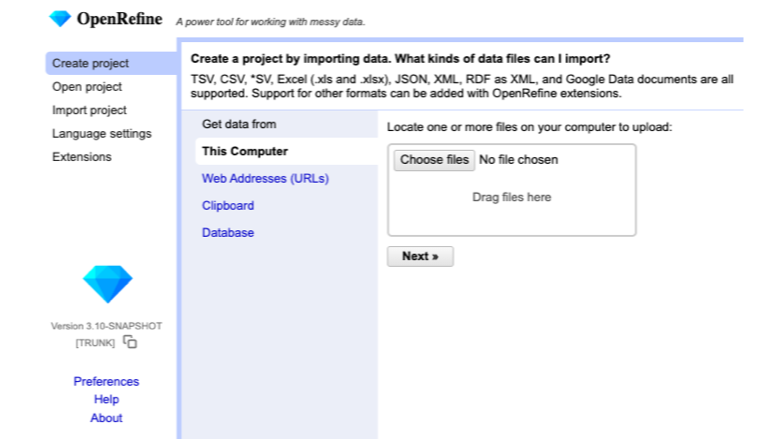
Create a project by importing data
This is a repackaged open source software product wherein additional charges apply for cloudimg support services.
Overview
OpenRefine is a popular open source power tool for working with messy tabular data. Import data from CSV, TSV, Excel, JSON or XML into a project workbench, then explore it with facets and filters, clean and normalise values with GREL, Jython or Clojure expressions, cluster and merge near-duplicate entries, and reconcile your data against external sources such as Wikidata - all through a browser-based data grid. Every change is recorded as a reproducible operation history you can undo, redo and export. This image delivers a fully installed, security-hardened OpenRefine 3.10 appliance so a working data workbench is operational within minutes of launch, self-hosted and fully under your control in your own AWS account.
Why This Image vs a Manual Install
This image eliminates the manual Java runtime setup, systemd service authoring, reverse-proxy configuration, TLS termination and credential hardening that a bare install requires. OpenRefine has no authentication of its own - it assumes a single trusted local user - so exposing it directly would put an unauthenticated data workbench with full read and write access to your host on the network. This image never leaves it exposed: OpenRefine is bound to the loopback interface only, and an nginx reverse proxy fronts it over HTTPS with HTTP Basic authentication whose password is generated uniquely on each instance's first boot. Launch the instance, read your unique credential, and start cleaning data.
Application Stack
OpenRefine is installed from the official pinned upstream Linux distribution under /opt/openrefine and runs as an unprivileged system user under a hardened systemd unit bound to the loopback interface. An nginx reverse proxy on port 443 forwards to it over a per-instance self-signed TLS certificate, enforcing HTTP Basic authentication; port 80 serves an unauthenticated health endpoint and redirects everything else to HTTPS. Customer projects, imported datasets and the operation-history cache live on a dedicated, independently-resizable data volume mounted at /var/lib/openrefine.
Security Hardening
This image follows a defence-in-depth approach:
- Network isolation: OpenRefine binds exclusively to the loopback interface; only the nginx reverse proxy is exposed
- Authentication enforced: every request is authenticated except an unauthenticated health endpoint for load-balancer probes
- No default or shared credentials: a cryptographically random web password is generated on each instance's first boot and written only to a root-only file
- Encrypted transport: the reverse proxy terminates HTTPS with a certificate generated uniquely per instance
- Least privilege: the workbench runs as an unprivileged system user with NoNewPrivileges, PrivateTmp, ProtectHome and ProtectSystem=strict
- Automatic restart: systemd monitors both the workbench and nginx and restarts them on failure
Concrete Use Cases
- Data cleanup and normalisation: Import an inconsistent export, use faceting and clustering to merge duplicate or mis-spelled values, apply GREL transforms to standardise dates, names and codes, and export clean structured data ready for a database load
- Reconciliation and enrichment: Reconcile a column of names or places against Wikidata or another reconciliation service, then pull in additional attributes to enrich the dataset in place
- Reproducible data preparation: Record a whole cleanup as an operation history, then replay that exact sequence on each new monthly data drop so the transformation is consistent and auditable
AWS Integration
Deploy on any EC2 instance type; larger instances give OpenRefine more memory for bigger datasets. Store projects on the dedicated EBS data volume and resize or snapshot it independently with EBS or AWS Backup. Use the unauthenticated health endpoint with an Application Load Balancer for availability monitoring, and forward logs to CloudWatch.
Pricing and Evaluation
This listing includes a software charge in addition to standard AWS infrastructure costs. See the Pricing tab on this page for the current rate. To evaluate the product at low cost, launch on a small instance type, verify the workflow meets your needs, and scale up when ready.
Getting Started
- Launch the AMI from this listing with a key pair and a Security Group allowing inbound ports 22, 80 and 443.
- SSH into the instance and retrieve your unique web password from /root/openrefine-credentials.txt.
- Open https:// in your browser, accept the self-signed certificate, and log in with username "admin" and your retrieved password.
- Create a project by importing a CSV, Excel, JSON or XML file, explore it with facets, clean it with transforms, and export the result.
Highlights
- Secure by default with unique credentials: OpenRefine has no built-in authentication, so this image binds it exclusively to the loopback interface and fronts it with an nginx HTTPS reverse proxy enforcing HTTP Basic auth. Every instance generates its own cryptographically random password and TLS certificate on first boot - no two deployments share a credential and the workbench is never reachable unauthenticated from the network.
- Operational in minutes with zero manual configuration: this image completes Java runtime installation, systemd service setup, HTTPS reverse-proxy configuration and credential generation at build time. Launch an instance, SSH in to read your unique password from /root/openrefine-credentials.txt, and open the browser to a working, authenticated data workbench without editing a single configuration file.
- Full data-cleaning power on a dedicated volume with 24/7 support: import CSV, Excel, JSON and XML, explore with facets and filters, clean with GREL transforms, cluster near-duplicates and reconcile against Wikidata or other services - all recorded as a replayable operation history. Projects live on a separate, independently-resizable EBS volume you can snapshot with AWS Backup, and the appliance is backed by 24/7 cloudimg technical support via email and chat.
Details
Sold by
Categories
Delivery method
Delivery option
64-bit (x86) Amazon Machine Image (AMI)
Latest version
Operating system
Ubuntu 24.04
Deployed on AWS
New
Introducing multi-product solutions
You can now purchase comprehensive solutions tailored to use cases and industries.

Features and programs
Financing for AWS Marketplace purchases
AWS Marketplace now accepts line of credit payments through the PNC Vendor Finance program. This program is available to select AWS customers in the US, excluding NV, NC, ND, TN, & VT.

Pricing
Free trial
Try this product free for 7 days according to the free trial terms set by the vendor. Usage-based pricing is in effect for usage beyond the free trial terms. Your free trial gets automatically converted to a paid subscription when the trial ends, but may be canceled any time before that.
Pricing is based on actual usage, with charges varying according to how much you consume. Subscriptions have no end date and may be canceled any time. Alternatively, you can pay upfront for a contract, which typically covers your anticipated usage for the contract duration. Any usage beyond contract will incur additional usage-based costs.
Additional AWS infrastructure costs may apply. Use the AWS Pricing Calculator to estimate your infrastructure costs.
If you are an AWS Free Tier customer with a free plan, you are eligible to subscribe to this offer. You can use free credits to cover the cost of eligible AWS infrastructure. See AWS Free Tier for more details. If you created an AWS account before July 15th, 2025, and qualify for the Legacy AWS Free Tier, Amazon EC2 charges for Micro instances are free for up to 750 hours per month. See Legacy AWS Free Tier for more details.
Dimension | Description | Cost/hour |
|---|---|---|
m5.large Recommended | m5.large | $0.08 |
t3.micro | t3.micro instance type | $0.04 |
t2.micro | t2.micro instance type | $0.04 |
i4i.2xlarge | i4i.2xlarge instance type | $0.24 |
m5d.4xlarge | m5d.4xlarge instance type | $0.24 |
c8a.xlarge | c8a.xlarge instance type | $0.12 |
c6id.24xlarge | c6id.24xlarge instance type | $0.24 |
c6in.large | c6in.large instance type | $0.08 |
r7a.4xlarge | r7a.4xlarge instance type | $0.24 |
r5dn.12xlarge | r5dn.12xlarge instance type | $0.24 |
Vendor refund policy
Refunds available on request.

Legal
Vendor terms and conditions
Upon subscribing to this product, you must acknowledge and agree to the terms and conditions outlined in the vendor's End User License Agreement (EULA) .
Content disclaimer
Vendors are responsible for their product descriptions and other product content. AWS does not warrant that vendors' product descriptions or other product content are accurate, complete, reliable, current, or error-free.
Delivery details
64-bit (x86) Amazon Machine Image (AMI)
Amazon Machine Image (AMI)
An AMI is a virtual image that provides the information required to launch an instance. Amazon EC2 (Elastic Compute Cloud) instances are virtual servers on which you can run your applications and workloads, offering varying combinations of CPU, memory, storage, and networking resources. You can launch as many instances from as many different AMIs as you need.
Version release notes
Initial release of OpenRefine as a ready-to-use self-hosted data-cleaning and transformation workbench, running behind an nginx HTTPS reverse proxy that enforces HTTP Basic authentication with a unique web password and TLS certificate generated on each instance's first boot, with a pinned Java runtime and a dedicated project data volume.
Additional details
Usage instructions
Connect via SSH on port 22 as the default login user for your operating system variant (for the Ubuntu 24.04 variant the user is ubuntu). Read the per-instance web credential with: sudo cat /root/openrefine-credentials.txt. Open the workbench in a browser at https://<instance-public-ip>/ and accept the per-instance self-signed certificate, then sign in with the username (admin) and password from that file. An unauthenticated health endpoint is available at https://<instance-public-ip>/healthz. In the workbench, create a project by importing a data file, then use facets, filters and GREL transforms to clean it. Customer projects are stored on a dedicated data volume at /var/lib/openrefine. The instance security group opens ports 22, 80 and 443. The services run under systemd: systemctl status openrefine nginx.
Resources
Vendor resources
Support
Vendor support
cloudimg Support
cloudimg provides 24/7 technical support for this product by email and live chat.
Contact: support@cloudimg.co.uk
What we help with:
- Deployment and initial configuration (Security Group rules, key pair setup, credential retrieval)
- Reverse-proxy termination with your own domain and TLS certificate
- Memory tuning and instance sizing for large datasets
- Reconciliation service configuration
- Data import and export workflows
- Performance tuning and troubleshooting
- Updates and security patching guidance
- EBS volume resizing and snapshot management
Refunds: For refund requests, contact support@cloudimg.co.uk with your AWS account ID and subscription details.
Pricing: This product includes a software charge for cloudimg support services in addition to standard AWS infrastructure costs. See the Pricing tab on this listing page for the current rate. To evaluate at low cost, launch on a small instance type before scaling up.
AWS infrastructure support
AWS Support is a one-on-one, fast-response support channel that is staffed 24x7x365 with experienced and technical support engineers. The service helps customers of all sizes and technical abilities to successfully utilize the products and features provided by Amazon Web Services.
Customer reviews
No customer reviews yet
Be the first to review this product . We've partnered with PeerSpot to gather customer feedback. You can share your experience by writing or recording a review, or scheduling a call with a PeerSpot analyst.