
Sold by: UST
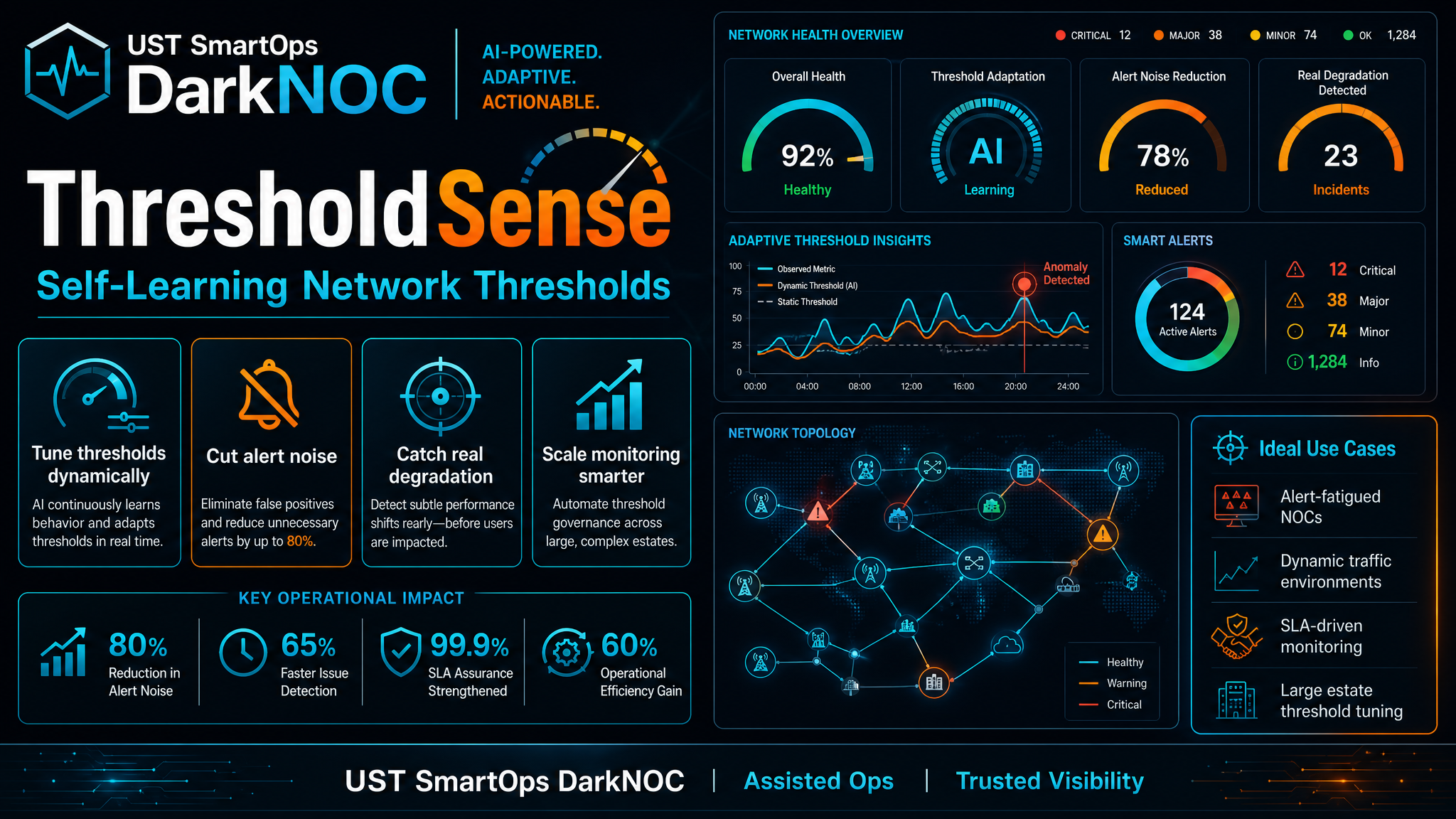
ThresholdSense automatically learns and tunes alarm thresholds per KPI and network element, replacing manual configuration with self-optimizing, context-aware limits that reduce alarm noise.
Overview
The Problem
Manually configured alarm thresholds are time-consuming to set up and quickly go stale as networks grow and change. This leads to either alarm floods that overwhelm operations teams or missed detections that allow issues to escalate unnoticed. For large-scale telecom operators and enterprise network teams managing thousands of network elements, the burden of maintaining accurate thresholds becomes an unsustainable engineering task.
How ThresholdSense Works
ThresholdSense replaces manual threshold configuration by learning the appropriate threshold for every KPI and network element directly from historical behavior and outcome data. Unlike standard statistical baselining approaches that rely solely on deviation from averages, ThresholdSense incorporates outcome data - correlating threshold settings with actual incident outcomes - to determine which alarm levels genuinely predict actionable issues.
Key capabilities:
- Builds context-aware thresholds reflecting the unique operating profile of each element
- Continuously re-tunes thresholds in the background as network conditions shift
- Learns from outcome data to distinguish actionable alarms from noise
- Keeps alarm sensitivity accurate without requiring engineers to revisit configuration
Target Environment and Prerequisites
ThresholdSense is designed for telecom operators, ISPs, and enterprise network teams managing large-scale environments. Typical deployments involve:
- Networks with hundreds to thousands of managed elements across multiple vendors
- Historical KPI data availability (minimum duration and format assessed during discovery)
- Existing network management or monitoring platforms that export time-series KPI data, including Amazon CloudWatch, AWS-hosted observability stacks, and third-party platforms
- KPI and outcome data can be ingested from Amazon S3 buckets or streamed via AWS Lambda functions for preprocessing
AWS Integration
ThresholdSense leverages AWS services to support scalable data ingestion and model training:
- Amazon S3 - Historical KPI and outcome data storage for model training pipelines
- Amazon CloudWatch - Integration with CloudWatch metrics and alarms for AWS-hosted network infrastructure
- Amazon Redshift - Storage and querying of large-scale threshold performance analytics
- Amazon QuickSight - Visualization of before-and-after alarm noise metrics and tuning reports
- AWS Lambda - Event-driven data preprocessing and threshold update triggers
Engagement Process
ThresholdSense is delivered as a professional services engagement structured in three phases:
Phase 1 - Discovery and Assessment (Weeks 1-2)
- Review of existing alarm configuration and KPI data sources
- Assessment of data quality, volume, and historical depth
- Definition of scope including target KPIs and network elements
- Deliverable: Scoping report with feasibility assessment and implementation plan
Phase 2 - Model Training and Integration (Weeks 3-6)
- Ingestion and analysis of historical KPI and outcome data
- Training of threshold models per element and KPI
- Integration with existing monitoring and alarm management platforms including Amazon CloudWatch and third-party tools
- Deliverable: Configured threshold model with integration documentation
Phase 3 - Go-Live and Continuous Tuning (Weeks 7-8 and ongoing)
- Deployment of self-optimizing thresholds into production
- Validation against live alarm data with before/after comparison
- Handover of tuning report and operational runbook
- Deliverable: Tuning report with alarm noise reduction metrics and operational documentation
Key Benefits
- Reduced alarm noise: Fewer false positives reaching operations teams
- Fewer missed detections: Context-aware limits catch genuine issues that static thresholds miss
- Eliminated manual maintenance: Thresholds stay current without recurring engineering effort
- Continuous improvement: Alarm quality improves over time as the system learns from outcomes
Security and Data Handling
ThresholdSense processes historical network KPI and outcome data with security controls aligned to enterprise requirements. Data stored in Amazon S3 is encrypted at rest, and all data in transit uses TLS encryption. Access controls follow the principle of least privilege, and audit logging tracks all data access and model operations. Specific compliance requirements and data residency considerations are addressed during the discovery phase to align with your organization's security policies.
Next Steps
To get started, request a discovery consultation to assess your network environment, data readiness, and scope.
Highlights
- Learns from outcome data - not just statistical baselines - to set thresholds that predict actionable issues. Unlike standard anomaly detection that flags any deviation from average behavior, ThresholdSense correlates threshold settings with actual incident outcomes, ensuring alarms reflect genuine operational problems rather than benign fluctuations. This outcome-driven approach means alarm quality improves continuously as the system processes more resolution data from your operations team.
- Delivered as a structured professional services engagement with clear phases: discovery and data assessment, model training and integration with your existing monitoring platforms, and go-live with continuous self-tuning. Each phase produces defined deliverables including a scoping report, configured threshold models with integration documentation, and a tuning report with before-and-after alarm noise metrics.
- Eliminates manual threshold maintenance as a recurring engineering burden across large-scale network environments. Designed for telecom operators, ISPs, and enterprise network teams managing hundreds to thousands of elements, ThresholdSense continuously re-tunes thresholds in the background as network conditions change - keeping alarm sensitivity accurate without requiring engineers to revisit configuration or respond to threshold drift.
Details
New
Introducing multi-product solutions
You can now purchase comprehensive solutions tailored to use cases and industries.

Pricing
Custom pricing options
Pricing is based on your specific requirements and eligibility. To get a custom quote for your needs, request a private offer.

Legal
Content disclaimer
Vendors are responsible for their product descriptions and other product content. AWS does not warrant that vendors' product descriptions or other product content are accurate, complete, reliable, current, or error-free.
Support
Vendor support
About UST
UST is a global digital transformation company with deep expertise in telecom and network operations. ThresholdSense is built on UST's experience delivering intelligent automation solutions for communications service providers and large enterprise networks.
Engagement Support
UST provides dedicated support throughout the ThresholdSense engagement lifecycle, from initial discovery through ongoing production operation.
During Engagement:
- Dedicated project team assigned for the duration of the engagement
- Regular status updates and milestone reviews at each phase transition
- Direct communication with UST's network intelligence specialists
Post-Deployment:
- Support for threshold model performance questions and tuning adjustments
- Guidance on expanding scope to additional KPIs or network elements
- Assistance with integration updates as your monitoring environment evolves
Buyer Responsibilities:
- Provide access to historical KPI and outcome data in agreed formats
- Designate a technical point of contact for integration coordination
- Allocate engineering resources for platform access and validation testing
Getting Started:
To initiate a discovery consultation or discuss your network environment, please contact UST through the AWS Marketplace. The UST team will respond to confirm next steps and schedule an initial scoping conversation.
Support Contact: For support inquiries, technical issues, or questions about your BaselineIQ deployment, please reach out to UST through the contact channels available at https://www.ust.com .
For issues related to your engagement, including service questions, troubleshooting, or refund requests, contact UST directly through the communication channel established during onboarding.