
Sold by: UST
SmartOps Deduplication collapses repeated alerts from multiple monitoring sources into a single living record using ML-based fingerprinting - built for SRE and NOC teams managing complex AWS environme
Overview
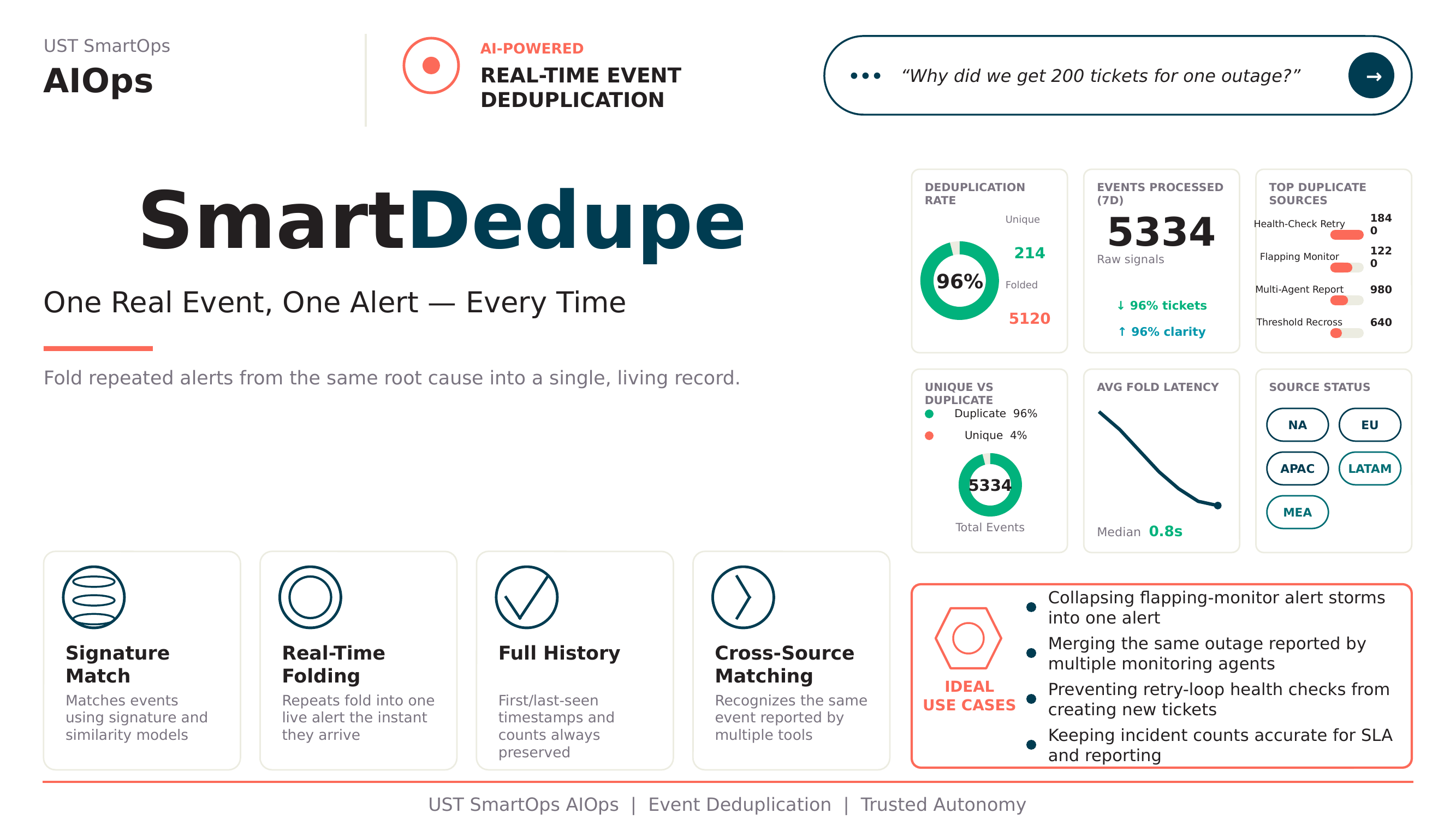
Overview
A single unstable component can generate hundreds of near-identical alerts in minutes - the same health check retried, the same threshold re-crossed, the same event reported by multiple monitoring agents. UST SmartOps Deduplication fingerprints incoming events using signature and similarity matching, recognizes repeats of an already-open alert, and folds them into a single continuously updated record rather than creating a new ticket each time.
The result is one alert per real-world problem, with a complete occurrence count and timeline preserved for context, rather than a flood of tickets overwhelming your operations team.
How It Works - Integration With Your Monitoring Stack
SmartOps Deduplication ingests events from multiple monitoring sources including AWS Amazon CloudWatch, third-party observability platforms, and custom health-check systems running on AWS infrastructure. Cross-source fingerprinting ensures that the same underlying event reported by different tools is recognized and merged into one living alert record.
Engagement Process
Phase 1 - Discovery and Scoping (Week 1-2) UST conducts an environment assessment to understand your current monitoring stack, alert volume, and deduplication requirements. Deliverables include a scoping document and integration plan.
Phase 2 - Configuration and Integration (Week 3-5) UST configures matching rules per event type and source, integrates with your monitoring tools, and establishes deduplication fingerprinting logic tailored to your environment. Deliverables include configured deduplication rules and integration documentation.
Phase 3 - Testing and Tuning (Week 6-7) Live alert traffic is processed through the deduplication engine with iterative tuning to optimize matching accuracy. Deliverables include a tuning report and accuracy metrics.
Phase 4 - Go-Live and Handoff (Week 8) Production cutover with knowledge transfer to your operations team. Deliverables include runbooks, operational documentation, and a post-deployment review.
Key Features
- Signature- and similarity-based event fingerprinting across heterogeneous monitoring sources
- Real-time folding of repeat events into a single live alert with full occurrence history
- First/last-seen timestamps and occurrence counts retained for context
- Cross-source deduplication when multiple tools report the same event
- Configurable matching rules per event type or source
Key Benefits
- Eliminates duplicate-ticket noise at the source before it reaches your operations queue
- Keeps ticket counts and SLAs meaningful and accurate
- Reduces manual effort spent closing repeat tickets
- Improves the quality of downstream correlation, resolution, and reporting
Key Use Cases
- Collapsing flapping-monitor alert storms into one alert during peak traffic periods
- Merging the same outage reported by multiple monitoring agents across hybrid AWS environments
- Preventing retry-loop health checks from creating a new ticket each cycle
- Keeping incident counts accurate for SLA and reporting purposes
Prerequisites
- Active AWS environment with monitoring tools generating structured alert events
- API access or webhook capability from your monitoring sources
- Designated point of contact from your operations team for discovery and testing phases
Security and Data Handling
Alert data processed by SmartOps Deduplication is handled with encryption in transit. Access controls ensure only authorized personnel interact with your event data during the engagement.
Next Steps
Contact UST through AWS Marketplace Messaging to schedule a discovery call and receive a scoped proposal tailored to your environment and alert volume.
Highlights
- Cross-source fingerprinting that works across heterogeneous monitoring stacks - including Amazon CloudWatch and third-party tools - without requiring a single event bus. Unlike native deduplication in individual platforms, SmartOps correlates events across your entire toolchain using both signature matching and similarity-based logic, catching duplicates that single-tool dedup misses.
- One living alert record replaces hundreds of duplicates in real time. Each deduplicated alert retains full occurrence history, first/last-seen timestamps, and source attribution so your team has complete context without the noise. Configurable matching rules per event type or source let you tune accuracy to your environment.
- Purpose-built for SRE leads and NOC managers running complex AWS environments with multiple monitoring sources. Reduces alert queue volume so operations teams can focus on genuine incidents, maintain accurate SLA reporting, and eliminate the manual effort of closing repeat tickets across systems.
Details
New
Introducing multi-product solutions
You can now purchase comprehensive solutions tailored to use cases and industries.

Pricing
Custom pricing options
Pricing is based on your specific requirements and eligibility. To get a custom quote for your needs, request a private offer.

Legal
Content disclaimer
Vendors are responsible for their product descriptions and other product content. AWS does not warrant that vendors' product descriptions or other product content are accurate, complete, reliable, current, or error-free.
Support
Vendor support
Support Channels
- AWS Marketplace Messaging: Available for initial inquiries, scoping questions, and engagement requests. Use this channel to schedule a discovery call or request a proposal.
- Dedicated Communication Channel: Established during onboarding for ongoing project collaboration, issue resolution, and milestone tracking throughout the engagement.
- Email Support: For pre-sales and post-engagement inquiries, contact the UST Sales team at salesteam_tes@ust.com .
- General Inquiries: For general inquiries or to learn more about UST's services, visit https://www.ust.com .
Engagement Delivery Process
Once engaged, UST assigns a dedicated delivery team who works through a structured process: discovery and scoping, configuration and integration, testing and tuning, and go-live with handoff. Your team will need to provide API access or webhook credentials to your monitoring sources and designate a point of contact for collaboration during the engagement.
Buyer Responsibilities
- Provide access to monitoring tool APIs or webhook endpoints
- Designate an operations team point of contact
- Participate in discovery sessions and testing validation
- Review and approve deliverables at each phase gate
Handoff Artifacts
At engagement completion, you receive configured deduplication rules, integration documentation, operational runbooks, and a post-deployment review summarizing outcomes and recommendations.