
Sold by: Software Sushi
Deployed on AWS
Free Trial
OpenHands Core with local Agent Canvas, Python terminal/Git and a private Telegram adapter. Customer cloud-model credentials are required after launch.
Overview
Image
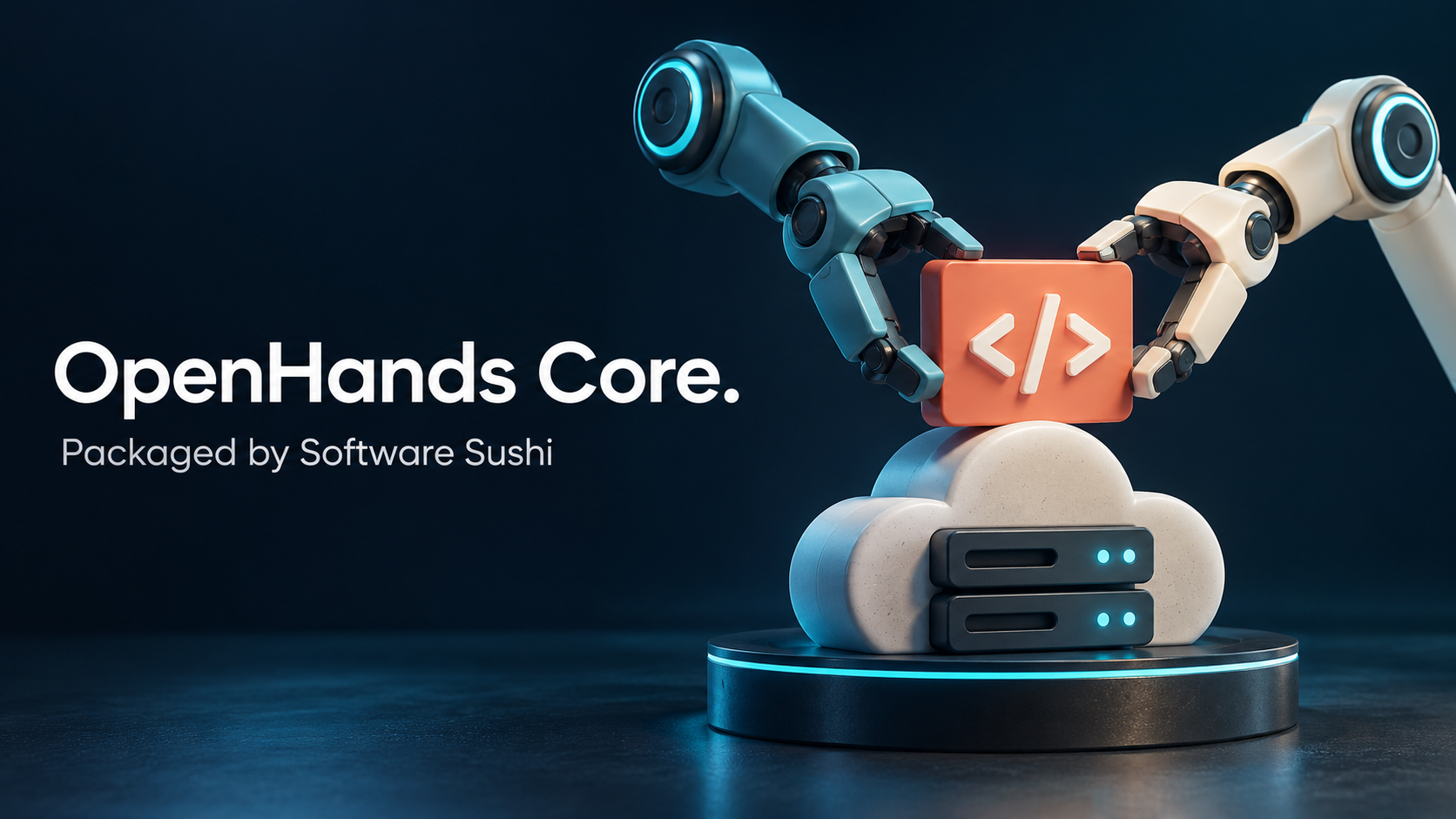
OpenHands Core - Software Sushi product illustration

Video
OpenHands Core - EC2 walkthrough (earlier candidate)
This is a repackaged open source software product wherein additional charges apply for independent AWS packaging, validation, maintenance and setup documentation. Upstream software is MIT licensed; Software Sushi does not claim upstream authorship or endorsement.
A curated CPU package with OpenHands Agent Canvas, Agent Server, native Python terminal/Git tools and persistent projects/conversations. Core excludes bundled ACP command-line agents, browser binaries and the editor. The optional private Telegram conversation bridge is maintained by Software Sushi; it is not native OpenHands Telegram support. Model profiles use native Canvas settings.
Customer setup: launch the approved Marketplace version on x86_64 EC2, connect as ubuntu using your EC2 key pair or Systems Manager, and open the localhost UI through a private tunnel. Configure your own model provider after launch. Telegram is optional and requires a dedicated bot and explicit private-chat/user allowlist. Runtime dependencies and automatic first boot are packaged; customer user data and seller approval are not required for instance initialization. Recommended starting resources are t3.medium (2 vCPU, 4 GiB RAM) with at least 32 GiB root storage. This is an initial functional target, not a workload capacity guarantee.
The software fee is USD 0.02 per running instance-hour. The optional five-day, one-instance free trial changes software billing only and converts to the paid hourly offer; the same installed software remains available before and after it. This is not a separate trial or evaluation edition, and there is no product-imposed time, user or usage limit. Additional concurrent instances incur software fees. EC2, EBS, data transfer and third-party model usage are separate, including during the software trial. No annual offer is configured.
External requirements are internet connectivity to the chosen model provider, a customer-controlled provider account/credentials with usable quota, and, only if Telegram is configured, a Telegram bot and outbound Telegram connectivity. No customer credentials are baked into the image. Model requests send their configured prompts and relevant tool context to the customer's chosen provider; Telegram messages use Telegram's service. AWS CLI and the Session Manager Plugin are workstation requirements for SSM access. SSH is an alternative. Keep application ports private and restrict SSH to a trusted administrator CIDR.
The linked customer guide contains launch, model/channel setup, acceptance checks, persistence, recovery and release status. Fresh consumers of the exact submitted distribution AMIs passed natural startup, native Claude UI/tool tasks, real private Telegram, independent saved-file verification and idle restart/recovery on October 5, 2026; the separate distribution acceptance record identifies the tested image and receipts. UI execution was observed before the idle restart; backend readiness and Telegram recovery passed afterward. Automatic frontend reconnection and a full EC2 reboot were not tested. These functional checks do not clear the retained full-host kernel findings or establish AWS approval. The English video remains a real earlier-candidate reference and is explicitly identified as that version. Availability is determined by the approved AWS Marketplace delivery version.
Highlights
- Pinned CPU runtime with automatic first boot and persistent per-instance customer state.
- Native model-backed tools with an optional dedicated private Telegram workflow.
- The same software functionality before and after the billing-only free trial; customer credentials configured after launch.
Details
Sold by
Categories
Delivery method
Delivery option
64-bit (x86) Amazon Machine Image (AMI)
Latest version
Operating system
Ubuntu 24.04 LTS
Deployed on AWS
New
Introducing multi-product solutions
You can now purchase comprehensive solutions tailored to use cases and industries.

Features and programs
Financing for AWS Marketplace purchases
AWS Marketplace now accepts line of credit payments through the PNC Vendor Finance program. This program is available to select AWS customers in the US, excluding NV, NC, ND, TN, & VT.

Pricing
Free trial
Try this product free for 5 days according to the free trial terms set by the vendor. Usage-based pricing is in effect for usage beyond the free trial terms. Your free trial gets automatically converted to a paid subscription when the trial ends, but may be canceled any time before that.
Pricing is based on actual usage, with charges varying according to how much you consume. Subscriptions have no end date and may be canceled any time.
Additional AWS infrastructure costs may apply. Use the AWS Pricing Calculator to estimate your infrastructure costs.
Dimension | Cost/hour |
|---|---|
t3.medium Recommended | $0.02 |
Dimensions summary
You pay by the hour for this software running on a single EC2 instance type, the t3.medium. Billing is usage-based, so charges accrue for each hour the instance runs. There is one pricing dimension, with no tiers or add-ons to choose between. The listing delivers an Amazon Machine Image that you launch in your own AWS account. AWS infrastructure costs such as EC2 compute, EBS storage, and data transfer are billed separately. Model provider and messaging charges from outside services are also separate from this software fee.
Top-of-mind questions for buyers
The software charge covers the pre-built Amazon Machine Image running on one t3.medium EC2 instance (x86_64). You add your own model-provider and messaging credentials after launch. The image comes security-hardened so you skip assembling the stack yourself. The instance runs in your own AWS account under your control.
The software fee meters each hour the t3.medium instance runs. A fully stopped instance stops accruing the hourly software charge. Underlying AWS storage, such as the gp3 root volume, may still bill while the instance is stopped. Those AWS infrastructure costs are separate from the software fee.
AWS infrastructure is billed separately, including EC2 compute, EBS storage, networking, and data transfer. Your model provider charges for API usage under your own account. Messaging platforms you connect may also charge for their usage. Review the current listing before subscribing.
softwaresushi.com+1
Helpful?
Vendor refund policy
We offer a full refund of software charges for the first 48 hours billing starts if the product does not perform as described. To request a refund, email info@softwaresushi.com with your EC2 instance ID and a description of the issue. AWS infrastructure costs (EC2, EBS, data transfer) are billed by AWS and are not eligible for refund by us.

Legal
Vendor terms and conditions
Upon subscribing to this product, you must acknowledge and agree to the terms and conditions outlined in the vendor's End User License Agreement (EULA) .
Content disclaimer
Vendors are responsible for their product descriptions and other product content. AWS does not warrant that vendors' product descriptions or other product content are accurate, complete, reliable, current, or error-free.
Delivery details
64-bit (x86) Amazon Machine Image (AMI)
Amazon Machine Image (AMI)
An AMI is a virtual image that provides the information required to launch an instance. Amazon EC2 (Elastic Compute Cloud) instances are virtual servers on which you can run your applications and workloads, offering varying combinations of CPU, memory, storage, and networking resources. You can launch as many instances from as many different AMIs as you need.
Version release notes
Initial Software Sushi Marketplace distribution build. Signed Ubuntu 24.04 AWS kernel 7.0.0-1014-aws, pinned agent inputs and automatic per-instance startup. Separate unencrypted ingestion source, with encrypted test consumers. Fresh actual source boot and native offline tool checks passed. Customer model and Telegram credentials are configured after launch. Independent full inventories retain kernel findings; this submission requests AWS security vetting and does not claim that the local High/Critical gate passed. Earlier English private-candidate videos are labeled reference evidence.
Additional details
Usage instructions
Setup and operations guide: https://docs.softwaresushi.com/openhands/getting-started/
- Subscribe and launch this version in us-east-1 on t3.medium (x86_64), with at least 32 GiB root storage and IMDSv2. Select encrypted customer storage if required. Allow outbound HTTPS for your selected model provider and optional Telegram bot. For SSH, select your EC2 key pair and change TCP 22 ingress from the conservative localhost-only recommendation to your trusted administrator CIDR. Application ports remain private. Alternatively, attach your own minimally privileged Systems Manager instance role and ensure SSM connectivity.
- Wait for automatic first boot; confirm sudo systemctl is-active sushi-openhands.service. Use an SSH tunnel: ssh -i YOUR_KEY -L 8000:127.0.0.1:8000 ubuntu@INSTANCE_ADDRESS. Open http://127.0.0.1:8000 on your workstation. SSM port forwarding is an alternative described in the guide. No software installation or seller credentials are needed at instance launch.
- Configure your own supported cloud-model provider and model in the native localhost UI. Enter keys privately. For Nanobot, retrieve its per-instance WebUI password through your private SSH connection as described in the guide, without capturing it in logs or screenshots. Core capability exclusions and persistent state paths are documented in the guide. Provider account, key, quota and model charges are separate.
- Optionally create your own dedicated Telegram bot using BotFather. Copy the empty template from the guide; fill it privately with your token and exact numeric private chat/user allowlist, then use the installed helper. Keep one polling owner per bot and groups disabled. No provider or bot credentials are baked.
- Send a tool task to create a CSV with 5, 17 and 20, assert total 42 and three rows, write result.json and independently read it back. Repeat through your allowed private Telegram chat when configured. A saved key or running service alone is not inference proof.
- Monitor service health and provider quotas. Stop unused instances. Software costs USD 0.02 per running instance-hour after the five-day software trial for one instance; EC2, EBS, transfer and model usage are separate. New AMI versions do not automatically upgrade running instances; migrate required protected customer state after backup. Contact info@softwaresushi.com for packaging/setup support.
Resources
Support
Vendor support
Software Sushi provides AMI packaging and setup guidance at info@softwaresushi.com . Include the product/version, sanitized reproduction steps and error category; do not send credentials, private configuration, session keys or customer content. Guaranteed response times require a separate agreed arrangement. Provider credits and upstream vendor support are not included.
AWS infrastructure support
AWS Support is a one-on-one, fast-response support channel that is staffed 24x7x365 with experienced and technical support engineers. The service helps customers of all sizes and technical abilities to successfully utilize the products and features provided by Amazon Web Services.
Similar products

Production-ready Hermes AI messaging agent on hardened Ubuntu 24.04. Add your model-provider and Telegram credentials and run it in your AWS account.

Finds and removes Brazilian personal data (CPF, CNPJ, RG, names, addresses, phones, bank details, vehicle plates and more) from Portuguese text, inside your own AWS account, with no network access. Real-time endpoints and batch jobs over JSON Lines, CSV and plain-text files.

This is a repackaged open source software product wherein additional charges apply for an authenticated Streamlit sentiment starter with CSV forms, SQLite persistence, verified JSON exports and setup documentation. Software: USD 0.03 per instance-hour; EC2, EBS and transfer are separate.
Crawl4AI turns web pages into clean Markdown and JSON for LLM, RAG and data pipelines. This Ubuntu 24.04 AMI runs Crawl4AI with a built-in headless browser behind a private, token-protected HTTPS API, so developers can extract content from JavaScript-heavy pages in their own AWS account.
Customer reviews
No customer reviews yet
Be the first to review this product . We've partnered with PeerSpot to gather customer feedback. You can share your experience by writing or recording a review, or scheduling a call with a PeerSpot analyst.