
Sold by: cloudimg
Deployed on AWS
Free Trial
AWS Free Tier
This product has charges associated with it for seller support. Pre-hardened Temporal durable execution AMI with authenticated Web UI, bundled PostgreSQL, and nginx reverse proxy. Launch a fault-tolerant workflow backend in minutes with 24/7 cloudimg support.
Overview
Image
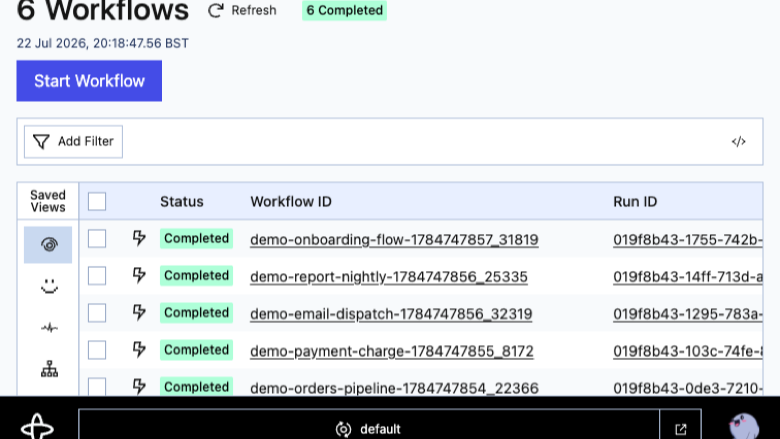
The Temporal Web UI workflows list
Image
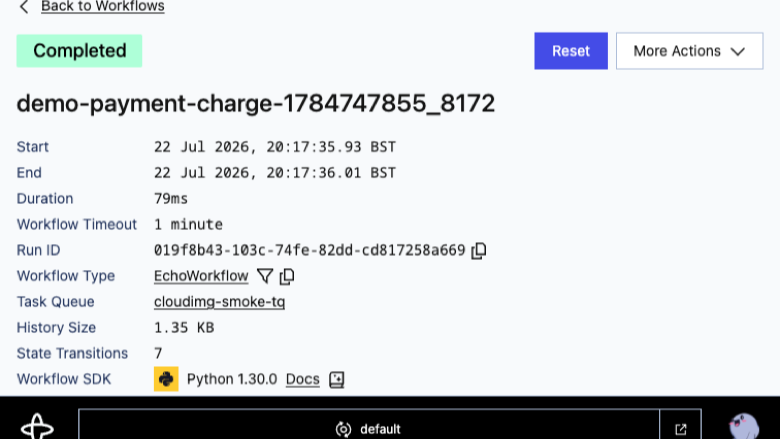
A single workflow execution detail
Image
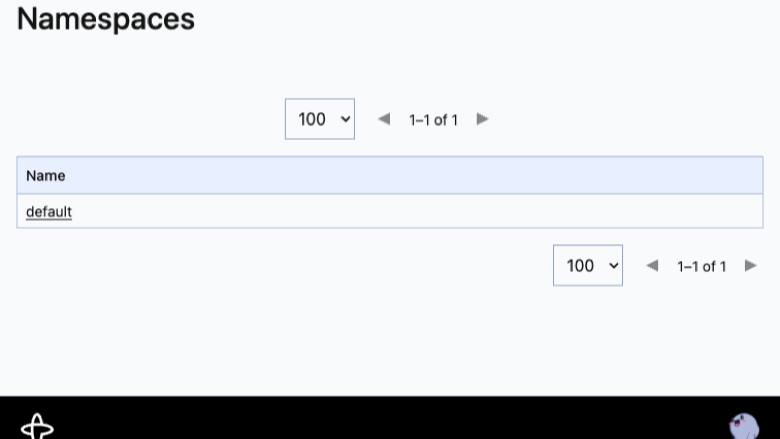
The Temporal Web UI namespaces page
This is a repackaged open source software product wherein additional charges apply for cloudimg support services.
Overview
Temporal is a popular open source durable execution engine. Your application defines Workflows and Activities in your own code and runs them against the Temporal server, which persists every execution's full event history so work survives process and host failures and resumes exactly where it left off. This AMI delivers a fully installed, security-hardened Temporal appliance - the Temporal server, its Web UI and a bundled PostgreSQL - so a working durable-execution backend is operational within minutes of launch, running privately in your own AWS account.
Why This Image vs a Manual Install
This image eliminates the manual work of wiring the Temporal server to a database, running schema setup and namespace registration, standing up the Web UI, and hardening the whole stack. Temporal's open source Web UI has no authentication of its own - anyone who can reach it can read every namespace, workflow input, result and full execution history. This image never leaves it exposed: the Temporal frontend and the bundled PostgreSQL are bound to the loopback interface only, and an nginx reverse proxy fronts the Web UI with HTTP Basic authentication whose password is generated uniquely on each instance's first boot. Launch the instance, read your unique credential, and start running workflows.
Application Stack
The Temporal server, its Web UI, an admin-tools container and a bundled PostgreSQL run as official upstream containers, pinned by image digest, orchestrated by Docker Compose under a single systemd unit. The Temporal frontend (gRPC) and the Web UI publish to the loopback interface only; PostgreSQL is never published to a host port. An nginx reverse proxy on port 80 fronts the Web UI, enforcing HTTP Basic authentication and upgrading the connection for the live UI stream. On first boot the image initialises a clean database, applies the Temporal schema, registers a default namespace, and generates a unique database password and a unique Web UI password - nothing is baked into the image.
Security Hardening
This image follows a defence-in-depth approach:
- Network isolation: the Temporal frontend and the bundled PostgreSQL bind exclusively to the loopback interface; only the nginx reverse proxy on port 80 and SSH are reachable
- Authentication enforced: every request to the Web UI and its API is authenticated - nothing is served anonymously except an unauthenticated health endpoint for load-balancer probes
- No default or shared credentials: cryptographically random Web UI and database passwords are generated on each instance's first boot and written only to a root-only file
- Clean state per instance: the captured image ships no database, workflows or credentials; a fresh database, schema and default namespace are created on first boot
- Pinned runtime: every container is version-locked by image digest
- Automatic restart: systemd monitors the stack and restarts it on failure
Buyers requiring formal compliance documentation should contact cloudimg to discuss specific requirements.
Concrete Use Cases
- Reliable microservice orchestration: Model multi-step business processes - order fulfilment, provisioning, refunds - as Workflows whose state survives crashes and deploys, replacing brittle queues and cron glue with durable, observable executions
- Long-running and human-in-the-loop processes: Run Workflows that wait days or weeks - approvals, onboarding, subscription lifecycles - with timers, retries and signals handled by the engine and every step visible in the Web UI
- Data and AI pipelines: Drive idempotent, automatically retried pipeline stages and scheduled recurring jobs from Temporal, inspecting each run's full event history when something needs debugging
AWS Integration
Deploy on any EC2 instance type; larger instances handle more concurrent workflow executions. Use the unauthenticated health endpoint with an Application Load Balancer for availability monitoring, place the instance in a VPC subnet with security-group control, forward logs to CloudWatch, and snapshot with EBS or AWS Backup to protect your workflow history.
Evaluate Before You Commit
Launch a small instance type such as t3.medium to validate the product at minimal cost. The AMI is fully functional on any supported instance size, so you can explore the Web UI, connect SDK workers, and run test workflows before scaling up for production workloads.
Getting Started
Read your credential from the root-only file, open the Web interface, sign in, and explore the pre-registered default namespace. Point your SDK workers at the frontend, start a workflow, and watch its status and event history update live in the Web UI. For a guided walkthrough or help connecting your first workers, contact cloudimg support at any time.
Highlights
- Operational in minutes with zero configuration: unlike a manual install requiring database wiring, schema setup, namespace registration, and Web UI deployment, this AMI completes every build step at image creation time. Launch an EC2 instance and reach a working Temporal server and Web UI without editing a single configuration file. Evaluate on a t3.medium before scaling to production.
- Secure by default with defence-in-depth isolation: Temporal's open source Web UI ships without authentication, but this image binds the frontend and PostgreSQL exclusively to the loopback interface and fronts the Web UI with an nginx reverse proxy enforcing HTTP Basic auth. Cryptographically random passwords are generated uniquely on each instance's first boot and stored in a root-only file, so no two deployments share credentials and nothing is served unauthenticated.
- Durable execution engine backed by 24/7 expert support: define Workflows and Activities in your own code and let the engine persist every execution's full event history so work survives process and host failures and resumes exactly where it left off. All containers are pinned by digest under systemd supervision. cloudimg provides 24/7 technical support via email and chat covering deployment, SDK worker connection, namespace configuration, scaling, and workflow debugging.
Details
Sold by
Categories
Delivery method
Delivery option
64-bit (x86) Amazon Machine Image (AMI)
Latest version
Operating system
Ubuntu 24.04
Deployed on AWS
New
Introducing multi-product solutions
You can now purchase comprehensive solutions tailored to use cases and industries.

Features and programs
Financing for AWS Marketplace purchases
AWS Marketplace now accepts line of credit payments through the PNC Vendor Finance program. This program is available to select AWS customers in the US, excluding NV, NC, ND, TN, & VT.

Pricing
Free trial
Try this product free for 7 days according to the free trial terms set by the vendor. Usage-based pricing is in effect for usage beyond the free trial terms. Your free trial gets automatically converted to a paid subscription when the trial ends, but may be canceled any time before that.
Pricing is based on actual usage, with charges varying according to how much you consume. Subscriptions have no end date and may be canceled any time. Alternatively, you can pay upfront for a contract, which typically covers your anticipated usage for the contract duration. Any usage beyond contract will incur additional usage-based costs.
Additional AWS infrastructure costs may apply. Use the AWS Pricing Calculator to estimate your infrastructure costs.
If you are an AWS Free Tier customer with a free plan, you are eligible to subscribe to this offer. You can use free credits to cover the cost of eligible AWS infrastructure. See AWS Free Tier for more details. If you created an AWS account before July 15th, 2025, and qualify for the Legacy AWS Free Tier, Amazon EC2 charges for Micro instances are free for up to 750 hours per month. See Legacy AWS Free Tier for more details.
Dimension | Description | Cost/hour |
|---|---|---|
m5.large Recommended | m5.large | $0.08 |
t2.micro | t2.micro instance type | $0.04 |
t3.micro | t3.micro instance type | $0.04 |
c5a.12xlarge | c5a.12xlarge instance type | $0.24 |
c5a.16xlarge | c5a.16xlarge instance type | $0.24 |
c5a.24xlarge | c5a.24xlarge instance type | $0.24 |
c5a.2xlarge | c5a.2xlarge instance type | $0.24 |
c5a.4xlarge | c5a.4xlarge instance type | $0.24 |
c5a.8xlarge | c5a.8xlarge instance type | $0.24 |
c5a.large | c5a.large instance type | $0.08 |
Vendor refund policy
Refunds available on request.

Legal
Vendor terms and conditions
Upon subscribing to this product, you must acknowledge and agree to the terms and conditions outlined in the vendor's End User License Agreement (EULA) .
Content disclaimer
Vendors are responsible for their product descriptions and other product content. AWS does not warrant that vendors' product descriptions or other product content are accurate, complete, reliable, current, or error-free.
Delivery details
64-bit (x86) Amazon Machine Image (AMI)
Amazon Machine Image (AMI)
An AMI is a virtual image that provides the information required to launch an instance. Amazon EC2 (Elastic Compute Cloud) instances are virtual servers on which you can run your applications and workloads, offering varying combinations of CPU, memory, storage, and networking resources. You can launch as many instances from as many different AMIs as you need.
Version release notes
Initial release of Temporal as a ready-to-use self-hosted durable-execution appliance: the Temporal server, its Web UI and a bundled PostgreSQL run as digest-pinned upstream containers under systemd, behind an nginx reverse proxy that enforces HTTP Basic authentication with a unique Web UI password generated on each instance's first boot, with the frontend and database bound to loopback and a clean database plus a pre-registered default namespace created on first boot.
Additional details
Usage instructions
Connect via SSH on port 22 as the default login user for your operating system variant (for the Ubuntu 24.04 variant the user is ubuntu). Read the per-instance Web UI credential with: sudo cat /root/temporal-notes.txt. Open the Web interface in a browser at http://<instance-public-ip>/ and sign in with the username (admin) and password from that file. An unauthenticated health endpoint is available at http://<instance-public-ip>/healthz. The Temporal frontend (gRPC) is bound to 127.0.0.1:7233 and the bundled PostgreSQL is not published to any host port - reach the frontend from your SDK workers over a private network or an SSH tunnel. The instance security group opens only ports 22 and 80. The services run under systemd: systemctl status docker temporal nginx. The Docker Compose project lives at /etc/temporal-appliance/compose.yaml.
Resources
Vendor resources
Support
Vendor support
cloudimg Support
cloudimg provides 24/7 technical support for this product by email and live chat.
Contact: support@cloudimg.co.uk
What we help with:
- Deployment and initial configuration
- Reverse-proxy termination with your own domain and TLS certificate
- Connecting Temporal SDK workers and clients to the frontend
- Namespace, retention and search-attribute configuration
- Scaling and tuning the PostgreSQL persistence store
- Interpreting workflow event histories and debugging executions
- Updates and security patching guidance
- Instance sizing recommendations for your workload
Guided Onboarding: Contact us after launch for a walkthrough of credential retrieval, SDK worker connection, and your first workflow execution.
Refunds: For refund requests, contact support@cloudimg.co.uk with your AWS account ID and subscription details.
AWS infrastructure support
AWS Support is a one-on-one, fast-response support channel that is staffed 24x7x365 with experienced and technical support engineers. The service helps customers of all sizes and technical abilities to successfully utilize the products and features provided by Amazon Web Services.
Similar products
Temporal Cloud is a fully managed durable execution platform on AWS for building reliable, long-running workflows without managing orchestration infrastructure.
Temporal Cloud is a fully managed durable execution platform on AWS for building reliable, long-running workflows without managing orchestration infrastructure.

Accelerate deployment of your Temporal workloads and enablement of your teams with Expert Temporal Services. Our service offerings encompass design, build, deploy and scale of your Temporal Workflows - with multiple services offerings that can be tailored to your individual needs.

This product has charges associated with it for seller support. Hossted Platform offers an intuitive dashboard and CLI that delivers comprehensive security, monitoring, logging, and applicative insights.

This product has charges associated with it for deployment, configuration, and ongoing support. Self-hosted Temporal workflow engine on EC2 with gRPC API, high availability, and auto-scaling ready for production workloads.
Customer reviews
No customer reviews yet
Be the first to review this product . We've partnered with PeerSpot to gather customer feedback. You can share your experience by writing or recording a review, or scheduling a call with a PeerSpot analyst.