
Sold by: cloudimg
Deployed on AWS
Free Trial
AWS Free Tier
This product has charges associated with it for seller support. Pre-hardened Dradis CE AMI for security teams. Import scanner output, organize findings, and generate consistent pentest reports - ready over TLS in minutes with 24/7 cloudimg support.
Overview
Image
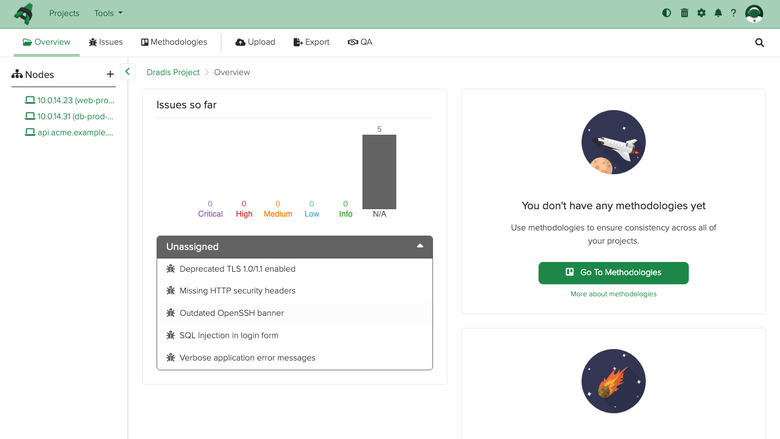
Project overview dashboard
Image
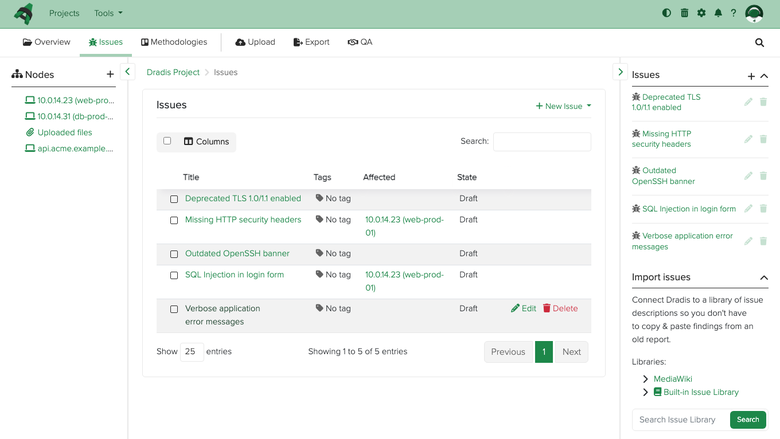
Findings and issues list
Image
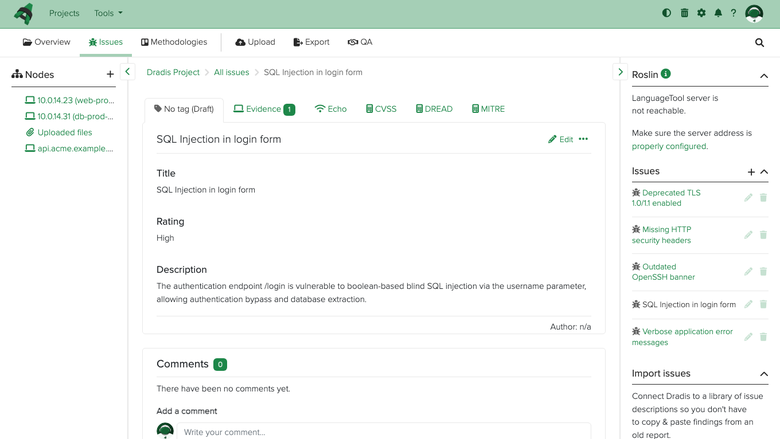
Issue and evidence detail
Image
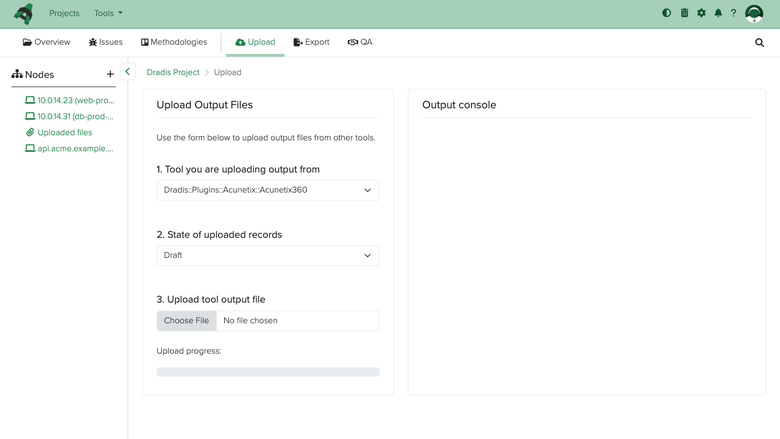
Import scanner output
This is a repackaged open source software product wherein additional charges apply for cloudimg support services.
Overview
Dradis Community Edition is an open-source collaboration and reporting framework for security assessments and penetration tests. It has been actively developed for over a decade and integrates with widely used security tools including Nmap, Nessus, Burp Suite, OpenVAS, and Qualys. Testing teams use Dradis to import scanner output, organize findings on a shared project tree of nodes, issues, and evidence, manage methodologies and testing checklists, and generate consistent client reports. Under the hood, Dradis is a Ruby on Rails application backed by SQLite, with Redis and a background worker for long-running jobs. This AMI delivers Dradis installed, hardened, and secured so a working reporting platform is operational within minutes of launch.
Why This Image vs. a Manual Install
Standing Dradis up by hand means installing a specific Ruby toolchain, building the application from source at a known-good release, precompiling assets, wiring up Redis and a background worker, generating the Rails secret key base, and putting an authenticated encrypted front door in front of it. This image completes every one of those steps at build time:
- Dradis is built from the official upstream source at a pinned release and runs under Puma bound to the loopback interface only
- An nginx reverse proxy terminates TLS on port 443 with a per-instance self-signed certificate
- The Rails secret key base and the single shared login password are generated on each instance's first boot
- The first-run setup is completed automatically so the instance boots straight to a login-gated dashboard with no open setup page
Security Hardening
This image follows a defence-in-depth approach:
- No default or shared credentials: the shared login password and the Rails secret key base are generated uniquely on every instance's first boot and written to a root-only file
- No open setup page: the first-run setup is completed automatically at first boot, so the instance never exposes an unauthenticated privileged setup wizard
- Login-gated by default: every application route redirects an unauthenticated visitor to the login page; only the login form and an unauthenticated health probe are served without the shared password
- Encrypted front door: nginx terminates TLS on port 443 with a per-instance self-signed certificate; plain HTTP on port 80 redirects to HTTPS
- Network isolation: the application binds exclusively to the loopback interface behind nginx; the database is a local file, never a network service
- Dedicated data volume: the SQLite database and uploaded evidence attachments live on their own disk, surviving OS-disk changes and resizable independently
Concrete Use Cases
- Centralize a penetration test: import scanner and tool output from across a team, organize every node, issue, and piece of evidence on one shared project tree, and keep the whole engagement in a single place instead of scattered spreadsheets
- Consistent client reporting: turn findings, methodologies, and evidence into a repeatable report using Dradis templates, so every assessment lands with the same structure and quality
- Team collaboration on findings: let assessors work the same project concurrently, tagging and prioritizing issues and reusing an issue library across nodes and engagements
AWS Integration
Deploy on any EC2 instance type; the recommended size is m5.large. Terminate TLS at an Application Load Balancer with your own certificate, or keep the per-instance self-signed certificate. Back up the SQLite database and uploaded evidence using EBS snapshots or AWS Backup, and resize the dedicated data volume independently of the OS disk as your projects grow.
Getting Started
Launch the AMI, wait for the instance to reach a running state, and navigate to the public IP over HTTPS. Retrieve the generated shared password from the root-only credentials file via SSH. From there, create your first project, import scanner output, and begin organizing findings. For a guided walkthrough of deployment options - including ALB termination with your own domain, per-user account setup, and EBS backup scheduling - contact cloudimg support.
cloudimg Support
24/7 technical support by email and chat. Help with deployment, enabling per-user accounts, reverse-proxy termination with your own domain and certificate, importing scanner output, tuning report templates, and backup planning for your assessment data.
Highlights
- Launch a working security-reporting platform over TLS in minutes with no manual build or configuration. This AMI handles the entire Ruby toolchain, from-source build, Redis worker setup, asset precompilation, and encrypted reverse-proxy configuration at build time so your team can focus on the assessment rather than infrastructure.
- Secure by default with unique per-instance credentials. The shared login password and Rails secret key base are generated fresh on every first boot, the setup wizard is completed automatically so it is never exposed, and all traffic is encrypted via an nginx TLS reverse proxy on port 443.
- Import output from Nmap, Nessus, Burp Suite, OpenVAS, Qualys, and more into a shared project tree. Organize findings, manage methodologies, and generate consistent client reports from templates. Data lives on a dedicated EBS volume you can snapshot and resize independently. Backed by 24/7 cloudimg technical support via email and chat.
Details
Sold by
Categories
Delivery method
Delivery option
64-bit (x86) Amazon Machine Image (AMI)
Latest version
Operating system
Ubuntu 24.04
Deployed on AWS
New
Introducing multi-product solutions
You can now purchase comprehensive solutions tailored to use cases and industries.

Features and programs
Financing for AWS Marketplace purchases
AWS Marketplace now accepts line of credit payments through the PNC Vendor Finance program. This program is available to select AWS customers in the US, excluding NV, NC, ND, TN, & VT.

Pricing
Free trial
Try this product free for 7 days according to the free trial terms set by the vendor. Usage-based pricing is in effect for usage beyond the free trial terms. Your free trial gets automatically converted to a paid subscription when the trial ends, but may be canceled any time before that.
Pricing is based on actual usage, with charges varying according to how much you consume. Subscriptions have no end date and may be canceled any time. Alternatively, you can pay upfront for a contract, which typically covers your anticipated usage for the contract duration. Any usage beyond contract will incur additional usage-based costs.
Additional AWS infrastructure costs may apply. Use the AWS Pricing Calculator to estimate your infrastructure costs.
If you are an AWS Free Tier customer with a free plan, you are eligible to subscribe to this offer. You can use free credits to cover the cost of eligible AWS infrastructure. See AWS Free Tier for more details. If you created an AWS account before July 15th, 2025, and qualify for the Legacy AWS Free Tier, Amazon EC2 charges for Micro instances are free for up to 750 hours per month. See Legacy AWS Free Tier for more details.
Dimension | Description | Cost/hour |
|---|---|---|
m5.large Recommended | m5.large | $0.08 |
t2.micro | t2.micro instance type | $0.04 |
t3.micro | t3.micro instance type | $0.04 |
c5a.12xlarge | c5a.12xlarge instance type | $0.24 |
c5a.16xlarge | c5a.16xlarge instance type | $0.24 |
c5a.24xlarge | c5a.24xlarge instance type | $0.24 |
c5a.2xlarge | c5a.2xlarge instance type | $0.24 |
c5a.4xlarge | c5a.4xlarge instance type | $0.24 |
c5a.8xlarge | c5a.8xlarge instance type | $0.24 |
c5a.large | c5a.large instance type | $0.08 |
Vendor refund policy
Refunds available on request.

Legal
Vendor terms and conditions
Upon subscribing to this product, you must acknowledge and agree to the terms and conditions outlined in the vendor's End User License Agreement (EULA) .
Content disclaimer
Vendors are responsible for their product descriptions and other product content. AWS does not warrant that vendors' product descriptions or other product content are accurate, complete, reliable, current, or error-free.
Delivery details
64-bit (x86) Amazon Machine Image (AMI)
Amazon Machine Image (AMI)
An AMI is a virtual image that provides the information required to launch an instance. Amazon EC2 (Elastic Compute Cloud) instances are virtual servers on which you can run your applications and workloads, offering varying combinations of CPU, memory, storage, and networking resources. You can launch as many instances from as many different AMIs as you need.
Version release notes
Initial release of Dradis Community Edition as a ready-to-use self-hosted security-assessment collaboration and reporting platform, built from the official upstream source at a pinned release and served over TLS behind nginx, secured with a single shared login password and a Rails secret key base generated on each instance's first boot, the first-run setup completed automatically so no open setup page is exposed, and a dedicated data volume for the SQLite database and uploaded evidence.
Additional details
Usage instructions
Connect via SSH on port 22 as the default login user for your operating system variant (for the Ubuntu 24.04 variant the user is ubuntu). Read the per-instance shared login password and the resolved URL with: sudo cat /root/dradis-credentials.txt. Open the web UI in a browser at https://<instance-public-ip>/login (the instance uses a per-instance self-signed TLS certificate, so accept the browser certificate warning, or front it with your own domain and certificate). At the login page enter any user name to identify yourself plus the DRADIS_SHARED_PASSWORD from that file. Change the shared password and enable per-user accounts from Configuration > Manage once you are signed in. The application binds to loopback only and the SQLite database is a local file on the dedicated data volume at /var/lib/dradis - neither is exposed on the network; only the nginx TLS reverse proxy is public. The instance security group opens ports 22 and 443. The services run under systemd: systemctl status redis-server dradis dradis-resque nginx.
Resources
Vendor resources
Support
Vendor support
cloudimg Support
cloudimg provides 24/7 technical support for this product by email and live chat.
Contact: support@cloudimg.co.uk
What we help with:
- Deployment and initial configuration
- Enabling per-user accounts and rotating the shared login password
- Reverse-proxy termination with your own domain and TLS certificate
- Importing scanner and tool output and tuning report templates
- Backing up the SQLite database and uploaded evidence using EBS snapshots or AWS Backup
- Performance tuning and troubleshooting
- Updates and security patching guidance
Refunds: For refund requests, contact support@cloudimg.co.uk with your AWS account ID and subscription details.
AWS infrastructure support
AWS Support is a one-on-one, fast-response support channel that is staffed 24x7x365 with experienced and technical support engineers. The service helps customers of all sizes and technical abilities to successfully utilize the products and features provided by Amazon Web Services.
Similar products

Dradis Framework is a pentest management platform that enables faster reporting and painless collaboration for cybersecurity teams. Combine multiple scanners (using your own descriptions), add manual findings, and generate a report with one click - or publish to the results portal. This repository contains the official Dradis Community Edition (CE) image. You can find the source code on github:dradis/dradis-ce.
Customer reviews
No customer reviews yet
Be the first to review this product . We've partnered with PeerSpot to gather customer feedback. You can share your experience by writing or recording a review, or scheduling a call with a PeerSpot analyst.