Sold by: OutcomeOps LLC
Deployed on AWS
OutcomeOps is a Context Engineering and Organizational Intelligence platform that grounds enterprise AI workflows in your own code, documents, and tickets. Connect repos, Confluence, Jira, SharePoint, Teams, and MCP tools into shared workspaces, then run AI-assisted code generation, PR analysis, ADR authoring, runbook creation, and migration planning with full source provenance on every answer. Deployed via Terraform into your AWS account on Bedrock, so sensitive context never leaves your security boundary.
5
Overview
Video
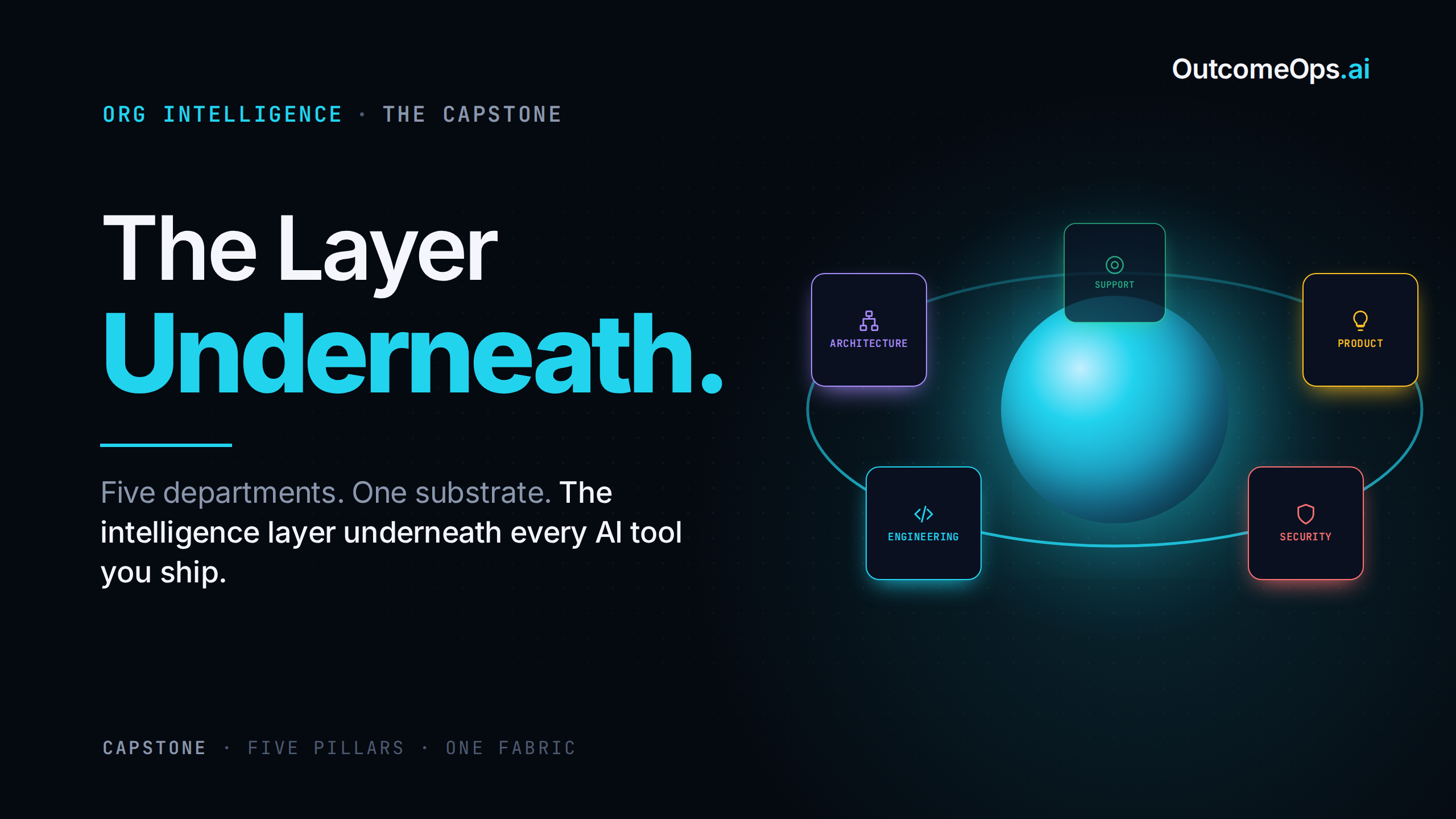
The Layer Underneath: Org Intelligence on AWS
Video
Which Apps Are Affected by This CVE?
Video
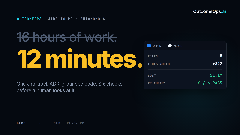
From Jira Ticket to Production PR in 12 Minutes
Video
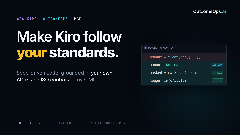
OutcomeOps as a Kiro Power
Video
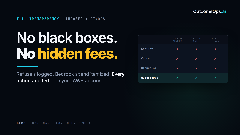
OutcomeOps: Full Transparency for Enterprise AI
OutcomeOps is the organizational intelligence layer your enterprise can query. Instead of asking engineers and architects to copy-paste sensitive code into hosted AI tools, OutcomeOps brings the AI to the context: deployed via Terraform into the customer's own AWS account, powered by Amazon Bedrock, with source code, ADRs, Confluence pages, Jira tickets, SharePoint documents, and Teams threads staying inside the customer's security perimeter.
At the core of the platform are workspaces. A workspace connects repositories, documentation systems, and ticketing tools into a single shared substrate every team can query together. OutcomeOps automatically generates code-maps from connected repositories and keeps them current as code evolves, with first-class language support for Java, TypeScript, Python, C# / .NET, and ABAP. Code-maps describe applications running anywhere - AWS, Azure, GCP, on-premises, or SAP - so teams can analyze and plan migrations from any source environment, even when OutcomeOps itself runs only on AWS. MCP server support is opt-in per query, letting teams selectively bring in real-time tool context from existing systems without expanding the platform's standing data access.
One corpus. Every team. Security verifies an app follows your PII-handling standards from the code, with citations to the standard. Operations resolves production incidents in minutes by querying how the pipeline fits together, and if no runbook exists, OutcomeOps writes one from the code. Product turns shipped features into the gaps that still need stories, scoped against what the code actually does instead of a stale PRD. Compliance and audit check a system against your controls and get a cited answer, not a manual review. Architecture catches drift before it ships - asking whether a service still follows the ADRs that govern it returns a grounded answer, not a quarterly review. Engineering ships every AI coding agent (Copilot, Cursor, Claude Code, and OutcomeOps' own Jira-to-PR generation) against one architecture, with every PR checked against your ADRs before a human looks.
When the documentation says one thing and the code says another, the code wins and the discrepancy gets surfaced before anyone acts on it. Every answer is anchored to your repositories as they exist right now, with citations to the code-maps and documents the model actually used. No more engineers shipping bad code because they followed a wiki nobody had updated since the last reorg.
OutcomeOps composes with the AI coding tools your engineers already use. Copilot, Cursor, Claude Code, and AWS Kiro all connect to OutcomeOps over the Model Context Protocol, so every AI-generated pull request is grounded in your ADRs, your architecture standards, and your organization's actual codebase, regardless of which IDE the engineer chose. Local spec-driven tools optimize the file. OutcomeOps ensures they optimize for your organization.
OutcomeOps is built for organizations where data sovereignty is a requirement, not a preference: aerospace, defense, healthcare, financial services, insurance, and other regulated industries that cannot put proprietary code into multi-tenant AI services. The platform is single-tenant by design. Customers own the infrastructure after deployment, control their own AWS account, and decide independently when and how to upgrade. Every inference call is governed by your existing AWS controls (IAM, VPC isolation, CloudTrail, KMS) and lands in your own audit trail. The complete usage stream - every interaction, every refusal, every dollar of spend - exports to your SIEM in OCSF for ingestion into the security and compliance tooling you already run. Phone-home licensing transmits only PR count and repository count, never code or PII, and can be disabled entirely for fully air-gapped operation.
The pipeline is the guardrail. The intelligence layer is what makes sure the pipeline has something worth shipping.
Highlights
- OutcomeOps ingests your ADRs, code-maps, Confluence, design docs, compliance frameworks, and runbooks into a single substrate every team can query. Security verifies an app follows your PII standards. Operations resolves incidents in minutes. Product turns shipped features into the gaps that still need stories. Same corpus. Different answer shapes per role. Every claim cites its source. Not just developers - the whole organization gets outcomes.
- When the documentation says one thing and the code says another, the code wins and the discrepancy gets surfaced before anyone acts on it. Every answer is anchored to your repositories as they exist right now, with citations to the code-maps and documents the model actually used. No more engineers shipping bad code because they trusted a runbook nobody had updated in two years.
- OutcomeOps deploys via Terraform into your AWS account and runs entirely on Amazon Bedrock inside your trust boundary. Every interaction lands in your cloud under your KMS keys: who asked, what was retrieved, what came back, what it cost. Refusal alerts fire in real time. Per-workspace budget thresholds catch runaway spend before it burns. The whole stream exports to your SIEM in OCSF. Your audit trail lives where your auditors work.
Details
Sold by
Categories
Delivery method
Deployed on AWS
New
Introducing multi-product solutions
You can now purchase comprehensive solutions tailored to use cases and industries.

Features and programs
Financing for AWS Marketplace purchases
AWS Marketplace now accepts line of credit payments through the PNC Vendor Finance program. This program is available to select AWS customers in the US, excluding NV, NC, ND, TN, & VT.

Pricing
Pricing is based on the duration and terms of your contract with the vendor. This entitles you to a specified quantity of use for the contract duration. If you choose not to renew or replace your contract before it ends, access to these entitlements will expire.
Additional AWS infrastructure costs may apply. Use the AWS Pricing Calculator to estimate your infrastructure costs.
Dimension | Description | Cost/12 months |
|---|---|---|
Team: Annual, 50 repos, 300 PRs/month | Annual Team license with up to 50 repositories and 300 pull requests per month, sized for a single team or small organization. Soft enforcement with usage alerts at 80% and 100% of monthly limits. Includes standard support, version upgrade guidance, and Bedrock model migration assistance for the OutcomeOps platform deployed in your AWS account. | $250,000.00 |
Division: Annual, 150 repos, 1,000 PRs/month | Annual Division license with up to 150 repositories and 1,000 pull requests per month, sized for multi-team deployments and engineering divisions. Soft enforcement with usage alerts at 80% and 100% of monthly limits. Includes standard support, version upgrade guidance, and Bedrock model migration assistance for the OutcomeOps platform deployed in your AWS account. | $750,000.00 |
Enterprise: Annual, unlimited repos and PRs | Annual Enterprise license with unlimited repositories and unlimited pull requests per month, sized for organization-wide deployments at 500+ engineers or strict data sovereignty requirements. Soft enforcement with usage alerts. Includes standard support, version upgrade guidance, and Bedrock model migration assistance. Custom contract terms available via AWS Marketplace Private Offer including extended hours support, custom SLAs, dedicated technical contact, and air gapped deployment options for regulated industries. | $2,000,000.00 |
Dimensions summary
You choose an annual license sized by usage capacity. The three tiers scale by repository count and monthly pull request volume. Team covers up to 50 repositories and 300 pull requests per month. Division covers up to 150 repositories and 1,000 pull requests per month. Enterprise removes those caps with unlimited repositories and pull requests, aimed at organization-wide deployments or strict data sovereignty needs. All tiers use soft enforcement, alerting you at 80% and 100% of monthly limits rather than blocking work. Enterprise adds optional custom contract terms through a Private Offer, including extended support and air-gapped deployment.
Top-of-mind questions for buyers
A repository is a code repo you connect to a workspace, where the platform generates code-maps of every function, class, and dependency. A pull request is each PR the platform produces and routes through automated review before human approval. Both count against your tier's monthly caps.
Each tier uses soft enforcement. You get usage alerts at 80% and 100% of your monthly limits. Work is not blocked when you reach the cap. This applies to Team, Division, and Enterprise. The Enterprise tier carries no repository or pull request caps at all.
No. Your annual license price is fixed by tier and sized by repositories and monthly pull requests. The platform deploys into your own AWS account, so foundation-model inference and infrastructure run on your AWS bill separately. The license itself is not metered by compute or model calls.
www.outcomeops.ai+2
Helpful?
Vendor refund policy
All sales are final. OutcomeOps does not offer refunds for purchases made through AWS Marketplace except as required by applicable law or as expressly provided in a Private Offer agreement. Customers experiencing product issues should contact support@outcomeops.ai or open a ticket at https://outcomeops.atlassian.net/servicedesk/customer/portal/1 within 30 days of purchase. We will work in good faith to resolve issues and may, at our discretion, issue a partial or full refund.

Legal
Vendor terms and conditions
Upon subscribing to this product, you must acknowledge and agree to the terms and conditions outlined in the vendor's End User License Agreement (EULA) .
Content disclaimer
Vendors are responsible for their product descriptions and other product content. AWS does not warrant that vendors' product descriptions or other product content are accurate, complete, reliable, current, or error-free.
Delivery details
Software as a Service (SaaS)
SaaS delivers cloud-based software applications directly to customers over the internet. You can access these applications through a subscription model. You will pay recurring monthly usage fees through your AWS bill, while AWS handles deployment and infrastructure management, ensuring scalability, reliability, and seamless integration with other AWS services.
Resources
Vendor resources
Support
Vendor support
Support Channels Customer Portal: https://outcomeops.atlassian.net/servicedesk/customer/portal/1 (free Atlassian account required for ticket tracking) Email: support@outcomeops.ai Mailing Address: OutcomeOps LLC, 304 S. Jones Blvd #3087, Las Vegas, NV 89107
Architecture Note OutcomeOps is fully serverless and runs entirely inside the customer's AWS account on AWS Lambda, DynamoDB, S3, and Amazon Bedrock. There is no shared backend or seller-side production environment that can fail. AWS Lambda's 99.95% availability SLA effectively becomes the platform's availability SLA. The vast majority of "production down" scenarios are AWS-side regional events (already covered by the customer's existing AWS support contract) or in-account misconfiguration, which we help diagnose.
Response Times All support requests are tracked through our Atlassian-backed customer portal, which provides ticket history, status updates, and SLA tracking. Initial response targets:
Critical (active deployment failure, security incident): 4 business hours High (significant feature impairment, upgrade blockers): 1 business day Standard (questions, configuration assistance, feature requests): 2 business days
Business hours are 8:00 AM to 6:00 PM Pacific, Monday through Friday, excluding U.S. federal holidays. Enterprise customers with private offers may negotiate extended hours coverage and tightened SLAs as part of their contract.
What's Included Standard support covers deployment assistance, configuration questions, troubleshooting, security advisories, version upgrade guidance, and Bedrock model migration guidance for the OutcomeOps platform deployed in your AWS account. Customers retain ownership of their AWS infrastructure after deployment; AWS-side service issues and customer-side modifications outside the OutcomeOps Terraform module are the customer's responsibility, though we provide reasonable diagnostic assistance.
AWS infrastructure support
AWS Support is a one-on-one, fast-response support channel that is staffed 24x7x365 with experienced and technical support engineers. The service helps customers of all sizes and technical abilities to successfully utilize the products and features provided by Amazon Web Services.
Similar products
Koios Pilot for Month-to-Month Koios software and model trial.

Actual Assistant is an AI workforce and contractor operating platform that helps businesses manage customer communication, sales follow-up, operations, marketing, and business intelligence from one connected system.

Modernize government cloud operations with Deloitte's Ascend Ops Assist — an AI-powered AIOps platform unifying observability, security event monitoring, and FinOps with agentic event triage and intelligent noise suppression. Built AWS-native for federal agencies and state and local governments, it helps reduce alert fatigue and accelerate incident response by consolidating monitoring tools into a single cloud-native operational layer.
Benjamin Assist is an AI-powered DataOps and monitoring platform designed to ensure continuous performance, reliability, and security across cloud data environments. Leveraging Gen AI, proactive monitoring, and intelligent operation, it enables operational excellence for mission-critical data workloads on AWS.
AI-powered
DataOps
monitoring
cloud data
Gen AI
operational excellence
Customer reviews
reviewer2856078
Structured AI governance has connected development activity to measurable business outcomes
Reviewed on Jun 13, 2026
Review provided by PeerSpot
What is our primary use case?
My primary use case for OutcomeOps AI Assist is helping organizations translate AI adoption into measurable business impact across the software delivery lifecycle.
More specifically, I use it to help clients improve visibility, governance, and execution around AI-assisted development by connecting engineering activity to outcomes such as faster delivery, better reuse, reduced technical debt, stronger compliance, and clearer ROI.
OutcomeOps AI Assist is especially valuable in highly regulated environments where organizations need to move faster but still maintain control, security, auditability, and alignment between business priorities and technical execution.
How has it helped my organization?
OutcomeOps AI Assist has improved our organization by helping us create a much stronger bridge between AI adoption, software delivery, governance, and measurable business outcomes.
It has provided a more structured way to evaluate how AI can support engineering teams beyond simple productivity gains.
The platform helps bring visibility into where AI-assisted development can accelerate execution, improve code reuse, reduce technical debt, and create better alignment between business priorities and technology delivery.
Equally important, OutcomeOps AI Assist has been very well received in client conversations because it addresses a critical gap many organizations are facing: how to adopt AI responsibly while maintaining security, auditability, compliance, and control.
It has strengthened our ability to have more strategic conversations with clients around enterprise AI, DevSecOps, modernization, and business impact.
What is most valuable?
The most valuable features have been the organizational knowledge query, reuse detection, and design-to-backlog capabilities.
The organizational knowledge query is valuable because it helps teams quickly understand existing systems, codebases, dependencies, and institutional knowledge without relying solely on tribal knowledge or lengthy discovery cycles.
Reuse detection is equally important because it helps identify where existing code, patterns, or services can be leveraged instead of rebuilding from scratch, which can reduce technical debt and improve delivery efficiency.
The design-to-backlog capability is especially compelling because it helps connect business intent to actionable engineering execution.
It creates a stronger bridge between strategy, requirements, development, and measurable outcomes.
For clients, the value is not just AI assistance; it is the ability to use AI in a structured, secure, and outcome-driven way that improves speed, governance, and confidence across the software delivery lifecycle.
What needs improvement?
OutcomeOps AI Assist is already addressing a very important gap in the market, particularly around secure, governed, and outcome-driven AI adoption across software delivery.
That said, the next release could be strengthened by adding more executive-level reporting and business impact dashboards.
The areas I would like to see expanded include stronger ROI measurement, clearer visibility into AI-assisted productivity gains, and more reporting that connects engineering activity to business outcomes.
This would help CIOs, CTOs, and business leaders better understand where AI is creating value, where risks exist, and where teams may need additional support or governance.
For how long have I used the solution?
I have been usingOutcomeOps for just under a year, and during that time I’ve had the opportunity to see its impact firsthand across several client conversations and use cases.
The platform has been very well received, particularly because it helps connect AI-assisted development to real business outcomes, governance, visibility, and execution.
Based on what I’ve seen, OutcomeOps is solving a meaningful gap in how organizations adopt, measure, and operationalize AI across the software delivery lifecycle.
What's my experience with pricing, setup cost, and licensing?
My advice on pricing is to evaluate OutcomeOps AI Assist through the lens of business value, risk reduction, and measurable execution impact rather than viewing it as a traditional AI or developer productivity tool.
For organizations investing heavily in AI, engineering modernization, DevSecOps, or regulated software delivery, the cost should be compared against the value of faster delivery, improved code reuse, reduced technical debt, stronger governance, and better visibility into AI-driven outcomes.
In that context, the pricing can be very compelling because the platform helps address both productivity and accountability.
I would also encourage organizations to align pricing to the specific use cases, expected outcomes, and executive priorities they want to measure.
The clearer the business case upfront, the easier it is to justify the investment and track ROI over time.
Which other solutions did I evaluate?
We evaluated OutcomeOps AI Assist in the broader context of other AI-assisted development and engineering productivity tools, including solutions such as GitHub Copilot, Microsoft Copilot, Cursor, Claude Code, and AWS Kiro.
What differentiated OutcomeOps was its focus beyond individual developer productivity.
While many tools are strong at code generation or developer assistance, OutcomeOps stood out because it connects AI-assisted development to enterprise governance, codebase understanding, reuse detection, auditability, and measurable business outcomes.
For our clients, especially in regulated and enterprise environments, that distinction is important.
The priority is not simply helping developers move faster; it is helping the organization adopt AI responsibly, improve execution, reduce risk, and clearly demonstrate business impact.
What other advice do I have?
OutcomeOps AI Assist is addressing a very timely and important challenge for enterprise organizations: how to move beyond AI experimentation and begin operationalizing AI in a way that is secure, measurable, and aligned to business outcomes.
My advice would be to approach OutcomeOps as more than an AI development assistant.
Its real value is in helping organizations create visibility, governance, and accountability across the software delivery lifecycle.
For companies in regulated industries or complex enterprise environments, that distinction is critical.
I would also recommend aligning early on the specific business outcomes you want to measure, whether that is faster delivery, improved code reuse, reduced technical debt, stronger auditability, or better prioritization of engineering work.
When the platform is tied to clear executive priorities, it becomes much easier to demonstrate value and drive adoption across both technology and business leadership.