
Sold by: cloudimg
Deployed on AWS
Free Trial
AWS Free Tier
This product has charges associated with it for seller support. A simple, standalone WebDAV server that serves a directory over HTTPS with HTTP Basic Auth, preinstalled and ready within minutes of launch. A per-instance username, password and TLS certificate are generated on first boot, so the server is never open and never unencrypted. Backed by 24/7 cloudimg support.
Overview
Image
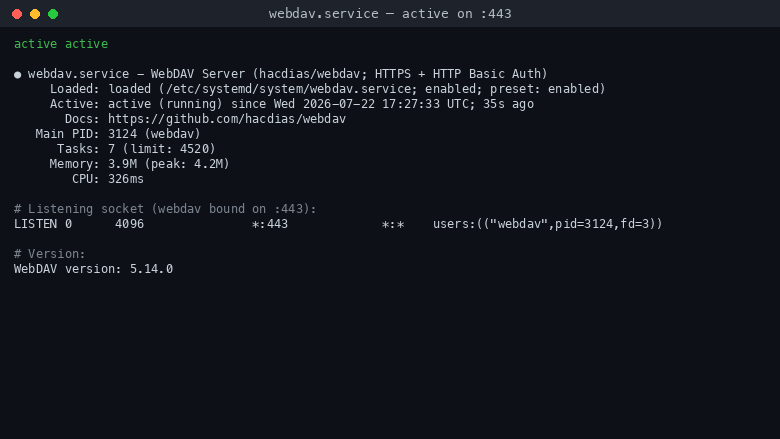
WebDAV service running on HTTPS :443
Image
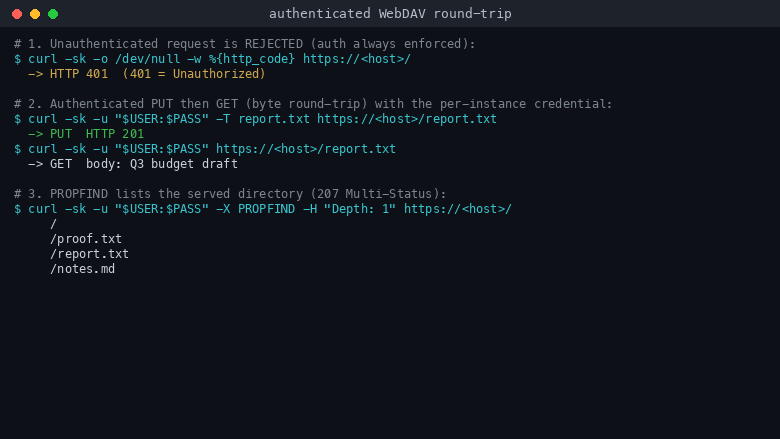
Authenticated WebDAV round-trip
Image
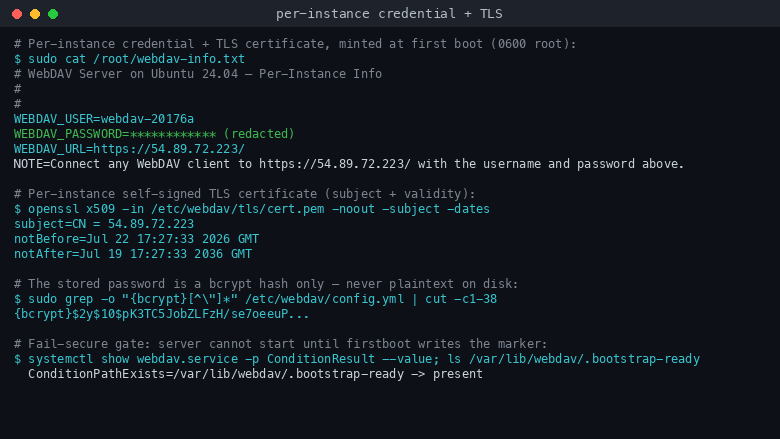
Per-instance credential and TLS certificate
This is a repackaged open source software product wherein additional charges apply for cloudimg support services.
Overview WebDAV Server delivers hacdias/webdav, a fast, self-hosted WebDAV server written as a single static Go binary, fully installed, hardened and managed by systemd, so a production-ready file server is operational within minutes of launch with no manual package installation and no configuration to write. WebDAV lets you mount and manage a remote directory as if it were a local drive from Windows Explorer, macOS Finder, Linux file managers and any WebDAV client, so it is an ideal drop-in remote file share, backup target or document store that you run and own inside your own cloud account. The current release available is hacdias/webdav 5.14.
Secure By Default Unlike a bare deployment, this image is secure by default. The server always runs over HTTPS with HTTP Basic Auth enforced, and there is no shared or default credential. A unique username and password, together with a TLS certificate, are generated on each instance's first boot; the password is stored only as a bcrypt hash in the server configuration and the plaintext credential is written to a file only the root user can read, so every request is authenticated and encrypted from the very first connection. A fail-secure bootstrap gate ensures the server cannot start at all until that per-instance credential and certificate exist, so the image can never come up as an open or unencrypted share.
Always Current On first boot the appliance refreshes itself to the newest release before it starts serving, so every launch runs current software, falling back to the pinned build if the network is unavailable.
Ready To Use The server serves a directory on disk with configurable per-user permissions for create, read, update and delete, and drops straight into an existing workflow: read the generated credentials, point any WebDAV client at the address in your instance details, and connect. Because the certificate is self-signed, clients will prompt to trust it on first connect.
cloudimg Support 24/7 technical support by email and chat. Help with deployment, connecting WebDAV clients, replacing the self-signed certificate with a trusted one, adding users and permissions, storage sizing and upgrade planning.
Use Cases A self-hosted remote file share you run and own inside your own cloud account, mountable as a drive from Windows, macOS and Linux. A backup or sync target for tools that speak WebDAV. A simple document store or drop box for a team, with per-user create, read, update and delete permissions.
This is a repackaged open source software product with additional charges for cloudimg support services. WebDAV Server (hacdias/webdav) is open source under the MIT licence. All product and company names are trademarks or registered trademarks of their respective holders. Use of them does not imply any affiliation with or endorsement by them.
Highlights
- A standalone WebDAV server preinstalled and hardened, serving a directory over HTTPS with HTTP Basic Auth enforced, so a production-ready remote file share is operational within minutes of launch with no configuration to write
- Secure by default with no shared or default credential: a unique username, password and TLS certificate are generated on every instance's first boot, and a fail-secure bootstrap gate blocks the server from ever starting open or unencrypted
- Mount and manage a remote directory as a local drive from Windows Explorer, macOS Finder, Linux and any WebDAV client, with configurable per-user create, read, update and delete permissions and 24/7 cloudimg support
New
Introducing multi-product solutions
You can now purchase comprehensive solutions tailored to use cases and industries.

Features and programs
Financing for AWS Marketplace purchases
AWS Marketplace now accepts line of credit payments through the PNC Vendor Finance program. This program is available to select AWS customers in the US, excluding NV, NC, ND, TN, & VT.

Pricing
Free trial
Try this product free for 7 days according to the free trial terms set by the vendor. Usage-based pricing is in effect for usage beyond the free trial terms. Your free trial gets automatically converted to a paid subscription when the trial ends, but may be canceled any time before that.
Pricing is based on actual usage, with charges varying according to how much you consume. Subscriptions have no end date and may be canceled any time. Alternatively, you can pay upfront for a contract, which typically covers your anticipated usage for the contract duration. Any usage beyond contract will incur additional usage-based costs.
Additional AWS infrastructure costs may apply. Use the AWS Pricing Calculator to estimate your infrastructure costs.
If you are an AWS Free Tier customer with a free plan, you are eligible to subscribe to this offer. You can use free credits to cover the cost of eligible AWS infrastructure. See AWS Free Tier for more details. If you created an AWS account before July 15th, 2025, and qualify for the Legacy AWS Free Tier, Amazon EC2 charges for Micro instances are free for up to 750 hours per month. See Legacy AWS Free Tier for more details.
Dimension | Description | Cost/hour |
|---|---|---|
m5.large Recommended | m5.large | $0.04 |
t3.micro | t3.micro instance type | $0.04 |
t2.micro | t2.micro instance type | $0.04 |
r5n.12xlarge | r5n.12xlarge instance type | $0.24 |
r7a.medium | r7a.medium instance type | $0.04 |
g6.16xlarge | g6.16xlarge instance type | $0.24 |
c8in.8xlarge | c8in.8xlarge instance type | $0.24 |
m8azn.xlarge | m8azn.xlarge instance type | $0.12 |
c8ine.12xlarge | c8ine.12xlarge instance type | $0.24 |
m5ad.12xlarge | m5ad.12xlarge instance type | $0.24 |
Vendor refund policy
Refunds available on request.

Legal
Vendor terms and conditions
Upon subscribing to this product, you must acknowledge and agree to the terms and conditions outlined in the vendor's End User License Agreement (EULA) .
Content disclaimer
Vendors are responsible for their product descriptions and other product content. AWS does not warrant that vendors' product descriptions or other product content are accurate, complete, reliable, current, or error-free.
Delivery details
64-bit (x86) Amazon Machine Image (AMI)
Amazon Machine Image (AMI)
An AMI is a virtual image that provides the information required to launch an instance. Amazon EC2 (Elastic Compute Cloud) instances are virtual servers on which you can run your applications and workloads, offering varying combinations of CPU, memory, storage, and networking resources. You can launch as many instances from as many different AMIs as you need.
Version release notes
Initial release of WebDAV Server (hacdias/webdav 5.14) as a ready-to-use, secure-by-default WebDAV file server over HTTPS with the username, password and TLS certificate generated on first boot.
Additional details
Usage instructions
Connect via SSH on port 22 as the default login user for your operating system variant (for the Ubuntu 24.04 variant the user is ubuntu). Retrieve the per-instance WebDAV username and password with: sudo cat /root/webdav-info.txt. The server runs over HTTPS on port 443 with HTTP Basic Auth enforced. Point any WebDAV client at https://<instance-public-ip>/ and sign in with the generated username and password; the certificate is self-signed, so your client will prompt to trust it on first connect. The served directory is /var/lib/webdav/data on the instance. The instance security group opens ports 22 (SSH) and 443 (WebDAV over HTTPS). The service runs under systemd: systemctl status webdav. An unauthenticated request returns 401 by design - authentication is always enforced.
Resources
Vendor resources
Support
Vendor support
cloudimg provides 24/7 technical support for this product by email and live chat. Our engineers help with deployment, configuration, updates, performance tuning and troubleshooting; critical issues receive a one hour average response. Contact support@cloudimg.co.uk .
AWS infrastructure support
AWS Support is a one-on-one, fast-response support channel that is staffed 24x7x365 with experienced and technical support engineers. The service helps customers of all sizes and technical abilities to successfully utilize the products and features provided by Amazon Web Services.
Similar products

SFTPGo is an SFTP, FTP/S, HTTP/S and WebDAV server backed by Amazon S3

SFTPGo is an SFTP, FTP/S, HTTP/S and WebDAV server backed by Amazon S3

SFTPGo is an SFTP, FTP/S, HTTP/S and WebDAV server backed by Amazon S3

SFTPGo is an SFTP, FTP/S, HTTP/S and WebDAV server backed by Amazon S3

SFTPGo is an SFTP, FTP/S, HTTP/S and WebDAV server backed by Amazon S3
Customer reviews
No customer reviews yet
Be the first to review this product . We've partnered with PeerSpot to gather customer feedback. You can share your experience by writing or recording a review, or scheduling a call with a PeerSpot analyst.