Sold by: cloudimg
Deployed on AWS
Free Trial
AWS Free Tier
This product has charges associated with it for seller support. Caddy web server and reverse proxy with automatic HTTPS, preinstalled and serving on first boot. Backed by 24/7 cloudimg support for DevOps teams and developers.
Overview
Image
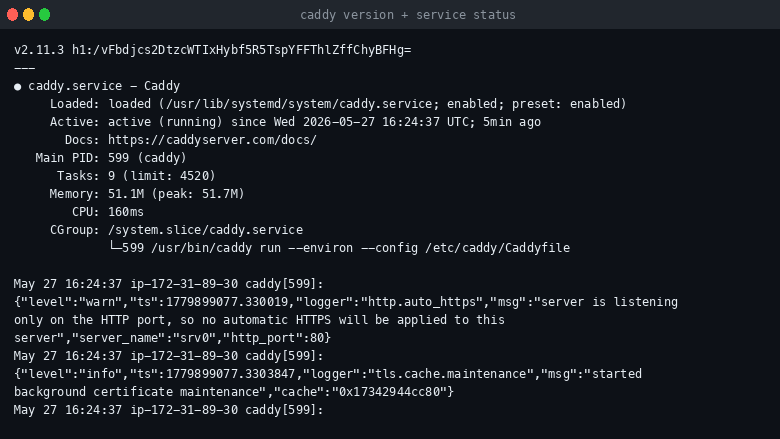
Caddy version and service status
Image
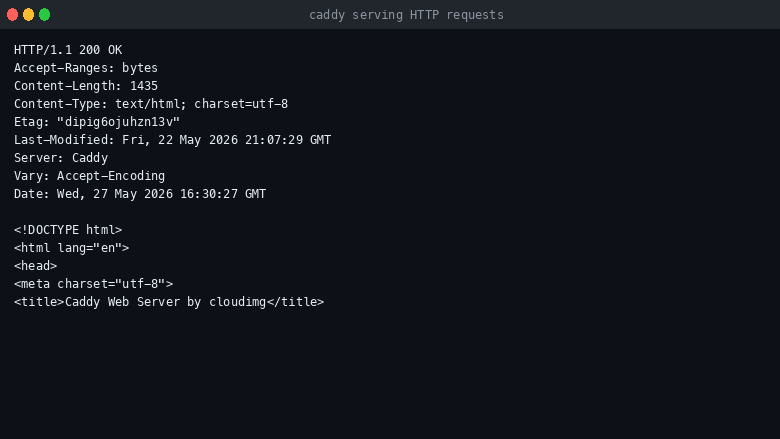
Caddy serving HTTP requests
Image
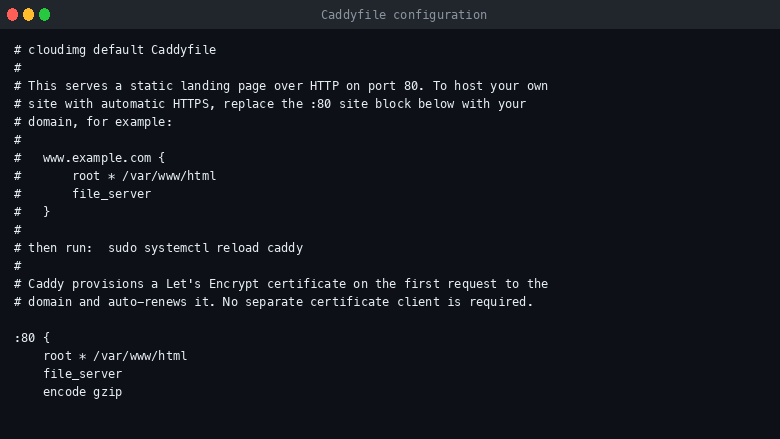
Caddy configuration
This is a repackaged open source software product wherein additional charges apply for cloudimg support services.
Caddy Web Server - Automatic HTTPS, Zero Configuration
Caddy is the open source web server and reverse proxy written in Go that makes HTTPS automatic. This AMI delivers Caddy 2 fully installed and configured on a hardened base, so a working web server is up and serving within minutes of launch - no package management, repository setup, or manual certificate tooling required.
Why Choose This AMI Over Alternatives
Unlike Nginx or Apache AMIs that require manual Certbot installation, cron-based renewal scripts, and separate TLS configuration, this image handles certificate provisioning and renewal natively. Compared to a DIY Caddy install, you skip systemd service creation, repository configuration, and storage layout decisions. The result: fewer moving parts, fewer maintenance tasks, and a faster path from launch to production HTTPS.
What Is Included
- Caddy 2 web server installed from the official Caddy team repository, enabled as a systemd service that starts on boot
- Default site configuration serving a landing page over HTTP on port 80, ready to edit
- Separate data volume for web content, independently resizable and kept off the OS disk
- File-based configuration with a loopback-only admin API - no exposed admin interface or passwords to manage
- First-boot info file recording listening ports and configuration paths for immediate orientation
Automatic HTTPS
Caddy provisions and renews TLS certificates automatically via Let's Encrypt or ZeroSSL. Point an Amazon Route 53 DNS record (or any DNS provider) at the instance, add the domain to the Caddyfile, reload the service, and Caddy obtains a publicly trusted certificate on the first request and keeps it renewed. There is no separate certificate client to install or schedule.
AWS Integration Points
- Amazon Route 53 - Create an A record pointing to your instance for automatic HTTPS domain validation
- Amazon EBS - The dedicated web content volume uses EBS, allowing snapshots, encryption at rest, and independent resizing
- Amazon CloudWatch - Forward Caddy access and error logs for centralized monitoring and alerting
- Elastic Load Balancing - Place Caddy behind an ALB or NLB for multi-instance deployments
- AWS Systems Manager - Manage configuration updates and patching across fleets without direct SSH
Dedicated Web Content Tier
The document root and site files live on a separate, independently resizable EBS volume. This architecture keeps web content off the operating system disk so storage can be grown, snapshotted, or encrypted without disturbing the rest of the instance.
Security Practices
- Loopback-only admin API prevents remote management exposure
- No default passwords or web-based admin panels
- Automatic TLS with publicly trusted certificates
- Separate data volume supports EBS encryption at rest
- Minimal installed package set to reduce attack surface
Use Cases
- Static website and SPA hosting - Deploy marketing sites or single page applications with automatic HTTPS in under five minutes
- Reverse proxy for application backends - Route traffic to multiple backend services (Node.js, Python, Go) running on the same instance or across a VPC, with automatic TLS termination
- Automatic HTTPS termination for internal services - Provide trusted certificates for internal APIs without managing a PKI
- API gateway and edge routing - Use Caddy's matcher and handler system to route, rewrite, and load balance API requests
cloudimg Support
24/7 technical support by email and live chat. Our engineers help with web server configuration, reverse proxy setup, automatic HTTPS, virtual hosts, upgrades, and AWS integration questions. Critical issues receive a one-hour average response.
To discuss your deployment before purchasing, start a live chat or email our team for a free configuration walkthrough.
All product and company names are trademarks or registered trademarks of their respective holders. Use of them does not imply any affiliation with or endorsement by them.
Highlights
- Highlight 1
- Caddy preinstalled and serving on first boot - skip the manual package installation, systemd configuration, and repository setup that a DIY deployment requires. Your instance responds to HTTP requests within minutes of launch, eliminating the typical 30-plus-minute provisioning workflow needed with raw Caddy or Nginx plus Certbot stacks. File-based configuration means you connect over SSH, edit the Caddyfile, reload, and you are live.
- Highlight 2
Details
Sold by
Categories
Delivery method
Delivery option
64-bit (x86) Amazon Machine Image (AMI)
Latest version
Operating system
Ubuntu 24.04
Deployed on AWS
New
Introducing multi-product solutions
You can now purchase comprehensive solutions tailored to use cases and industries.

Features and programs
Financing for AWS Marketplace purchases
AWS Marketplace now accepts line of credit payments through the PNC Vendor Finance program. This program is available to select AWS customers in the US, excluding NV, NC, ND, TN, & VT.

Pricing
Free trial
Try this product free for 7 days according to the free trial terms set by the vendor. Usage-based pricing is in effect for usage beyond the free trial terms. Your free trial gets automatically converted to a paid subscription when the trial ends, but may be canceled any time before that.
Pricing is based on actual usage, with charges varying according to how much you consume. Subscriptions have no end date and may be canceled any time. Alternatively, you can pay upfront for a contract, which typically covers your anticipated usage for the contract duration. Any usage beyond contract will incur additional usage-based costs.
Additional AWS infrastructure costs may apply. Use the AWS Pricing Calculator to estimate your infrastructure costs.
If you are an AWS Free Tier customer with a free plan, you are eligible to subscribe to this offer. You can use free credits to cover the cost of eligible AWS infrastructure. See AWS Free Tier for more details. If you created an AWS account before July 15th, 2025, and qualify for the Legacy AWS Free Tier, Amazon EC2 charges for Micro instances are free for up to 750 hours per month. See Legacy AWS Free Tier for more details.
Dimension | Description | Cost/hour |
|---|---|---|
m5.large Recommended | m5.large | $0.08 |
t2.micro | t2.micro instance type | $0.04 |
t3.micro | t3.micro instance type | $0.04 |
d3.xlarge | d3.xlarge instance type | $0.12 |
c6a.32xlarge | c6a.32xlarge instance type | $0.24 |
g7e.8xlarge | g7e.8xlarge instance type | $0.24 |
r8a.2xlarge | r8a.2xlarge instance type | $0.24 |
i7ie.metal-48xl | i7ie.metal-48xl instance type | $0.24 |
c7i.8xlarge | c7i.8xlarge instance type | $0.24 |
r8i.metal-96xl | r8i.metal-96xl instance type | $0.24 |
Vendor refund policy
Refunds available on request.

Legal
Vendor terms and conditions
Upon subscribing to this product, you must acknowledge and agree to the terms and conditions outlined in the vendor's End User License Agreement (EULA) .
Content disclaimer
Vendors are responsible for their product descriptions and other product content. AWS does not warrant that vendors' product descriptions or other product content are accurate, complete, reliable, current, or error-free.
Delivery details
64-bit (x86) Amazon Machine Image (AMI)
Amazon Machine Image (AMI)
An AMI is a virtual image that provides the information required to launch an instance. Amazon EC2 (Elastic Compute Cloud) instances are virtual servers on which you can run your applications and workloads, offering varying combinations of CPU, memory, storage, and networking resources. You can launch as many instances from as many different AMIs as you need.
Version release notes
Initial release of Caddy on AWS.
Additional details
Usage instructions
Connect via SSH on port 22 as the default login user for your operating system variant (the user guide lists it per variant). Caddy is already installed, enabled and serving a default landing page over HTTP on port 80. Confirm the server is up with: curl http://localhost/ and systemctl status caddy. To host your own site, edit /etc/caddy/Caddyfile and place files under /var/www/html, then run: sudo systemctl reload caddy. For automatic HTTPS, point a DNS record at the instance, replace the :80 site block with your domain name, and reload; Caddy obtains a TLS certificate on the first request. The listening ports and configuration paths are recorded in /stage/scripts/caddy-info.log.
Resources
Vendor resources
Support
Vendor support
cloudimg Support
cloudimg provides 24/7 technical support for this Caddy Web Server AMI by email and live chat.
What We Help With:
- Deployment and initial configuration
- Reverse proxy and load balancer setup
- Automatic HTTPS and certificate troubleshooting
- Virtual host configuration
- Caddy upgrades and version migrations
- Performance tuning and optimization
- AWS integration (Route 53 DNS, EBS volumes, CloudWatch logging)
- Troubleshooting and issue resolution
- Refund requests
Response Times:
- Critical issues: one-hour average response
- General inquiries: responded to within the same business day
How to Reach Us:
- Email: support@cloudimg.co.uk
- Live chat: available 24/7
Pre-Purchase Support: Have questions before subscribing? Contact us for a free configuration walkthrough to discuss your deployment requirements, instance sizing, or integration needs.
Our engineers are experienced with Caddy deployments on AWS and can assist with everything from single-instance setups to multi-server architectures behind Elastic Load Balancing.
AWS infrastructure support
AWS Support is a one-on-one, fast-response support channel that is staffed 24x7x365 with experienced and technical support engineers. The service helps customers of all sizes and technical abilities to successfully utilize the products and features provided by Amazon Web Services.
Similar products
This product has charges associated with it for seller support. Deploy a production-ready single sign-on and multi-factor authentication gateway in minutes. Authelia pre-configured with nginx forward-auth, secure first boot, and 24/7 cloudimg support.

This product has charges associated with it for seller support. Caddy is an open-source web server known for its simplicity, performance, and automatic HTTPS. It is ideal for modern web development, offering easy configuration, high scalability, and secure defaults out of the box.

This product has charges associated with it for AWS support & maintenance. Caddy Reverse Proxy forwards client requests to backend servers, providing benefits like SSL termination, load balancing, and enhanced security.

This product has charges associated with it for deployment, configuration, and ongoing support. Self-hosted Caddy web server with automatic HTTPS via Let's Encrypt. Zero-config TLS, reverse proxy, load balancing, and file server in a single binary.

This product has charges associated with it for seller support. Caddy is a modern, open-source web server and reverse proxy that provides automatic HTTPS, easy configuration, high performance, and built-in security features for hosting websites and web applications.
Customer reviews
No customer reviews yet
Be the first to review this product . We've partnered with PeerSpot to gather customer feedback. You can share your experience by writing or recording a review, or scheduling a call with a PeerSpot analyst.