
Sold by: Spark Business Group
Spark EPC deploys a governed, multi-account AWS Landing Zone using Terraform-based IaC aligned with the Well-Architected Framework for enterprise organisations.
Overview
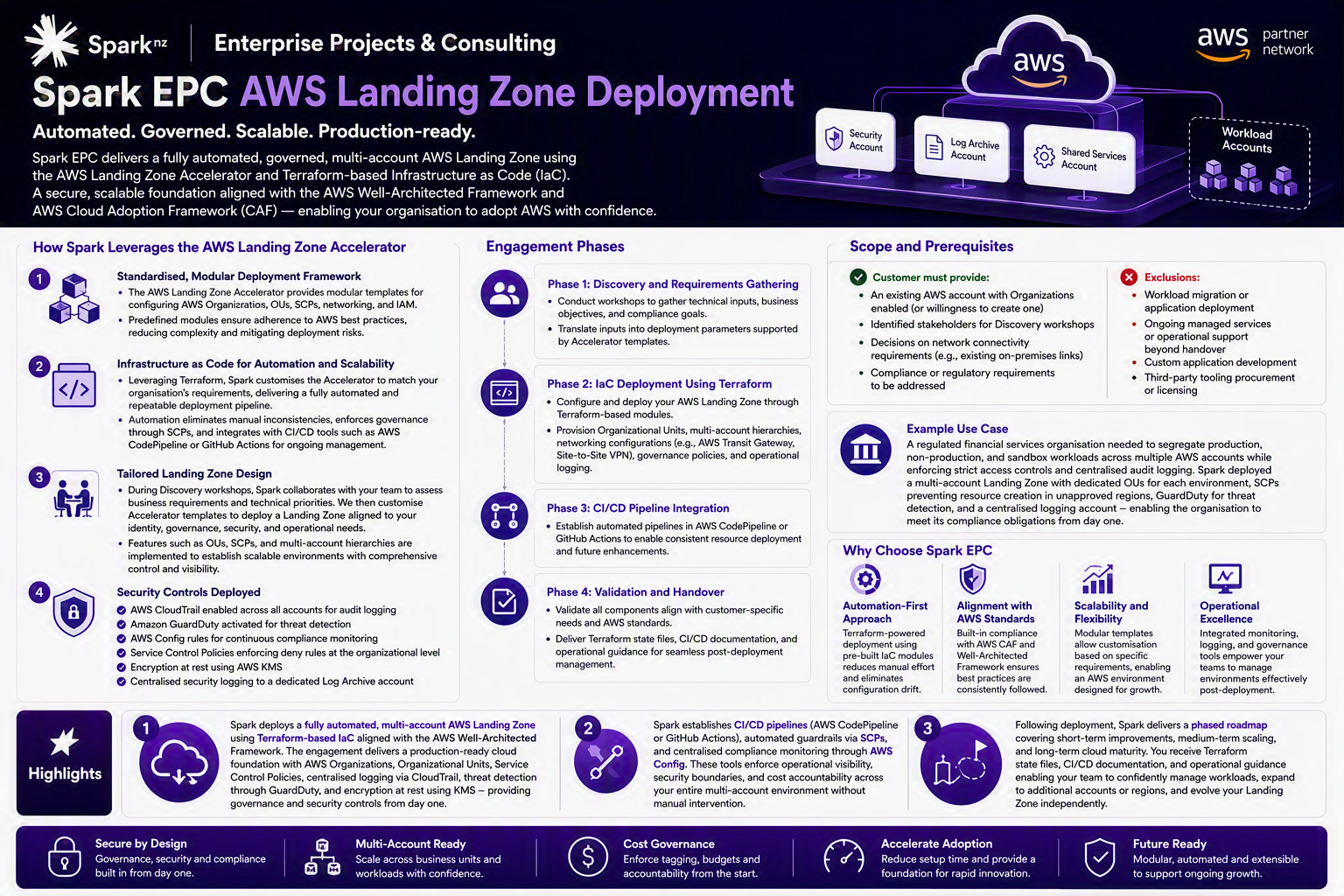
Spark EPC AWS Landing Zone Deployment
Spark EPC delivers a fully automated, governed, multi-account AWS Landing Zone using the AWS Landing Zone Accelerator and Terraform-based Infrastructure as Code (IaC). This engagement establishes a secure, scalable cloud foundation aligned with the AWS Well-Architected Framework and AWS Cloud Adoption Framework (CAF), enabling your organisation to adopt AWS with confidence.
This service is designed for enterprise organisations requiring robust governance, multi-account identity management, structured networking, and repeatable deployment capabilities for scaling workloads across AWS.
How Spark Leverages the AWS Landing Zone Accelerator
1. Standardised, Modular Deployment Framework
- The AWS Landing Zone Accelerator provides modular templates for configuring critical AWS components including AWS Organizations, Organizational Units (OUs), Service Control Policies (SCPs), networking, and IAM.
- Predefined modules ensure adherence to AWS best practices, reducing complexity and mitigating deployment risks.
2. Infrastructure as Code for Automation and Scalability
- Leveraging Terraform, Spark customises the Accelerator to match your organisation's requirements, delivering a fully automated and repeatable deployment pipeline.
- Automation eliminates manual inconsistencies, enforces governance through SCPs, and integrates with CI/CD tools such as AWS CodePipeline or GitHub Actions for ongoing management.
3. Tailored Landing Zone Design
- During Discovery workshops, Spark collaborates with your team to assess business requirements and technical priorities. We then customise Accelerator templates to deploy a Landing Zone aligned to your identity, governance, security, and operational needs.
- Features such as Organizational Units, SCPs, and multi-account hierarchies are implemented to establish scalable environments with comprehensive control and visibility.
4. Security Controls Deployed
- AWS CloudTrail enabled across all accounts for audit logging
- Amazon GuardDuty activated for threat detection
- AWS Config rules for continuous compliance monitoring
- Service Control Policies enforcing deny rules at the organizational level
- Encryption at rest using AWS KMS
- Centralised security logging to a dedicated Log Archive account
Engagement Phases
Phase 1: Discovery and Requirements Gathering
- Conduct workshops to gather technical inputs, business objectives, and compliance goals.
- Translate inputs into deployment parameters supported by Accelerator templates.
Phase 2: IaC Deployment Using Terraform
- Configure and deploy your AWS Landing Zone through Terraform-based modules.
- Provision Organizational Units, multi-account hierarchies, networking configurations (e.g., AWS Transit Gateway, Site-to-Site VPN), governance policies, and operational logging.
Phase 3: CI/CD Pipeline Integration
- Establish automated pipelines in AWS CodePipeline or GitHub Actions to enable consistent resource deployment and future enhancements.
Phase 4: Validation and Handover
- Validate all components align with customer-specific needs and AWS standards.
- Deliver Terraform state files, CI/CD documentation, and operational guidance for seamless post-deployment management.
Scope and Prerequisites
Customer must provide:
- An existing AWS account with Organizations enabled (or willingness to create one)
- Identified stakeholders for Discovery workshops
- Decisions on network connectivity requirements (e.g., existing on-premises links)
- Compliance or regulatory requirements to be addressed
Exclusions:
- Workload migration or application deployment
- Ongoing managed services or operational support beyond handover
- Custom application development
- Third-party tooling procurement or licensing
Example Use Case
A regulated financial services organisation needed to segregate production, non-production, and sandbox workloads across multiple AWS accounts while enforcing strict access controls and centralised audit logging. Spark deployed a multi-account Landing Zone with dedicated OUs for each environment, SCPs preventing resource creation in unapproved regions, GuardDuty for threat detection, and a centralised logging account - enabling the organisation to meet its compliance obligations from day one.
Why Choose Spark EPC
- Automation-First Approach: Terraform-powered deployment using pre-built IaC modules reduces manual effort and eliminates configuration drift.
- Alignment with AWS Standards: Built-in compliance with AWS CAF and Well-Architected Framework ensures best practices are consistently followed.
- Scalability and Flexibility: Modular templates allow customisation based on specific requirements, enabling an AWS environment designed for growth.
- Operational Excellence: Integrated monitoring, logging, and governance tools empower your teams to manage environments effectively post-deployment.
Highlights
- Spark deploys a fully automated, multi-account AWS Landing Zone using Terraform-based IaC aligned with the AWS Well-Architected Framework. The engagement delivers a production-ready cloud foundation with AWS Organizations, Organizational Units, Service Control Policies, centralised logging via CloudTrail, threat detection through GuardDuty, and encryption at rest using KMS - providing governance and security controls from day one.
- Spark establishes CI/CD pipelines (AWS CodePipeline or GitHub Actions), automated guardrails via SCPs, and centralised compliance monitoring through AWS Config. These tools enforce operational visibility, security boundaries, and cost accountability across your entire multi-account environment without manual intervention.
- Following deployment, Spark delivers a phased roadmap covering short-term improvements, medium-term scaling, and long-term cloud maturity. You receive Terraform state files, CI/CD documentation, and operational guidance enabling your team to confidently manage workloads, expand to additional accounts or regions, and evolve your Landing Zone independently.
Details
Sold by
Delivery method
Deployed on AWS
New
Introducing multi-product solutions
You can now purchase comprehensive solutions tailored to use cases and industries.

Pricing
Custom pricing options
Pricing is based on your specific requirements and eligibility. To get a custom quote for your needs, request a private offer.

Legal
Content disclaimer
Vendors are responsible for their product descriptions and other product content. AWS does not warrant that vendors' product descriptions or other product content are accurate, complete, reliable, current, or error-free.
Support
Vendor support
Professional Services Engagement Support
Engagement Overview
The AWS Landing Zone Deployment is a phased professional services engagement covering Discovery, IaC Deployment using Terraform, CI/CD Pipeline Integration, and Validation and Handover. Spark EPC delivers an automated, governed, multi-account AWS Landing Zone aligned with the AWS Well-Architected Framework.
Deliverables
Upon completion, you receive:
- Fully deployed multi-account Landing Zone with governance controls
- Terraform state files and IaC codebase
- CI/CD pipeline configuration and documentation
- Operational guidance and phased maturity roadmap
Support Contacts
For engagement inquiries, scoping discussions, or post-handover questions:
- Brett Snyman, Chapter Lead - Public Cloud Enterprise Projects and Consulting: Brett.Snyman@spark.co.nz
- Chris Nicholson, Domain Chapter Lead - Enterprise Projects and Consulting: Chris.Nicholson@spark.co.nz
Getting Started
To initiate the engagement, contact the team above to schedule an initial scoping conversation. Spark will assess your requirements and confirm engagement parameters before commencing the Discovery phase.
For any issues including service inquiries, troubleshooting, or refund requests, please contact the named representatives above.