
Sold by: cloudimg
Deployed on AWS
Free Trial
AWS Free Tier
This product has charges associated with it for seller support. Pre-hardened OliveTin appliance that turns approved shell commands into secure one-click web buttons. Deploy an authenticated automation dashboard on EC2 in minutes with 24/7 cloudimg support.
Overview
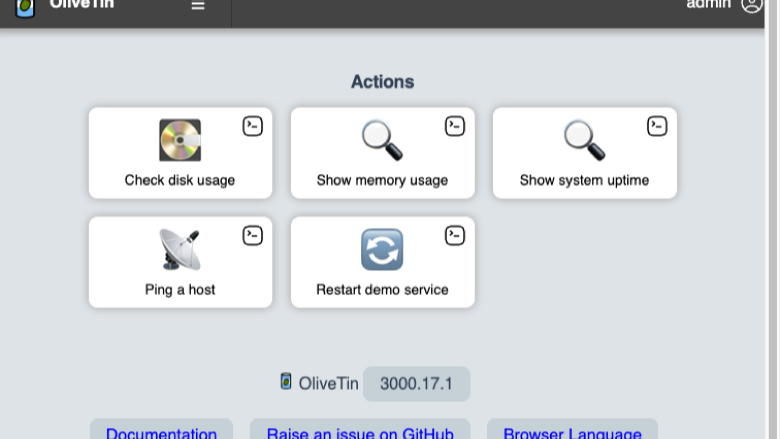
Image
One-click actions dashboard
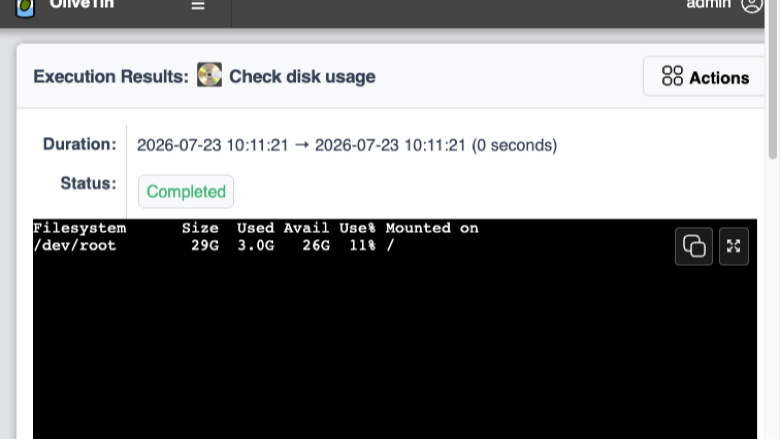
Image
Live command output
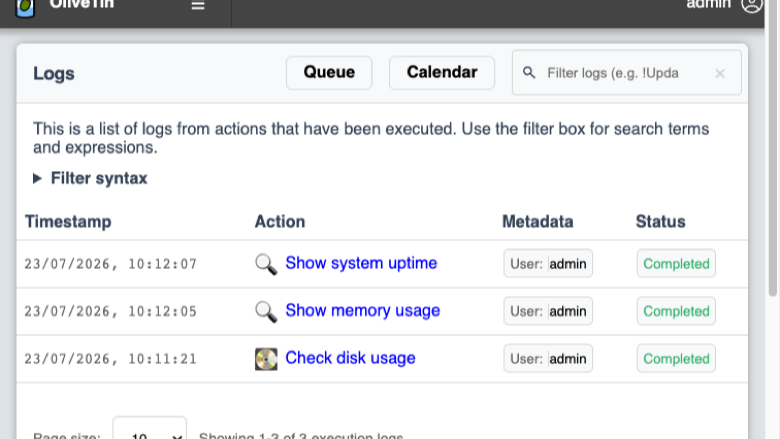
Image
Execution log and audit view
This is a repackaged open source software product wherein additional charges apply for cloudimg support services.
Overview
OliveTin is a self-hosted web interface that turns a curated set of predefined shell commands into safe, one-click buttons. Instead of handing people SSH access to run ad hoc commands, an administrator defines a vetted set of actions in a single YAML file, and users click to run them and watch the live output stream back to the page. It is a natural fit for operations teams, home labs, and on-call engineers who want to let less technical users safely trigger routine jobs - restarting a service, checking disk space, pinging a host, or running a playbook - from a browser or a phone. This AMI delivers a fully installed, security-hardened OliveTin appliance so a working automation dashboard is operational within minutes of launch.
Why This Image vs a Manual Install
Because every button is a real shell command running on the server, an OliveTin instance reachable without authentication is, in effect, remote command execution. This image is built around that fact and ships secure by default, eliminating the manual reverse-proxy, TLS, service-hardening, and credential setup a bare install requires. OliveTin is bound to the loopback interface and never exposed directly; an nginx reverse proxy terminates TLS and enforces HTTP Basic authentication whose password is generated uniquely on each instance's first boot. Launch the instance, read your unique credential, and start clicking.
Application Stack
OliveTin 3000.17.1, the official release, is installed from the vendor package and runs as a dedicated unprivileged system user under a systemd unit, bound to the loopback interface only. An nginx reverse proxy on port 443 terminates TLS with a self-signed certificate regenerated per instance at first boot, redirects port 80 to HTTPS, serves an unauthenticated health endpoint for load balancers, and forwards the authenticated identity to OliveTin as spoof-proof headers. systemd starts the command runner and the web server on boot and restarts them on failure.
Security Hardening
This image follows a defence-in-depth approach:
- Network isolation: the command runner binds exclusively to the loopback interface; only the authenticating nginx reverse proxy is exposed
- Authentication enforced: every request to the web UI and API is authenticated - nothing is served anonymously except a health endpoint for load-balancer probes
- No default or shared credentials: a cryptographically random administrator password is generated on each instance's first boot, hashed with bcrypt, and written only to a root-only file
- Least privilege: OliveTin runs as an unprivileged system user; the one privileged demo action is granted through a narrow, single-command sudoers rule rather than blanket root
- Safe defaults and TLS: only non-destructive, read-mostly sample actions ship, with no free-form command-injection surface, and a per-instance self-signed certificate is regenerated on first boot
Buyers requiring formal compliance documentation should contact cloudimg to discuss specific requirements.
Concrete Use Cases
- Safe self-service for non-technical users: Expose a small set of vetted buttons - restart an application, clear a cache, trigger a backup - so support staff can run approved tasks from a browser without SSH access or the risk of a mistyped command
- Home lab and edge automation: Put one-click controls for media servers, network tools, and routine maintenance jobs on a phone-friendly dashboard, each action defined and constrained in advance
- Runbook and incident actions: Curate approved diagnostic and remediation actions so first responders can execute a documented runbook step consistently, with every run and its live output captured in the log view
AWS Integration
Deploy on any EC2 instance type; the appliance is CPU-only and lightweight. Use the unauthenticated health endpoint with an Application Load Balancer for availability monitoring, place the instance in a VPC subnet with security-group control over what its actions can reach, and forward logs to CloudWatch for centralized auditing.
Getting Started
- Launch the AMI on your chosen EC2 instance type
- Read your unique credential from the root-only file
- Open the web interface over HTTPS and accept the per-instance self-signed certificate
- Sign in and click a shipped sample action to watch its output stream live
- Edit /etc/OliveTin/config.yaml to add your own carefully-constrained actions
For a guided walkthrough, architecture consultation, or help wiring OliveTin to your identity provider, contact cloudimg support at any time.
cloudimg Support
24/7 technical support by email and chat.
Highlights
- Operational in minutes with zero manual hardening: launch the AMI and reach a fully authenticated automation dashboard without configuring a reverse proxy, terminating TLS, or creating credentials yourself. Every build and hardening step is completed at image creation time, eliminating the multi-step manual setup a bare OliveTin install requires.
- Defence-in-depth security architecture: OliveTin is bound exclusively to the loopback interface and is never directly reachable. An nginx reverse proxy enforces TLS and HTTP Basic authentication with a cryptographically random password generated uniquely on each instance's first boot - no two deployments share a credential, and no request reaches the command runner without authentication.
- Safe one-click operations backed by 24/7 cloudimg support: turn approved shell commands into browser buttons that non-technical users can run and watch live. Only non-destructive sample actions ship by default, and the runner executes as an unprivileged user. Add your own constrained actions in a single YAML file, with 24/7 email and chat support for authoring, integration, and identity-provider wiring.
Details
Sold by
Delivery method
Delivery option
64-bit (x86) Amazon Machine Image (AMI)
Latest version
Operating system
Ubuntu 24.04
Deployed on AWS
New
Introducing multi-product solutions
You can now purchase comprehensive solutions tailored to use cases and industries.

Features and programs
Financing for AWS Marketplace purchases
AWS Marketplace now accepts line of credit payments through the PNC Vendor Finance program. This program is available to select AWS customers in the US, excluding NV, NC, ND, TN, & VT.

Pricing
Free trial
Try this product free for 7 days according to the free trial terms set by the vendor. Usage-based pricing is in effect for usage beyond the free trial terms. Your free trial gets automatically converted to a paid subscription when the trial ends, but may be canceled any time before that.
Pricing is based on actual usage, with charges varying according to how much you consume. Subscriptions have no end date and may be canceled any time. Alternatively, you can pay upfront for a contract, which typically covers your anticipated usage for the contract duration. Any usage beyond contract will incur additional usage-based costs.
Additional AWS infrastructure costs may apply. Use the AWS Pricing Calculator to estimate your infrastructure costs.
If you are an AWS Free Tier customer with a free plan, you are eligible to subscribe to this offer. You can use free credits to cover the cost of eligible AWS infrastructure. See AWS Free Tier for more details. If you created an AWS account before July 15th, 2025, and qualify for the Legacy AWS Free Tier, Amazon EC2 charges for Micro instances are free for up to 750 hours per month. See Legacy AWS Free Tier for more details.
Dimension | Description | Cost/hour |
|---|---|---|
m5.large Recommended | m5.large | $0.08 |
t2.micro | t2.micro instance type | $0.04 |
t3.micro | t3.micro instance type | $0.04 |
c5a.12xlarge | c5a.12xlarge instance type | $0.24 |
c5a.16xlarge | c5a.16xlarge instance type | $0.24 |
c5a.24xlarge | c5a.24xlarge instance type | $0.24 |
c5a.2xlarge | c5a.2xlarge instance type | $0.24 |
c5a.4xlarge | c5a.4xlarge instance type | $0.24 |
c5a.8xlarge | c5a.8xlarge instance type | $0.24 |
c5a.large | c5a.large instance type | $0.08 |
Vendor refund policy
Refunds available on request.

Legal
Vendor terms and conditions
Upon subscribing to this product, you must acknowledge and agree to the terms and conditions outlined in the vendor's End User License Agreement (EULA) .
Content disclaimer
Vendors are responsible for their product descriptions and other product content. AWS does not warrant that vendors' product descriptions or other product content are accurate, complete, reliable, current, or error-free.
Delivery details
64-bit (x86) Amazon Machine Image (AMI)
Amazon Machine Image (AMI)
An AMI is a virtual image that provides the information required to launch an instance. Amazon EC2 (Elastic Compute Cloud) instances are virtual servers on which you can run your applications and workloads, offering varying combinations of CPU, memory, storage, and networking resources. You can launch as many instances from as many different AMIs as you need.
Version release notes
Initial release of OliveTin as a ready-to-use self-hosted automation appliance, running behind an nginx reverse proxy that terminates TLS with a per-instance self-signed certificate and enforces HTTP Basic authentication with a unique administrator password generated on each instance's first boot. OliveTin is bound to the loopback interface, runs as an unprivileged user, and ships only safe, non-destructive sample actions.
Additional details
Usage instructions
Connect via SSH on port 22 as the default login user for your operating system variant (for the Ubuntu 24.04 variant the user is ubuntu). Read the per-instance web credential with: sudo cat /root/olivetin-credentials.txt. Open the web interface in a browser at https://<instance-public-ip>/ (accept the per-instance self-signed certificate) and sign in with the admin username and password from that file. An unauthenticated health endpoint is available at https://<instance-public-ip>/healthz and port 80 redirects to HTTPS. Click a shipped sample action (check disk usage, show memory, show uptime, ping a host) and watch its live output. Add your own actions by editing /etc/OliveTin/config.yaml - every action is a real shell command run as the unprivileged olivetin user, so constrain arguments carefully; restart the runner with: sudo systemctl restart olivetin. The instance security group opens ports 22, 80 and 443. The services run under systemd: systemctl status olivetin nginx.
Resources
Vendor resources
Support
Vendor support
cloudimg Support
cloudimg provides 24/7 technical support for this product by email and live chat.
Contact: support@cloudimg.co.uk
What we help with:
- Deployment and initial configuration on any EC2 instance type
- Reverse-proxy termination with your own domain and TLS certificate
- Authoring and safely constraining your own shell-command actions
- Wiring OliveTin's header authentication to your own identity provider (OIDC, SAML, etc.)
- Integrating actions with your operational tooling and runbooks
- Updates and security patching guidance
- Troubleshooting connectivity, authentication, and action execution issues
How to get help: Email support@cloudimg.co.uk or reach us via live chat. Include your EC2 instance ID and a description of the issue for fastest resolution.
Refunds: For refund requests, contact support@cloudimg.co.uk with your AWS account ID and subscription details.
AWS infrastructure support
AWS Support is a one-on-one, fast-response support channel that is staffed 24x7x365 with experienced and technical support engineers. The service helps customers of all sizes and technical abilities to successfully utilize the products and features provided by Amazon Web Services.
Customer reviews
No customer reviews yet
Be the first to review this product . We've partnered with PeerSpot to gather customer feedback. You can share your experience by writing or recording a review, or scheduling a call with a PeerSpot analyst.