
Sold by: UST
ML-driven alert suppression that learns from operator behavior to silence non-actionable noise before it reaches engineers. Built for operations teams managing high alert volumes on AWS.
Overview
The Problem with Static Suppression
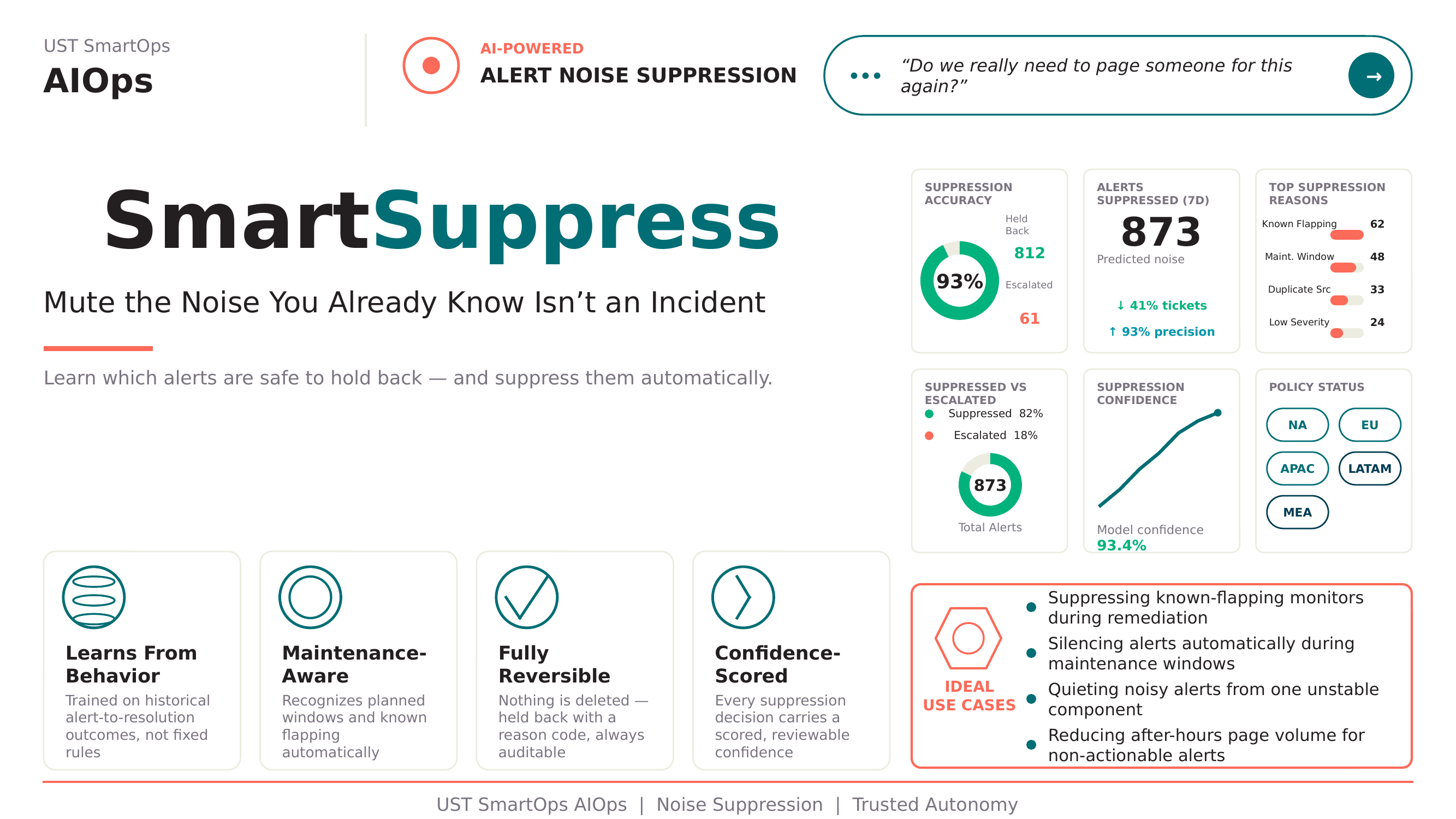
Traditional suppression relies on static rules - mute this alert type between these hours - that quickly go stale as environments change. SmartOps Suppression instead trains a model on historical alert-to-resolution outcomes, including which alerts operators habitually acknowledge-and-ignore, close without action, or associate with planned maintenance, and uses that model to hold back low-value events in real time.
Every suppressed event is retained (not deleted), tagged with the suppression reason and confidence score, and available for audit or replay. As operators provide feedback, the model recalibrates automatically, so suppression accuracy improves over time instead of drifting.
Engagement Overview
SmartOps Suppression is delivered as a structured professional services engagement with defined phases:
- Discovery and Assessment (Weeks 1-2): Review existing alert sources, ticketing workflows, and change management processes. Deliverable: Assessment report with suppression opportunity analysis.
- Model Training and Integration (Weeks 3-5): Ingest historical alert-to-resolution data, configure integrations, and train the suppression model. Deliverable: Configured suppression model connected to your monitoring stack.
- Tuning and Validation (Weeks 6-8): Run the model in shadow mode, validate suppression decisions against operator judgment, and refine confidence thresholds. Deliverable: Tuned model with documented accuracy metrics and feedback loop operational.
- Go-Live and Handover: Activate real-time suppression, deliver audit dashboard, and train your team on ongoing model management. Deliverable: Fully operational suppression system with runbook documentation.
Key Features
- ML-based pattern recognition trained on historical alert outcomes
- Maintenance-window and change-calendar awareness via AWS Systems Manager integration
- Confidence scoring on every suppression decision
- Full retention and audit trail of suppressed events (nothing is discarded)
- Continuous feedback loop from operator actions
- Per-source, per-team, and per-severity suppression policies
AWS Integration
SmartOps Suppression is built to work natively within your AWS environment:
- AWS CloudWatch: Serves as a primary alert source and monitoring integration point, ingesting CloudWatch Alarms and metric anomalies directly into the suppression model.
- AWS Systems Manager: Syncs with Systems Manager maintenance windows and change calendars to automatically suppress alerts during approved change activities.
- AWS IAM: Provides role-based access controls governing who can view suppressed events, modify suppression policies, and access model decisions and audit logs.
- Customer AWS Environment: All suppressed event data is retained within the buyer's AWS environment, ensuring data residency and control.
Integrations
SmartOps Suppression connects to the tools your operations teams already use, including PagerDuty for escalation policy alignment, ServiceNow for ITSM ticket correlation, and AWS CloudWatch for native alert ingestion. Change-calendar awareness integrates with AWS Systems Manager to automatically recognize approved maintenance windows.
Key Benefits
- Cuts alert volume reaching the service desk without losing visibility
- Reduces alert fatigue and improves signal-to-noise ratio
- Frees engineers to focus on incidents that actually require action
- Lowers mean time to acknowledge (MTTA) by shrinking the triage queue
- Fully auditable - nothing is silently dropped
Use Cases
- Flapping monitors during active remediation: When an SRE team is actively remediating an unstable microservice generating hundreds of repeat CloudWatch alarms, SmartOps Suppression recognizes the pattern and holds back duplicates while preserving novel alerts from the same component.
- Approved maintenance windows: For organizations running weekly patching cycles via AWS Systems Manager, the model automatically silences expected alerts during the change window without manual mute rules.
- Noisy component isolation: When a single unstable component generates cascading alerts across PagerDuty escalation policies, SmartOps Suppression groups and suppresses the noise so only the root signal reaches the on-call engineer.
- After-hours page reduction: For operations teams managing large-scale environments, the model identifies non-actionable alerts that historically result in no remediation action and holds them from after-hours paging.
Highlights
- Learns from operator behavior, not just hardcoded rules. The ML model trains on historical alert-to-resolution outcomes - including which alerts operators habitually acknowledge-and-ignore, close without action, or associate with planned maintenance - and continuously recalibrates based on ongoing feedback. Integrates with PagerDuty, ServiceNow, AWS CloudWatch, Datadog, and Splunk On-Call to ingest alert data from your existing monitoring stack.
- Time-aware suppression with change-calendar integration. Automatically silences alerts during approved maintenance windows by syncing with ServiceNow Change Management or AWS Systems Manager. Confidence scoring on every suppression decision provides transparency, and per-source, per-team, and per-severity policies give operations leaders granular control over what gets suppressed and when.
- Fully auditable and reversible - nothing is deleted, only held back with a reason code and confidence score. Every suppressed event is retained for compliance review or replay. The structured engagement includes discovery, model training, pilot deployment, and production handoff with documented deliverables at each phase, typically completed within 8-10 weeks.
Details
New
Introducing multi-product solutions
You can now purchase comprehensive solutions tailored to use cases and industries.

Pricing
Custom pricing options
Pricing is based on your specific requirements and eligibility. To get a custom quote for your needs, request a private offer.

Legal
Content disclaimer
Vendors are responsible for their product descriptions and other product content. AWS does not warrant that vendors' product descriptions or other product content are accurate, complete, reliable, current, or error-free.
Support
Vendor support
Engagement Support
UST provides structured support throughout the SmartOps Suppression engagement and beyond.
Support Channels
- AWS Marketplace Messaging: Available for initial inquiries, scoping questions, and engagement requests.
- Dedicated Communication Channel: Established during onboarding for ongoing project collaboration and issue resolution.
- Email Support: For pre-sales and post-engagement inquiries, contact the UST Sales team - salesteam_tes@ust.com
- General enquiries: For general inquiries or to learn more about UST's services, visit https://www.ust.com .
During Engagement:
- Dedicated Communication Channel: Established during the discovery phase for ongoing project collaboration, issue resolution, and milestone tracking.
- Named engagement lead assigned to your account for the duration of the project.
Post-Engagement:
- Email support for production issues, model tuning requests, and general inquiries.
- Visit https://www.ust.com to learn more about UST's broader service portfolio.
Buyer Responsibilities:
- Provide read access to alerting systems and historical alert resolution data.
- Designate a primary point of contact from your operations team for feedback loop calibration.
- Ensure minimum 30 days of historical alert data is available for model training.
Refunds and Issue Resolution: For questions about billing, service scope adjustments, or refund requests, contact UST through AWS Marketplace Messaging or email salesteam_tes@ust.com .