
Sold by: Sphere
Sphere deploys its Cost Intelligence AI Accelerator on AWS, combining spend classification and anomaly detection with ERP and financial-system integration using Amazon SageMaker AI and Amazon Bedrock.
Overview
Image
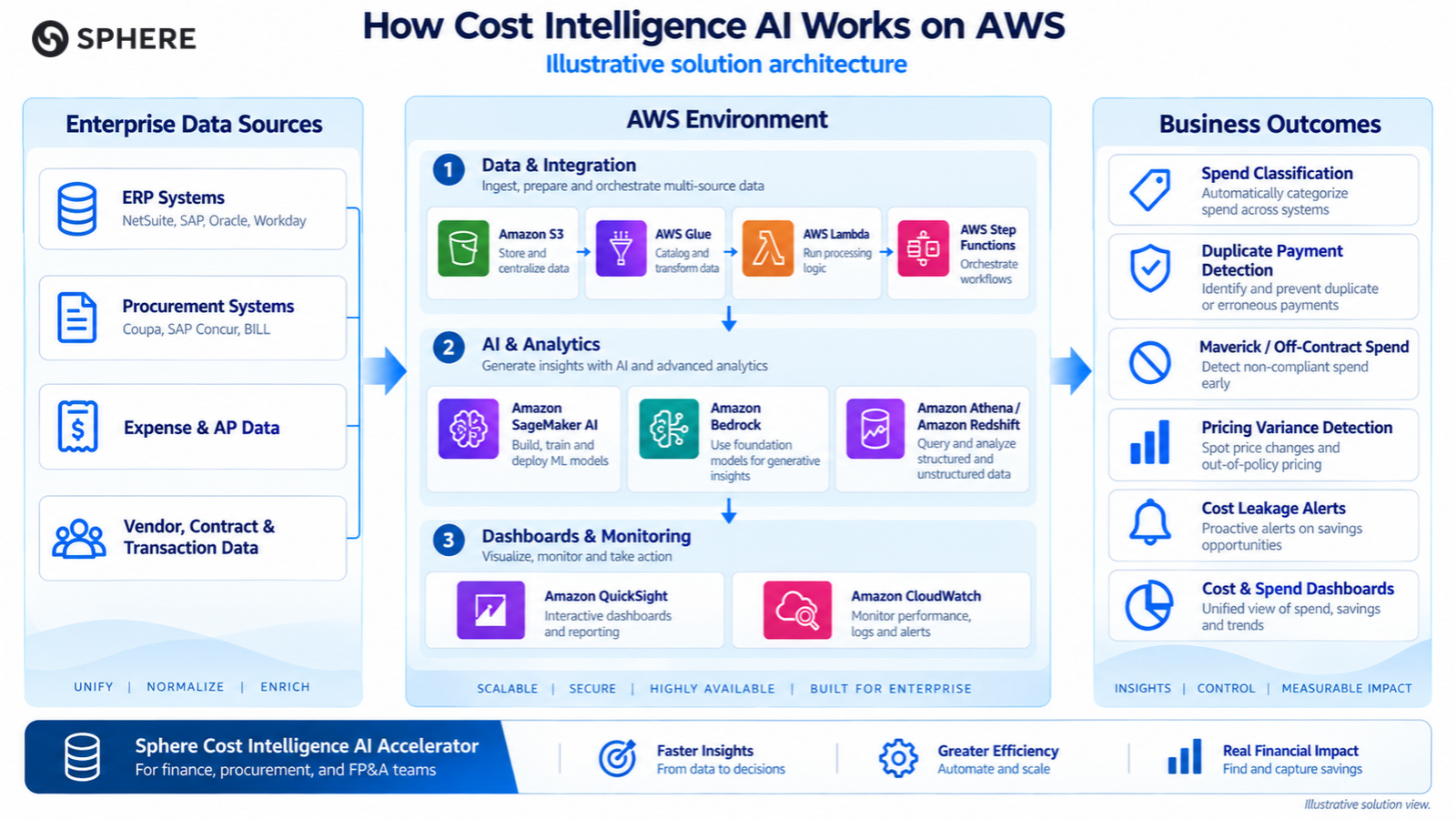
Cost Intelligence AI on AWS Architecture
Image
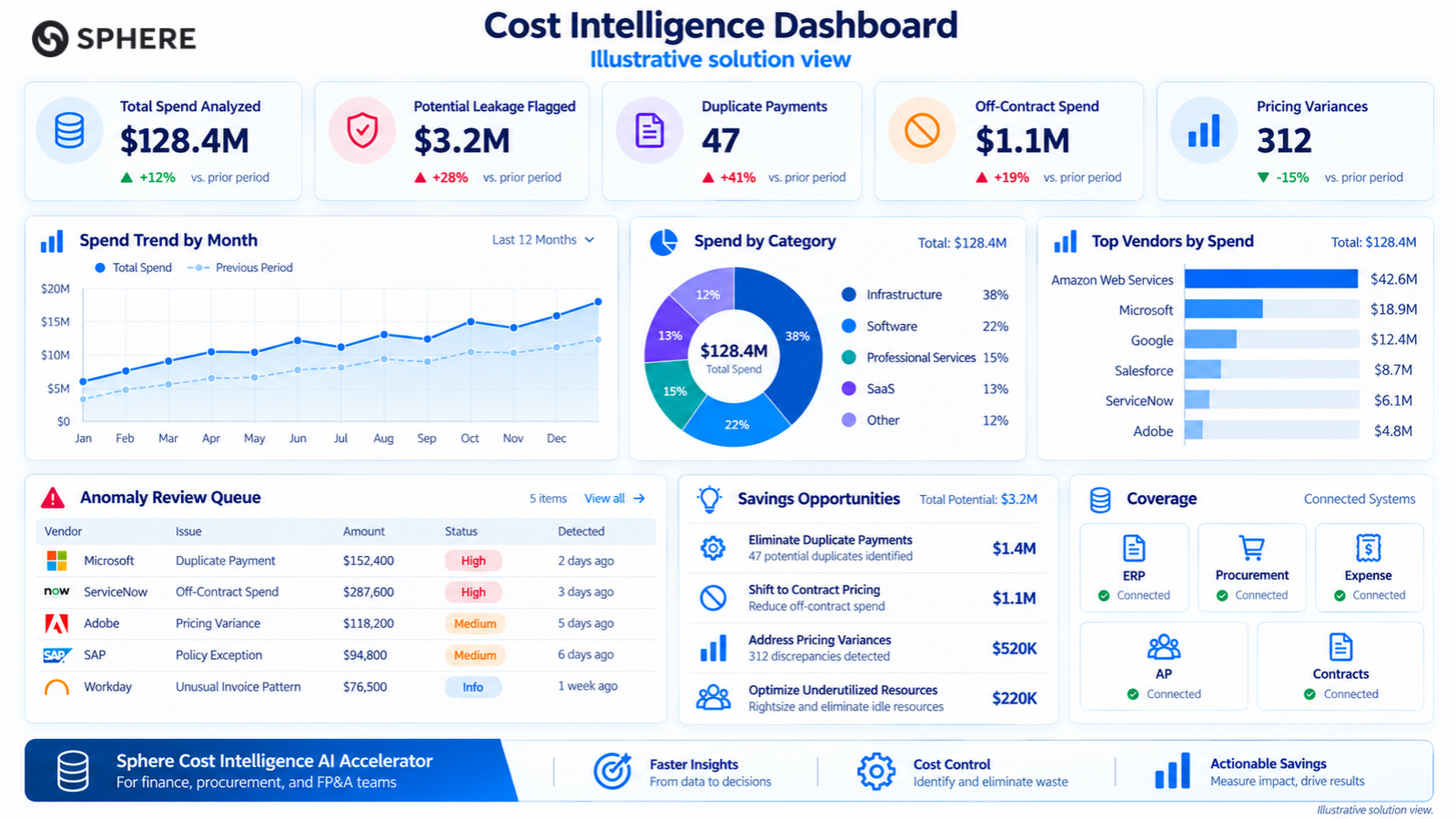
Cost Intelligence Dashboard
Cost Intelligence AI Implementation Services on AWS
Sphere provides professional services to design, integrate, and deploy AI-powered cost and spend intelligence solutions within the customer's AWS environment. Finance, procurement, and FP&A teams gain a unified view of enterprise spend with workflows for transaction classification, anomaly detection, cost leakage analysis, and financial reporting.
Why Cost Intelligence AI Financial data is often fragmented across ERP, procurement, expense, AP, vendor, and contract systems. Sphere's Cost Intelligence AI Accelerator provides a repeatable implementation framework that brings these sources together on AWS and configures models around the customer's chart of accounts, category taxonomy, spend patterns, and reporting structure.
Why Sphere Sphere is an AWS Partner with certified expertise across cloud, data, AI, and security, including Data & Analytics and Generative AI competencies. Sphere brings 21+ years of technology delivery experience, 600+ completed projects, and 300+ clients across enterprise environments.
Business Outcomes Implemented capabilities can include transaction and spend classification, duplicate-payment identification, maverick and off-contract spend analysis, pricing and contract variance detection, policy-exception identification, vendor and category analysis, multi-entity spend visibility, historical trend analysis, savings-opportunity tracking, and financial reporting workflows.
AI-generated findings support finance and procurement teams while financial, sourcing, and remediation decisions remain under human control.
AWS Services Implemented Sphere uses services such as Amazon SageMaker AI for classification and anomaly detection, Amazon Bedrock for AI-assisted analysis, Amazon S3 for financial data storage, AWS Glue for ingestion and transformation, AWS Lambda and AWS Step Functions for workflow automation, Amazon Athena or Amazon Redshift for analytics, Amazon QuickSight for dashboards, and Amazon CloudWatch for monitoring.
ERP and Finance System Integration Sphere integrates Cost Intelligence workflows with systems including NetSuite, SAP, Oracle, Workday, Coupa, SAP Concur, BILL, and other ERP, procurement, expense, and financial applications. Standard integrations are typically live within 4 to 6 weeks, depending on API availability, data quality, and customer requirements.
Five-Phase Implementation Approach
- Discovery and Assessment - A typical 2-week discovery phase covers ERP and spend-system inventory, API availability, chart-of-accounts mapping, historical transaction sampling, and analytical requirements. A typical deliverable is a Cost Intelligence Integration Blueprint.
- Data Integration and Model Configuration - Connect ERP, expense, and procurement systems and ingest available historical transactions. Engagements can use 12 to 24 months of history when available, with classification models configured around the customer's accounts and category taxonomy.
- Anomaly Tuning and Dashboard Configuration - Calibrate anomaly thresholds to customer spend patterns, configure dashboards to the organization's reporting structure, and conduct iterative finance-team review. Sphere's standard approach can include three rounds of feedback before pilot launch.
- Pilot and Validate - Run a supervised 30-day pilot focused on a defined business unit or spend category. Detected anomalies and savings opportunities are reviewed with finance stakeholders and models are refined based on feedback.
- Deploy and Enable - Expand into production with monitoring, documentation, knowledge transfer, model refinement, and ongoing optimization as scoped.
Typical Deliverables Deliverables may include AWS solution architecture, financial data pipelines, classification workflows, anomaly-detection models, ERP and procurement integrations, spend dashboards, monitoring configuration, pilot findings, technical documentation, and knowledge transfer.
Security and Data Isolation Customer financial data remains within the customer's AWS environment. Security, access controls, encryption, credential management, and monitoring are configured according to the agreed architecture and customer requirements.
The exact AWS architecture, services, integrations, scope, deliverables, and commercial model are defined before the AWS Marketplace private offer is issued. AWS infrastructure and service usage charges are separate from Sphere's professional services fees unless specifically included in the private offer.
Request a Cost Intelligence Assessment The engagement begins with a discovery conversation covering the customer's AWS environment, financial systems, spend data, and priorities. Sphere then defines the recommended architecture, implementation scope, pilot, deliverables, and private-offer structure.
Highlights
- Deploy Sphere's Cost Intelligence AI Accelerator on AWS to classify transactions, identify duplicate payments, analyze maverick and off-contract spend, detect pricing variances, and surface financial anomalies. Models are configured around the customer's chart of accounts, category taxonomy, and spend patterns.
- Connect NetSuite, SAP, Oracle, Workday, Coupa, SAP Concur, BILL, and other financial systems into a unified AWS data foundation. Standard integrations are typically live within 4 to 6 weeks, enabling centralized spend analysis, classification, anomaly detection, and reporting across previously siloed systems.
- Use a structured delivery model with a 2-week discovery phase, iterative finance-team testing, and a supervised 30-day pilot before broader rollout. Deliverables can include an Integration Blueprint, data pipelines, classification models, dashboards, pilot findings, documentation, and knowledge transfer.
Details
Sold by
Categories
Delivery method
Deployed on AWS
New
Introducing multi-product solutions
You can now purchase comprehensive solutions tailored to use cases and industries.

Pricing
Custom pricing options
Pricing is based on your specific requirements and eligibility. To get a custom quote for your needs, request a private offer.

Legal
Content disclaimer
Vendors are responsible for their product descriptions and other product content. AWS does not warrant that vendors' product descriptions or other product content are accurate, complete, reliable, current, or error-free.
Support
Vendor support
Sphere provides support throughout the Cost Intelligence AI implementation through its cloud engineering, data, and Client Success teams.
Engagement Support Support includes AWS architecture assistance, financial data integration, spend classification and anomaly-detection configuration, ERP and procurement integration, dashboard implementation, testing, deployment, troubleshooting, monitoring, optimization, documentation, and knowledge transfer within the agreed project scope.
The engagement typically includes a 2-week discovery phase, data integration and model configuration, iterative finance-team testing, a supervised 30-day pilot, and production deployment. Standard integrations are typically live within 4 to 6 weeks depending on system and data complexity.
Post-Launch Support Sphere provides a 30-day hypercare period following launch. Ongoing managed support, monitoring, model optimization, and cloud operations can be scoped separately.
Contact and Response Times Customers can contact Sphere at https://www.sphereinc.com/contact/ . Sphere responds to AWS Marketplace customer inquiries within two business days unless otherwise specified in the private offer. Troubleshooting, service issues, refunds, and commercial adjustments are handled according to the applicable private-offer terms. This stays below the 2,000-character support limit. The 30-day hypercare period and integration timing are published on Sphere's Cost Intelligence page.