Sold by: UST
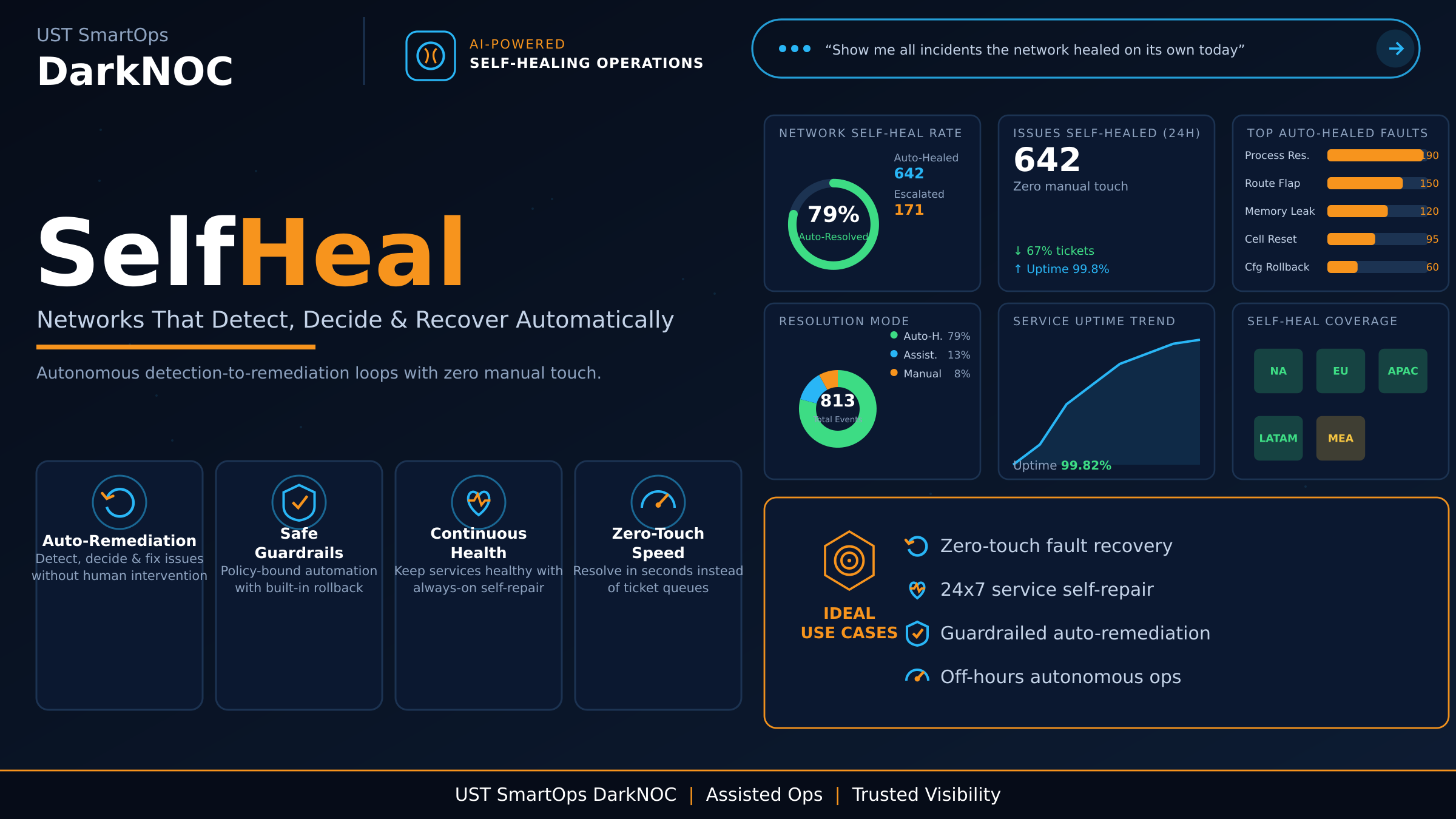
UST SmartOps Network SelfHeal delivers autonomous, closed-loop detection-to-remediation for network faults, resolving issues in seconds without manual intervention or ticket queues.
Overview
UST SmartOps Network SelfHeal
SelfHeal is a professional services engagement that delivers autonomous, closed-loop network remediation - transforming intelligent observation into autonomous orchestration. UST deploys and configures a self-repairing automation layer that continuously monitors network health and executes pre-approved remediation actions the moment a known-fault pattern is detected - restarting processes, rerouting traffic, resetting interfaces, or rolling back configurations as needed.
All actions run within defined policy guardrails with automatic rollback if a fix does not verify, shifting operations from a reactive, ticket-driven model to a proactive, self-repairing network that keeps services healthy around the clock.
Engagement Process
UST delivers SelfHeal through a structured professional services engagement:
Phase 1 - Discovery and Assessment: UST engineers assess your current network environment, monitoring stack, fault patterns, and operational workflows. Deliverables include a network readiness report and prioritized list of automatable fault scenarios.
Phase 2 - Integration and Configuration: UST integrates SelfHeal with your existing monitoring and ticketing platforms, configures policy guardrails, and builds the initial runbook library of pre-approved auto-remediation actions. This phase includes integration with AWS services such as Amazon CloudWatch and Amazon EventBridge for event ingestion and orchestration.
Phase 3 - Pilot and Validation: A controlled pilot runs against a subset of network elements to validate detection accuracy, remediation effectiveness, and rollback safety before broader rollout.
Phase 4 - Go-Live and Handoff: Full production deployment with operational dashboard handoff, documentation of all configured policies and runbooks, and knowledge transfer to your operations team.
Key Capabilities
- Autonomous detect-decide-remediate closed loop
- Policy-bound automation with automatic rollback verification
- 24x7 continuous health monitoring and self-repair
- Library of pre-approved auto-remediation actions
- Self-heal rate and service-uptime analytics dashboard
- Integration with AWS services (Amazon CloudWatch, Amazon EventBridge, AWS Systems Manager)
Proven Outcomes
- Cuts manual ticket volume by up to 67%
- Improves service uptime to 99.8%+ through continuous self-repair
- Resolves issues in seconds instead of ticket-queue wait times
- Resolves nearly 80% of eligible incidents without human intervention
- Reduces on-call burden for off-hours incidents
- Lowers operational cost through reduced manual intervention
Use Cases
- Telecom NOC Operations: Zero-touch recovery for recurring fault patterns such as interface flaps and routing protocol resets across thousands of network elements, enabling overnight autonomous coverage without NOC staff escalation.
- Enterprise Multi-Site WAN: Automated detection and remediation of SD-WAN edge device issues including link degradation and tunnel failures across distributed branch locations.
- 24x7 Service Self-Repair: Guardrailed auto-remediation for high-volume alarm types during off-hours windows when on-call engineering resources are limited.
Prerequisites and Supported Environments
SelfHeal requires an existing network monitoring platform capable of generating structured alerts. UST will work with your team during the Discovery phase to confirm compatibility with your specific network vendors and device types.
Get Started
Contact UST through AWS Marketplace messaging to schedule a discovery call and receive a tailored network assessment for your environment.
Highlights
- UST delivers SelfHeal through a structured professional services engagement that integrates with your existing monitoring stack and AWS services including Amazon CloudWatch and Amazon EventBridge. The closed-loop automation autonomously detects, decides, and remediates network faults in seconds - cutting manual ticket volume by up to 67% and resolving nearly 80% of eligible incidents without human intervention.
- All remediation actions operate within policy-bound guardrails with automatic rollback verification if a fix does not confirm. This ensures safe autonomous operations 24x7 - including off-hours and weekends - improving service uptime to 99.8%+ while reducing on-call burden for engineering teams managing large-scale network environments.
- The engagement includes discovery and assessment, integration and configuration, pilot validation, and production go-live with full handoff. Buyers receive a configured runbook library of pre-approved remediation actions, operational analytics dashboards, policy documentation, and knowledge transfer to enable ongoing autonomous network operations.
Details
New
Introducing multi-product solutions
You can now purchase comprehensive solutions tailored to use cases and industries.

Pricing
Custom pricing options
Pricing is based on your specific requirements and eligibility. To get a custom quote for your needs, request a private offer.

Legal
Content disclaimer
Vendors are responsible for their product descriptions and other product content. AWS does not warrant that vendors' product descriptions or other product content are accurate, complete, reliable, current, or error-free.
Support
Vendor support
Support Channels
UST provides support for SmartOps Network SelfHeal through the following channels:
- AWS Marketplace Messaging: Available directly through your AWS Marketplace console for engagement inquiries, issue reporting, and refund requests.
- Email: salesteam_tes@ust.com for pre-sales questions, scoping discussions, and scheduling discovery calls.
- Dedicated Communication Channel: Established during your engagement for ongoing operational support and escalation.
Engagement Support
During an active SelfHeal engagement, UST assigns a dedicated team including engineers and a project manager who serve as your primary points of contact. Support covers platform configuration issues, runbook adjustments, policy guardrail modifications, integration troubleshooting, and operational questions.
Getting Started
To initiate a SelfHeal engagement, contact UST via AWS Marketplace messaging or email to schedule a discovery call. UST will assess your network environment and provide a tailored proposal outlining scope, timeline, and deliverables.
For issues related to billing, subscription management, or refund requests, contact UST through AWS Marketplace messaging for prompt assistance.