Sold by: Weaviate
The easiest way to build and scale AI applications
4.6
Overview
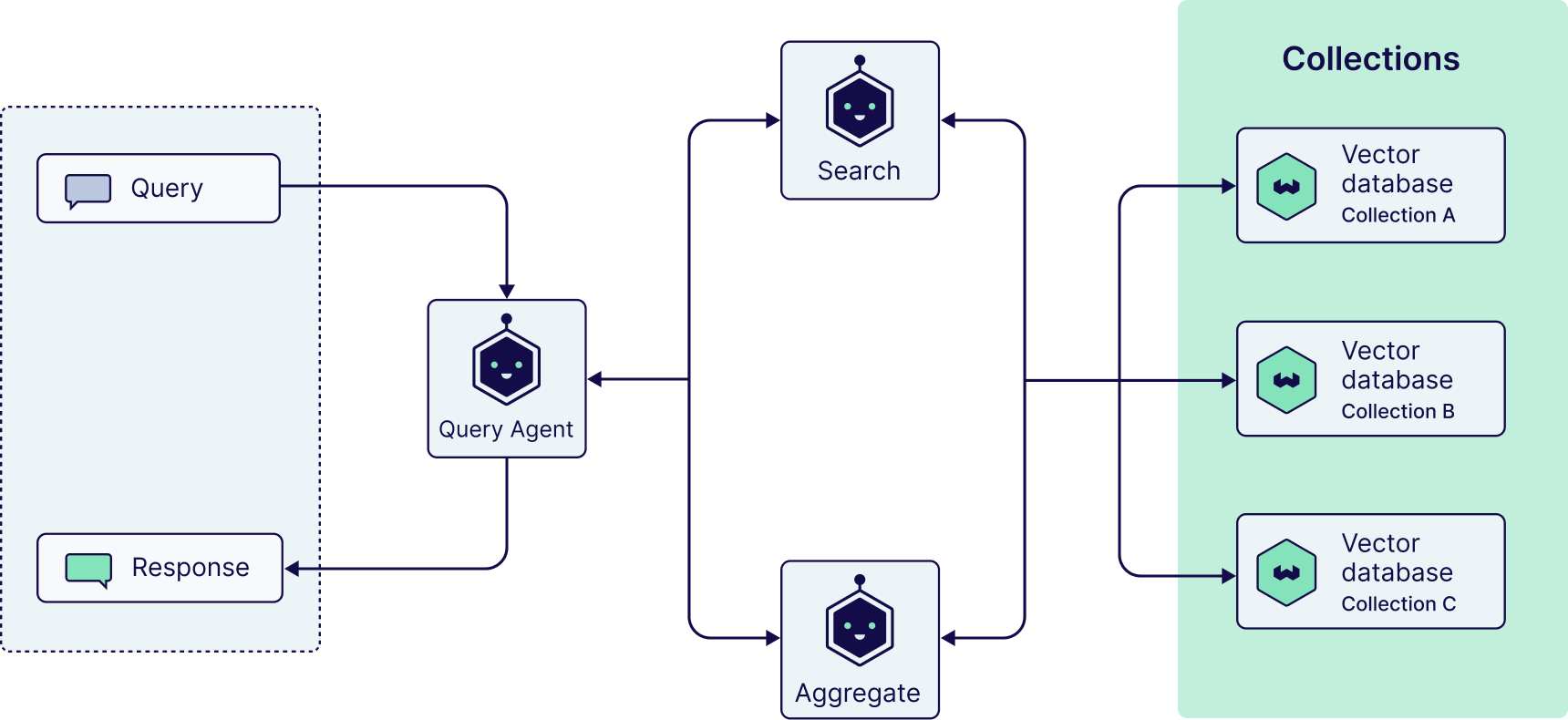
A SaaS solution built on the popular open-source low-latency vector database. Benefit from out-of-the-box support for multimodal media types (text, images, etc.) and seamlessly combine vector search with structured filtering. Leverage the fault tolerance of a cloud-native database accessible through a variety of client-side programming languages, enhancing your data capabilities effortlessly.
Please note that if you cancel your SaaS Marketplace Subscription, Weaviate will delete your clusters and your Weaviate organization.
Highlights
- End to end vector database for vector similarity search, hybrid search, and advanced filtered search.
- Optional integrations with AWS SageMaker, AWS Bedrock, OpenAI, Cohere, Anthropic, HuggingFace, and many others.
- Suited for vector search, retrieval augmented generation (RAG), and generative search.
Details
New
Introducing multi-product solutions
You can now purchase comprehensive solutions tailored to use cases and industries.

Features and programs
Financing for AWS Marketplace purchases
AWS Marketplace now accepts line of credit payments through the PNC Vendor Finance program. This program is available to select AWS customers in the US, excluding NV, NC, ND, TN, & VT.

Pricing
Pricing is based on actual usage, with charges varying according to how much you consume. Subscriptions have no end date and may be canceled any time.
Additional AWS infrastructure costs may apply. Use the AWS Pricing Calculator to estimate your infrastructure costs.
Dimension | Description | Cost/unit |
|---|---|---|
Weaviate Cloud Shared | Weaviate Cloud Shared | $0.01 |
Weaviate Cloud Shared (HA, Standard SLA) per 1M Dimensions Stored-min $75 pm | Weaviate Cloud Shared (HA, Standard SLA) per 1M Dimensions Stored (min $75 pm) | $0.285 |
Weaviate Cloud Shared (non-HA, Standard SLA) per 1M Dimensions Stored-min $25 pm | Weaviate Cloud Shared (non-HA, Standard SLA) per 1M Dimensions Stored (min $25 pm) | $0.095 |
Vendor refund policy
All fees are non-cancellable and non-refundable except as required by law.
Custom pricing options
Request a private offer to receive a custom quote.

Legal
Vendor terms and conditions
Upon subscribing to this product, you must acknowledge and agree to the terms and conditions outlined in the vendor's End User License Agreement (EULA) .
Content disclaimer
Vendors are responsible for their product descriptions and other product content. AWS does not warrant that vendors' product descriptions or other product content are accurate, complete, reliable, current, or error-free.
Delivery details
Software as a Service (SaaS)
SaaS delivers cloud-based software applications directly to customers over the internet. You can access these applications through a subscription model. You will pay recurring monthly usage fees through your AWS bill, while AWS handles deployment and infrastructure management, ensuring scalability, reliability, and seamless integration with other AWS services.
Resources
Vendor resources
Support
Vendor support
Please visit https://weaviate.io/partners/aws/contactus or reach out to support@weaviate.com to request additional support.
AWS infrastructure support
AWS Support is a one-on-one, fast-response support channel that is staffed 24x7x365 with experienced and technical support engineers. The service helps customers of all sizes and technical abilities to successfully utilize the products and features provided by Amazon Web Services.
Similar products
Enterprise Vector Database Platform and Assurance Support Services sold as a Weaviate UNITS SKU that customer can flexibly use
The Weaviate SaaS Platform offers hassle-free deployment, hosting the vector database cluster within your AWS tenant and VPC. This end-to-end deployment includes the Weaviate Enterprise Terms (support) and Enterprise Service License Agreement, ensuring a comprehensive and supported SaaS experience for your organization.
This product has charges associated with it for seller support. Deploy a production-ready Weaviate vector database in minutes with secure API-key auth and 24/7 expert support from cloudimg. Built for RAG, semantic search, and AI workloads.
Code Creator Weaviate Vector AI Server deploys Weaviate Community Edition on Ubuntu as a ready-to-launch self-hosted vector database for semantic search, RAG, embeddings storage, and AI application backends. It exposes REST on port 8080 and gRPC on port 50051, and supports secure API based access through official client libraries and standard Weaviate interfaces. Note: this AMI provides the server backend only, so customers should plan to connect using their own API calls, client libraries, or external applications. This product has charges associated with it for the provision and deployment of the application and AMI support.
Customer reviews
Nanthakumar M.
Weaviate Makes Semantic + Traditional Search Fast, Scalable, and Developer-Friendly
Reviewed on Jun 24, 2026
Review provided by G2
What do you like best about the product?
I like Weaviate's ability to combine semantic vector search with traditional search capabilities in a scalable, developer-friendly platform. It makes building AI and retrieval-augmented applications much faster and more effective.
What do you dislike about the product?
The main drawback is the initial learning curve. Understanding vector search concepts, embeddings, and configuration can take time for new users, although it becomes easier with experience.
What problems is the product solving and how is that benefiting you?
Weaviate solves the problem of finding relevant information in large amounts of unstructured data by using semantic search instead of relying only on exact keyword matches. This helps retrieve more accurate and context-aware results. For me, the benefit is faster access to relevant information, improved search quality, and the ability to build AI-powered applications such as knowledge bases, chatbots, and retrieval-augmented generation (RAG) systems more efficiently.
Apoorv D.
easy to start but needs work at scale
Reviewed on Oct 03, 2025
Review provided by G2
What do you like best about the product?
i really like how quick it is to get going with weaviate. you don’t need to spend days messing around with configs or setups. just spin it up and start pushing data in, which makes it perfect when you’re prototyping or just testing ideas. i also like that it handles both vectors and metadata together, so you can try hybrid searches without building a whole extra system. overall, it feels beginner friendly but still powerful enough to run real demos fast
What do you dislike about the product?
the main issue is performance when you try to scale things up. it feels fine for small to medium datasets, but once the load grows the latency can get kinda unpredictable. sometimes queries just take longer than expected even with good hardware. for experiments it’s fine, but for production where speed really matters it can be frustrating. i’d say scaling is the weak point right now.
What problems is the product solving and how is that benefiting you?
weaviate is solving the problem of doing semantic search without needing to glue together 3 different tools. normally you’d need a database for structured data, a search engine for keywords, and some extra service for embeddings. with weaviate it’s all in one place, so you can store objects, vectors, and metadata together. the benefit for me is speed of building stuff. i don’t waste time wiring up multiple systems just to test an idea. i can push in text, run hybrid queries, and see results fast. it also makes building rag pipelines simpler since the vector storage and filtering logic already exists, so i just connect my llm to it. basically it cuts down setup pain and lets me focus on the actual application instead of infra headaches.
Satvik K.
Fast, flexible, and developer-friendly vector database.
Reviewed on Sep 29, 2025
Review provided by G2
What do you like best about the product?
Weaviate makes it incredibly easy to implement semantic search and generative AI applications. The integration with Python and REST APIs is smooth, and the support for hybrid search (vector + keyword) is powerful for real-world use cases. Its modular design and integrations with tools like OpenAI, Cohere, and Hugging Face let you plug in embeddings quickly. The documentation is clear, and the community is active and responsive, which shortens the learning curve.
What do you dislike about the product?
The cloud pricing can scale up quickly if you’re handling large datasets, and the learning curve for more advanced features (like sharding or schema design) can be a bit steep for beginners. Some SDKs lag slightly behind the core feature set, so you occasionally need to rely on REST calls. More built-in visualization or monitoring features would make it easier to track cluster performance without third-party tools.
What problems is the product solving and how is that benefiting you?
Weaviate solves the challenge of building semantic and vector-based search at scale without requiring us to manage complex infrastructure. It allows us to unify structured data with embeddings, making it possible to deliver more accurate and context-aware search and recommendation systems.
Carlos F.
Outstanding RAG and support for customer & community
Reviewed on Jun 10, 2025
Review provided by G2
What do you like best about the product?
Weaviate stores the data objects as vectors in multidimensional space, so you can search and find relationships between the data based on semantic meaning, resulting in great and stable accuracy.
Their customer support is impeccable, and there's a great community environment too in Slack.
Their customer support is impeccable, and there's a great community environment too in Slack.
What do you dislike about the product?
Could focus more on AI docs for direct API access.
What problems is the product solving and how is that benefiting you?
Weaviate is creating embeddings, storing them in a vector DB and retrieving them when performing a semantic search for generative augmentation, together as self-contained RAG in Weaviate.
I've also used their transformation agent and I was impressed about the quality of the answers, even though I made some mistakes in the setup at the time.
I subscribe to their cloud instance so that I don't have to deal with user data on my servers, and a great deal of RAG infra moving parts in general. It has reduced cost at scale, and it's easy to provision and configure.
I've also used their transformation agent and I was impressed about the quality of the answers, even though I made some mistakes in the setup at the time.
I subscribe to their cloud instance so that I don't have to deal with user data on my servers, and a great deal of RAG infra moving parts in general. It has reduced cost at scale, and it's easy to provision and configure.
Computer Software
Clean Interface and Straightforward Setup Make Vector Database Implementation Simple
Reviewed on May 28, 2025
Review provided by G2
What do you like best about the product?
The interface is impressively clean and intuitive, making it easy to navigate even as a newcomer to vector databases. The setup and testing process is refreshingly straightforward - you can get up and running quickly without wrestling through complex configuration steps. What really stands out is their commitment to continuous improvement; they're consistently rolling out new products and features that genuinely make the developer experience easier.
Their free office hours, workshops, and events are incredibly valuable for newcomers - having direct access to experts who can answer questions and provide guidance makes the learning curve much more manageable. The integration process feels well-thought-out, and the documentation guides you through implementation without unnecessary complexity.
Their free office hours, workshops, and events are incredibly valuable for newcomers - having direct access to experts who can answer questions and provide guidance makes the learning curve much more manageable. The integration process feels well-thought-out, and the documentation guides you through implementation without unnecessary complexity.
What do you dislike about the product?
As someone just getting started, it's hard to identify major pain points yet. The learning curve for vector database concepts and who to use them themselves can be steep if you're new to the space, though that's more about the technology category than Weaviate specifically.
What problems is the product solving and how is that benefiting you?
As someone just beginning to explore vector databases, I'm still in the early stages of understanding how Weaviate will fit into my application architecture. From what I've learned so far, Weaviate appears to solve the challenge of efficiently storing and retrieving high-dimensional data for AI applications - particularly for semantic search, recommendation systems, and RAG (Retrieval Augmented Generation) implementations.
While I haven't yet implemented a full production use case, the benefit I'm already seeing is how Weaviate makes vector database concepts more accessible to developers like me who are new to this space. Their clean interface and educational resources (office hours, workshops) are helping me understand not just how to use their product, but how vector databases can enhance applications with more intelligent search and data retrieval capabilities.
I'm exploring use cases around improving search functionality in my applications and potentially implementing AI-powered features, but I'm still in the learning phase of understanding where vector databases provide the most value compared to traditional databases.
While I haven't yet implemented a full production use case, the benefit I'm already seeing is how Weaviate makes vector database concepts more accessible to developers like me who are new to this space. Their clean interface and educational resources (office hours, workshops) are helping me understand not just how to use their product, but how vector databases can enhance applications with more intelligent search and data retrieval capabilities.
I'm exploring use cases around improving search functionality in my applications and potentially implementing AI-powered features, but I'm still in the learning phase of understanding where vector databases provide the most value compared to traditional databases.