
Sold by: cloudimg
Deployed on AWS
Free Trial
AWS Free Tier
This product has charges associated with it for seller support. Skip hours of manual setup - launch a hardened Apache Jena Fuseki SPARQL 1.1 server with a persistent TDB2 RDF triplestore, a web query and admin UI, secure first-boot credentials, and 24/7 cloudimg support in minutes.
Overview
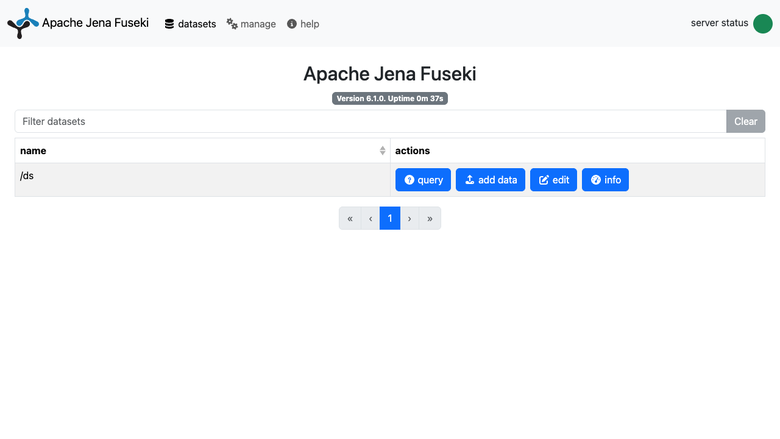
Image
Fuseki datasets dashboard
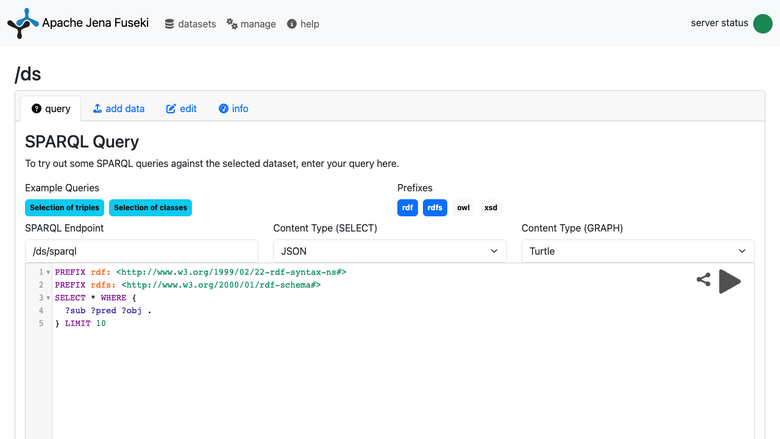
Image
SPARQL query editor
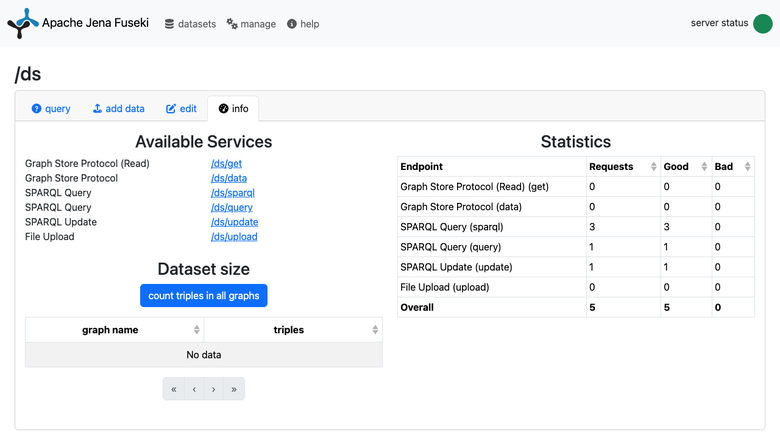
Image
Dataset endpoints and statistics
This is a repackaged open source software product wherein additional charges apply for cloudimg support services.
Apache Jena Fuseki - Production-Ready SPARQL Server AMI
Deploy a fully configured SPARQL 1.1 server and RDF triplestore on AWS in minutes - not hours. This AMI delivers Apache Jena Fuseki preinstalled and running as a managed system service over a persistent TDB2 store, so you can load RDF data and run SPARQL queries and updates immediately after launch.
Why This AMI Instead of a DIY Install
- Versus manual EC2 setup: Skip the hours of installing a Java 21 runtime, downloading and verifying the Fuseki distribution, writing systemd units, provisioning a data disk, defining a persistent TDB2 dataset, and hardening the Shiro security configuration. This image handles all of that at launch.
- Versus a raw upstream install: The upstream default configuration leaves every dataset endpoint open to the public and the admin console reachable only from localhost - unusable and unsafe behind a reverse proxy. This image ships a hardened Shiro policy and a per-instance administrator password out of the box.
- Versus other community AMIs: Benefit from a hardened first-boot process that generates a unique administrator password per instance (no shared or default credentials), a dedicated data disk for the triplestore, and 24/7 professional support from cloudimg.
Application Stack
- Apache Jena Fuseki installed under /opt/fuseki, run by a dedicated unprivileged service account
- Headless OpenJDK 21 Java runtime
- A persistent TDB2 triplestore on a dedicated EBS data disk holding the RDF databases, Shiro configuration and dataset definitions - independently resizable for IOPS and capacity scaling
- systemd service that starts the server on boot and restarts on failure
- nginx reverse proxy publishing the Fuseki web UI on port 80
SPARQL 1.1 and RDF
The server exposes a SPARQL 1.1 Query endpoint, a SPARQL 1.1 Update endpoint and the SPARQL Graph Store HTTP Protocol over a persistent TDB2 dataset named ds. Point your applications, ETL jobs or the built-in web query editor at the endpoints and start querying and loading RDF (Turtle, N-Triples, RDF/XML, JSON-LD and more) immediately. Additional datasets can be created through the admin UI or by dropping assembler files into the configuration directory.
Web Query and Admin UI
The Fuseki web UI is served on port 80 through nginx. Use the built-in SPARQL query editor to run queries against your datasets, upload RDF files, and inspect dataset statistics. Sign in with the generated administrator credentials to manage datasets, run backups, and access administrative functions.
Security
Secure First Boot: A one-shot service generates a fresh administrator password unique to each instance, rewrites the Shiro user configuration, and stores the password in a root-only file. No shared or default credentials ship in the image.
Endpoint Hardening: The admin UI and API and every dataset write endpoint (SPARQL Update, Graph Store Protocol data and file upload) require HTTP basic authentication. Read-only SPARQL query endpoints and the UI stay open for easy evaluation; lock them down further in shiro.ini for production.
Encryption at Rest: The dedicated data disk holding the triplestore can leverage AWS EBS encryption. Enable EBS encryption when launching the instance or use encrypted snapshots.
Network Isolation: Deploy in a private VPC subnet and use security groups to restrict access to only the ports your clients require (80 for the web UI, 3030 for direct Fuseki access).
Use Cases
- Life sciences and enterprise knowledge graphs: load ontologies such as OWL or SKOS taxonomies from an ETL pipeline and expose them via SPARQL to downstream search and analytics services handling tens of millions of triples
- Serving RDF and SPARQL to semantic-web and data-integration applications
- Ontology, taxonomy and metadata management
- Reference-data and master-data triplestores
- Research and teaching with SPARQL 1.1
Evaluation Path
Launch this AMI on a small instance type to evaluate the server with minimal AWS infrastructure cost. The server is fully functional on any supported instance size, allowing you to validate SPARQL query and update, RDF loading, UI access and authentication before scaling up for production workloads.
24/7 cloudimg Support
Technical support by email and live chat covers server deployment, dataset and endpoint configuration, TDB2 tuning and backups, Shiro authentication and TLS setup, and JVM administration.
All product and company names are trademarks or registered trademarks of their respective holders. Use of them does not imply any affiliation with or endorsement by them.
Highlights
- Zero-setup production triplestore: Apache Jena Fuseki launches as a systemd-managed service with a persistent TDB2 dataset and the web SPARQL query and admin UI on port 80. Skip hours of installing a Java 21 runtime, verifying the distribution, writing systemd units, provisioning a data disk and hardening the Shiro security policy. The server answers SPARQL queries and updates within minutes of instance launch.
- Persistent RDF on a dedicated data disk: A SPARQL 1.1 Query and Update server over a TDB2 triplestore whose databases, Shiro configuration and dataset definitions live on a dedicated EBS volume that you can resize independently for IOPS and capacity. This enables safer instance replacement and predictable storage scaling without risking your RDF data.
- Hardened security from first boot: Every instance generates a unique administrator password stored in a root-only file - no shared or default credentials ever ship. The admin UI and API and all dataset write endpoints require HTTP basic authentication, replacing the insecure upstream default. Deploy in a private VPC subnet with security groups restricting access. Backed by 24/7 cloudimg technical support via email and live chat.
Details
Sold by
Categories
Delivery method
Delivery option
64-bit (x86) Amazon Machine Image (AMI)
Latest version
Operating system
Ubuntu 24.04
Deployed on AWS
New
Introducing multi-product solutions
You can now purchase comprehensive solutions tailored to use cases and industries.

Features and programs
Financing for AWS Marketplace purchases
AWS Marketplace now accepts line of credit payments through the PNC Vendor Finance program. This program is available to select AWS customers in the US, excluding NV, NC, ND, TN, & VT.

Pricing
Free trial
Try this product free for 7 days according to the free trial terms set by the vendor. Usage-based pricing is in effect for usage beyond the free trial terms. Your free trial gets automatically converted to a paid subscription when the trial ends, but may be canceled any time before that.
Pricing is based on actual usage, with charges varying according to how much you consume. Subscriptions have no end date and may be canceled any time. Alternatively, you can pay upfront for a contract, which typically covers your anticipated usage for the contract duration. Any usage beyond contract will incur additional usage-based costs.
Additional AWS infrastructure costs may apply. Use the AWS Pricing Calculator to estimate your infrastructure costs.
If you are an AWS Free Tier customer with a free plan, you are eligible to subscribe to this offer. You can use free credits to cover the cost of eligible AWS infrastructure. See AWS Free Tier for more details. If you created an AWS account before July 15th, 2025, and qualify for the Legacy AWS Free Tier, Amazon EC2 charges for Micro instances are free for up to 750 hours per month. See Legacy AWS Free Tier for more details.
Dimension | Description | Cost/hour |
|---|---|---|
m5.large Recommended | m5.large | $0.08 |
t3.micro | t3.micro instance type | $0.04 |
t2.micro | t2.micro instance type | $0.04 |
m8idn.24xlarge | m8idn.24xlarge instance type | $0.24 |
m8ib.2xlarge | m8ib.2xlarge instance type | $0.24 |
m7i-flex.12xlarge | m7i-flex.12xlarge instance type | $0.24 |
r5a.large | r5a.large instance type | $0.08 |
i7ie.48xlarge | i7ie.48xlarge instance type | $0.24 |
c8in.metal-96xl | c8in.metal-96xl instance type | $0.24 |
m7i.metal-24xl | m7i.metal-24xl instance type | $0.24 |
Vendor refund policy
Refunds available on request.

Legal
Vendor terms and conditions
Upon subscribing to this product, you must acknowledge and agree to the terms and conditions outlined in the vendor's End User License Agreement (EULA) .
Content disclaimer
Vendors are responsible for their product descriptions and other product content. AWS does not warrant that vendors' product descriptions or other product content are accurate, complete, reliable, current, or error-free.
Delivery details
64-bit (x86) Amazon Machine Image (AMI)
Amazon Machine Image (AMI)
An AMI is a virtual image that provides the information required to launch an instance. Amazon EC2 (Elastic Compute Cloud) instances are virtual servers on which you can run your applications and workloads, offering varying combinations of CPU, memory, storage, and networking resources. You can launch as many instances from as many different AMIs as you need.
Version release notes
Initial release of Apache Jena Fuseki 6.1.0 SPARQL server over a persistent TDB2 triplestore.
Additional details
Usage instructions
Connect via SSH on port 22 as the default login user for your operating system variant (the user guide lists it per variant). The Fuseki web query and admin UI is served on port 80: browse to http://<instance-public-ip>/ and use the built-in SPARQL query editor. Administrative functions and dataset write endpoints require the generated administrator credentials (username admin). Retrieve them with: sudo cat /root/apache-jena-fuseki-credentials.txt. The SPARQL endpoints for the pre-created dataset are http://<instance-public-ip>/ds/query (query), http://<instance-public-ip>/ds/update (update) and http://<instance-public-ip>/ds/data (Graph Store Protocol). Fuseki also listens directly on port 3030. The triplestore, Shiro config and dataset definitions live on a dedicated data disk mounted at /var/lib/fuseki.
Resources
Vendor resources
Support
Vendor support
cloudimg Support - 24/7 Technical Assistance
cloudimg provides round-the-clock technical support for this Apache Jena Fuseki AMI via email and live chat. Our engineers assist with:
- Initial deployment and instance sizing guidance
- Dataset, endpoint and assembler configuration
- TDB2 tuning, loading and backups
- Shiro authentication and TLS setup
- JVM administration
- Troubleshooting connectivity and performance issues
- Security hardening and credential management
Response Times: Critical issues receive a one-hour average response time.
Contact: Email support@cloudimg.co.uk or reach us via live chat.
Deployment Prerequisites
- Minimum instance type: Select an instance with sufficient memory for your expected dataset size and query concurrency.
- EBS data volume: The server uses a dedicated data disk for the TDB2 triplestore. Provision an EBS volume sized for your RDF data and growth.
- Security groups: Open ports 80 (web UI) and 3030 (direct Fuseki) only to trusted sources.
- VPC: Deploy in a VPC subnet appropriate for your network isolation requirements.
Getting Started
- Launch the AMI and attach or confirm the dedicated data volume.
- Retrieve the generated admin password from /root/apache-jena-fuseki-credentials.txt via SSH.
- Open port 80 in your security group and navigate to the instance public IP to access the Fuseki web UI.
- Use the query editor to run SPARQL against the pre-created ds dataset; sign in with username admin and the retrieved password for administrative functions and writes.
For sizing recommendations, production architecture planning, or any issues including requesting refunds, contact support@cloudimg.co.uk .
AWS infrastructure support
AWS Support is a one-on-one, fast-response support channel that is staffed 24x7x365 with experienced and technical support engineers. The service helps customers of all sizes and technical abilities to successfully utilize the products and features provided by Amazon Web Services.
Similar products

Apache Hudi connector with shaded dependencies to work with AWS Glue.

Easily access Iceberg tables and operate DDLs, reads/writes, time-travels, streaming writes on the Iceberg tables.

Bansir offers this software product repackaged where additional charges apply for technical support provided by Bansir Cloud email support@bansircloud.com.

This is a repackaged open source software product wherein additional charges apply for technical support. Softwares included: Ubuntu and Apache Web Server

This product has a fee associated with the provision and deployment of the application and AMI support. Apache Superset is a modern, enterprise-ready business intelligence web application.
Customer reviews
No customer reviews yet
Be the first to review this product . We've partnered with PeerSpot to gather customer feedback. You can share your experience by writing or recording a review, or scheduling a call with a PeerSpot analyst.